

Currently Empty: ر.ق 0,00


IELTS
IELTS Academic Vocabulary for University Students
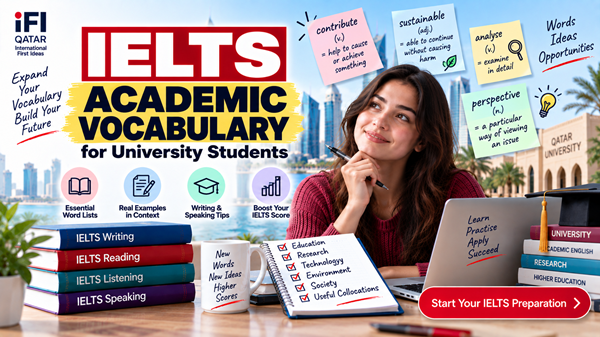
Building a strong academic vocabulary is one of the most useful things you can do when preparing for IELTS Academic and planning to study at university. You need more than everyday English to understand academic texts, discuss complex ideas, write essays and explain your opinions clearly.
The good news is that you do not need to memorise thousands of difficult words. The most effective approach is to learn useful academic words in context, understand their common collocations, and practise using them accurately.
In this guide, you will learn essential IELTS academic vocabulary for university students, including words for education, research, technology, society, the environment and common academic discussions. You will also learn how to use these words naturally in IELTS Writing and Speaking.
What Is IELTS Academic Vocabulary?
IELTS academic vocabulary refers to words and expressions that are commonly used when discussing formal, educational, scientific, social and university-related topics.
Examples include:
- analyse
- assess
- significant
- contribute
- establish
- evidence
- approach
- consequence
- perspective
- sustainable
These words are useful because IELTS Academic often requires you to understand and discuss ideas rather than simply describe everyday situations.
In IELTS Writing, vocabulary is assessed under Lexical Resource, which considers the range of vocabulary you use as well as how accurately and appropriately you use it. Vocabulary is also part of the assessment in IELTS Speaking.
However, using complicated words does not automatically produce a higher score. A relatively simple word used precisely is usually more effective than an advanced word used incorrectly.
Why Is Academic Vocabulary Important for IELTS?
Academic vocabulary can help you communicate ideas more precisely in both written and spoken English.
It is particularly useful for IELTS Academic because the test includes topics related to education, science, society, technology, the environment and other areas of general interest.
Academic Vocabulary Improves IELTS Writing
Academic vocabulary allows you to:
- explain causes and effects
- compare different ideas
- describe trends
- present arguments
- give examples
- discuss advantages and disadvantages
- express opinions carefully
- describe research and evidence
- evaluate different viewpoints
For example:
Basic:
University education gives students many useful skills.
More academic:
University education enables students to develop a wide range of professional and transferable skills.
The second sentence is more precise and appropriate for an academic context.
Academic Vocabulary Helps With IELTS Reading
IELTS Academic Reading texts are written for students at undergraduate or postgraduate level and may cover subjects such as science, history, education, technology and society.
Knowing academic vocabulary can help you recognise:
- main ideas
- supporting arguments
- cause-and-effect relationships
- comparisons
- opinions
- explanations
- examples
- changes and trends
You should also learn to recognise different forms of the same word.
For example:
| Verb | Noun | Adjective |
|---|---|---|
| analyse | analysis | analytical |
| develop | development | developed/developing |
| contribute | contribution | contributory |
| differ | difference | different |
| educate | education | educational |
Academic Vocabulary Helps With IELTS Speaking
Academic vocabulary is not only for Writing.
In Speaking Part 3, you may need to discuss broader and more abstract issues related to education, technology, society, culture or the environment. Using precise vocabulary can help you express complex ideas more effectively.
For example:
I think technology has changed education considerably because students now have greater access to educational resources.
This is more precise than:
Technology has changed education a lot because students can find many things online.
The goal is not to make every sentence complicated. The goal is to choose the most appropriate words for your meaning.
Essential IELTS Academic Vocabulary for University Students
The following vocabulary groups are particularly useful for IELTS preparation and university-related discussions.
Academic Verbs
Academic verbs are useful when explaining ideas, discussing research and presenting arguments.
| Word | Meaning | Example |
|---|---|---|
| Analyse | Examine something in detail | Researchers analysed the survey results. |
| Assess | Evaluate something | Universities assess students through exams and coursework. |
| Evaluate | Judge the quality or value of something | The study evaluates the effectiveness of the programme. |
| Examine | Study something carefully | The research examines the impact of social media. |
| Identify | Recognise or find something | The researchers identified several major problems. |
| Establish | Prove or determine something | The study established a link between the two factors. |
| Demonstrate | Show clearly | The results demonstrate the importance of regular practice. |
| Indicate | Show or suggest | The findings indicate that online learning is becoming more popular. |
| Investigate | Study a problem or question | Scientists are investigating the causes of the disease. |
| Compare | Examine similarities and differences | The researchers compared the two groups. |
| Contrast | Identify important differences | The study contrasts traditional and modern teaching methods. |
| Contribute | Help to cause or achieve something | Technology can contribute to better learning outcomes. |
| Implement | Put a plan or system into practice | The university implemented a new assessment system. |
| Determine | Discover or establish something | The experiment aimed to determine the effects of the treatment. |
| Require | Need something | Many university courses require students to complete research projects. |
These verbs are especially useful in IELTS Writing Task 2 when discussing evidence, policies, education and social issues.
Education Vocabulary
Education is one of the most important topics for IELTS preparation.
| Word | Meaning | Example |
|---|---|---|
| Curriculum | Subjects and content taught in an educational programme | The university has revised its curriculum. |
| Institution | An organisation such as a university or college | The institution offers several postgraduate programmes. |
| Undergraduate | A university student studying for a first degree | She is an undergraduate student. |
| Postgraduate | Study undertaken after a first degree | He plans to pursue postgraduate education. |
| Tuition | Teaching or the cost of teaching | International students often pay higher tuition fees. |
| Assessment | The process of evaluating students | Continuous assessment can reduce exam pressure. |
| Assignment | A piece of academic work given to students | Students must submit their assignments on time. |
| Scholarship | Financial support for education | She received a scholarship to study abroad. |
| Qualification | An official achievement showing education or training | A university degree is an important qualification for many careers. |
| Discipline | An academic field of study | Psychology is a popular academic discipline. |
| Lecture | A formal educational talk | Students attended a lecture on climate change. |
| Seminar | A class involving discussion and study | The seminar focused on research methodology. |
| Academic performance | How well a student performs in education | Sleep can influence academic performance. |
| Higher education | Education at university or college level | Access to higher education has expanded in many countries. |
| Distance learning | Education delivered remotely | Distance learning allows students to study from home. |
Research Vocabulary
Research vocabulary is particularly useful for IELTS Reading and Writing.
| Word | Meaning | Example |
|---|---|---|
| Research | A systematic study of a subject | The research focuses on student behaviour. |
| Evidence | Information supporting an idea or claim | There is strong evidence that exercise benefits mental health. |
| Finding | A result discovered through research | The findings were published in an academic journal. |
| Data | Facts or information collected for analysis | The researchers collected data from 500 participants. |
| Methodology | The system of methods used in research | The study uses a qualitative methodology. |
| Hypothesis | An idea tested through research | The researchers developed a hypothesis before the experiment. |
| Sample | A group selected to represent a larger population | The researchers surveyed a sample of university students. |
| Survey | A method of collecting information from people | The university conducted a survey of student satisfaction. |
| Variable | A factor that can change in a study | Age was treated as an important variable. |
| Outcome | The final result of an activity or process | The programme produced positive outcomes. |
| Correlation | A relationship between two variables | The study found a correlation between exercise and academic performance. |
| Publication | A written work published for an audience | The findings appeared in an academic publication. |
Technology Vocabulary
Technology is a frequent area of discussion in IELTS.
| Word | Meaning | Example |
|---|---|---|
| Innovation | A new idea, method or technology | Technological innovation has transformed education. |
| Digitalisation | The use of digital technology in processes | Digitalisation has changed how universities deliver courses. |
| Automation | The use of technology to perform tasks automatically | Automation may change the nature of many jobs. |
| Artificial intelligence | Technology that performs tasks associated with human intelligence | Artificial intelligence is increasingly used in education. |
| Accessibility | How easily something can be accessed or used | Online courses can improve access and accessibility. |
| Device | A piece of electronic equipment | Students often use digital devices for research. |
| Platform | An online system used for a particular purpose | The university uses an online learning platform. |
| Cybersecurity | Protection against digital threats | Cybersecurity is becoming increasingly important for universities. |
| Digital literacy | The ability to use digital technology effectively | Digital literacy is an important workplace skill. |
| Online learning | Education delivered through the internet | Online learning has become more flexible and accessible. |
Society and Culture Vocabulary
These words can be useful when discussing social issues.
| Word | Meaning | Example |
|---|---|---|
| Community | A group of people living or interacting together | Universities can play an important role in the local community. |
| Diversity | The presence of different groups or characteristics | Cultural diversity can enrich the university experience. |
| Equality | Equal treatment or opportunities | Education can contribute to greater equality of opportunity. |
| Inequality | A lack of equality | Income inequality can affect access to education. |
| Population | All people living in a particular area | The urban population has increased significantly. |
| Demographic | Relating to characteristics of a population | The university analysed demographic changes. |
| Socialisation | The process of learning how to interact within society | Universities provide opportunities for socialisation. |
| Perspective | A particular way of viewing an issue | Students should consider the issue from different perspectives. |
| Behaviour | The way a person or group acts | Social media can influence consumer behaviour. |
| Integration | The process of becoming part of a group or society | Language skills can support social integration. |
Environment Vocabulary
Environmental topics are common in academic discussions and IELTS preparation.
| Word | Meaning | Example |
|---|---|---|
| Sustainable | Able to continue without causing serious long-term damage | Universities should adopt sustainable practices. |
| Sustainability | The ability to maintain something over the long term | Environmental sustainability requires long-term planning. |
| Renewable | Naturally replaced over time | Solar power is a renewable source of energy. |
| Emission | Gas released into the atmosphere | Governments are trying to reduce carbon emissions. |
| Conservation | Protection of natural resources | Wildlife conservation requires international cooperation. |
| Biodiversity | The variety of living organisms | Climate change threatens biodiversity. |
| Ecosystem | A community of living organisms and their environment | Human activity can damage fragile ecosystems. |
| Climate change | Long-term changes in global or regional climate | Climate change is a major international concern. |
| Resource | A useful supply or source of something | Water is a limited natural resource in some regions. |
| Pollution | Harmful substances entering the environment | Air pollution can affect public health. |
Academic Adjectives for IELTS Writing
Adjectives can help you make your IELTS essays more precise.
Here are some useful examples:
- significant
- substantial
- considerable
- essential
- beneficial
- detrimental
- effective
- efficient
- practical
- relevant
- widespread
- controversial
- complex
- challenging
- sustainable
- reliable
- accessible
- diverse
- crucial
- influential
Examples in IELTS Sentences
Instead of:
Education is very important for society.
You could write:
Education plays a crucial role in social and economic development.
Instead of:
Online learning has many good effects.
You could write:
Online learning can have significant benefits, particularly for students who require greater flexibility.
Instead of:
Pollution is a very bad problem.
You could write:
Air pollution is a serious environmental challenge in many urban areas.
Useful Academic Nouns for IELTS
Academic nouns are particularly helpful when developing arguments.
Useful examples include:
- advantage
- disadvantage
- consequence
- implication
- factor
- approach
- perspective
- evidence
- impact
- influence
- development
- improvement
- limitation
- opportunity
- challenge
- solution
- strategy
- priority
- trend
- outcome
Example Sentences
One significant factor contributing to this problem is population growth.
The development of online education has had a considerable impact on traditional universities.
A possible solution is to provide students with more flexible learning opportunities.
The long-term consequences of this policy should be carefully considered.
IELTS Academic Vocabulary for Describing Trends
Trend vocabulary is especially useful for IELTS Academic Writing Task 1.
Verbs for Increases
- increase
- rise
- grow
- climb
- surge
- expand
- accelerate
Examples:
The number of international students increased steadily.
The percentage of online learners rose significantly.
Verbs for Decreases
- decrease
- decline
- fall
- drop
- reduce
- diminish
Examples:
The number of applicants declined gradually.
The proportion of students using the service fell slightly.
Nouns for Trends
- increase
- rise
- growth
- surge
- decrease
- decline
- reduction
- drop
- fluctuation
- variation
For Academic Writing Task 1, vocabulary should describe the information accurately rather than exaggerating changes.
IELTS Academic Vocabulary for Comparing Ideas
Comparison vocabulary is useful in both Writing and Speaking.
Useful expressions include:
- similarly
- likewise
- in contrast
- by comparison
- whereas
- while
- compared with
- in comparison with
- considerably higher
- significantly lower
- relatively similar
- a marked difference
Example
Online students reported higher levels of flexibility, whereas students attending traditional classes reported greater opportunities for face-to-face interaction.
Another example:
The two groups produced relatively similar results, despite differences in their learning environments.
IELTS Vocabulary for Cause and Effect
Cause-and-effect language helps you develop arguments clearly.
Words for Causes
- cause
- factor
- reason
- contribute to
- result from
- lead to
- give rise to
- stem from
Words for Effects
- result
- consequence
- impact
- effect
- outcome
- influence
- lead to
- result in
- contribute to
Example Sentences
Increased tuition fees may discourage some students from pursuing higher education.
Greater access to digital resources can contribute to improved learning outcomes.
Excessive screen time may result in reduced physical activity among young people.
Academic Linking Words for IELTS
Linking words can help organise your ideas, but they should be used naturally rather than inserted into every sentence.
Adding Ideas
- furthermore
- moreover
- in addition
- additionally
- similarly
Giving Examples
- for example
- for instance
- such as
- particularly
- namely
Showing Contrast
- however
- nevertheless
- in contrast
- whereas
- although
- while
Showing Cause and Effect
- therefore
- consequently
- as a result
- thus
- for this reason
Concluding
- overall
- in conclusion
- to summarise
- on balance
For example:
Online education can reduce geographical barriers. Furthermore, it allows students to access courses that may not be available in their local area.
However, strong cohesion is not simply about using as many linking words as possible. The relationship between ideas should be clear.
Academic Collocations You Should Learn
Learning individual words is useful, but learning collocations can make your vocabulary more natural.
A collocation is a combination of words that commonly appear together.
Education Collocations
- higher education
- academic performance
- academic achievement
- tuition fees
- educational institution
- learning outcomes
- academic qualifications
- university degree
- research project
- study programme
Research Collocations
- conduct research
- collect data
- analyse data
- present findings
- provide evidence
- support a hypothesis
- research methodology
- research findings
- academic study
- empirical evidence
Society Collocations
- social inequality
- cultural diversity
- social development
- economic growth
- public awareness
- social responsibility
- living standards
- population growth
- public policy
- social change
Environment Collocations
- environmental impact
- climate change
- renewable energy
- carbon emissions
- natural resources
- environmental protection
- sustainable development
- environmental damage
- air pollution
- conservation efforts
Learning conduct research is more useful than simply memorising the word research because you learn how the word naturally functions in a sentence.
Common Academic Vocabulary Mistakes in IELTS
Using advanced vocabulary incorrectly can weaken your writing and speaking.
Using a Word Without Understanding Its Meaning
Do not memorise a sophisticated word and use it simply because it sounds academic.
For example, if you are unsure about the meaning of inevitable, do not use it to mean “important” or “common.”
Always learn:
- the definition
- pronunciation
- part of speech
- common collocations
- example sentences
- similar words
- differences between synonyms
Using Synonyms That Are Not Interchangeable
Some words have similar meanings but cannot always be used in the same contexts.
For example:
- economic relates to the economy
- economical means efficient or inexpensive
Compare:
Economic growth has increased.
and:
This car is economical to operate.
The two adjectives are not interchangeable.
Overusing Advanced Words
A common mistake is trying to make every sentence sound sophisticated.
For example:
The implementation of technologically advanced pedagogical methodologies facilitates the optimisation of educational outcomes.
This sentence is unnecessarily complicated.
A clearer version is:
Modern teaching methods can improve students’ learning outcomes.
Clear and accurate English is more valuable than complicated vocabulary.
Using Informal Words in Academic Writing
Try to avoid unnecessarily informal expressions such as:
- kids
- a lot of
- stuff
- things
- huge
- super
- really good
- really bad
Depending on the context, more precise alternatives may be:
- children
- many / a considerable number of
- materials / factors / issues
- factors / issues / objects
- substantial
- particularly
- highly beneficial
- detrimental
The correct choice depends on the exact meaning.
How to Learn IELTS Academic Vocabulary Effectively
Memorising long word lists is rarely enough. A better strategy is to learn vocabulary actively.
Learn Words by Topic
Create vocabulary groups for common IELTS topics such as:
- education
- technology
- environment
- health
- transport
- society
- crime
- employment
- globalisation
- media
This makes it easier to retrieve relevant vocabulary when you encounter a similar IELTS question.
Learn Words in Context
Instead of memorising:
contribute = help
Learn:
contribute to economic growth
contribute to environmental damage
contribute to improved academic performance
This teaches you how the word works in real sentences.
Learn Word Families
Word families help you recognise different forms of vocabulary in Reading and use them accurately in Writing.
For example:
| Word Family | Example |
|---|---|
| analyse | Researchers analyse the data. |
| analysis | The analysis produced interesting results. |
| analytical | Students need strong analytical skills. |
| develop | The university developed a new programme. |
| development | The development of technology has changed education. |
| developed | Developed countries often have greater access to technology. |
| significant | There was a significant increase. |
| significance | The findings have considerable significance. |
| significantly | The number increased significantly. |
Use New Vocabulary in Your Own Sentences
After learning a new word, write two or three sentences using it.
For example, after learning sustainable:
Universities should adopt more sustainable transport policies.
Sustainable development requires long-term planning.
This makes active recall much easier.
Review Vocabulary Regularly
Use spaced revision rather than trying to learn 50 new words in one evening.
A simple schedule could be:
- Day 1: Learn new vocabulary.
- Day 2: Review the words.
- Day 4: Use them in sentences.
- Day 7: Test yourself.
- Day 14: Use them in an IELTS task.
- Day 30: Review them again.
How to Use IELTS Academic Vocabulary in Writing
For IELTS Writing, focus on precision, relevance and flexibility.
Use Vocabulary to Develop Your Ideas
Do not add advanced vocabulary just to make your essay sound academic.
Suppose the topic is university education.
Weak:
Universities are good because they give students good things for their future.
Better:
Universities provide students with academic knowledge and transferable skills that can improve their long-term employment prospects.
The second sentence communicates a much more specific idea.
Use Topic-Specific Vocabulary
If your essay is about education, use relevant terms such as:
- curriculum
- assessment
- tuition fees
- academic performance
- higher education
- learning outcomes
- qualifications
- educational institutions
If the essay is about the environment, vocabulary such as the following may be more appropriate:
- carbon emissions
- renewable energy
- environmental protection
- natural resources
- sustainable development
- biodiversity
The vocabulary should support the argument rather than replace it.
How to Use Academic Vocabulary in IELTS Speaking
In Speaking, vocabulary should sound natural.
You do not need to speak like an academic journal.
For example, if the examiner asks:
Why do some students prefer studying online?
You could answer:
I think flexibility is one of the main advantages. Students can organise their study schedule around work or other responsibilities, and they can often access course materials whenever they need them.
This answer uses useful vocabulary without sounding memorised.
Build Vocabulary for Speaking Part 3
Part 3 often requires broader discussion, so practise vocabulary related to:
- advantages and disadvantages
- causes and effects
- social change
- education
- technology
- government
- employment
- culture
- future developments
Useful phrases include:
One major factor is…
From my perspective…
This can have a significant impact on…
One possible consequence is…
There are several reasons for this trend…
This is particularly relevant when…
A 7-Day IELTS Academic Vocabulary Study Plan
You can use this simple plan to build your vocabulary systematically.
| Day | Focus | Practice |
|---|---|---|
| Day 1 | Education | Learn 15 words and 5 collocations |
| Day 2 | Research | Learn 15 words and write example sentences |
| Day 3 | Technology | Learn 15 words and practise Speaking questions |
| Day 4 | Environment | Learn 15 words and write a short paragraph |
| Day 5 | Society | Review previous vocabulary and learn 10 new words |
| Day 6 | Academic verbs | Practise analyse, assess, evaluate, demonstrate and related words |
| Day 7 | Revision | Complete a vocabulary test and write one IELTS paragraph |
At the end of the week, focus more on the words you still struggle to use correctly rather than simply adding more vocabulary.
IELTS Academic Vocabulary Checklist
Before your IELTS test, make sure you can:
- understand common academic vocabulary
- recognise academic words in Reading passages
- use topic-specific vocabulary
- use academic verbs accurately
- describe trends and changes
- compare ideas
- explain causes and effects
- discuss advantages and disadvantages
- use common academic collocations
- recognise word families
- distinguish between similar words
- use vocabulary naturally in Speaking
- use precise vocabulary in Writing
- avoid unnecessary repetition
- avoid memorised phrases
- avoid forcing advanced vocabulary into sentences
How Many Academic Words Do You Need for IELTS?
There is no official number of academic words that you must memorise to achieve a particular IELTS band.
Instead of focusing on a target number, focus on whether you can use vocabulary accurately, appropriately and flexibly.
A smaller vocabulary that you can actively use is more valuable than a huge list of words that you only recognise.
For example, knowing how to use:
significant increase
contribute to
provide evidence
academic performance
sustainable development
is more useful than memorising dozens of isolated synonyms without understanding their context.
Frequently Asked Questions About IELTS Academic Vocabulary
What is IELTS academic vocabulary?
IELTS academic vocabulary consists of words and expressions commonly used in academic, educational, scientific and social contexts. It is particularly useful for IELTS Academic Reading, Writing and Speaking.
What vocabulary is important for IELTS Academic?
Important vocabulary includes academic verbs, topic-specific nouns and adjectives, collocations, words for comparing ideas, cause-and-effect expressions and language for describing trends.
How can I improve my IELTS academic vocabulary?
Learn vocabulary by topic, study words in context, learn common collocations, practise word families and use new vocabulary in your own Writing and Speaking responses.
Should I use difficult words in IELTS Writing?
Not necessarily. You should use vocabulary that is accurate, appropriate and precise. A simple word used correctly is better than an advanced word used incorrectly.
Is vocabulary important in IELTS Speaking?
Yes. Lexical Resource is one of the criteria used to assess IELTS Speaking. You should aim to express ideas clearly and use a range of vocabulary appropriately.
Is academic vocabulary important for IELTS Reading?
Yes. IELTS Academic Reading uses texts of general interest to undergraduate and postgraduate students, so familiarity with academic vocabulary can make complex texts easier to understand.
How can I learn IELTS vocabulary faster?
Focus on high-value vocabulary and learn it through context. Study words by topic, learn their common collocations, create your own examples and review them regularly.
Can memorising vocabulary lists improve my IELTS score?
Vocabulary lists can help you build knowledge, but memorisation alone is not enough. You also need to understand meaning, word forms, collocations and appropriate usage.
What are the best vocabulary topics for IELTS?
Useful topics include education, technology, environment, health, society, employment, transport, media, crime and globalisation.
Final Thoughts on IELTS Academic Vocabulary
A strong academic vocabulary is not about knowing the longest or most complicated words. It is about having enough language to understand complex information, express precise ideas and communicate naturally.
For university students preparing for IELTS Academic, the most effective approach is to combine academic vocabulary with regular Reading, Writing and Speaking practice.
Start with high-frequency academic verbs, topic-specific vocabulary and common collocations. Then practise using them in your own sentences and IELTS responses.
If you are preparing for IELTS and want structured support, expert feedback and a clear study plan, an IELTS preparation course can help you build vocabulary alongside the other skills required for the test.
Ready to improve your IELTS performance? Explore IELTS preparation options with IFI Qatar and start building the skills you need for your target band score.