

Currently Empty: ر.ق 0,00


IELTS
IELTS Test Week Checklist: A Practical Plan for the Final Seven Days
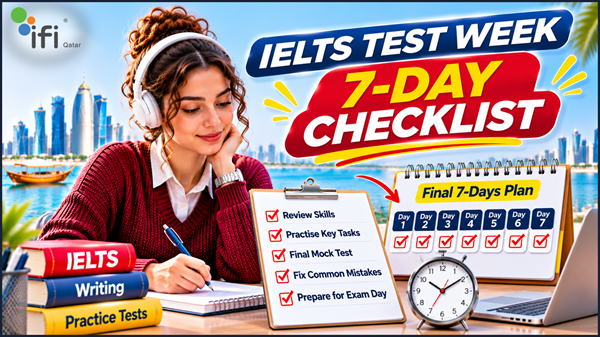
The final seven days before your IELTS examination can make a difference to how confidently and consistently you perform. By this stage, you should already understand the test format and have completed most of your preparation. Your priority now is to review important skills, practise under realistic conditions and make sure you are ready for the examination itself.
However, the last week is also when many candidates make avoidable mistakes. Some spend too much time learning new vocabulary, others complete several full practice tests without reviewing their errors, and some continue studying late into the night because they are worried about their target band score.
A better approach is to follow a structured IELTS test week checklist. This helps you use your remaining time effectively without exhausting yourself before the actual examination.
This guide provides a practical seven-day IELTS preparation plan covering Listening, Reading, Writing and Speaking. It also includes a final mock test strategy, an exam-day checklist and advice on what to avoid during the last week.
What Should You Focus on During the Final Week Before IELTS?
The final week is not the ideal time to rebuild your entire English language foundation. Instead, concentrate on the skills and routines that can help you perform consistently on test day.
Your main priorities should be:
- Reviewing the IELTS test format and instructions.
- Identifying and correcting recurring mistakes.
- Practising time management.
- Completing a realistic final mock test.
- Reviewing important vocabulary and grammar.
- Improving confidence in Speaking.
- Preparing your identification documents and test-day arrangements.
- Getting enough sleep and maintaining a consistent routine.
The amount of study you need depends on your current level and preparation history. A candidate who consistently achieves their target band in mock tests may need more revision and less intensive practice than someone who is still struggling with one or two components.
The goal is not to study as many hours as possible. It is to make the remaining preparation time useful.
Your IELTS Test Week Checklist: A 7-Day Preparation Plan
The following schedule is designed for candidates who have already completed most of their IELTS preparation. Adjust the workload according to your strengths, weaknesses and examination format.
Day 1: Assess Your Current Level and Plan the Week
Start the week by reviewing your recent practice results.
Do not immediately begin another full practice test. First, identify what has been affecting your performance.
Review your latest Listening, Reading, Writing and Speaking results and ask yourself:
- Which skill is closest to my target band?
- Which skill is consistently below my target?
- Do I lose marks because of a lack of understanding or careless mistakes?
- Do I struggle with time management?
- Are there particular question types that cause problems?
- Do I perform differently under timed conditions?
Once you have identified your weaknesses, create a short revision plan for the remaining days.
Your Day 1 checklist:
-
Review your latest mock test or practice results.
-
Identify your three most important weaknesses.
-
Check the minimum band score required in each skill.
-
Review the format of your selected IELTS test.
-
Decide when to complete your final full mock test.
-
Organise your study materials for the week.
Practical tip: Avoid trying to improve every weakness at once. Choose the areas that are most likely to affect your final result and give them priority.
Day 2: Review IELTS Listening and Reading
Use the second day to revise Listening and Reading strategies.
These components require accurate comprehension, concentration and effective time management. During the final week, it is often more useful to review the mistakes you repeatedly make than to complete large numbers of unrelated exercises.
IELTS Listening Revision
Focus on the question types that have caused difficulties in your previous practice tests.
Review:
- Multiple-choice questions.
- Form and note completion.
- Sentence completion.
- Matching questions.
- Map and diagram labelling.
- Recognising paraphrased information.
- Identifying corrections and distractors.
Pay particular attention to spelling, word limits and grammatical accuracy when completing answers.
For example, if you regularly miss answers because a speaker changes information during a conversation, practise recognising corrections and following the complete statement rather than focusing only on the first detail you hear.
You should also review the instructions carefully. A correct word may still be marked wrong if it does not follow the stated word limit or answer requirements.
IELTS Reading Revision
For Reading, concentrate on locating information efficiently and understanding how questions relate to the passage.
Review:
- True, False, Not Given questions.
- Yes, No, Not Given questions.
- Matching headings.
- Matching information.
- Multiple-choice questions.
- Summary completion.
- Sentence completion.
- Identifying paraphrased statements.
If you frequently run out of time, practise moving on from difficult questions instead of spending too long on a single item.
Your Day 2 checklist:
-
Complete one focused Listening practice session.
-
Review your previous Listening mistakes.
-
Practise one or two difficult Reading question types.
-
Check spelling and word-limit requirements.
-
Review common paraphrasing patterns.
-
Practise managing time across Reading passages.
Practical tip: Do not spend the entire day completing full Listening and Reading tests. Targeted practice followed by careful error review can be more useful during the final week.
Day 3: Focus on IELTS Writing
Writing deserves particular attention because candidates often find it difficult to evaluate their own performance accurately.
The goal on Day 3 is to review the structure, timing and recurring weaknesses in your Writing responses.
Academic Writing Task 1
If you are taking IELTS Academic, review how to describe visual information.
Focus on:
- Writing a clear introduction.
- Identifying the main trends or features.
- Selecting relevant data.
- Making accurate comparisons.
- Organising information into logical paragraphs.
- Using appropriate vocabulary to describe changes and differences.
Practise writing a clear overview without listing every number in the chart.
For example, if a line graph shows that three categories increased but one declined, your overview should communicate that overall pattern rather than describe every individual figure.
General Training Writing Task 1
If you are taking IELTS General Training, review the requirements of letter writing.
Focus on:
- Understanding the purpose of the letter.
- Addressing all the bullet points.
- Choosing an appropriate tone.
- Organising the information clearly.
- Using suitable vocabulary and expressions.
Practise recognising when a letter requires a formal, semi-formal or informal style.
IELTS Writing Task 2
Task 2 requires you to respond to an essay question with relevant ideas and clear organisation.
Review common question types, including:
- Opinion essays.
- Discussion essays.
- Advantages and disadvantages essays.
- Problem and solution essays.
- Two-part questions.
Pay attention to whether your response addresses every part of the question.
A well-written introduction cannot compensate for an essay that does not answer the task properly. Your arguments should be relevant, sufficiently developed and supported with explanations or examples.
Remember that Task 2 carries twice as much weight as Task 1 in the overall IELTS Writing score.
Your Day 3 checklist:
-
Review the requirements of your Task 1 test type.
-
Practise identifying key features in an Academic chart, if applicable.
-
Review letter structure and tone, if taking General Training.
-
Plan one Task 2 essay.
-
Review paragraph organisation and idea development.
-
Check your recurring grammar and vocabulary mistakes.
-
Complete at least one timed Writing task.
Practical tip: Do not memorise complete essays or complicated sentences during the final week. Focus on producing clear, relevant and accurate responses.
Day 4: Practise IELTS Speaking and Review Vocabulary
Speaking practice should remain part of your daily preparation, even if it is not your weakest component.
On Day 4, focus on answering naturally, developing your ideas and maintaining fluency.
Speaking Part 1
Review familiar topics such as:
- Work and studies.
- Hometown.
- Accommodation.
- Daily routines.
- Hobbies.
- Food.
- Technology.
- Travel.
- Weather.
Practise giving direct answers with enough explanation to make them meaningful.
Avoid giving extremely short answers or memorising long responses.
Speaking Part 2
Choose several cue cards and practise speaking for up to two minutes.
Work on:
- Using the preparation time effectively.
- Organising your ideas.
- Covering the main points.
- Providing relevant details.
- Maintaining a natural speaking pace.
You do not need to memorise a complete speech for every possible topic. Develop the ability to organise your thoughts quickly and speak about familiar experiences.
Speaking Part 3
Part 3 involves a more developed discussion connected to the Part 2 topic.
Practise:
- Explaining opinions.
- Comparing different situations.
- Discussing advantages and disadvantages.
- Considering causes and consequences.
- Making predictions.
- Supporting arguments with examples.
Try to extend your answers naturally instead of repeating the same idea using different words.
Vocabulary Review
Review useful vocabulary from topics you have already studied.
Focus on accurate word choice, collocations and expressions that you can use naturally.
Do not try to memorise hundreds of unfamiliar words in one day.
Your Day 4 checklist:
-
Practise several Speaking Part 1 topics.
-
Complete at least one Part 2 cue card.
-
Practise developing answers for Part 3.
-
Review common pronunciation problems.
-
Revise useful vocabulary and collocations.
-
Record one speaking practice session and review it.
Practical tip: Listen to your recording and notice whether you hesitate frequently, repeat words or fail to develop your answers. Focus on one or two improvements rather than trying to change everything.
Day 5: Complete Your Final IELTS Mock Test
Day 5 is a suitable point for many candidates to complete their final full mock test, provided they have enough time to review the results before the official examination.
The exact timing is not an official IELTS rule. If your examination is very close or you are already feeling exhausted, a shorter targeted assessment may be more appropriate.
A realistic mock test should help you evaluate your readiness under conditions similar to the official examination.
What Should Your Final Mock Test Include?
Ideally, your mock test should cover:
- Listening.
- Reading.
- Writing.
- Speaking.
It should reflect the IELTS test type you intend to take, whether Academic or General Training.
Where possible, practise under realistic timing conditions and follow the relevant instructions.
For Listening, Reading and Writing, complete the tasks without unnecessary interruptions. For Speaking, practise all three parts in a structured interview format.
What Should You Evaluate After the Mock Test?
Do not focus only on the overall estimated band score.
Review your performance in each component.
| IELTS Skill | What to Review |
|---|---|
| Listening | Accuracy, spelling, distractors and missed information |
| Reading | Comprehension, question accuracy and time management |
| Writing | Task response or achievement, organisation, vocabulary and grammar |
| Speaking | Fluency, coherence, vocabulary, grammar and pronunciation |
If your mock test includes assessed Writing and Speaking feedback, review the evaluator’s comments carefully.
You should understand whether your weaknesses are related to task achievement, idea development, language accuracy or another specific issue.
Your Day 5 checklist:
-
Complete a realistic full IELTS mock test if appropriate.
-
Follow the correct test format.
-
Practise under timed conditions.
-
Review individual skill results.
-
Identify any remaining high-priority weaknesses.
-
Record the areas that need final revision.
Practical tip: A mock test is useful only when you learn from the results. Do not complete another full test immediately without reviewing what the previous one revealed.
Day 6: Review Your Mistakes and Prepare for Exam Day
Day 6 should be focused on reviewing the feedback from your final mock test and organising your practical arrangements.
You should not attempt to learn an entirely new preparation strategy at this stage.
Instead, concentrate on correcting avoidable mistakes and making sure you understand what will happen on examination day.
Review Your Final Mock Test Feedback
Go through the comments and results from your assessment.
Ask yourself:
- Did I lose marks because of misunderstanding the questions?
- Did I run out of time?
- Were my Writing responses fully relevant to the tasks?
- Did I organise my Speaking answers clearly?
- Were there repeated grammar or vocabulary errors?
- Did I perform consistently across all four skills?
Choose only the most important areas for final revision.
Check Your IELTS Test Arrangements
Confirm:
- Your examination date.
- Your test start time.
- Your test centre address.
- Your travel arrangements.
- Your test format.
- The identification document required for your booking.
- Any instructions sent by your test provider.
Make sure the identification document you bring meets the test centre’s requirements and matches the details used for registration.
Do not rely on an old email or an unofficial checklist if your test provider has sent specific instructions for your session.
Your Day 6 checklist:
-
Review final mock test feedback.
-
Correct your most common mistakes.
-
Confirm the examination date and start time.
-
Check the test centre location.
-
Review identification requirements.
-
Prepare your journey to the test centre.
-
Check any instructions sent by the test provider.
Practical tip: Preparing your documents and travel arrangements one day in advance can help reduce unnecessary stress on the morning of the examination.
Day 7: Keep Your Preparation Light and Get Ready
The day before IELTS should not be filled with intensive study.
At this stage, your priority is to remain mentally prepared without becoming exhausted.
You can review a small amount of familiar material, but avoid spending hours completing difficult practice tests.
What Should You Review?
Consider a short revision session covering:
- Listening instructions and common question types.
- Reading time-management strategies.
- Writing task structures.
- Speaking assessment criteria.
- Frequently repeated grammar mistakes.
- Important vocabulary you already know.
Keep the review focused and manageable.
What Should You Avoid?
Try not to:
- Complete several full mock tests.
- Learn large amounts of unfamiliar vocabulary.
- Memorise complete Speaking answers.
- Study late into the night.
- Compare your preparation with other candidates.
- Make major changes to your test strategy.
- Spend too much time worrying about possible questions.
A calm and organised final day is generally more useful than an exhausting last-minute study session.
Your Day 7 checklist:
-
Review only familiar and important material.
-
Check your test confirmation details.
-
Prepare the required identification document.
-
Confirm your travel arrangements.
-
Set an appropriate alarm.
-
Eat normally and stay hydrated.
-
Avoid intensive last-minute studying.
-
Get enough sleep.
Practical tip: You do not need to prove how much you can study on the final day. You need to arrive at the examination ready to use the skills you have already developed.
IELTS Exam Day Checklist: What to Do Before Leaving Home
After completing your final seven-day preparation plan, make sure you are ready for the practical requirements of the examination.
The exact arrangements depend on your test provider and examination format, so always follow the instructions provided for your booking.
Documents and Identification
-
Check the original identification document required for your test.
-
Make sure it matches the document used during registration.
-
Review your test confirmation information.
-
Check any additional instructions from the test centre.
Do not assume that a photocopy, digital image or alternative identification document will be accepted.
Before Leaving Home
-
Confirm your test centre address.
-
Check your travel time.
-
Plan to arrive according to the test centre’s instructions.
-
Eat a suitable meal before leaving.
-
Allow enough time for unexpected travel delays.
-
Avoid unnecessary distractions.
During the Examination
- Listen carefully to the instructions.
- Read each question before answering.
- Pay attention to word limits.
- Manage your time across each component.
- Do not spend too long on one difficult question.
- Review your answers when time allows.
- Follow the invigilator’s instructions.
For computer-delivered IELTS, make sure you understand how to navigate the test interface and enter your answers.
For paper-based IELTS, pay attention to answer-sheet instructions and the time available for each component.
Should You Take a Final IELTS Mock Test Before the Real Exam?
A final mock test can be valuable if you want to understand how prepared you are before the official examination.
However, taking a mock test is not automatically necessary for every candidate in the final week.
The decision should depend on your preparation level, previous practice results and remaining time.
When a Final Mock Test Is Useful
Consider a final mock test if:
- You have not completed a full test under timed conditions.
- You are unsure whether you can manage the examination time.
- You want to evaluate all four skills together.
- You have recently improved a weak component.
- You need an updated assessment of your performance.
- You want to identify any remaining preparation priorities.
A realistic assessment can help you recognise weaknesses that may not appear during short, untimed exercises.
When You May Not Need Another Full Mock Test
Another full mock test may not be the best choice if:
- You completed a realistic assessment very recently.
- You already have detailed feedback to review.
- Your main weaknesses are clearly identified.
- You are physically or mentally exhausted.
- There is insufficient time to review the results meaningfully.
In these situations, targeted revision may be more useful than completing another full examination.
What Makes a Good Final IELTS Mock Test?
Before booking, check whether the mock test:
- Reflects your intended IELTS test type.
- Covers the relevant examination components.
- Uses realistic time limits.
- Includes appropriate question formats.
- Provides individual skill results.
- Offers Writing and Speaking assessment where available.
- Gives useful feedback on performance.
- Allows enough time to review the results before your official test.
A mock test should help you make better preparation decisions, not simply give you another score to compare.
Common Mistakes Candidates Make During the Final Seven Days
Even well-prepared candidates can make poor decisions when they become anxious about their upcoming examination.
Avoid these common mistakes.
1. Studying Too Much
Spending every available hour studying can leave you tired before the actual examination.
Better approach: Use focused revision sessions and allow time for rest.
2. Learning Too Much New Vocabulary
Trying to memorise hundreds of unfamiliar words in the final week is unlikely to be an effective strategy.
Better approach: Review vocabulary you already understand and practise using it accurately.
3. Taking Too Many Full Mock Tests
Completing several full tests without reviewing the results can waste valuable preparation time.
Better approach: Choose a suitable final assessment and use its feedback to guide your revision.
4. Ignoring Your Weakest Skill
Some candidates spend most of their time practising the components they already enjoy.
Better approach: Give priority to the weaknesses most likely to affect your target score.
5. Memorising Speaking Answers
Prepared answers may sound unnatural if they do not directly address the examiner’s questions.
Better approach: Practise developing ideas naturally and responding to unfamiliar questions.
6. Changing Your Writing Strategy at the Last Minute
Trying a completely new essay structure or memorised template immediately before the test can create unnecessary confusion.
Better approach: Use a structure you understand and have already practised.
7. Forgetting Practical Test Arrangements
Even a well-prepared candidate can experience unnecessary stress if they arrive at the wrong location or bring an unsuitable identification document.
Better approach: Confirm all test-day instructions before the final day.
How to Use Your Final Mock Test Feedback Effectively
If you complete an assessed mock test during the final week, make sure you understand the results before deciding what to practise next.
A useful assessment should help you identify your current performance and the areas that need attention.
Review Your Individual Skill Results
Look at Listening, Reading, Writing and Speaking separately.
An overall estimated band score may hide an important weakness in one component.
For example, you may be performing well in Listening and Reading but still need to improve Writing to meet your target.
Understand Why You Lost Marks
Try to distinguish between different types of mistakes.
For example:
- Knowledge gaps: You do not understand a particular question type.
- Accuracy problems: You understand the task but make avoidable errors.
- Time-management problems: You spend too long on certain questions.
- Language problems: Your grammar or vocabulary limits your performance.
- Task-response problems: You do not fully address the requirements of the question.
Different problems require different solutions.
Focus on High-Priority Improvements
If your examination is only a few days away, concentrate on changes that are realistic within the remaining time.
For example:
| Weakness | Final-Week Action |
|---|---|
| Listening spelling mistakes | Review commonly confused words and answer transcription |
| Reading time management | Practise moving efficiently between questions |
| Writing Task 1 overview | Review how to identify and summarise key features |
| Writing Task 2 development | Practise planning and supporting relevant ideas |
| Speaking hesitation | Practise structured answers aloud |
| Pronunciation clarity | Review recordings and focus on intelligibility |
Do not expect to transform your entire English level in a few days. Aim to reduce avoidable mistakes and perform as consistently as possible.
Frequently Asked Questions About the IELTS Test Week Checklist
What should I do seven days before my IELTS exam?
Start by reviewing your recent practice results and identifying your main weaknesses. Then organise your remaining preparation around Listening, Reading, Writing and Speaking. Include a suitable final mock test if you need one, and confirm your examination arrangements before test day.
Should I take a full IELTS mock test during the final week?
A full mock test can be useful if you have enough time to complete it and review the results. Many candidates find it helpful to take their final full mock test several days before the official examination. However, the ideal timing depends on your preparation level and how much rest you need.
Is seven days enough to prepare for IELTS?
Seven days may be enough for final revision if you have already completed most of your preparation. It is generally not enough to develop all four language skills from a low starting level. Your readiness depends on your current English proficiency, target band score and previous practice.
How many hours should I study during the last week before IELTS?
There is no fixed number of hours suitable for every candidate. Focus on the quality of your revision rather than the total time spent studying. Short, focused sessions with proper review and rest can be more useful than long, exhausting study days.
What should I revise first during the final week?
Start with your most important weaknesses, based on recent practice or mock test results. Then review the test format, question types and time-management strategies for each skill. Avoid spending all your time on the components you already perform well in.
Should I learn new vocabulary one day before IELTS?
It is better to review familiar vocabulary and practise using it accurately. Trying to memorise a large number of unfamiliar words immediately before the examination is unlikely to provide meaningful improvement and may increase unnecessary pressure.
When should I take my final IELTS mock test?
Many candidates find it useful to complete a final full mock test approximately three to seven days before the official examination. This is a preparation recommendation, not an official IELTS rule. Choose a time that leaves enough room to review the feedback without making you feel exhausted.
Should I practise Speaking every day before IELTS?
Regular short Speaking sessions can help you maintain fluency and confidence. Practise different topics, develop your answers and review your pronunciation. Avoid memorising complete responses because the examiner may ask questions in an unexpected way.
What should I bring to the IELTS test centre?
You must bring the original identification document required for your booking. It should match the document used during registration. Check your test provider’s confirmation and instructions for any additional requirements. Do not assume that alternative documents will be accepted.
What should I avoid doing the day before IELTS?
Avoid intensive last-minute studying, excessive full mock tests, learning large amounts of new vocabulary and making major changes to your test strategy. Focus on light revision, practical arrangements and getting enough rest.
Can a final IELTS mock test predict my official band score?
A mock test can provide an indication of your current performance, but it cannot guarantee your official result. The reliability of an estimated score depends on the quality of the practice test and assessment process, and your performance may vary on the actual examination day.
Is it worth getting Writing and Speaking feedback before IELTS?
It can be useful, particularly if you are unsure why your performance is below your target. Feedback based on the IELTS assessment criteria can help you identify problems with task achievement, coherence, vocabulary, grammar, fluency and pronunciation.
What if my mock test score is below my target band?
Review the individual skill results and identify the reasons for the gap. If your examination is very close, focus on correcting recurring mistakes and using effective strategies rather than attempting to learn everything again. If the gap is substantial, consider whether you need more preparation time before taking the official test.
Get Ready for Your IELTS Exam with a Final Assessment
The last seven days before IELTS should be focused on preparation, not panic.
A structured IELTS test week checklist helps you review the four skills, identify important weaknesses, practise under realistic conditions and prepare for the practical requirements of exam day.
If you are unsure whether your current performance matches your target band score, a final assessed mock test can provide useful information before the official examination.
At IFI Qatar, you can enquire about available IELTS mock test and assessment options to understand your current preparation level and identify areas that may need further attention.
Before booking, confirm which components are included, whether Writing and Speaking are assessed, what type of feedback is provided and when you can expect to receive the results.
Your IELTS examination is approaching. Contact IFI Qatar to enquire about available final mock tests, assessment options and IELTS booking arrangements. Use your remaining preparation time wisely and approach exam day with a clearer understanding of your performance.