

Currently Empty: ر.ق 0,00


IELTS
IELTS Reading Practice Test with Answers and Tips
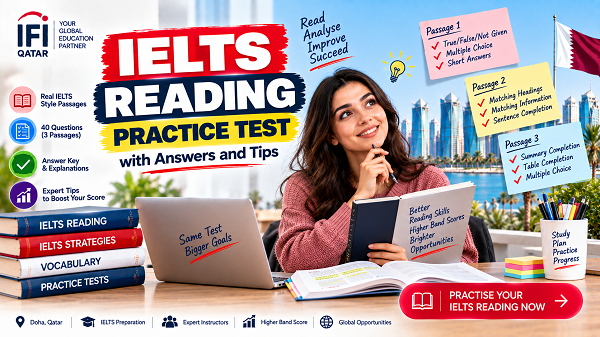
If you are preparing for IELTS, taking an IELTS Reading practice test is one of the most effective ways to become familiar with the question types, improve your reading speed and identify the skills you need to strengthen.
The IELTS Reading test contains 40 questions, and you have 60 minutes to complete them. Academic and General Training Reading are different tests, although both assess your ability to understand written English and use skills such as reading for detail, identifying main ideas, understanding opinions, scanning for information and recognising logical relationships.
This guide includes an original IELTS-style Reading practice test with answers, explanations and practical strategies you can use to improve your score.
Quick tip: Do not treat a practice test simply as a way to get a score. Your biggest improvement usually comes from analysing why you got questions wrong and changing the way you approach those question types.
IELTS Reading Test Format
Before taking a practice test, you should understand what the real IELTS Reading section involves.
How Many Questions Are in IELTS Reading?
There are 40 questions in the IELTS Reading test, with one mark awarded for each correct answer. Your raw score is then converted to an IELTS band score from 1 to 9.
How Much Time Do You Have?
You have 60 minutes to complete the Reading test.
A useful starting point for practice is to divide your time approximately as follows:
| Reading Section | Suggested Time |
|---|---|
| Passage 1 | 15–17 minutes |
| Passage 2 | 18–20 minutes |
| Passage 3 | 23–25 minutes |
| Final checking | 2–4 minutes |
These are practice recommendations rather than official time allocations. You are responsible for managing the 60 minutes yourself.
Academic vs General Training Reading
The Reading tests are different for IELTS Academic and IELTS General Training.
Academic Reading contains three sections with longer texts on topics of general interest to students at undergraduate or postgraduate level. The total text length is approximately 2,150–2,750 words.
General Training Reading also contains 40 questions across three sections, but the texts are based more heavily on everyday, workplace and general-interest contexts.
If you are preparing for IELTS in Qatar, make sure your practice materials match the type of IELTS test you intend to take.
IELTS Reading Question Types
The IELTS Reading test uses a range of question formats. Official IELTS sample materials include multiple choice, True/False/Not Given, Yes/No/Not Given, matching headings, matching information, matching features, sentence endings, summary completion, note completion, table completion, flow-chart completion, diagram labelling and short-answer questions.
Multiple Choice
You choose the correct answer from a number of options.
These questions may test:
- Specific details
- Main ideas
- Reasons
- Opinions
- Conclusions
- Overall understanding
Do not select an answer simply because you see the same word in the passage. The correct answer is often expressed through paraphrasing.
True, False or Not Given
You must decide whether a statement:
- True — agrees with the information in the passage
- False — contradicts the information
- Not Given — is neither confirmed nor contradicted
One of the most important rules is not to use your own knowledge of the subject. Your answer must come from the information provided in the text.
Yes, No or Not Given
This question type is similar to True/False/Not Given, but it generally focuses on the writer’s views or claims.
You need to distinguish between:
- What the writer agrees with
- What the writer disagrees with
- What the writer does not express
Matching Headings
You are given a list of headings and must match them with paragraphs or sections.
The challenge is to identify the main idea of each paragraph rather than choosing a heading because one word appears in both places.
Matching Information
You need to identify which paragraph contains particular information.
The information could be:
- A specific example
- A reason
- A comparison
- A description
- A fact
- An explanation
Matching Features
You match information to a list of people, places, theories, inventions, dates or other features.
This requires effective scanning and careful attention to paraphrasing.
Sentence Completion
You complete sentences using information from the passage.
Always check the instructions carefully because they may specify a maximum number of words.
Summary, Note or Table Completion
You complete missing information in a summary, notes or table.
The words may need to be taken directly from the passage, depending on the instructions.
Short-Answer Questions
You answer questions using information from the reading passage.
Pay particular attention to the word limit. Exceeding the stated word limit can result in losing the mark.
IELTS Reading Practice Test: Passage 1
The following is an original IELTS-style practice passage created for this article. It is not an official IELTS test.
The Changing Role of Urban Libraries
For centuries, libraries have been associated primarily with books. Visitors entered a library to borrow printed materials, conduct research or read quietly. However, the role of libraries has changed considerably as technology has transformed the way people access information.
Digital resources have not made physical libraries irrelevant. In many cities, libraries have responded to technological changes by offering computers, internet access and digital databases. Some also provide access to electronic books and online educational resources.
Another important development is the use of libraries as community spaces. Modern libraries may provide rooms for meetings, workshops, language classes and educational activities. This has allowed them to serve people who may not necessarily visit a library simply to borrow a book.
Libraries have also become increasingly important for people who do not have reliable access to technology at home. A person without a computer or high-speed internet connection may use a public library to complete an online application, attend a virtual class or search for employment.
However, the transition has not been without challenges. Libraries need to invest in technology while continuing to maintain physical collections. Staff members may also require additional training so that they can help visitors use digital services effectively.
Despite these challenges, many library professionals argue that technology has expanded rather than reduced the potential role of libraries. Instead of being places where people simply collect books, libraries can now function as centres for learning, information and community interaction.
Questions 1–6
Questions 1–3: True, False or Not Given
Decide whether the following statements are True, False or Not Given according to the passage.
1. Libraries have always been used primarily for community meetings.
2. Some libraries provide access to digital resources.
3. All modern libraries have stopped collecting printed books.
Questions 4–6: Multiple Choice
4. Why may libraries be particularly useful to people without reliable internet access?
A. They provide free printed newspapers.
B. They can provide access to computers and online resources.
C. They employ professional job recruiters.
D. They guarantee employment.
5. What challenge is mentioned in the passage?
A. Libraries are finding it difficult to attract young people.
B. Visitors are no longer interested in educational activities.
C. Libraries must balance technological investment with physical collections.
D. Digital resources are becoming more expensive than books.
6. What is the main idea of the passage?
A. Printed books are disappearing from public libraries.
B. Technology has made libraries unnecessary.
C. Libraries are changing their role in response to technological and social needs.
D. Libraries should focus exclusively on digital education.
Answers 1–6
| Question | Answer |
|---|---|
| 1 | False |
| 2 | True |
| 3 | Not Given |
| 4 | B |
| 5 | C |
| 6 | C |
Explanation of the Answers
1. False
The passage says libraries were traditionally associated with books and later became community spaces. It does not say they have always been used primarily for meetings.
2. True
The passage explicitly mentions computers, internet access, digital databases and electronic books.
3. Not Given
The passage says libraries continue to maintain physical collections, but it does not state that every modern library has stopped collecting books.
4. B
The passage explains that people without reliable access to technology can use library computers and online resources.
5. C
The fifth paragraph explains that libraries need to invest in technology while continuing to maintain physical collections.
6. C
The passage focuses on the changing role of libraries rather than the disappearance of books.
What This Practice Test Teaches You
Notice how several answers depend on understanding meaning rather than identical vocabulary.
For example, the passage says:
“Libraries have responded to technological changes by offering computers, internet access and digital databases.”
The question asks why libraries are useful to people without reliable internet access.
The correct answer does not repeat the entire sentence word for word. You need to connect the idea of technology access with computers and online resources.
This is one of the most important skills for IELTS Reading.
How to Approach an IELTS Reading Practice Test
Taking a practice test without a strategy can lead to the same mistakes repeatedly.
Use the following process.
Step 1: Read the Instructions Carefully
Before answering questions, check:
- What type of question is it?
- How many answers are required?
- Is there a word limit?
- Can an option be used more than once?
- Do you need to select one answer or several?
Instructions are part of the test.
Step 2: Preview the Questions
Do not immediately read every word of the passage in detail.
Look through the questions first and identify:
- Names
- Dates
- Numbers
- Technical terms
- Keywords
- Important nouns
- Distinctive phrases
These can help you locate relevant parts of the passage.
Step 3: Skim the Passage
Skimming means reading quickly to understand the general structure and main ideas.
Pay attention to:
- The title
- Introduction
- First sentence of paragraphs
- Last sentence of paragraphs
- Names
- Dates
- Repeated concepts
- Changes in topic
Do not try to memorise every sentence.
Step 4: Scan for Specific Information
Scanning is different from skimming.
When scanning, you are looking for a specific piece of information.
For example, if a question asks:
In which year was the research published?
You can search the passage for years rather than reading the entire text from beginning to end.
Step 5: Read the Relevant Section Carefully
Once you locate the likely section, slow down.
Read the surrounding sentences and confirm the meaning.
This prevents you from choosing an answer based on a single keyword.
Step 6: Watch for Paraphrasing
IELTS Reading frequently tests whether you can recognise the same idea expressed using different words.
For example:
Question:
The project was unsuccessful because of a lack of funding.
Passage:
The initiative failed after financial support was withdrawn.
The wording is different, but the relationship between the ideas is similar.
IELTS Reading Tips for a Higher Band Score
Improve Your Skimming Skills
You do not need to read every sentence slowly.
Practise identifying the main idea of a paragraph in approximately 10–20 seconds.
After reading a paragraph, ask:
“What is this paragraph mainly about?”
If you cannot answer, your reading may be too focused on individual words.
Develop Your Scanning Skills
Train yourself to locate:
- Names
- Numbers
- Dates
- Places
- Technical terms
- Capitalised words
This can save valuable time.
Learn Synonyms and Paraphrases
Vocabulary knowledge is important, but memorising isolated lists is not enough.
Learn words together with common alternatives.
For example:
| Word | Possible IELTS Paraphrase |
|---|---|
| increase | rise, grow, expand |
| important | significant, major, crucial |
| problem | issue, difficulty, challenge |
| reduce | decrease, lower, cut |
| method | approach, technique, procedure |
| result | outcome, consequence, effect |
The exact synonym depends on context, so focus on meaning rather than memorising one-to-one substitutions.
Do Not Assume Information
One of the most common IELTS Reading mistakes is answering based on general knowledge.
If a statement sounds reasonable but the passage does not confirm it, you should not automatically choose True.
This is particularly important for True/False/Not Given questions.
Check the Word Limit
If the instruction says:
NO MORE THAN TWO WORDS
your answer cannot contain three words.
Official IELTS guidance specifically warns that exceeding the stated word limit can result in losing the mark.
Do Not Spend Too Long on One Question
If a question is taking too long, make your best decision, mark it mentally or on your answer sheet as appropriate, and continue.
You can return to difficult questions later if time allows.
How to Improve IELTS Reading Speed
Reading faster does not mean reading carelessly.
The goal is to process the important information efficiently.
Practise Reading in Groups of Words
Instead of reading:
The / rapid / development / of / technology…
train yourself to recognise:
the rapid development of technology
as one meaningful phrase.
This can reduce unnecessary pauses.
Stop Translating Every Word
If you translate every sentence into your first language, your reading speed will usually become much slower.
Try to understand the meaning directly in English.
If you encounter an unfamiliar word, ask:
Do I actually need to know this word to answer the question?
Often, the answer is no.
Build Topic-Based Vocabulary
IELTS Reading can cover a wide range of subjects.
Useful vocabulary areas include:
- Environment
- Technology
- Education
- Health
- Science
- History
- Business
- Society
- Psychology
- Agriculture
Learning vocabulary by topic makes it easier to recognise ideas when you encounter them in a passage.
Common IELTS Reading Mistakes
Reading the Entire Passage Slowly Before Looking at the Questions
This can consume too much of your limited time.
Instead, develop a balance between skimming, scanning and detailed reading.
Looking for Exact Words Only
The passage may express the answer using completely different vocabulary.
Always look for meaning and relationships, not just matching words.
Confusing False with Not Given
Remember:
False = the passage contradicts the statement.
Not Given = the passage does not provide enough information to decide.
Using Your Own Knowledge
IELTS Reading tests your understanding of the passage.
Do not choose an answer simply because you know something about the topic.
Ignoring Grammar in Completion Questions
The grammar of the sentence can help you predict the type of answer required.
For example:
The main cause of the problem was ______.
A noun or noun phrase is likely to be required.
Spending Too Much Time on Difficult Questions
One difficult question should not damage your performance on five easier questions.
Manage your time strategically.
How to Check Your IELTS Reading Practice Test
After completing a practice test, do not simply count your correct answers.
Create a mistake log.
| Question | Type | Your Answer | Correct Answer | Reason for Mistake |
|---|---|---|---|---|
| 4 | Multiple Choice | A | B | Misread detail |
| 8 | T/F/NG | True | Not Given | Used outside knowledge |
| 13 | Matching Headings | iii | v | Focused on supporting detail |
| 21 | Completion | technology tools | digital resources | Word limit |
| 29 | Multiple Choice | C | A | Missed paraphrase |
After several tests, patterns will become visible.
For example, you may discover that:
- You perform well on multiple choice.
- You struggle with Matching Headings.
- You frequently confuse Not Given and False.
- Your vocabulary is strong, but your reading speed is slow.
- You lose marks because of word limits.
That information is much more useful than simply knowing that you scored 27/40.
Approximate IELTS Reading Band Scores
Your 40-question raw score is converted into an IELTS band score.
The exact conversion can vary depending on the test version, so practice-score conversions should be treated as approximate.
For IELTS Academic Reading, commonly used approximate benchmarks include:
| Correct Answers | Approximate Band |
|---|---|
| 15 | 5.0 |
| 23 | 6.0 |
| 30 | 7.0 |
| 35 | 8.0 |
IELTS confirms that each correct Reading answer receives one mark and that the raw score is converted to a band score from 1 to 9.
Do not use one practice test to predict your final result with certainty.
A better approach is to take several tests and look for a consistent performance pattern.
IELTS Reading Practice Plan
If you want to improve systematically, use a weekly cycle rather than taking random practice tests.
Day 1: Full Reading Practice Test
Complete a full 40-question test under timed conditions.
Record your score.
Day 2: Mistake Analysis
Review every incorrect answer.
Classify each mistake as:
- Vocabulary
- Misunderstanding
- Paraphrasing
- Time management
- Question-type strategy
- Careless error
Day 3: Vocabulary Practice
Review unfamiliar words from your reading materials.
Do not only memorise definitions.
Learn:
- Synonyms
- Collocations
- Word families
- Example sentences
Day 4: Question-Type Practice
Focus on your weakest question type.
For example:
Matching Headings
or
True/False/Not Given
Day 5: Timed Passage Practice
Complete one or two passages while controlling your time.
Focus on maintaining accuracy while increasing speed.
Day 6: Difficult Passage Practice
Choose a challenging reading passage and practise identifying:
- Main ideas
- Supporting details
- Writer’s opinions
- Examples
- Comparisons
- Cause-and-effect relationships
Day 7: Full Practice Test
Take another complete test.
Compare your score and mistake pattern with Day 1.
The goal is not just a higher score.
You want to see fewer repeated mistakes.
How Many IELTS Reading Practice Tests Should You Take?
There is no single number that works for every candidate.
Quality matters more than quantity.
Taking ten tests without analysing your mistakes can be less useful than taking five tests and reviewing them carefully.
A good practice cycle is:
Test → Check → Analyse → Practise → Retest
If you consistently make the same mistake, stop taking full tests for a moment and work specifically on that weakness.
How to Use IELTS Reading Practice Tests Effectively
Use three stages for every practice test.
Before the Test
Set up realistic conditions.
- Remove distractions.
- Set a 60-minute timer.
- Use appropriate IELTS-level material.
- Have your answer sheet ready.
- Decide which IELTS version you are preparing for.
During the Test
Follow the real time limit.
Do not:
- Pause unnecessarily
- Search for vocabulary
- Use a dictionary
- Translate every sentence
- Spend several minutes on one question
After the Test
This is where much of the learning happens.
For every wrong answer, ask:
Where was the answer?
Why did I miss it?
What wording in the passage gave me the answer?
Was the information paraphrased?
Did I misunderstand the question type?
Could I avoid the same mistake next time?
Practice Test vs IELTS Preparation Course
Practice tests are valuable, but they do not replace structured preparation.
A practice test tells you what happened.
A preparation course can help you understand why it happened and what to do next.
For example, if you repeatedly lose marks in Matching Headings, simply taking another ten tests may not solve the problem.
You may need to learn how to:
- Identify the central idea of a paragraph.
- Separate the main idea from supporting details.
- Eliminate headings that focus on only one example.
- Recognise paraphrased ideas.
- Compare the remaining headings systematically.
This is where targeted IELTS preparation can make a significant difference.
Frequently Asked Questions About IELTS Reading Practice Tests
How many questions are in the IELTS Reading test?
There are 40 questions in the IELTS Reading test. Each correct answer receives one mark.
How long is the IELTS Reading test?
You have 60 minutes to complete the Reading test.
Is IELTS Academic Reading the same as General Training Reading?
No. Academic and General Training have different Reading tests and different types of texts. Both contain 40 questions and are completed in 60 minutes.
What is the best way to practise IELTS Reading?
Use full timed practice tests alongside targeted exercises for specific question types. After each test, analyse your mistakes rather than focusing only on your score.
How can I improve my IELTS Reading score?
Focus on the skills causing you to lose marks. These may include skimming, scanning, vocabulary, paraphrase recognition, time management or specific question types such as Matching Headings or True/False/Not Given.
How can I improve my IELTS Reading speed?
Practise skimming for main ideas, scanning for specific information and reading groups of words rather than translating each word individually.
Should I read the whole IELTS passage first?
There is no single strategy that works for every candidate. However, many students benefit from previewing the questions, skimming the passage for structure and then reading relevant sections more carefully.
What should I do when I do not know a word?
Use the surrounding context to understand its likely meaning when necessary. If the word is not important for answering the question, do not spend too much time on it.
Is a practice test enough to prepare for IELTS?
A practice test is useful for measuring performance and becoming familiar with the format, but structured preparation is usually more effective when you need to improve specific weaknesses.
Improve Your IELTS Reading Skills with IFI Qatar
An IELTS Reading practice test can show you where you are today, but consistent improvement requires a clear strategy.
If you are preparing for IELTS in Qatar, IFI Qatar can help you build the skills needed across the four IELTS components through structured preparation and guided practice.
Whether your target is Band 6, Band 7 or higher, the most effective approach is to identify your current weaknesses, practise them deliberately and measure your progress regularly.
Ready to improve your IELTS score? Explore IELTS preparation courses with IFI Qatar and build a structured study plan around your target band.
Final IELTS Reading Tips
Before your next practice test, remember these key points:
- Manage your 60 minutes carefully.
- Read the questions strategically.
- Skim for the main idea before reading deeply.
- Scan for names, numbers and keywords.
- Look for paraphrases rather than exact words.
- Do not use outside knowledge for True/False/Not Given questions.
- Follow every word-limit instruction.
- Do not spend too long on one question.
- Analyse every mistake after the test.
- Practise your weakest question types instead of repeatedly doing what you already do well.
The goal of an IELTS Reading practice test is not simply to discover your score.
It is to discover what is preventing you from achieving your target score — and then fix it.