

Currently Empty: ر.ق 0,00


IELTS
IELTS Preparation Guide for Beginners: Step-by-Step Plan to Get Band 7+
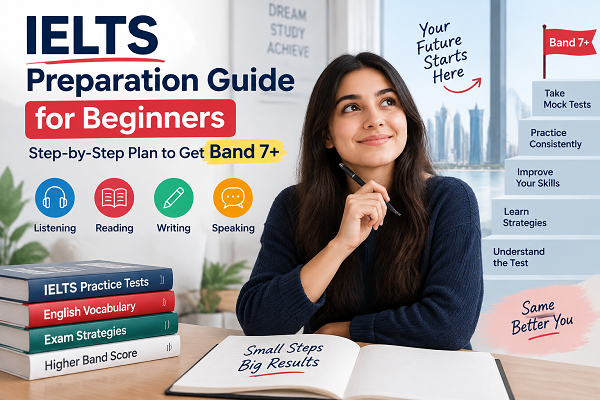
Starting IELTS preparation can feel overwhelming, especially if you are taking the test for the first time.
You need to understand the exam format, improve your English, learn IELTS-specific techniques, manage your time, and practise all four skills. Without a clear plan, it is easy to spend months studying without making meaningful progress.
The good news is that IELTS preparation does not have to be complicated.
A structured approach can help you understand your current level, identify your weaknesses, practise effectively, and work toward your target band score.
This IELTS preparation guide for beginners explains how to prepare for the exam step by step, including Listening, Reading, Writing, Speaking, vocabulary, mock tests, study schedules, and common preparation mistakes.
Whether you need IELTS for university admission, immigration, professional requirements, or career opportunities, this guide will help you build a practical preparation plan.
What Is IELTS?
The International English Language Testing System (IELTS) is an English language proficiency test used by organizations, educational institutions, employers, and governments around the world.
The test measures four English skills:
- Listening
- Reading
- Writing
- Speaking
IELTS uses a 0–9 band scale, with separate scores reported for each skill as well as an overall band score.
Preparing for IELTS requires more than improving general English.
You also need to understand:
- IELTS question types
- Time limits
- Assessment criteria
- Exam strategies
- Task requirements
- How to manage your answers under pressure
That is why having a structured IELTS study plan can make your preparation more efficient.
What IELTS Score Do You Need?
Before you start preparing, find out what band score you actually need.
Your target may depend on your:
- University or course requirements
- Immigration requirements
- Professional registration
- Employer requirements
- Personal goals
Do not assume that you automatically need Band 7.
Some candidates may need a particular overall score, while others may need minimum scores in individual skills.
Once you know your target, you can compare it with your current level and determine how much improvement is required.
Understand the IELTS Exam Format
Before studying individual skills, make sure you understand how the IELTS test works.
The four sections are:
| IELTS Section | Main Focus |
|---|---|
| Listening | Understanding spoken English |
| Reading | Understanding written texts |
| Writing | Producing written responses |
| Speaking | Communicating verbally |
IELTS Listening
The Listening test contains 40 questions and uses four recordings.
You may hear:
- Everyday conversations
- Monologues
- Discussions
- Educational or academic situations
Useful skills include:
- Predicting answers
- Identifying keywords
- Following changes in topic
- Understanding different accents
- Listening for specific information
IELTS Reading
The Reading test contains 40 questions.
Depending on the IELTS test you take, the reading material and tasks differ, but you need to be able to understand texts and locate relevant information efficiently.
Common question types include:
- Multiple choice
- True/False/Not Given
- Yes/No/Not Given
- Matching headings
- Matching information
- Sentence completion
- Summary completion
Successful candidates need both reading comprehension and effective time management.
IELTS Writing
The Writing test lasts 60 minutes and contains two tasks.
For Academic IELTS:
Task 1 requires you to describe visual information such as:
- Graphs
- Charts
- Tables
- Maps
- Processes
Task 2 requires you to write an essay in response to a question or issue.
For General Training IELTS, Task 1 involves writing a letter, while Task 2 is also an essay.
Writing Task 2 carries greater weight than Task 1 when your Writing score is calculated.
You should therefore dedicate substantial preparation time to essay structure, idea development, vocabulary, grammar, and task response.
IELTS Speaking
The Speaking test is a face-to-face or video-call interview lasting around 11–14 minutes.
It has three parts:
Part 1: Familiar questions about topics such as your home, studies, work, hobbies, and daily life.
Part 2: A longer individual response based on a task card.
Part 3: A more detailed discussion connected to the Part 2 topic.
To perform well, you need to develop:
- Fluency
- Vocabulary
- Grammar
- Pronunciation
- Confidence
Step-by-Step IELTS Preparation Plan for Beginners
Now that you understand the exam, you can create your preparation plan.
Step 1: Take an IELTS Diagnostic or Practice Test
Before you begin intensive study, find out where you are starting from.
A realistic IELTS practice or mock test can help you identify:
- Your current level
- Strong skills
- Weak skills
- Time-management problems
- Question types that cause difficulty
- Your approximate target gap
For example, if your Reading is already close to your target but your Writing is significantly weaker, your study time should not be divided equally between the two skills.
Your preparation should be based on your actual weaknesses.
Why Take a Diagnostic Test First?
Without a starting assessment, you may spend too much time practising skills you already perform well.
A diagnostic test gives you a clearer picture of where your preparation should begin.
Step 2: Create a Realistic IELTS Study Schedule
Consistency is more important than studying for many hours once or twice a week.
A beginner-friendly schedule could include around 2–3 focused hours per day, depending on your current level, target score, and available time.
Example Daily IELTS Study Plan
| Skill | Suggested Time | Activity |
|---|---|---|
| Listening | 30 minutes | Practice + error review |
| Reading | 45 minutes | Reading practice + vocabulary |
| Writing | 45 minutes | Essay or Task 1 practice |
| Speaking | 30 minutes | Question practice + recording |
You do not have to follow this exact schedule every day.
The important principle is to maintain regular contact with all four skills.
Step 3: Build Your IELTS Vocabulary
Vocabulary affects your performance across multiple parts of the IELTS test.
However, memorizing hundreds of random words is not the most effective approach.
Focus on:
- Topic-specific vocabulary
- Academic expressions
- Collocations
- Synonyms
- Paraphrasing
- Words you can actually use confidently
Learn Vocabulary by Topic
Useful IELTS topics include:
- Education
- Technology
- Environment
- Health
- Work
- Society
- Government
- Crime
- Transport
- Globalisation
Instead of simply memorizing:
important
learn useful alternatives and combinations such as:
- a significant factor
- a crucial issue
- a key element
- play an important role
- have a significant impact
The objective is not to use the most complicated vocabulary possible.
The objective is to use accurate, natural, and appropriate language.
Step 4: Improve Your IELTS Listening Skills
IELTS Listening requires you to process information quickly while answering questions.
Focus on Prediction
Before the recording begins, examine the questions and predict what type of answer you need.
For example, if the sentence is:
The course begins on ______.
you can predict that the answer is probably a date or day.
Practise Different Accents
IELTS Listening can expose you to different varieties of English.
Regularly listening to different speakers can help you become more comfortable with variations in pronunciation and accent.
Review Your Mistakes
Do not simply check the answers and move on.
For every incorrect answer, ask:
- Did I misunderstand the speaker?
- Did I miss the information?
- Did I choose the wrong answer?
- Did I make a spelling mistake?
- Did I lose concentration?
Understanding why you made a mistake is more valuable than simply knowing that the answer was wrong.
Step 5: Improve Your IELTS Reading Skills
Reading success depends on both comprehension and strategy.
Practise Skimming
Skimming means reading quickly to understand the overall purpose and main ideas of a text.
Practise Scanning
Scanning means searching for specific information, such as:
- Names
- Dates
- Numbers
- Places
- Keywords
Learn to Paraphrase
IELTS Reading questions often use language that differs from the wording in the passage.
For example:
Question:
The company experienced a rapid increase in sales.
Passage:
The business saw a significant rise in the number of products it sold.
Understanding synonyms and paraphrasing can make it easier to recognize the correct information.
Do Not Spend Too Long on One Question
If a question is taking too much time, move on and return to it later if possible.
Time management is an essential part of IELTS Reading.
Step 6: Master IELTS Writing Task 2
Writing is one of the areas where many candidates struggle.
A strong IELTS Writing preparation plan should include both Task 1 and Task 2, but Task 2 deserves particular attention because it carries greater weight.
Learn the Basic Essay Structure
For many Task 2 questions, a practical structure is:
Introduction
- Paraphrase the question
- Give your position or main response
Body Paragraph 1
- Main idea
- Explanation
- Example
Body Paragraph 2
- Main idea
- Explanation
- Example
Conclusion
- Summarize the main ideas
- Restate your position where appropriate
This is a framework, not a memorized template.
Focus on Task Response
Ask yourself:
- Did I answer the exact question?
- Did I address every part?
- Is my position clear?
- Did I develop my ideas sufficiently?
- Are my examples relevant?
Improve Coherence and Cohesion
Your essay should be easy to follow.
Use:
- Clear paragraphing
- Topic sentences
- Logical progression
- Appropriate linking expressions
- Referencing and substitution where natural
Do not add linking words to every sentence simply to make your essay appear more organized.
Get Writing Feedback
Writing practice is much more effective when you understand what you are doing wrong.
A teacher or experienced IELTS instructor can help identify recurring problems with:
- Grammar
- Vocabulary
- Organization
- Task Response
- Coherence and Cohesion
Step 7: Practise IELTS Speaking Every Day
You do not need to spend hours speaking English every day.
Even 20–30 minutes of focused practice can be useful if you practise consistently.
Record Yourself
Choose a Speaking question and record your answer.
Then listen for:
- Grammar mistakes
- Repeated words
- Long pauses
- Unclear pronunciation
- Limited vocabulary
- Unnatural expressions
Practise Common IELTS Topics
Start with familiar topics such as:
- Hometown
- Home
- Work
- Studies
- Family
- Hobbies
- Food
- Technology
- Travel
- Daily routines
- Future plans
Develop Extended Answers
Avoid stopping after one sentence.
Instead of:
I like studying English because it is useful.
try:
I enjoy studying English because it gives me access to international educational opportunities and allows me to communicate with people from different cultures. I also use it regularly when I study online, so improving my English has practical benefits for me.
The goal is not to memorize this answer.
The goal is to learn how to develop your own ideas naturally.
Step 8: Practise IELTS Grammar
Grammar affects both your Writing and Speaking performance.
Do not study grammar only by reading rules.
Use grammar actively in your IELTS practice.
Important Grammar Areas
Pay attention to:
- Verb tenses
- Articles
- Subject-verb agreement
- Countable and uncountable nouns
- Prepositions
- Relative clauses
- Conditionals
- Complex sentences
- Sentence structure
Keep a Grammar Error Log
If you repeatedly make the same mistake, record it.
For example:
Incorrect:
People believes that…
Correct:
People believe that…
Review your error log regularly and actively look for those mistakes in future practice.
Step 9: Learn IELTS Time Management
Knowing the answers is not enough if you cannot complete the test within the time limit.
Practise under realistic conditions.
IELTS Listening
Follow the timing of the actual test and practise answering while listening.
IELTS Reading
Train yourself to move through the passages efficiently instead of spending too long on individual questions.
IELTS Writing
A useful 40-minute Task 2 approach is:
- 5 minutes: Analyze and plan
- 30 minutes: Write
- 5 minutes: Check
IELTS Speaking
Practise answering without preparing long scripts.
You need to become comfortable thinking and responding in real time.
Step 10: Take IELTS Mock Tests Regularly
Mock tests are an important part of effective IELTS preparation.
They help you:
- Measure progress
- Practise time management
- Experience exam conditions
- Identify recurring mistakes
- Build confidence
How Often Should You Take an IELTS Mock Test?
Your frequency can change as your exam approaches.
Early preparation:
Take a mock test every few weeks to measure progress.
Final stage:
Increase the frequency and use full-length tests under realistic conditions.
Do not take one mock test after another without reviewing the results.
The value of a mock test comes from what you learn from it.
Step 11: Analyse Your IELTS Mistakes
One of the most overlooked parts of IELTS preparation is error analysis.
After every practice session, ask:
What did I get wrong?
Then ask:
Why did I get it wrong?
For example:
| Error | Possible Cause | Action |
|---|---|---|
| Listening mistake | Missed key information | Practise prediction |
| Reading mistake | Misunderstood paraphrase | Study synonyms |
| Writing error | Weak paragraph development | Practise PEEL |
| Speaking hesitation | Limited preparation | Practise spontaneous answers |
| Grammar error | Incorrect verb form | Review and reuse structure |
This turns mistakes into a personalized study plan.
Step 12: Review Your Progress and Adjust Your Plan
Your IELTS preparation plan should not remain exactly the same from the first day until the exam.
Review your performance regularly.
If your Listening score improves significantly but Writing remains weak, allocate more time to Writing.
If your Speaking fluency improves but pronunciation remains unclear, adjust your practice accordingly.
Your study plan should evolve with your results.
How Long Does IELTS Preparation Take?
There is no universal IELTS preparation timeline.
The amount of time required depends on:
- Your current English level
- Your target band score
- Previous English experience
- Study consistency
- Quality of practice
- Access to feedback
- Familiarity with IELTS
As a general planning guide, candidates at different levels may require very different amounts of preparation.
| Starting Level | Example Target | Possible Preparation Range |
|---|---|---|
| Beginner | Band 7 | Several months or longer |
| Intermediate | Band 7 | Around 3–6 months |
| Upper-intermediate | Band 7–7.5 | Around 1–3 months |
These are only broad planning estimates. A diagnostic test is a much better way to determine your individual preparation needs.
Should Beginners Take an IELTS Preparation Course?
Self-study can work well for some candidates, particularly those who already have strong English skills and understand the IELTS format.
However, an IELTS preparation course can provide additional support through:
- Structured lessons
- Expert guidance
- Writing correction
- Speaking feedback
- Practice tests
- Exam strategies
- Progress monitoring
- Personalized recommendations
For beginners, structured guidance can be particularly useful because it reduces the risk of developing ineffective study habits.
Self-Study vs IELTS Preparation Course
| Factor | Self-Study | IELTS Course |
|---|---|---|
| Flexibility | High | Moderate |
| Expert feedback | Limited | Available |
| Writing correction | Self-review | Instructor feedback |
| Speaking practice | Often limited | Regular practice |
| Study structure | Self-managed | Structured |
| Accountability | Lower | Higher |
| Personal guidance | Limited | Greater |
The best option depends on your English level, learning style, available time, and target score.
Common IELTS Preparation Mistakes Beginners Should Avoid
Studying Without a Plan
Random practice can make it difficult to measure progress.
Create a weekly plan and assign specific goals to each study session.
Focusing Only on Vocabulary
Vocabulary is important, but IELTS requires four different skills.
You need to practise:
- Listening
- Reading
- Writing
- Speaking
Ignoring Writing Feedback
Writing the same type of essay repeatedly without understanding your mistakes may not lead to significant improvement.
Taking Too Many Mock Tests
Mock tests are useful when followed by analysis.
Five tests without review can be less valuable than two carefully analyzed tests.
Memorizing IELTS Answers
Memorized essays and Speaking answers can sound unnatural and may not answer the actual question.
Learn flexible structures and useful language instead.
Ignoring the IELTS Assessment Criteria
Understand what the examiner is looking for.
For Writing and Speaking, learn how the scoring criteria affect your performance and use them to guide your practice.
Studying for Long Hours Without Focus
Long study sessions are not automatically productive.
Focused, consistent practice is usually more effective than studying for many hours without a clear objective.
A Simple Weekly IELTS Study Plan for Beginners
Here is an example of how you could organize a week.
| Day | Main Focus |
|---|---|
| Monday | Listening + Vocabulary + Speaking |
| Tuesday | Reading + Writing Task 2 |
| Wednesday | Listening + Grammar + Speaking |
| Thursday | Reading + Writing Task 1 |
| Friday | Vocabulary + Speaking + Reading |
| Saturday | Full or partial IELTS mock test |
| Sunday | Error analysis + Review |
Adapt the schedule according to your weakest skills.
If Writing is your biggest problem, for example, you may need to devote more time to writing practice and feedback.
IELTS Preparation Checklist
Before your exam, make sure you can:
- Explain the IELTS test format
- Identify your target band score
- Complete timed Listening practice
- Manage Reading time effectively
- Structure IELTS Writing responses
- Develop relevant essay ideas
- Use topic-specific vocabulary naturally
- Speak confidently about familiar topics
- Practise under realistic exam conditions
- Analyze your recurring mistakes
- Complete full IELTS mock tests
- Follow a consistent study plan
Frequently Asked Questions About IELTS Preparation
How should beginners start IELTS preparation?
Start by understanding the IELTS format, identifying your target score, and taking a diagnostic or practice test. Then create a structured study plan covering Listening, Reading, Writing, and Speaking.
Can I get Band 7 in IELTS as a beginner?
Yes, but the time required depends heavily on your current English level. A beginner may need significantly more preparation time than someone who is already at an intermediate or upper-intermediate level.
How many hours should I study IELTS every day?
There is no universal number. Many learners can benefit from around two to three focused hours per day, but the ideal schedule depends on your starting level, target score, and available time.
Which IELTS skill is the hardest?
There is no single hardest skill for every candidate. Many students find Writing challenging because it requires organization, idea development, vocabulary, grammar, and an understanding of the assessment criteria.
Should I take an IELTS mock test before starting preparation?
Yes. A diagnostic mock test can help you identify your current level and determine which skills require the most attention.
How long does it take to reach IELTS Band 7?
It depends on your starting level and study consistency. Candidates starting from a lower level may require several months or longer, while those already close to Band 7 may need considerably less time.
Is an IELTS preparation course worth it?
An IELTS preparation course can be valuable if you need structured lessons, professional feedback, speaking practice, writing correction, and guidance on exam strategies.
What is the best way to prepare for IELTS?
The most effective approach combines understanding the exam format, regular practice across all four skills, targeted vocabulary and grammar work, timed practice, mock tests, error analysis, and feedback.
Start Your IELTS Preparation With IFI Qatar
A high IELTS score requires more than studying English randomly.
You need a clear strategy, consistent practice, realistic goals, and an understanding of what the IELTS exam actually assesses.
At IFI Qatar, our IELTS preparation programs are designed to help students strengthen all four skills while developing the exam strategies and confidence needed for test day.
With structured preparation, guided practice, feedback, and realistic IELTS exercises, you can make your study time more focused and work toward your target band score.
If you are preparing for IELTS in Qatar and want professional support throughout your preparation journey, explore the IELTS preparation options available at IFI Qatar.
Ready to start your IELTS preparation?
Join IFI Qatar and build a structured path toward your target IELTS score.
Final Thoughts on IELTS Preparation for Beginners
IELTS preparation becomes much easier when you know exactly what you need to improve.
Start by identifying your current level and target score. Then build a realistic study plan covering all four skills.
Focus on:
- Consistent practice
- IELTS-specific strategies
- Vocabulary in context
- Grammar accuracy
- Writing and Speaking feedback
- Timed practice
- Regular mock tests
- Careful error analysis
Most importantly, do not measure your preparation only by the number of hours you study.
Measure it by what you can do better than you could before.
With a structured approach and consistent practice, you can make steady progress toward your IELTS target score.