

Currently Empty: ر.ق 0,00


IELTS
IELTS Mock Test: Why Practice Tests Improve Your Score
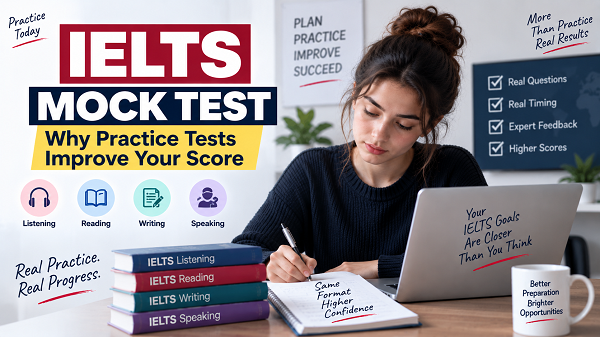
Preparing for IELTS is not only about learning vocabulary, studying grammar, or completing practice questions. You also need to know how you perform under real exam conditions.
That is where an IELTS mock test can make a significant difference.
A well-designed IELTS practice test gives you the opportunity to experience the exam format, work within the time limits, identify your weaknesses, and understand which areas require more preparation before your actual test day.
Whether you are aiming for Band 6.5, Band 7, Band 7.5, or higher, regular mock testing can help turn your preparation from general practice into a more focused study plan.
In this guide, you will learn what an IELTS mock test is, how it can improve your performance, what you should look for in a quality practice test, and how to use your results effectively.
What Is an IELTS Mock Test?
An IELTS mock test is a practice exam designed to replicate the structure, timing, question types, and overall experience of the real IELTS test.
Depending on the test format, an IELTS mock exam can include:
- IELTS Listening
- IELTS Reading
- IELTS Writing
- IELTS Speaking
- Official-style time limits
- Exam-style question formats
- Band score assessment or estimated scoring
- Performance feedback
The purpose is not simply to answer more questions.
The real value of a mock test is to measure your current performance and identify what you need to improve before taking the actual IELTS exam.
IELTS Mock Test vs. Regular IELTS Practice
These two forms of preparation are related, but they are not the same.
| Regular IELTS Practice | IELTS Mock Test |
|---|---|
| Focuses on individual skills | Simulates the complete exam experience |
| Can be completed without strict timing | Uses realistic time limits |
| Usually targets specific question types | Tests your overall performance |
| Mistakes can be corrected immediately | Results show your performance under pressure |
| Flexible study environment | More realistic exam conditions |
| Useful for learning | Useful for measuring readiness |
Both are important.
Practice helps you learn, while mock tests help you measure.
Why Take an IELTS Mock Test Before the Real Exam?
One of the biggest mistakes IELTS candidates make is assuming that studying more automatically means they are ready for the exam.
You may understand IELTS questions during practice but still struggle with:
- Time pressure
- Concentration
- Exam anxiety
- Writing within the required time
- Finding answers quickly in Reading
- Following Listening recordings accurately
- Speaking confidently under pressure
An IELTS mock test exposes these problems before they affect your real score.
Here are some of the most important ways practice tests can improve your IELTS preparation.
1. You Discover Your Current IELTS Level
A mock test gives you a clearer picture of where you currently stand.
For example, you may believe that your Reading is your strongest skill because you usually answer practice questions correctly. However, when you complete a full Reading test within the official time limit, you may discover that you spend too much time on difficult questions.
Similarly, you may feel confident about Writing but find that you cannot complete both tasks effectively within the available time.
A mock test helps replace assumptions with performance data.
What Your Results Can Tell You
Your results may help identify:
- Your estimated performance level
- Strong and weak skills
- Common question types you struggle with
- Time-management problems
- Repeated language mistakes
- Areas requiring additional practice
This information can then be used to build a more targeted IELTS study plan.
2. You Learn How to Manage Your Time
Time management is one of the most important skills in IELTS.
You have a limited amount of time to complete each section, which means you cannot spend too long on one question or paragraph.
For example, in Reading, spending several minutes trying to solve one difficult question can leave you without enough time for the final section.
In Writing, spending too much time planning Task 1 can reduce the time available for Task 2.
A mock test allows you to identify these problems while there is still time to correct them.
Use Mock Tests to Develop a Time Strategy
After each test, ask yourself:
- Did I finish every section?
- Which question types took the most time?
- Did I spend too long on difficult questions?
- Did I leave enough time to check my answers?
- Did I complete Writing Task 2 within the required time?
- Did my concentration decrease toward the end of the test?
Your answers can help you create a more effective exam strategy.
3. You Become Familiar With the IELTS Exam Format
Knowing English is only part of IELTS preparation.
You also need to understand how the test works.
A candidate who is unfamiliar with the IELTS format may waste valuable time trying to understand instructions or decide how to approach different question types.
Regular mock tests help make the exam structure more familiar.
You become more comfortable with:
- Question formats
- Instructions
- Time limits
- Section order
- Answer requirements
- Reading strategies
- Listening question types
- Writing task requirements
- Speaking questions and follow-up questions
The more familiar the format becomes, the less mental energy you need to spend figuring out what to do.
4. You Identify Your Weakest IELTS Skills
Most candidates have different strengths and weaknesses.
For example:
Candidate A
- Listening: Band 7
- Reading: Band 7
- Writing: Band 6
- Speaking: Band 6.5
For this candidate, spending most of their study time doing additional Reading exercises may not be the most productive approach.
The results suggest that Writing and Speaking deserve more attention.
A mock test can therefore help you prioritize your preparation.
Focus on the Skills That Need the Most Improvement
Instead of simply asking:
“How many hours should I study?”
Ask:
“Which skills are preventing me from reaching my target band?”
That is a much more useful question.
5. You Reduce Exam-Day Anxiety
Many candidates feel nervous because they do not know what to expect.
The real IELTS test can feel very different from studying at home.
You may suddenly become more aware of:
- The clock
- Other candidates
- Exam instructions
- Limited time
- The importance of every question
- The pressure of achieving your required band score
Taking IELTS practice exams under realistic conditions can make this experience more familiar.
You cannot completely eliminate exam anxiety, but familiarity can make the test environment feel less unfamiliar.
6. You Improve Your Ability to Concentrate
IELTS requires sustained concentration.
Listening requires you to follow information as it is presented.
Reading requires you to process long passages and locate relevant information.
Writing requires planning, organizing, and producing accurate language under time pressure.
Speaking requires you to respond naturally and continuously.
A full IELTS mock exam helps you practice maintaining concentration across multiple skills.
This is especially important for candidates who perform well during short practice sessions but lose focus during a complete test.
7. You Learn From Your Mistakes
Simply taking an IELTS mock test is not enough.
The most valuable part often comes after the test.
Your mistakes can reveal patterns.
For example, you might discover that you repeatedly:
- Miss keywords in Listening
- Confuse True/False/Not Given questions
- Spend too long on Reading passages
- Write unclear topic sentences
- Repeat the same vocabulary
- Make tense errors
- Give very short Speaking answers
- Fail to develop ideas in Writing Task 2
These patterns give you specific areas to work on.
The Mock Test → Analysis → Practice Cycle
A productive IELTS preparation cycle looks like this:
Take a mock test → Analyze your results → Identify weaknesses → Practice those weaknesses → Take another mock test → Compare your performance
This is much more useful than repeatedly taking tests without analyzing the results.
8. You Can Track Your Progress
One practice test gives you a snapshot.
Several tests can show a trend.
For example:
| Mock Test | Listening | Reading | Writing | Speaking |
|---|---|---|---|---|
| Test 1 | 6.0 | 6.5 | 5.5 | 6.0 |
| Test 2 | 6.5 | 6.5 | 6.0 | 6.0 |
| Test 3 | 7.0 | 7.0 | 6.0 | 6.5 |
| Test 4 | 7.0 | 7.5 | 6.5 | 7.0 |
This type of tracking can help you see whether your preparation is actually producing results.
It can also show whether one particular skill continues to hold back your overall performance.
9. You Practice Performing Under Pressure
There is an important difference between knowing how to answer a question and being able to answer it correctly under exam conditions.
At home, you might pause, check vocabulary, reread a passage, or spend extra time thinking.
During IELTS, you cannot do that indefinitely.
A realistic IELTS mock test introduces constraints similar to those you will face during the actual examination.
This helps you develop the ability to:
- Make decisions quickly
- Move on from difficult questions
- Work within time limits
- Maintain concentration
- Organize ideas quickly
- Continue working when you make a mistake
These are exam skills, not simply English-language skills.
How Often Should You Take an IELTS Mock Test?
There is no single schedule that works for every candidate.
Your frequency should depend on your current level, target band, available preparation time, and distance from your exam date.
A practical approach is to combine mock tests with focused study.
Early Preparation
At the beginning of your preparation, take a mock test to establish a baseline.
The goal is to discover your current level and identify weaknesses.
During Preparation
Once you know your weaknesses, spend more time on targeted practice.
You can then take additional mock tests periodically to measure progress.
Before the IELTS Exam
As your test date approaches, full-length practice exams become particularly useful.
They can help you check whether you are able to perform consistently under realistic conditions.
The key principle is:
Do not use mock tests as a replacement for learning. Use them to measure and improve what you have learned.
What Makes a Good IELTS Mock Test?
Not every online IELTS practice test provides the same value.
When choosing an IELTS mock exam, look for a test that provides a realistic preparation experience.
1. IELTS-Style Question Formats
The questions should reflect the types of tasks you are likely to encounter in IELTS.
2. Realistic Timing
The test should encourage you to work within appropriate time limits.
3. Complete Skill Coverage
If your goal is to evaluate overall readiness, look for a mock test that assesses all four IELTS skills:
- Listening
- Reading
- Writing
- Speaking
4. Meaningful Feedback
A score alone does not tell you everything.
Useful feedback should help you understand:
- What you did well
- Where you lost marks
- Which skills need improvement
- What you should practice next
5. Realistic Test Conditions
The closer the practice environment is to the actual exam experience, the more useful the simulation can be for developing test-day strategies.
How to Use Your IELTS Mock Test Results
After receiving your results, avoid simply writing down your score and moving on.
Use the results to make decisions about your preparation.
Step 1: Record Your Scores
Keep a record of your performance in each skill.
Step 2: Identify Your Weakest Areas
Look beyond the overall result.
Ask which skill or question type is causing the biggest problems.
Step 3: Analyze Your Errors
Do not only count incorrect answers.
Try to understand why you made each mistake.
Was it because you:
- Did not understand the question?
- Misread the information?
- Ran out of time?
- Did not know the vocabulary?
- Used the wrong strategy?
- Made a grammar mistake?
- Failed to develop your answer?
Step 4: Create a Targeted Study Plan
Turn your findings into specific actions.
For example:
Problem: Reading takes too long.
Action: Practice locating keywords and answering question types under shorter time limits.
Problem: Writing lacks development.
Action: Practice planning ideas and developing each main point with explanations and examples.
Problem: Speaking answers are too short.
Action: Practice extending answers with reasons, examples, and details.
Step 5: Take Another Mock Test
After targeted practice, take another test and compare the results.
This gives you evidence of whether your preparation is working.
Should You Take an IELTS Mock Test Online or In Person?
Both options can be useful, depending on your preparation needs.
IELTS Mock Test Online
Online tests can be convenient because you can practice from home and access a wide range of materials.
However, the quality of online practice varies considerably.
Some tests may not accurately replicate the IELTS experience or provide meaningful feedback.
IELTS Mock Test in a Test-Centre Environment
An in-person mock test can provide a more realistic practice experience.
It may be particularly useful if you want to:
- Experience a formal test environment
- Practice working under realistic conditions
- Receive structured feedback
- Understand how you perform under pressure
- Prepare for the experience of taking IELTS at a test centre
For candidates who are approaching their real IELTS exam, realistic simulation can be especially valuable.
IELTS Mock Test for Band 7 and Above
If your target is Band 7 or higher, simply completing practice questions may not be enough.
At higher band levels, relatively small weaknesses can make a meaningful difference to your performance.
For example, you may need to work on:
- More accurate grammar
- Better vocabulary control
- Stronger idea development
- More effective Reading strategies
- Better Listening concentration
- Greater Speaking fluency
- More precise answers
- Improved time management
Mock tests can help identify these issues.
The important point is to use your results diagnostically rather than treating the score as the final goal.
Common Mistakes When Using IELTS Mock Tests
Taking Too Many Tests Without Reviewing Them
Completing five mock tests without analyzing your mistakes may be less useful than completing two tests and carefully reviewing both.
Practicing Without Time Limits
If you always give yourself unlimited time, your practice may not reflect your real exam performance.
Focusing Only on Your Overall Score
Your overall result can hide important weaknesses.
Always examine individual skills and recurring mistakes.
Memorizing Model Answers
Model answers can help you understand structure and language, but memorizing answers is not a reliable way to prepare for unpredictable IELTS questions.
Ignoring Writing and Speaking Feedback
Listening and Reading can be easier to measure objectively because they have fixed answers.
Writing and Speaking require deeper analysis of performance, including areas such as coherence, vocabulary, grammar, fluency, and pronunciation.
A Simple IELTS Mock Test Preparation Strategy
You can build your preparation around four stages:
Stage 1: Baseline
Take an initial IELTS mock test.
Goal: Understand your current level.
Stage 2: Diagnosis
Analyze your results.
Goal: Identify your weakest skills and recurring mistakes.
Stage 3: Targeted Practice
Work specifically on those weaknesses.
Goal: Improve the areas that are limiting your score.
Stage 4: Reassessment
Take another mock test.
Goal: Measure progress and determine whether you are getting closer to your target band.
This creates a continuous improvement cycle instead of random practice.
When Should You Book an IELTS Mock Test?
Consider taking an IELTS mock test when:
- You have recently started preparing and want a baseline score.
- You are unsure about your current IELTS level.
- You keep getting different results in practice.
- You struggle to finish sections on time.
- You want to identify your weakest skill.
- Your IELTS exam is approaching.
- You want to experience realistic test conditions.
- You need to know whether your current preparation is working.
A mock test is particularly useful when you have a clear target score and need to determine what remains between your current performance and your goal.
IELTS Mock Test: What Should You Do After the Test?
Your score should be the beginning of your next preparation phase, not the end.
After your mock test:
- Record your results.
- Review every mistake.
- Identify recurring problems.
- Separate knowledge gaps from strategy problems.
- Prioritize your weakest areas.
- Practice those areas.
- Take another mock test later.
- Compare your performance.
This approach turns an IELTS mock exam into a practical diagnostic tool.
Frequently Asked Questions About IELTS Mock Tests
Is an IELTS mock test useful?
Yes. An IELTS mock test can help you understand your current performance, practice working under time limits, identify weaknesses, become familiar with the exam format, and measure progress during preparation.
How many IELTS mock tests should I take?
There is no fixed number. What matters most is how you use the results. Take enough tests to measure progress while leaving sufficient time between tests for targeted improvement.
Can an IELTS mock test improve my score?
A mock test itself does not automatically increase your band score. Its value comes from identifying weaknesses and showing you what to improve. When combined with targeted practice and feedback, mock testing can make your preparation more effective.
Should I take a full IELTS mock test?
If you want to evaluate your overall exam readiness, a full mock test can be useful because it allows you to practice multiple skills under realistic time constraints.
Is an IELTS mock test the same as the real IELTS exam?
No. A mock test is a practice simulation and does not replace the official IELTS examination. Its purpose is to help you prepare and assess your readiness.
When should I take an IELTS mock test before my IELTS exam?
Taking one early in your preparation can establish a baseline. Additional mock tests during preparation can help measure progress, while a realistic practice test closer to your exam can help you assess your readiness.
Can I take an IELTS mock test online?
Yes. Online IELTS practice tests are available, but their quality and realism can vary. Look for practice tests that closely follow IELTS-style formats, realistic timing, and meaningful assessment.
Is an IELTS mock test useful for Band 7?
Yes. Candidates targeting Band 7 or higher can use mock tests to identify specific weaknesses in areas such as time management, Writing, Speaking, vocabulary, grammar, Reading, and Listening.
Ready to Test Your IELTS Level?
Studying IELTS materials is important, but knowing how you perform under test conditions is equally important.
An IELTS mock test gives you a practical way to measure your current performance, identify weaknesses, improve your exam strategy, and track your progress before the real test.
If you are preparing for IELTS in Qatar and want a more realistic way to assess your readiness, book an IELTS mock test with IFI Qatar and use your results to make your preparation more focused and effective.
Take the test. Understand your weaknesses. Improve with purpose.
Book your IELTS Mock Test with IFI Qatar today.