

Currently Empty: ر.ق 0,00


IELTS
What Happens During an IELTS Mock Test and What Feedback Should You Receive?
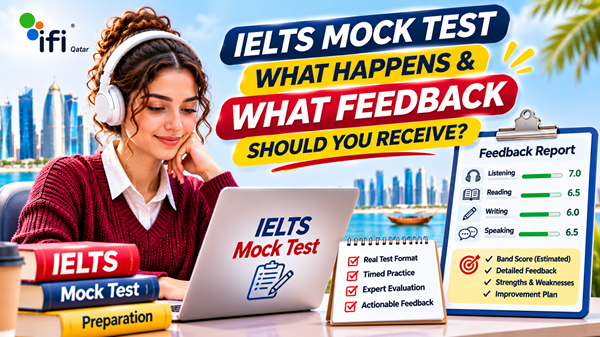
Taking an IELTS mock test is an important step in preparing for the official examination. It gives you an opportunity to experience IELTS-style questions, practise under time limits and understand how well you can perform across the four test components.
However, not all mock tests provide the same value.
Some are simply practice exercises that show you the answers and an estimated score. Others include a more structured assessment, with feedback explaining your strengths, weaknesses and the areas you need to improve.
If you are considering booking an assessed IELTS mock test, it is important to understand what happens during the assessment and what you should expect to receive afterwards.
A useful mock test should do more than tell you whether you answered questions correctly. It should help you understand why you lost marks, which skills need attention and what steps you should take before your official examination.
In this guide, we explain what happens during an IELTS mock test, how each section is assessed, what useful IELTS mock test feedback should include and how to choose an assessment that supports your preparation.
What Is an IELTS Mock Test?
An IELTS mock test is a practice examination designed to reproduce important aspects of the official IELTS test.
It allows candidates to practise the Listening, Reading, Writing and Speaking components in a structured assessment environment.
Depending on the provider and assessment option, a mock test may include:
- IELTS-style questions and tasks.
- Time limits similar to the official examination.
- Separate assessment of the four language skills.
- Estimated band scores or performance indicators.
- Writing and Speaking evaluation.
- Feedback on common mistakes.
- Recommendations for further preparation.
The main purpose is to help you understand your current performance before taking the official test.
A mock test is not an official IELTS examination, and its results do not replace an official Test Report Form (TRF). Any estimated band score should be treated as an indication of performance under the conditions of that particular assessment.
IELTS Mock Test vs Regular IELTS Practice
Regular practice and an assessed mock test can both support your preparation, but they serve different purposes.
| Feature | Regular IELTS Practice | Assessed IELTS Mock Test |
|---|---|---|
| Main purpose | Develop individual skills | Evaluate overall performance |
| Test conditions | Often flexible | Usually structured and timed |
| Question coverage | May focus on selected tasks | Can cover all four skills |
| Scoring | May involve self-checking | May include formal assessment |
| Writing evaluation | Often self-reviewed | May include evaluator feedback |
| Speaking evaluation | May involve independent practice | May include an assessment of spoken performance |
| Weakness identification | Depends on personal review | Can include structured feedback |
| Preparation guidance | Usually self-directed | May include recommendations |
The key difference is the level of assessment.
If you only need to practise a particular question type, regular exercises may be sufficient. If you want to understand your readiness and identify weaknesses across the examination, an assessed mock test can provide more useful information.
What Happens During an IELTS Mock Test?
The exact procedure depends on the provider, test format and assessment package. However, a comprehensive mock test generally follows a structured process.
Understanding each stage can help you know what to expect before booking.
1. Registration and Test Preparation
Before the mock test begins, you may need to complete a registration process and confirm the assessment arrangements.
This can include:
- Selecting IELTS Academic or General Training.
- Confirming the test format.
- Checking the test date and time.
- Receiving information about the assessment procedure.
- Understanding which components are included.
- Reviewing any instructions about the test environment.
If you are booking a mock test because you have a specific target band score, make sure the assessment is suitable for your intended IELTS test type.
Academic and General Training Reading and Writing have different content and task requirements. Your practice assessment should reflect the examination you plan to take.
2. IELTS Listening Assessment
The Listening component evaluates your ability to understand spoken English in different situations.
During a Listening mock test, you typically complete questions based on recordings that may include conversations and monologues.
Depending on the question types, you may need to:
- Select the correct option.
- Complete notes or forms.
- Identify specific information.
- Match information.
- Label a map or diagram.
- Complete sentences or summaries.
A structured assessment should help you understand how accurately you identify information from recordings.
Useful feedback may highlight problems such as:
- Missing important details.
- Confusing similar-sounding words.
- Failing to recognise corrections made by speakers.
- Losing concentration during longer recordings.
- Making spelling or grammatical errors.
- Misunderstanding instructions or word limits.
For example, you may understand the general meaning of a conversation but repeatedly lose marks when speakers change or correct information.
Recognising this pattern is more useful than simply seeing the number of correct answers.
3. IELTS Reading Assessment
The Reading component measures your ability to understand written texts, locate information and interpret meaning.
During a mock test, you complete Reading tasks within the available time.
These may include:
- Multiple-choice questions.
- True, False, Not Given questions.
- Yes, No, Not Given questions.
- Matching headings.
- Matching information.
- Sentence completion.
- Summary completion.
- Diagram labelling.
A useful Reading assessment should show more than your final number of correct answers.
It should help you identify whether your difficulties are related to comprehension, vocabulary, locating information or time management.
For example, you might achieve reasonable accuracy but spend too much time on matching headings questions. Alternatively, you may understand the passage but lose marks because you confuse False and Not Given answers.
This information can help you choose more effective practice activities.
4. IELTS Writing Assessment
Writing is one of the components where detailed feedback can be particularly valuable.
Unlike Listening and Reading, where many answers can be checked against an answer key, Writing requires an evaluation of how effectively you communicate ideas in written English.
For IELTS Academic, the mock test normally includes:
- Task 1: Describing visual information, such as a graph, chart, table, diagram or process.
- Task 2: Writing an essay in response to a question or statement.
For IELTS General Training, Task 1 involves writing a letter, while Task 2 requires an essay.
A structured Writing assessment should consider the relevant IELTS assessment criteria.
These include:
Task Achievement or Task Response
This considers how effectively you address the requirements of the question.
For example, in Academic Task 1, the assessment should consider whether you identify and present the key features of the visual information.
In Task 2, it should consider whether you address the question, develop relevant ideas and support your position.
Coherence and Cohesion
This evaluates how clearly your ideas are organised and connected.
Feedback may identify problems such as:
- Poor paragraph organisation.
- Weak progression of ideas.
- Overuse of linking expressions.
- Unclear relationships between sentences.
Lexical Resource
This relates to vocabulary use, including the range and accuracy of words and expressions.
An evaluator may identify repetitive vocabulary, inappropriate word choices or inaccurate collocations.
Grammatical Range and Accuracy
This considers your use of grammatical structures and how accurately you use them.
Feedback may highlight recurring issues with articles, verb forms, sentence structure, punctuation or complex grammatical constructions.
A useful Writing assessment should explain which areas are affecting your performance and provide practical examples wherever possible.
5. IELTS Speaking Assessment
The Speaking component evaluates your ability to communicate in English through a structured interview.
A realistic Speaking mock test should reflect the three parts of the IELTS Speaking format.
| Speaking Part | What Happens | Main Focus |
|---|---|---|
| Part 1 | Questions about familiar topics | Giving clear answers about everyday subjects |
| Part 2 | An individual long turn based on a task card | Organising and developing a longer response |
| Part 3 | A discussion connected to the Part 2 topic | Explaining opinions and developing ideas |
A structured Speaking assessment should consider the four official assessment criteria:
- Fluency and Coherence.
- Lexical Resource.
- Grammatical Range and Accuracy.
- Pronunciation.
Useful feedback should explain more than whether your answers were understandable.
It may identify issues such as:
- Frequent hesitation.
- Repetition of ideas.
- Limited vocabulary.
- Incorrect word choice.
- Grammatical errors.
- Unclear pronunciation.
- Difficulty developing answers in Part 3.
For example, a candidate may speak confidently but rely on simple vocabulary and repetitive sentence structures. Another candidate may have a wide vocabulary but pause frequently while trying to construct complicated sentences.
These candidates need different preparation strategies.
What Feedback Should You Receive After an IELTS Mock Test?
The quality of IELTS mock test feedback is one of the most important factors to consider before booking an assessment.
A useful report should help you understand your performance and decide what to improve next.
Receiving only a score may tell you how you performed, but it does not necessarily explain how to improve.
Here are the main elements you should look for.
1. An Estimated Band Score for Each Skill
A useful assessment should provide a clear indication of your performance in the relevant IELTS components.
Where the provider offers band estimates, you should be able to understand how you performed in:
- Listening.
- Reading.
- Writing.
- Speaking.
An overall estimated score may also be provided.
For example:
| IELTS Skill | Illustrative Estimated Band |
|---|---|
| Listening | 7.0 |
| Reading | 6.5 |
| Writing | 6.0 |
| Speaking | 6.5 |
| Overall | 6.5 |
These figures are an illustrative example, not an actual candidate result.
It is also important to understand that estimated scores from a mock test are not official IELTS results. Their accuracy depends on the quality of the test materials, assessment process and evaluator.
2. A Breakdown of Writing Performance
Writing feedback should identify how your responses perform against the relevant assessment criteria.
A useful report may explain:
- Whether you fully answered the question.
- Whether your ideas are relevant and sufficiently developed.
- Whether your paragraphs are logically organised.
- Whether your vocabulary is appropriate and accurate.
- Whether your grammar is varied and controlled.
- Which recurring errors are affecting your performance.
For example, instead of simply saying that your Writing needs improvement, useful feedback might explain that your Task 2 position is clear but your supporting ideas are underdeveloped.
This gives you a specific area to work on.
3. Detailed Speaking Feedback
Speaking feedback should help you understand how effectively you communicate.
Look for comments about:
- Fluency and the frequency of hesitation.
- Organisation and development of answers.
- Vocabulary range and accuracy.
- Grammatical flexibility.
- Pronunciation and intelligibility.
- Performance across the three Speaking parts.
For example, an evaluator might explain that you answer Part 1 questions naturally but give insufficiently developed responses in Part 3.
This type of observation helps you practise the skills that need the most attention.
4. Identification of Repeated Mistakes
A valuable assessment should identify patterns rather than focus only on isolated errors.
For example:
| Skill | Possible Repeated Problem | What You Need to Improve |
|---|---|---|
| Listening | Missing corrections made by speakers | Follow the complete statement |
| Reading | Confusing False and Not Given | Distinguish contradiction from missing information |
| Writing | Repeating the same vocabulary | Develop more accurate lexical choices |
| Speaking | Frequent hesitation | Improve fluency through structured speaking practice |
Identifying repeated problems allows you to work on the underlying weakness instead of correcting individual mistakes without a clear strategy.
5. Specific Recommendations for Improvement
Feedback should ideally include practical recommendations.
A statement such as “improve your vocabulary” is too general to guide your preparation effectively.
More useful recommendations might include:
- Practise paraphrasing common IELTS Reading question statements.
- Review spelling errors in Listening answer completion.
- Develop clearer overviews for Academic Writing Task 1.
- Practise supporting arguments with relevant examples in Task 2.
- Extend Speaking Part 3 answers using explanations and examples.
The more specific the recommendations, the easier it becomes to turn assessment results into a preparation plan.
6. Clear Explanation of Your Strengths
Good feedback should not focus exclusively on weaknesses.
Understanding what you already do well is equally important.
For example:
- You may identify Listening keywords accurately.
- Your Reading comprehension may be strong.
- Your Writing paragraphs may be logically organised.
- Your Speaking pronunciation may be clear.
Knowing your strengths helps you maintain effective habits while concentrating on the areas that need improvement.
7. A Practical Next-Step Study Plan
The final purpose of feedback is to help you decide what to do next.
A useful mock test assessment should help you prioritise your preparation based on your results.
For example:
| Priority | Finding | Recommended Action |
|---|---|---|
| High | Writing Task 2 ideas are underdeveloped | Practise planning and supporting arguments |
| High | Reading accuracy decreases under time pressure | Complete timed Reading exercises |
| Medium | Listening spelling errors | Review answer transcription and spelling |
| Medium | Speaking answers contain frequent repetition | Practise developing answers with examples |
This type of guidance is especially useful if your examination date is approaching.
What Is the Difference Between a Mock Test Score and Mock Test Feedback?
These two elements are related, but they are not the same.
A mock test score indicates your estimated level of performance. Feedback explains what contributed to that performance and how you can improve.
| Mock Test Score | Detailed Mock Test Feedback |
|---|---|
| Shows estimated performance | Explains performance |
| Provides numerical results | Identifies strengths and weaknesses |
| Helps you understand your current level | Helps you understand what to improve |
| May show differences between skills | Explains why those differences may exist |
| Provides a performance snapshot | Supports future preparation decisions |
For example, receiving an estimated Writing band of 6.0 tells you that your performance may be around that level under the assessment conditions.
However, it does not explain whether the main issue is task response, paragraph organisation, vocabulary or grammar.
Detailed feedback helps you understand those differences.
For candidates who want to improve efficiently, the explanation behind the score can be more valuable than the number itself.
How to Choose the Right IELTS Mock Test with Feedback
If you are comparing different IELTS mock test providers, do not base your decision only on the advertised price or estimated band score.
Consider the following factors before booking.
1. Check Whether All Four IELTS Skills Are Included
Some assessments focus on one or two components, while others provide a complete IELTS mock test.
Before booking, confirm whether the assessment covers:
- Listening.
- Reading.
- Writing.
- Speaking.
If you need an overall readiness assessment, a mock test covering all four skills may be more suitable.
However, if your main weakness is Writing or Speaking, a skill-specific assessment may be more appropriate.
2. Check Whether Writing and Speaking Are Evaluated
Writing and Speaking require more than simple answer checking.
Ask whether the provider offers an actual assessment of these components and whether the feedback is based on the relevant IELTS assessment criteria.
You should also clarify who evaluates the responses and what type of comments you will receive.
3. Understand What the Feedback Includes
Before making a booking, find out whether the assessment provides:
- Estimated band scores.
- Individual skill results.
- Writing criterion-based comments.
- Speaking performance feedback.
- Identification of recurring mistakes.
- Recommendations for further preparation.
Do not assume that every mock test advertised as “assessed” includes all these features.
4. Check Whether the Test Is Timed
If your main concern is time management, the mock test should provide conditions that allow you to practise working within the relevant time limits.
An untimed practice exercise may help you understand questions, but it does not fully evaluate your ability to manage the pace of the examination.
5. Confirm the Test Type
Make sure you select the correct preparation assessment.
| Your Intended IELTS Test | What to Check |
|---|---|
| Academic | Academic Reading and Writing tasks |
| General Training | General Training Reading and Writing tasks |
| Computer-delivered IELTS | Whether the practice format reflects the computer-based experience |
| Paper-based IELTS | Whether you can practise writing answers by hand |
The Listening and Speaking components are broadly comparable across IELTS test types, while Reading and Writing requirements differ between Academic and General Training.
6. Ask When You Will Receive Your Feedback
The feedback delivery time may vary depending on the assessment and provider.
Before booking, check:
- Whether results are provided immediately.
- Whether Writing and Speaking require additional evaluation time.
- Whether feedback is delivered digitally or in another format.
- Whether you receive a written report.
- Whether a separate feedback discussion is available.
Knowing the delivery arrangements helps you plan your preparation, particularly if your official IELTS date is approaching.
Questions to Ask Before Booking an Assessed IELTS Mock Test
If you want to make an informed decision, ask the provider a few practical questions.
Does the mock test cover all four IELTS skills?
Confirm which components are included in the assessment.
Will I receive an estimated band score for each skill?
Find out whether the provider reports individual skill scores or only an overall estimate.
Who evaluates Writing and Speaking?
Ask about the evaluator’s experience and the assessment criteria used.
Will I receive detailed feedback or only a score?
Clarify whether you will receive explanations of your mistakes and recommendations for improvement.
Is the test completed under timed conditions?
This is important if you want to assess your time management.
How long does it take to receive the results?
Check the expected feedback delivery time before choosing an assessment date.
Can I choose Academic or General Training?
Make sure the mock test matches the IELTS test type you intend to take.
These questions help you understand what you are paying for and whether the assessment matches your preparation needs.
Who Should Book an IELTS Mock Test with Feedback?
An assessed mock test can be useful for candidates at different stages of IELTS preparation.
However, it may be particularly valuable in the following situations.
Candidates Who Have Already Studied the IELTS Format
If you understand the examination structure but are unsure about your current performance, an assessed mock test can help you identify your strengths and weaknesses.
Candidates with a Specific Target Band Score
If you need an overall score or a minimum band in each skill, an assessment can help you compare your current performance with your target.
For example, a candidate who needs an overall 7.0 but struggles with Writing may benefit from feedback that identifies the specific areas affecting that component.
Candidates Who Have Taken IELTS Before
If you have already completed an official IELTS examination, a mock test may help you investigate recurring weaknesses.
For example, if your Writing score has remained lower than your other skills, detailed evaluation can help you understand which assessment criteria need attention.
Candidates Who Are Preparing for an Upcoming Exam
If your official test date is approaching, an assessed mock test can provide a useful performance check.
It may help you decide whether to focus on specific skills, improve time management or review recurring mistakes before the examination.
Candidates Who Are Unsure Whether They Need More Preparation
Sometimes candidates feel ready because they have completed many practice exercises.
However, the number of exercises completed does not necessarily reflect examination readiness.
An assessed mock test can provide a more structured indication of your current performance.
How to Use Your IELTS Mock Test Feedback Effectively
Receiving feedback is only the first step. What you do with the results determines how useful the assessment becomes.
Step 1: Review Your Individual Skill Scores
Start by examining each component separately.
Do not focus only on the overall estimated band score.
Identify which skills are performing well and which require more attention.
Step 2: Read the Evaluator’s Comments Carefully
Review the feedback for Writing and Speaking in particular.
Look for repeated observations and explanations of performance problems.
If the same issue appears in several comments, it may be a priority for your preparation.
Step 3: Identify Your Three Main Weaknesses
Trying to improve everything at once can make your preparation difficult to manage.
Instead, identify the three areas that are most likely to affect your target score.
For example:
- Writing Task 2 idea development.
- Reading time management.
- Speaking fluency.
You can then organise your next study sessions around these priorities.
Step 4: Practise the Specific Skills You Need
Use your feedback to select appropriate exercises.
If your Reading problem is matching information, practise that question type.
If your Writing weakness is grammatical accuracy, focus on reviewing and correcting recurring sentence-level errors.
If you struggle with Speaking Part 3, practise developing explanations and supporting opinions.
Step 5: Assess Your Progress Again
After working on your weaknesses, another mock test or targeted assessment can help you evaluate whether your performance has improved.
Compare the new results with your previous assessment, paying attention to both scores and recurring comments.
Avoid taking repeated tests without making changes to your preparation. Assessment is most useful when it informs what you practise next.
Why Choose an Assessed IELTS Mock Test at IFI Qatar?
Choosing the right mock test is an important part of your IELTS preparation.
If your goal is to understand your current performance rather than simply complete more practice questions, an assessed mock test may provide a more useful preparation experience.
At IFI Qatar, candidates can enquire about available IELTS mock test and assessment options to understand which service is appropriate for their preparation needs.
Before booking, it is worth confirming the details of the available assessment, including:
- Whether you need Academic or General Training.
- Which test components are included.
- Whether the assessment is timed.
- Whether Writing and Speaking are evaluated.
- What type of feedback is provided.
- When you can expect to receive your results.
This helps you select an assessment that matches your goals.
The most useful mock test is not necessarily the one with the highest number of questions or the lowest price. It is the one that gives you relevant information about your performance and helps you make better preparation decisions.
Ready to assess your IELTS preparation? Contact IFI Qatar to enquire about available assessed mock tests, understand the feedback options and choose a suitable assessment before your official examination.
Frequently Asked Questions About IELTS Mock Test Feedback
What is IELTS mock test feedback?
IELTS mock test feedback is an evaluation of your performance during a practice examination. Depending on the assessment, it may include estimated band scores, individual skill results, comments on Writing and Speaking, identification of common mistakes and recommendations for improvement.
What should I receive after an IELTS mock test?
A useful assessment may include individual skill scores, an overall estimated band score, Writing and Speaking feedback, explanations of recurring mistakes and recommendations for further preparation. The exact deliverables depend on the provider and the selected assessment package.
Is an IELTS mock test band score accurate?
A mock test band score is an estimate, not an official IELTS result. Its reliability depends on the quality of the practice materials, the assessment process and the evaluator’s experience. It should be used as a preparation indicator rather than a guaranteed prediction of your official result.
Do IELTS mock tests include Writing and Speaking feedback?
Some assessed mock tests include Writing and Speaking evaluation, while others focus mainly on objective practice questions. Before booking, confirm whether these components are assessed and whether you receive comments based on the relevant IELTS assessment criteria.
Is detailed IELTS mock test feedback worth paying for?
It can be valuable if you need to understand why you are losing marks and what to improve. Detailed feedback can help identify weaknesses that may not be obvious from a numerical score alone. Its value depends on the relevance and quality of the assessment.
How long does it take to receive IELTS mock test feedback?
The delivery time depends on the provider and assessment type. Listening and Reading results may be available relatively quickly when answers can be checked automatically or against an answer key. Writing and Speaking may require additional evaluation time. Always confirm the expected delivery time before booking.
Should I take an IELTS mock test before booking the real exam?
An assessed mock test can help you understand your current performance and identify areas that need improvement before making a booking decision. However, it is one preparation indicator, not a guarantee that you will achieve a particular score in the official examination.
How many IELTS mock tests should I take?
There is no fixed number suitable for every candidate. Your current level, target score, available preparation time and previous results should influence your decision. Focus on reviewing your feedback and improving weaknesses rather than taking repeated tests without a clear purpose.
What is the difference between an IELTS mock test and an official IELTS exam?
A mock test is a practice assessment designed to help candidates prepare. An official IELTS examination is administered through authorised arrangements and produces an official result. Mock test scores are estimates and cannot replace an official IELTS Test Report Form.
Should I choose an IELTS Academic or General Training mock test?
Choose the mock test that matches the IELTS examination you intend to take. Academic and General Training have different Reading and Writing requirements, so practising the correct test type is important.
Can an IELTS mock test help me improve my band score?
A mock test does not directly improve your English level or guarantee a higher band score. However, when combined with useful feedback and targeted practice, it can help you identify weaknesses and make your preparation more effective.
What is the most important part of IELTS mock test feedback?
There is no single most important element for every candidate. Individual skill results, detailed Writing and Speaking comments, explanations of repeated mistakes and practical recommendations can all be valuable. The most useful feedback is the information that helps you understand your performance and decide what to improve next.
Book an Assessed IELTS Mock Test and Understand Your Performance
Preparing for IELTS involves more than completing practice questions and memorising useful vocabulary.
You also need to understand how effectively you can apply your English skills under examination conditions.
An assessed IELTS mock test gives you an opportunity to evaluate your performance, identify weaknesses and receive feedback that can guide your next preparation steps.
Before booking, make sure you understand exactly what the assessment includes. Check whether all four skills are covered, how Writing and Speaking are evaluated, whether you receive individual skill scores and what type of feedback is provided.
Most importantly, use the results to make informed decisions about your preparation rather than relying on an estimated band score alone.
Take the next step towards your IELTS target. Contact IFI Qatar to enquire about available assessed mock tests and find an assessment option that matches your preparation goals.