

Currently Empty: ر.ق 0,00


IELTS
IELTS Listening Form Completion: Common Traps and Practice Questions
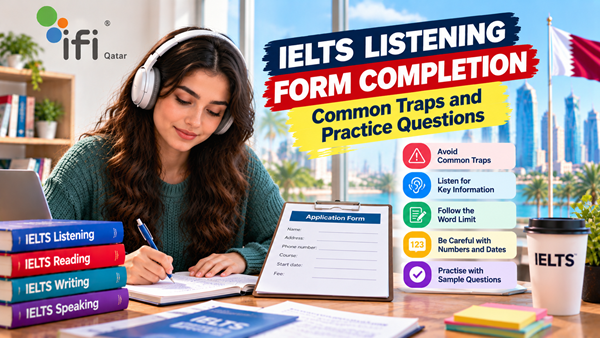
IELTS Listening form completion questions may look straightforward, but small mistakes can cost you valuable marks. You might understand the conversation perfectly and still lose a point because you exceed the word limit, miss a corrected number, or spell a name incorrectly.
The key to answering these questions accurately is to listen for the information requested, anticipate the type of answer you need, and check that your response follows the instructions.
IELTS Listening form completion requires you to identify specific information in a recording and enter it into the correct gaps without exceeding the stated word limit. The missing information may include names, addresses, telephone numbers, dates, prices, or other factual details.
In this guide, you will learn how form completion questions work, discover common traps, and practise with original IELTS-style exercises and answer explanations. You will also learn how to use Listening mock tests to identify recurring mistakes and improve your accuracy before the official exam.
What Is IELTS Listening Form Completion?
IELTS Listening form completion is a question type in which you fill in missing information on a form while listening to a recording.
The form usually represents a practical situation, such as registering for a course, booking accommodation, arranging a delivery, or making an appointment.
For example, you might hear a conversation between a customer and a receptionist. The form could ask you to complete the customer’s name, contact number, preferred appointment time, and reason for visiting.
Your task is to identify the correct information and write it in the corresponding gaps.
What Information Do You Need to Identify?
Form completion questions commonly test your ability to recognise factual details, including:
- Full names and surnames.
- Street addresses and postcodes.
- Telephone numbers.
- Dates and times.
- Prices and fees.
- Course names and appointment details.
- Types of services or requested items.
- Quantities and other numerical information.
The information depends on the recording. You should not assume that every form will contain the same categories.
Where Do Form Completion Questions Appear in IELTS Listening?
Form completion is one of several completion-style tasks used in IELTS Listening. The official IELTS format includes forms, notes, tables, and flow charts, among other question types. Forms are often used to record factual details, such as names.
These questions are commonly associated with everyday conversations, making them especially relevant to situations involving bookings, registrations, and enquiries.
However, you should practise a range of Listening tasks rather than assume a particular question type will always appear in the same position.
How Is Form Completion Different from Note Completion?
Both question types require you to fill gaps using information from a recording, but their layouts and purposes differ.
| Feature | Form Completion | Note Completion |
|---|---|---|
| Main purpose | Record specific information | Summarise important points |
| Common layout | Registration or booking form | Structured notes |
| Typical information | Names, addresses, contact details, dates | Ideas, explanations, facts, and key points |
| Main challenge | Capturing exact details accurately | Understanding and summarising relevant information |
Both tasks require careful listening, accurate spelling, and attention to the instructions.
How to Answer IELTS Listening Form Completion Questions Step by Step
A consistent approach can help you avoid unnecessary mistakes and use your preparation time more effectively.
Step 1: Read the Instructions Carefully
Before listening, check the word limit.
You might see instructions such as:
- NO MORE THAN ONE WORD.
- NO MORE THAN TWO WORDS.
- NO MORE THAN TWO WORDS AND/OR A NUMBER.
- NO MORE THAN THREE WORDS AND/OR A NUMBER.
These instructions determine how many words or numbers you can write for each answer.
For example, if the instruction says NO MORE THAN TWO WORDS AND/OR A NUMBER, an answer containing three words would be incorrect even if it communicates the right information.
Hyphenated words count as one word under IELTS completion-task instructions. You should always follow the exact wording of the task.
Practical tip: Before the recording starts, make a mental note of the maximum number of words allowed. This simple habit can prevent avoidable errors.
Step 2: Identify What Each Gap Requires
Read the form and examine the labels around each blank.
The surrounding information often tells you what type of answer to expect.
| Form label | Likely answer |
|---|---|
| Full name | A person’s name |
| Date of birth | A date |
| Contact number | A telephone number |
| Street address | A street name or address |
| Course selected | A course name |
| Registration fee | An amount of money |
| Appointment date | A date |
| Preferred time | A time |
Predicting the answer type helps you focus your attention during the recording.
For example, if a gap follows the label “Preferred appointment time”, you should listen for a time rather than a person’s name or a price.
Remember that prediction helps you prepare; the recording provides the answer.
Step 3: Underline Keywords
Identify the most important words in the form.
These may include labels such as “address”, “telephone number”, “course”, “date”, and “fee”.
Keywords help you understand what information is required and recognise when the conversation moves towards that topic.
However, the speaker may use different words from those printed in the form. For example, a form might say “course fee”, while the speaker says “the programme costs”.
You should therefore listen for meaning rather than wait for an exact repetition of the printed words.
Step 4: Listen for the Information, Not Just Familiar Words
A common mistake is to write down the first number, name, or date you hear.
The speaker may mention several details before giving the final answer. Some information may be irrelevant, outdated, or corrected later.
For example:
“The evening class originally started at six, but we changed it to half past six this term.”
If the form asks for the current class time, the answer is 6:30.
The first time mentioned is not necessarily the correct answer.
Step 5: Follow the Order of the Questions
In IELTS Listening, questions generally follow the order in which information appears in the recording. This can help you anticipate the next answer and avoid becoming distracted by details you have already heard.
Once you have identified an answer, move your attention to the next gap.
If you miss one detail, do not spend too long trying to recover it while the recording continues. You could miss several subsequent answers.
Make your best reasonable attempt when possible, then continue listening.
Step 6: Check Spelling and Grammar
Correct information can still be marked wrong if it is written incorrectly.
Pay particular attention to:
- Names and surnames.
- Street names.
- Unfamiliar place names.
- Singular and plural forms.
- Commonly confused words.
- Numbers and dates.
The answer must fit the form and follow the instructions. Do not add unnecessary words or repeat information that is already printed outside the gap.
Step 7: Review Your Answers
After completing the form, check each answer against the instructions and the surrounding text.
Ask yourself:
- Does the answer provide the information requested?
- Is the spelling correct?
- Have I exceeded the word limit?
- Is the number or date accurate?
- Did the speaker correct an earlier detail?
- Does the answer fit grammatically in the form?
A brief review can help you catch mistakes that occurred even when you understood the recording.
Common IELTS Listening Form Completion Traps
Knowing the most frequent sources of error can make your practice more effective.
Trap 1: Exceeding the Word Limit
This is one of the easiest mistakes to prevent.
Suppose the form says:
Address: ______
The recording gives the address as “24 Garden Street”.
If the instruction says “NO MORE THAN TWO WORDS AND/OR A NUMBER”, writing “24 Garden Street” would exceed the permitted limit because it contains a number and two words. The response contains three answer elements under the task’s word-count convention.
The appropriate answer would be:
24 Garden
However, if the complete street name is required and the instruction permits only two words and/or a number, you must pay close attention to the precise wording and how the answer fits the task. In a real IELTS question, the expected answer is designed to fit the stated limit.
The safest rule is to follow the instruction and provide only the missing information.
Trap 2: Writing the First Answer You Hear
Speakers sometimes change or clarify information during a conversation.
For example:
“Your appointment is on Thursday—sorry, I mean Friday, the 18th.”
If the form asks for the final appointment date, writing Thursday would be incorrect.
Listen for correction signals such as:
- Sorry, I meant…
- Actually…
- No, that’s not right.
- Let me correct that.
- We’ve changed it to…
- I should say…
These expressions may indicate that the speaker is replacing earlier information.
Trap 3: Confusing Similar Numbers
Numbers can be difficult to distinguish, especially when speakers talk quickly or use unfamiliar accents.
For example, you might confuse:
- Thirteen and thirty.
- Fourteen and forty.
- Fifteen and fifty.
- Sixteen and sixty.
Telephone numbers may be spoken digit by digit, while prices, dates, and quantities may be expressed differently.
To improve your accuracy, practise listening to numbers in different contexts and repeat them aloud after listening.
During the test, use the surrounding information to check whether the number makes sense. However, never replace what you hear with a guess based only on what seems logical.
Trap 4: Missing Spelled-Out Names
A speaker may spell a name or place when the listener needs to record it accurately.
For example:
“The surname is McLean. That’s M-C-L-E-A-N.”
Do not assume that you know how to spell a name simply because it sounds familiar.
When practising, listen carefully to individual letters and pay attention to similar-sounding letter names, particularly when speakers use different accents.
A useful exercise is to listen to short recordings of names and write them down before checking the transcript.
Trap 5: Confusing Dates and Times
Dates and times may be expressed in several ways.
For example:
- The twenty-first of August.
- August twenty-first.
- Half past nine.
- A quarter to eleven.
- Eleven fifteen.
Practise recognising these expressions so you can identify the information quickly.
Also pay attention to corrections. A speaker might mention an original appointment time before explaining that it has changed.
Trap 6: Missing Paraphrased Information
The wording in the form may differ from the wording used by the speaker.
For example:
Form label: Cost of registration
Recording: “You’ll need to pay £45 to enrol.”
The relevant information is the registration cost, even though the speaker does not use the exact phrase printed on the form.
Build your ability to recognise common synonyms and expressions connected with payments, bookings, addresses, and appointments.
Trap 7: Ignoring Singular and Plural Forms
A missing answer may require a singular or plural noun.
For example, the recording might refer to “three workshops”, but you write “workshop”.
This small error can affect your answer.
Listen carefully to the speaker’s wording and check whether the form requires a plural noun. When the answer is a name, address, or other fixed expression, do not change its form unnecessarily.
Trap 8: Losing Your Place in the Form
If you are not sure which gap the speaker is answering, you may enter correct information in the wrong place.
Use the time before listening to review the order of the gaps and predict the type of information needed.
As you listen, keep your attention on the current question and prepare for the next one.
If you miss an answer, move on rather than allowing one difficult detail to affect the rest of the task.
Essential Vocabulary for IELTS Listening Form Completion
Learning vocabulary related to common forms can help you recognise the context more quickly.
| Category | Useful vocabulary |
|---|---|
| Registration | Register, enrol, application, membership |
| Personal information | Full name, surname, date of birth |
| Contact details | Telephone number, email address, postcode |
| Accommodation | Booking, reservation, single room, double room |
| Payments | Fee, deposit, balance, total cost |
| Appointments | Available, reschedule, confirm, cancel |
| Education | Course, programme, tutor, start date |
| Transport and delivery | Collection, destination, departure, delivery |
You do not need to memorise every possible expression before practising. Instead, learn vocabulary in context and notice how speakers communicate the same information in different ways.
IELTS Listening Form Completion Practice Questions
The following original practice exercises are designed to help you apply the strategies in this guide.
Important: These exercises include written scripts rather than audio recordings. For a more realistic experience, ask someone to read each script aloud once at a natural pace, or use text-to-speech without viewing the script while answering. These are IELTS-style learning exercises, not official IELTS questions.
Practice Exercise 1: Course Registration Form
Instructions: Write NO MORE THAN TWO WORDS AND/OR A NUMBER for each answer.
Listen to the conversation and complete the form.
English Language Course Registration
| Information | Answer |
|---|---|
| 1. Student’s first name | __________ |
| 2. Surname | __________ |
| 3. Course name | __________ |
| 4. Start date | __________ |
| 5. Registration fee | __________ |
Practice script
Receptionist: Good morning. How can I help you?
Student: Hello. I’d like to register for an English course.
Receptionist: Certainly. Could I have your first name, please?
Student: My first name is Daniel.
Receptionist: And your surname?
Student: It’s Foster. F-O-S-T-E-R.
Receptionist: Thank you. Which course would you like to take?
Student: I was considering General English, but I’d prefer the Academic English course because I need to prepare for university.
Receptionist: That’s fine. The next Academic English course begins on the 12th of November.
Student: Great. How much is the registration fee?
Receptionist: The registration fee is 75 riyals. The course tuition is separate.
Student: That’s fine. I’d like to register.
Answers and Explanations
1. Daniel
The student clearly states his first name.
2. Foster
The surname is spelled out, helping you confirm the correct letters.
3. Academic English
The student mentions General English first but then selects Academic English. This tests your ability to recognise a change in preference.
4. 12th November
The receptionist gives the course start date. Writing “November 12” would also communicate the same date, provided the answer follows the task’s requirements.
5. 75 riyals
The question asks for the registration fee, not the total tuition cost. The receptionist specifically states the registration fee.
Practice Exercise 2: Hotel Booking Form
Instructions: Write NO MORE THAN TWO WORDS AND/OR A NUMBER for each answer.
Complete the form using the information in the conversation.
Hotel Reservation
| Information | Answer |
|---|---|
| 6. Guest’s surname | __________ |
| 7. Arrival date | __________ |
| 8. Room type | __________ |
| 9. Number of nights | __________ |
| 10. Breakfast | __________ |
Practice script
Receptionist: Good afternoon. City View Hotel. How may I help you?
Guest: Hello. I’d like to make a reservation for next month.
Receptionist: Certainly. May I have your surname?
Guest: It’s Ahmed.
Receptionist: Thank you. When would you like to arrive?
Guest: I originally planned to arrive on the 6th of December, but my flight has changed. I’ll arrive on the 7th instead.
Receptionist: No problem. What type of room would you prefer?
Guest: A double room, please.
Receptionist: And how long will you be staying?
Guest: Four nights.
Receptionist: Would you like breakfast included?
Guest: No, thank you. I’ll have breakfast outside the hotel.
Receptionist: That’s fine. Your reservation will be for a double room from the 7th of December for four nights, without breakfast.
Answers and Explanations
6. Ahmed
The guest clearly states the surname.
7. 7th December
The guest changes the original arrival date from the 6th to the 7th. The final date is the correct answer.
8. Double room
This is the room type selected by the guest.
9. Four nights
The guest explicitly confirms the length of the stay.
10. No
Breakfast is not included because the guest declines the option.
Practice Exercise 3: Telephone and Address Details
Instructions: Write NO MORE THAN TWO WORDS AND/OR A NUMBER for each answer.
Complete the form using the conversation.
Delivery Request Form
| Information | Answer |
|---|---|
| 11. Customer’s name | __________ |
| 12. Street name | __________ |
| 13. House number | __________ |
| 14. Delivery date | __________ |
| 15. Contact number | __________ |
Practice script
Customer: Hello. I’d like to arrange a delivery for next week.
Agent: Of course. Could I have your name?
Customer: My name is Sarah Wilson.
Agent: Thank you. What’s the delivery address?
Customer: It’s 18 Palm Street.
Agent: Sorry, did you say 80 Palm Street?
Customer: No, eighteen. That’s one-eight.
Agent: Understood. And when would you like the delivery?
Customer: I initially asked for Tuesday, but Wednesday would be better.
Agent: Wednesday, then. Could I have a contact number?
Customer: Yes, it’s 555-284-617.
Agent: Let me repeat that: 555-284-617.
Customer: That’s correct.
Answers and Explanations
11. Sarah Wilson
The customer gives her full name.
12. Palm Street
This is the street name in the delivery address.
13. 18
The agent initially mishears the house number as 80, but the customer corrects it to 18.
14. Wednesday
The customer changes the preferred delivery day from Tuesday to Wednesday.
15. 555-284-617
The number is repeated and confirmed at the end of the conversation. In an actual test, follow the answer format and conventions used in the question.
How to Review Your Form Completion Practice Results
Completing exercises is useful, but reviewing your mistakes is what helps you improve.
After checking your answers, identify why you missed each question.
Classify Your Mistakes
Use a simple table to track recurring problems.
| Mistake category | Example | Improvement action |
|---|---|---|
| Word limit | Writing too many words | Check instructions before listening |
| Spelling | Incorrectly writing a surname | Practise spelling names from audio |
| Numbers | Confusing 18 with 80 | Complete focused number-recognition exercises |
| Corrections | Recording the original date | Listen for correction signals |
| Paraphrasing | Not recognising equivalent expressions | Build vocabulary through context |
| Attention | Missing the next answer | Move on promptly after a difficult question |
Do not simply record whether an answer was right or wrong. Identify the reason behind the mistake and choose a practice activity that addresses it.
Repeat the Exercise with a Different Focus
After reviewing the answers, repeat a similar exercise while concentrating on your weakest area.
For example, if you repeatedly miss corrected dates, focus on identifying the final confirmed information in short conversations.
If spelling is your main weakness, practise writing names and places from audio.
If you frequently lose your place, practise following the question sequence while keeping your attention on the next gap.
This targeted approach makes your practice more purposeful.
How IELTS Listening Mock Tests Can Help You Improve
Individual exercises help you practise specific skills, but full Listening mock tests allow you to apply those skills in a broader test environment.
Official IELTS and British Council preparation resources include sample Listening tasks and practice materials that help candidates become familiar with the test format and review their answers.
Practise Different Listening Question Types
Although form completion is the focus of this guide, IELTS Listening also includes other tasks, such as multiple choice, matching, map labelling, note completion, and sentence completion.
Practising different question types helps you prepare for the range of tasks that may appear in the test.
Build Concentration and Timing Skills
In the IELTS Listening test, recordings are played once only. You need to listen carefully, identify the required information, and keep moving through the questions.
A mock test gives you an opportunity to practise these skills in a more complete assessment.
Track Your Performance Over Time
Record your scores across several practice tests and look for patterns.
For example, you may discover that you answer most form completion questions accurately but struggle with map labelling or multiple choice.
This information helps you decide how to allocate your study time.
A mock test should not simply produce another score. Use the results to identify what needs improvement before your next attempt.
Frequently Asked Questions About IELTS Listening Form Completion
What is IELTS Listening form completion?
IELTS Listening form completion is a question type in which you fill gaps in a form using information from a recording. The missing information often includes factual details such as names, addresses, dates, telephone numbers, and prices.
How can I improve my IELTS Listening form completion score?
Read the instructions carefully, predict the type of information required, listen for the relevant details, and check spelling and word limits. Review incorrect answers to identify recurring weaknesses and practise those skills before taking another mock test.
Do I need to write the exact words I hear?
When the task requires you to select words from the recording, you should use the words spoken rather than replace them with your own paraphrase. Always follow the instructions for the specific question.
What is the biggest mistake in form completion questions?
Common mistakes include exceeding the word limit, misspelling names, confusing numbers, and writing information that the speaker later corrects. Careful preparation and targeted practice can help reduce these errors.
Are form completion questions difficult in IELTS Listening?
Difficulty varies by candidate. Some find these questions manageable because the form provides context, while others struggle with spelling, numbers, accents, or corrected information. Practising a range of examples can help you identify your particular challenges.
How should I practise IELTS Listening form completion at home?
Use reliable practice materials, read the instructions, and complete the questions without viewing the transcript. Then check your answers and review the recording or transcript to understand each mistake. Gradually include these exercises in timed Listening mock tests.
Does spelling matter in IELTS Listening?
Yes. Incorrect spelling can make an answer unacceptable even when you have understood the spoken information. Practise spelling names, addresses, and unfamiliar words, and review every answer carefully.
Can IELTS Listening mock tests improve my form completion skills?
Mock tests provide opportunities to practise form completion alongside other question types under test-like conditions. They can help you identify weaknesses in accuracy, concentration, spelling, and time management when used alongside detailed answer review.
Improve Your IELTS Listening Accuracy with IFI Qatar
IELTS Listening form completion questions reward careful attention to detail. To answer them accurately, you need to understand the form, anticipate the information required, recognise corrections, and follow the word limit.
Start by practising short conversations involving registrations, bookings, and appointments. Review your answers carefully and identify whether your mistakes relate to spelling, numbers, paraphrasing, or attention.
Once you are comfortable with individual exercises, practise a broader range of Listening question types under timed conditions. This will help you understand how well you apply your skills when moving between different tasks.
Ready to assess your Listening skills? Explore the IELTS Listening mock-test options available through IFI Qatar to practise different question types, review your performance, and identify the areas that need more attention before your official exam.
Consistent practice combined with careful error analysis can help you prepare more effectively and approach your IELTS Listening test with greater confidence.