

Currently Empty: ر.ق 0,00


IELTS
English Level Test Before Joining a Course: How to Find Your Current Proficiency Level
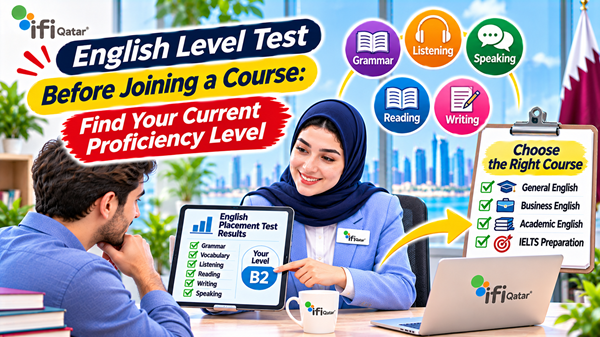
Choosing an English course is an important decision, but how can you be sure that you are selecting the right level?
You might understand English conversations quite well but struggle with writing. Perhaps you have studied grammar for years but still find it difficult to speak confidently. Or you may have completed an English course in the past without knowing whether your current proficiency has changed.
These situations are more common than you might think.
Before enrolling in a language programme, it is useful to understand your actual English abilities rather than relying only on previous course certificates, personal assumptions or the amount of time you have spent studying.
An English level test before joining a course can help identify your current proficiency, highlight areas that need improvement and guide you towards a more suitable learning programme.
However, not all assessments provide the same information. A short online quiz may test grammar and vocabulary, while a more comprehensive placement assessment may also consider listening, speaking, reading and writing.
In this guide, you will learn how English placement tests work, what they should assess, how to interpret your results and what to consider before choosing a course.
1. Why Should You Take an English Level Test Before Joining a Course?
Choosing an English course without understanding your current level can lead to an unsuitable learning experience.
If the course is too basic, you may spend time reviewing material you already understand. If it is too advanced, you may struggle to follow lessons and complete learning activities confidently.
A placement assessment helps reduce this uncertainty.
Avoid Enrolling in a Course That Is Too Easy
Some learners underestimate their abilities because they have not used English regularly.
They may remember basic grammar lessons but have developed stronger reading, listening or communication skills through work, travel or independent practice.
An appropriate assessment can reveal whether they are ready for a more challenging programme.
Avoid Starting at a Level That Is Too Advanced
The opposite situation can also happen.
A learner may feel confident because they understand written English but struggle with spontaneous conversations or accurate sentence construction.
Joining an advanced course without identifying these weaknesses can make lessons unnecessarily difficult.
Identify Your Actual Language Strengths and Weaknesses
Your English proficiency is not necessarily identical across all four skills.
For example:
- You may read English articles comfortably but struggle to understand fast conversations.
- You may speak confidently but make frequent grammar mistakes.
- You may understand lectures but find academic writing difficult.
- You may know many vocabulary items but struggle to use them naturally.
A useful placement assessment should help identify these differences.
Choose a Course That Matches Your Learning Objectives
Your current level is only one factor in selecting a course.
You also need to consider why you want to learn English.
Someone preparing for IELTS may need a different learning pathway from someone who wants to improve workplace communication.
A level assessment, combined with a discussion of your goals, can help you make a more informed decision.
2. What Is an English Placement Test?
An English placement test is an assessment used to estimate a learner’s current language proficiency and identify an appropriate starting point in a course.
Unlike an examination designed primarily to award a certificate or official qualification, a placement test is intended to support an educational decision.
Its main purpose is to help learners and course providers understand what the learner can currently do in English.
What Is the Difference Between a Placement Test and a Proficiency Examination?
These assessments may cover similar language skills, but they serve different purposes.
| Assessment Type | Main Purpose | Typical Outcome |
|---|---|---|
| English placement test | Identify a suitable course level | Course placement recommendation |
| General English proficiency test | Measure overall language ability | Proficiency result or score |
| IELTS examination | Assess English ability for academic or general purposes | Official IELTS band score |
| Course progress assessment | Evaluate development during a programme | Feedback on learning progress |
A placement test does not automatically provide an official IELTS score or an internationally recognised certificate.
Its value lies in helping you understand which learning programme may be appropriate.
Is an Online English Level Test Enough?
Online tests can be useful for an initial indication of your English proficiency.
Many short assessments focus on grammar, vocabulary and reading comprehension. These can help identify certain areas of knowledge.
However, a multiple-choice test cannot fully demonstrate how effectively you communicate in real situations.
For example, selecting the correct answer in a grammar exercise does not necessarily mean you can use that structure accurately while speaking.
For a more complete understanding, it is useful to consider additional skills such as listening, speaking and writing.
3. What Skills Should an English Level Test Assess?
A useful English placement assessment should examine more than your knowledge of grammar rules.
Ideally, it should provide information about the language skills relevant to your learning objectives.
Grammar and Sentence Construction
Grammar assessment helps identify how accurately you understand and use English structures.
Depending on the assessment, questions may examine:
- Verb tenses.
- Subject–verb agreement.
- Articles and prepositions.
- Sentence structure.
- Word order.
- Modal verbs.
- Conditional sentences.
- Relative clauses.
The objective is not simply to count correct answers. It is to understand whether you can apply grammatical knowledge appropriately.
Vocabulary Knowledge
Vocabulary assessment helps determine whether you understand common words, expressions and their meanings in context.
A useful assessment may examine:
- Everyday vocabulary.
- Word meanings.
- Synonyms and related expressions.
- Collocations.
- Word forms.
- Vocabulary in reading passages.
Recognising a word in a multiple-choice question is different from using it naturally in a conversation or written response.
That is why vocabulary knowledge should ideally be considered alongside productive language skills.
Reading Comprehension
Reading assessment helps determine how effectively you understand written English.
It may examine your ability to:
- Identify main ideas.
- Find specific information.
- Understand vocabulary in context.
- Follow paragraph organisation.
- Recognise relationships between ideas.
- Interpret the writer’s meaning.
The difficulty of the reading material should be appropriate to the purpose of the assessment.
Listening Comprehension
Listening assessment examines your ability to understand spoken English.
Depending on the format, you may need to:
- Identify the main topic.
- Recognise important details.
- Follow conversations.
- Understand instructions.
- Identify specific information.
- Interpret the speaker’s intention.
Listening ability is particularly important because understanding written English does not necessarily mean you can follow spoken communication at the same level.
Speaking Ability
Speaking assessment helps determine how effectively you communicate verbally.
A speaking activity may examine:
- Fluency.
- Pronunciation.
- Grammar accuracy.
- Vocabulary use.
- Sentence organisation.
- Ability to explain ideas.
- Responses to follow-up questions.
For example, you may be asked to describe your work, discuss your interests or explain an opinion.
The purpose is to understand how you use English spontaneously, rather than how well you can repeat memorised sentences.
Writing Ability
Writing assessment can reveal language weaknesses that may not appear in a grammar quiz.
It may examine your ability to:
- Construct accurate sentences.
- Organise paragraphs.
- Explain ideas.
- Use appropriate vocabulary.
- Connect information logically.
- Maintain grammatical consistency.
For learners interested in academic or professional English, writing can be particularly important when selecting a course.
4. How to Prepare for an English Placement Test
A placement test is designed to understand your current abilities. You should not try to memorise answers or temporarily create an impression of a higher level than your actual proficiency.
The most useful preparation is to become familiar with the assessment process and make sure you can demonstrate your abilities accurately.
Understand the Assessment Format
Before taking the test, find out what it includes.
Useful questions include:
- Is the assessment online or in person?
- Does it include grammar and vocabulary questions?
- Will there be a listening section?
- Is there a speaking interview?
- Do I need to complete a writing task?
- How long does the assessment take?
Knowing the format can help you feel more comfortable.
Review Your Recent English Experience
Think about how you currently use English.
For example:
- Do you read English articles regularly?
- Can you understand conversations without subtitles?
- Do you use English at work?
- Can you write emails independently?
- Do you feel comfortable explaining opinions?
These observations can help you discuss your strengths and weaknesses during a placement consultation.
Avoid Memorising Answers
Trying to memorise grammar answers or prepared speaking responses may not reflect your real abilities.
It is better to demonstrate what you can understand and communicate naturally.
If you do not know an answer, do not guess your way through the entire assessment. An accurate result is more useful than an artificially high score.
Get Enough Rest Before the Assessment
If you are tired or distracted, you may not perform at your usual level.
Choose a suitable time, find a quiet environment and make sure you have a stable internet connection if the assessment is online.
5. How to Understand Your English Placement Test Results
Receiving a placement result is only the beginning.
The next step is understanding what the result means and how it should influence your course selection.
Look Beyond the Overall Score
An overall score can provide a useful summary, but it may hide differences between individual skills.
Consider this example:
| Skill | Example Assessment Result |
|---|---|
| Grammar | Strong |
| Vocabulary | Good |
| Reading | Strong |
| Listening | Developing |
| Speaking | Needs improvement |
| Writing | Developing |
This learner may understand written English reasonably well but need more opportunities to practise communication and writing.
A single overall result would not explain these differences.
Understand Your Strongest Skills
Identifying your strengths helps you avoid spending too much time repeating material you already understand.
For example, if your reading comprehension is strong, your learning plan may need to place greater emphasis on speaking and listening.
Identify Skills That Need Further Development
Pay particular attention to areas that could prevent you from benefiting fully from your chosen course.
These may include:
- Frequent grammar errors.
- Limited vocabulary.
- Difficulty following spoken English.
- Unclear pronunciation.
- Weak paragraph organisation.
- Hesitation when speaking.
Understanding these issues can help you select a course that addresses your actual needs.
Ask How the Result Influences Course Placement
A useful placement discussion should explain how your assessment results relate to the available programmes.
Ask:
- Which course level is recommended?
- What are my main strengths?
- Which skills need improvement?
- Is additional foundation learning necessary?
- Can I progress to another course later?
- Is the recommended programme suitable for my goals?
A recommendation should consider your overall language profile rather than relying exclusively on one test score.
6. How to Choose the Right English Course After Your Assessment
Once you understand your current proficiency, you can compare courses more effectively.
The next step is matching your assessment results with your learning objectives.
Choose a Course That Addresses Your Weakest Skills
Suppose your assessment shows that you understand written English well but struggle with speaking.
A programme with opportunities for guided speaking practice may be more suitable than one that focuses primarily on grammar exercises.
Similarly, if your writing is weak, look for learning activities that help develop sentence construction, paragraph organisation and written accuracy.
Match the Course to Your Main Goal
Your course should also reflect what you want to achieve.
| Learning Goal | Course Type to Consider |
|---|---|
| Improve overall English proficiency | General English |
| Develop workplace communication | Business English |
| Improve academic reading and writing | Academic English |
| Prepare for IELTS | IELTS Preparation |
| Develop advanced communication skills | Upper-Intermediate or Advanced English |
The assessment identifies your current ability, while your learning objectives help determine which programme is most relevant.
Check the Course Curriculum
Before enrolling, ask what the programme actually covers.
Consider:
- Which skills are included?
- What topics are taught?
- How are lessons structured?
- Are learning materials provided?
- Is feedback available?
- How is progress monitored?
A course title alone does not provide enough information to evaluate its suitability.
Consider Your Preferred Learning Format
Your learning environment can influence your experience.
Some learners prefer face-to-face classes because they value direct interaction. Others prefer online learning because it is easier to fit around work or family responsibilities.
Compare the available options and choose a format that you can attend consistently.
7. What If Your English Skills Are at Different Levels?
It is common for learners to have uneven language skills.
For example, you may understand written English well but struggle to speak spontaneously. Another learner may communicate confidently but make frequent grammar mistakes in writing.
This does not necessarily mean that your placement result is incorrect.
Language skills develop at different rates depending on your previous learning experiences and opportunities to use English.
Strong Reading but Weak Speaking
You may understand articles, emails and written instructions but find conversations difficult.
Possible reasons include:
- Limited speaking practice.
- Difficulty retrieving vocabulary quickly.
- Pronunciation challenges.
- Hesitation when constructing sentences.
- Lack of confidence in spontaneous communication.
A suitable learning programme should provide opportunities to practise speaking and receive feedback.
Strong Speaking but Weak Grammar
Some learners communicate confidently but make frequent grammatical errors.
They may be understood easily but struggle to use more complex structures accurately.
In this situation, additional grammar development and structured writing practice may be helpful.
Strong Grammar but Weak Listening
Knowing grammar rules does not automatically make it easy to understand natural speech.
You may need more exposure to different speakers, speaking speeds and everyday expressions.
Listening practice should be an important part of your learning plan.
Strong Listening but Weak Writing
Understanding spoken English and producing organised written language are different abilities.
If you can follow conversations but struggle to write clear paragraphs, you may need focused writing instruction.
This is another reason to consider individual skill results rather than relying only on an overall level.
8. When Should You Retake an English Level Assessment?
An English placement result reflects your abilities at a particular point in time.
It should not be treated as a permanent description of your language proficiency.
There are several situations in which another assessment may be useful.
After Completing an English Course
Once you finish a programme, an assessment can help evaluate whether your skills have developed sufficiently for the next learning stage.
After a Long Break from Studying
If you have not used English regularly for several months or years, your current abilities may differ from your previous course level.
An updated assessment can help identify where to restart.
Before Moving to a More Advanced Course
If you want to progress to another level, an assessment can help determine whether you are ready for more demanding learning materials.
When Your Learning Goals Change
You may initially study English for everyday communication and later decide to prepare for IELTS or develop professional English skills.
A new assessment can help identify which abilities you need to strengthen for your new objective.
9. Common Mistakes to Avoid When Taking an English Placement Test
A placement assessment is most useful when it provides an accurate picture of your abilities.
Avoid these common mistakes.
Choosing a Course Based Only on Your Previous Certificate
A certificate from a previous course may not reflect your current proficiency.
Your English ability may have improved through regular use, or certain skills may have become weaker after a long break.
Use current assessment information when selecting a programme.
Assuming Your Speaking Level Is the Same as Your Reading Level
Reading and speaking involve different language abilities.
Do not assume that strong reading comprehension automatically means you are ready for an advanced speaking programme.
Consider each skill separately.
Choosing a Higher Level to Progress Faster
Enrolling in a more advanced course does not necessarily lead to faster progress.
If the material is too difficult, you may spend more time trying to understand basic concepts rather than developing new skills.
Choose a programme that provides an appropriate level of challenge.
Relying Only on Free Online Quizzes
Short online quizzes can be useful for initial self-assessment, but they may not evaluate all four language skills.
Use them as a starting point rather than treating their results as a complete placement recommendation.
Ignoring Your Learning Objectives
Your placement level and your learning goal should be considered together.
A learner preparing for IELTS may need a different course from someone at a similar level who wants to improve professional communication.
10. English Placement Assessment at IFI Qatar: Finding the Right Course Starting Point
If you are considering joining an English course in Doha, understanding your current level can help you make a more informed decision.
IFI Qatar offers English language learning opportunities from A1 to C1, with face-to-face and online options.
Rather than choosing a course based only on your previous experience or personal estimate, consider discussing your current abilities and learning objectives before selecting a programme.
What Should You Discuss Before Choosing a Course?
When enquiring about an English programme, prepare to explain:
- Your previous English learning experience.
- How frequently you currently use English.
- Which skills you find most difficult.
- Whether you need English for work, study or everyday communication.
- Whether you are planning to take IELTS.
- Your preferred learning format.
- Your available study schedule.
These details can help the course team understand what type of learning pathway may be appropriate.
Choosing Between General English and Specialised Courses
The assessment result should be considered alongside your intended learning outcome.
For example:
- If you need to strengthen your overall language ability, General English may be appropriate.
- If you need English for university study, Academic English may be relevant.
- If you want to improve workplace communication, Business English may be worth considering.
- If you are preparing for an examination, IELTS preparation may be the more relevant option.
The objective is to select a programme that addresses both your current proficiency and your future goals.
Face-to-Face and Online Learning Options
IFI Qatar provides face-to-face and online English learning options.
When making an enquiry, explain which format you prefer and ask about the available course arrangements.
This can help you identify a suitable option that fits your schedule and learning preferences.
Not sure which English course matches your current level?
Contact IFI Qatar to enquire about course placement guidance. Discuss your English skills, learning objectives and preferred study format before deciding which programme to join.
Frequently Asked Questions About English Level Tests Before Joining a Course
Should I take an English level test before joining a course?
Yes. An English placement assessment can help identify your current proficiency and reduce the risk of joining a course that is too easy or too advanced. It can also highlight individual skills that need further development.
What is an English placement test?
An English placement test is an assessment used to estimate a learner’s language proficiency and recommend an appropriate starting point in a course. Depending on its format, it may assess grammar, vocabulary, reading, listening, speaking and writing.
Are free online English level tests accurate?
Free online tests can provide an initial indication of your English ability, particularly in grammar and vocabulary. However, short quizzes may not assess speaking and writing effectively. A more comprehensive assessment can provide a clearer picture of your skills.
How long does an English placement test take?
The duration depends on the assessment format. A short online quiz may take only a few minutes, while a comprehensive assessment involving multiple skills or a speaking interview may take longer.
Can I choose my own English course level?
You can express your preferred learning level, but it is advisable to consider assessment results and course requirements before making a final decision. Choosing a suitable level can help you get more value from your lessons.
What happens if my English skills are at different levels?
This is common among language learners. Your reading, listening, speaking and writing abilities may develop at different rates. A useful assessment should identify these differences and help determine which skills need additional attention.
Is an English placement test the same as IELTS?
No. An English placement test helps identify an appropriate course level, while IELTS is a standardised English language examination. A placement test does not automatically provide an IELTS band score or an official IELTS qualification.
Can I take an English course without a placement test?
Course enrolment requirements vary between providers. Some may offer direct enrolment, while others may recommend or require an assessment to help determine the appropriate starting level.
Should I take a placement test again after completing a course?
An updated assessment can be useful after completing a course, particularly if you want to move to a more advanced programme or evaluate your development. It can help identify whether your skills have improved and what you should focus on next.
Does IFI Qatar offer English courses for different proficiency levels?
IFI Qatar offers English learning opportunities across levels A1 to C1, with face-to-face and online options. Prospective learners can enquire about available programmes and discuss which learning pathway may suit their current proficiency and objectives.
Find the Right English Course Starting Point with IFI Qatar
Choosing an English course should begin with understanding your current abilities, not simply selecting a level that sounds appropriate.
An English placement assessment can help identify your strengths, reveal areas that need improvement and guide you towards a programme that matches your learning objectives.
Whether you want to improve general communication, develop academic or professional English, or prepare for IELTS, knowing your starting point can make your learning pathway more focused.
IFI Qatar offers English language learning opportunities from A1 to C1, with face-to-face and online options.
Before enrolling, take the opportunity to discuss your current proficiency, learning priorities and preferred course format.
Ready to find out which English course is right for you?
Contact IFI Qatar to enquire about placement guidance and available English programmes. Share your learning objectives and discuss a suitable starting point before making your enrolment decision.