

Currently Empty: ر.ق 0,00


IELTS
What English Skills Should You Build Before Starting IELTS Preparation?
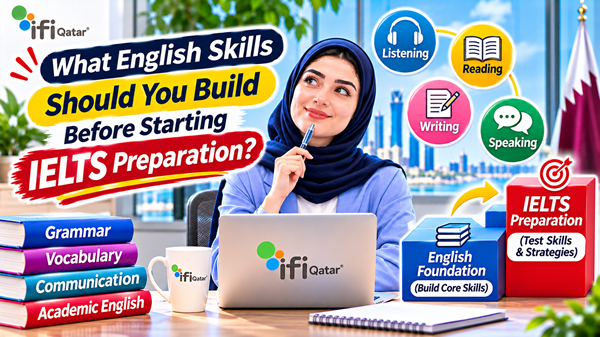
Planning to take the IELTS test is an important step if you want to study abroad, pursue international career opportunities or meet an English language requirement. You may already know that IELTS preparation involves practising Listening, Reading, Writing and Speaking, learning examination strategies and becoming familiar with the test format.
However, there is an important question to consider before starting: Is your general English strong enough to benefit from IELTS preparation?
Some learners begin practising IELTS questions before developing the grammar, vocabulary and communication skills needed to understand them properly. They may spend hours completing practice tests but struggle to understand reading passages, follow listening recordings or express ideas clearly in writing and speaking.
The solution is to build a strong English foundation before focusing heavily on examination techniques.
Developing the right English skills before IELTS preparation can help you understand the test materials more effectively, make better use of practice sessions and identify the areas that need the most attention.
In this guide, you will learn which English skills matter most before starting IELTS preparation, how to assess your current level and when it may be time to move from general English learning to a specialised IELTS course.
1. Why Do You Need an English Foundation Before IELTS Preparation?
IELTS is an English language proficiency test. It assesses your ability to understand and use English in different contexts, rather than simply testing whether you know examination strategies.
Understanding the test format is useful, but it cannot replace the language skills needed to complete the tasks successfully.
For example, knowing how to approach an IELTS Reading question will not help much if you struggle to understand the passage itself.
Similarly, memorising an essay structure does not guarantee that you can develop a clear argument using accurate grammar and appropriate vocabulary.
The Difference Between English Foundation and IELTS Preparation
Although these two learning stages are connected, they have different purposes.
| English Foundation | IELTS Preparation |
|---|---|
| Develops general language proficiency | Develops skills for the IELTS examination |
| Builds grammar knowledge | Applies grammar accurately in IELTS tasks |
| Expands everyday and academic vocabulary | Develops vocabulary relevant to test topics |
| Improves general listening comprehension | Practises IELTS listening question types |
| Develops reading comprehension | Builds IELTS reading strategies and timing |
| Strengthens general speaking ability | Practises IELTS Speaking Parts 1, 2 and 3 |
| Develops writing fundamentals | Applies writing skills to IELTS Academic or General Training tasks |
You do not necessarily need to complete a separate foundation course before beginning IELTS preparation. The appropriate starting point depends on your current English level and the skills you already have.
However, if your basic language skills are weak, strengthening them first may make IELTS preparation more productive.
Why Starting IELTS Practice Too Early Can Be Difficult
Learners who begin with full IELTS practice tests before developing their English foundation may experience several challenges:
- They struggle to understand unfamiliar vocabulary.
- They make repeated grammar mistakes.
- They cannot follow longer listening recordings.
- They find it difficult to understand complex reading passages.
- They give short or underdeveloped speaking answers.
- They struggle to organise ideas in writing.
- They spend too much time translating instead of processing English directly.
These difficulties do not mean that IELTS is beyond your ability. They may simply indicate that you need more general English development before concentrating on examination techniques.
2. Understand Your Current English Level Before Starting IELTS
The first step towards effective IELTS preparation is understanding your current proficiency.
A learner at A2 needs a different learning pathway from someone who is already at B2. Choosing the right starting point can help you avoid unnecessary frustration and make better use of your study time.
The CEFR English Levels
The Common European Framework of Reference for Languages (CEFR) describes language proficiency through six levels.
| Level | Description | General Language Ability |
|---|---|---|
| A1 | Beginner | Understands and uses basic everyday expressions |
| A2 | Elementary | Communicates in simple and familiar situations |
| B1 | Intermediate | Handles many everyday situations and discusses familiar topics |
| B2 | Upper Intermediate | Communicates independently and understands more complex material |
| C1 | Advanced | Uses English flexibly and effectively in demanding situations |
| C2 | Proficient | Demonstrates a very high level of language control and understanding |
CEFR levels are not direct equivalents of IELTS band scores. They describe language proficiency using a different framework, so you should not assume that a particular CEFR level guarantees a specific IELTS result.
Which English Level Is Suitable for Starting IELTS Preparation?
There is no universal minimum CEFR level required to begin learning about IELTS.
However, your current proficiency can influence how much time you should spend developing general English before focusing on test-specific practice.
If you are at A1–A2:
Prioritise basic English development.
Focus on:
- Everyday vocabulary.
- Basic grammar.
- Simple sentence construction.
- Common expressions.
- Basic listening comprehension.
- Short conversations.
- Reading simple texts.
If you are at B1:
You may be ready to begin understanding the IELTS format while continuing to strengthen your English foundation.
Focus on:
- Expanding vocabulary.
- Improving grammar accuracy.
- Understanding longer listening materials.
- Reading more complex texts.
- Developing extended speaking responses.
- Writing organised paragraphs.
If you are at B2:
You may be ready for more focused IELTS preparation, depending on your individual strengths and weaknesses.
Focus on:
- Understanding complex texts.
- Developing precise vocabulary.
- Improving speaking fluency.
- Writing well-developed arguments.
- Practising IELTS question types.
- Managing examination time.
If you are at C1:
You may already have a strong language foundation. Your preparation can focus more heavily on the test format, assessment criteria, task requirements and performance improvement.
The best approach is to assess your actual skills rather than choosing a course based only on your estimated level.
3. Build a Strong English Grammar Foundation
Grammar is one of the most important skills to develop before starting serious IELTS preparation.
You do not need to master every advanced grammatical structure before taking the test. However, you should understand common structures and use them accurately in both spoken and written English.
Learn Essential Verb Tenses
Begin by developing a reliable understanding of common English tenses.
These include:
- Present simple.
- Present continuous.
- Past simple.
- Past continuous.
- Present perfect.
- Past perfect.
- Future forms.
You should understand not only how these structures are formed but also when they are appropriate.
For example:
Present Simple:
“Many students use online resources to improve their English.”
Present Perfect:
“Technology has changed the way people access educational materials.”
Past Simple:
“The government introduced the new policy last year.”
Using verb tenses appropriately is important when describing experiences, discussing trends and explaining events.
Develop Sentence Construction Skills
IELTS Speaking and Writing require you to communicate ideas clearly.
You should be comfortable creating:
- Simple sentences.
- Compound sentences.
- Complex sentences.
- Sentences with relative clauses.
- Conditional sentences.
- Sentences using appropriate linking expressions.
Compare these examples:
Simple:
“Online learning is convenient. It saves time.”
More developed:
“Online learning is convenient because it allows students to access educational resources without travelling to a classroom.”
The second sentence communicates the relationship between the ideas more clearly.
However, complex sentences should not be used simply to make your English appear advanced. Accuracy and clarity are more important than unnecessary complexity.
Understand Articles, Prepositions and Subject–Verb Agreement
Some grammar mistakes are particularly common among English learners.
Pay attention to:
- A, an and the.
- Prepositions of time and place.
- Subject–verb agreement.
- Countable and uncountable nouns.
- Singular and plural forms.
- Pronouns and reference.
- Word order.
For example:
Incorrect: “People has different opinions.”
Correct: “People have different opinions.”
Incorrect: “I am interested to study abroad.”
Correct: “I am interested in studying abroad.”
Developing accuracy in these areas can improve the clarity of your writing and speaking.
4. Develop a Wider English Vocabulary
Vocabulary is essential for all four IELTS skills.
You need to recognise words when listening and reading, and use appropriate vocabulary when speaking and writing.
However, vocabulary development should involve more than memorising long lists of words.
Focus on High-Utility Everyday Vocabulary
Before studying specialised IELTS vocabulary, make sure you are comfortable with common words and expressions used in everyday communication.
You should be able to discuss:
- Work and employment.
- Education.
- Family and relationships.
- Health and lifestyle.
- Travel and transport.
- Technology.
- Food and daily activities.
- Environment.
- Hobbies and interests.
These topics also provide useful foundations for discussing broader IELTS subjects.
Learn Academic Vocabulary Gradually
If you plan to take IELTS Academic, developing familiarity with academic vocabulary can be particularly useful.
Start with expressions that appear across different academic subjects.
| Word or Expression | Meaning |
|---|---|
| Significant | Important or considerable |
| Evidence | Information supporting an idea or claim |
| Approach | A method or way of dealing with something |
| Impact | An effect or influence |
| Consequence | A result of an action or event |
| Indicate | Show or suggest something |
| Contribute to | Help cause or achieve something |
| Advantage | A positive feature or benefit |
| Limitation | A restriction or disadvantage |
| Factor | An element that influences a situation |
Do not learn these words only through definitions. Write example sentences and practise using them in different contexts.
Learn Collocations and Natural Expressions
A collocation is a combination of words that commonly appear together.
For example:
- Make a decision.
- Take responsibility.
- Reach a conclusion.
- Conduct research.
- Raise awareness.
- Address an issue.
- Play a significant role.
- Have an impact.
Learning collocations can make your English sound more natural and help you avoid awkward word combinations.
Build Vocabulary Through Reading and Listening
Instead of studying vocabulary in isolation, collect new expressions from articles, podcasts and conversations.
For each new expression:
- Write down the word or phrase.
- Identify its meaning in context.
- Record a natural example.
- Learn common word combinations.
- Use it in your own sentence.
- Review it regularly.
This approach helps you develop vocabulary that you can actually use.
5. Improve Your Listening Comprehension Before IELTS
IELTS Listening requires you to understand spoken information, identify details and follow the development of conversations or presentations.
Before practising full examination recordings, develop your general ability to understand spoken English.
Practise Understanding the Main Idea
Begin with short audio recordings about familiar subjects.
Listen and ask yourself:
- What is the conversation about?
- Who is speaking?
- What is the main purpose?
- What information is being discussed?
- What conclusion can you identify?
You do not need to understand every word to understand the overall message.
Learn to Recognise Different English Accents
IELTS Listening recordings can feature a range of English accents.
Regular exposure to different speakers can help you become more comfortable with variations in pronunciation, rhythm and intonation.
Try listening to:
- Interviews.
- Educational podcasts.
- News reports.
- University lectures.
- Everyday conversations.
Do not focus on imitating every accent. Your priority should be understanding spoken English accurately.
Practise Listening for Specific Information
In addition to understanding the main idea, practise identifying details such as:
- Names.
- Dates.
- Numbers.
- Places.
- Prices.
- Reasons.
- Instructions.
- Changes in information.
These skills are useful in everyday communication and relevant to IELTS Listening tasks.
Use Active Listening Techniques
A simple listening routine can help you improve.
Step 1: Listen to a short recording without reading a transcript.
Step 2: Write down the main ideas.
Step 3: Listen again and identify details you missed.
Step 4: Check the transcript if one is available.
Step 5: Note useful expressions and pronunciation patterns.
Step 6: Summarise the recording in your own words.
This process develops comprehension and helps you notice how spoken English works.
6. Strengthen Your English Reading Comprehension
IELTS Reading involves understanding written information, identifying key ideas and interpreting relationships between different parts of a text.
Before concentrating on test-specific question types, build the ability to read English accurately and efficiently.
Read Different Types of English Texts
Use a variety of materials, including:
- News articles.
- Educational articles.
- Opinion pieces.
- Short reports.
- Essays.
- Informational websites.
- Academic texts appropriate to your level.
Gradually introduce longer and more complex materials as your reading ability improves.
Learn to Identify Main Ideas
A strong reader does not focus equally on every sentence.
Practise identifying:
- The main argument.
- The topic of each paragraph.
- Supporting details.
- Examples.
- The writer’s opinion.
- Conclusions.
For example, after reading an article about remote working, try to explain its main argument in two or three sentences.
Expand Your Reading Vocabulary
Reading is one of the most useful ways to develop vocabulary in context.
When you encounter an unfamiliar word:
- Read the surrounding sentence.
- Try to understand its meaning from context.
- Check the dictionary if necessary.
- Record the word and an example.
- Review it later.
Avoid stopping to translate every unfamiliar word. Try to understand the overall meaning first.
Practise Reading Without Translating Every Sentence
If you constantly translate English into your first language, reading may become slow and mentally demanding.
Gradually practise understanding sentences and paragraphs directly in English.
Start with materials that are slightly challenging but still manageable.
7. Develop Speaking Confidence and Fluency
Speaking is often one of the most challenging skills for learners preparing for IELTS.
You may understand English reasonably well but struggle to respond quickly, organise your thoughts or explain opinions.
Building general speaking confidence before starting intensive IELTS practice can make a difference.
Practise Speaking About Familiar Topics
Begin with subjects you already know.
For example:
- Your hometown.
- Your daily routine.
- Your education.
- Your job.
- Your hobbies.
- Your family.
- Your future plans.
- Your favourite activities.
Try speaking for one or two minutes about each topic.
Focus on explaining your ideas clearly rather than memorising complete answers.
Learn to Give Extended Answers
A common speaking problem is giving answers that are too short.
For example:
Question: Do you enjoy reading?
Short answer: Yes, I do.
More developed answer: Yes, I do, particularly when I have some free time. I enjoy reading non-fiction because it allows me to learn about different subjects and understand new perspectives.
The second answer provides more information and creates opportunities for natural follow-up questions.
Practise Expressing Opinions
You should be comfortable explaining what you think and supporting your opinions.
Useful expressions include:
- In my opinion…
- From my perspective…
- I would argue that…
- One reason for this is…
- I tend to believe that…
- Another important consideration is…
- For example…
- On the other hand…
Practise using these expressions in complete responses rather than memorising them without context.
Improve Pronunciation and Clarity
You do not need to imitate a native English accent to communicate effectively.
Focus on:
- Clear pronunciation.
- Word stress.
- Sentence stress.
- Intonation.
- Individual sounds that cause difficulty.
- Speaking at a manageable pace.
Recording your voice and listening to it can help you notice pronunciation problems and repeated hesitation.
8. Build Essential Writing Skills Before IELTS
Writing is another area where a strong English foundation is important.
Before attempting full IELTS Writing tasks, develop your ability to write clear sentences, organise paragraphs and explain ideas logically.
Learn to Write Accurate Sentences
Start by checking whether you can write grammatically correct sentences using a variety of structures.
For example:
“Education plays an important role in society.”
“Although online learning offers flexibility, some students prefer traditional classrooms because they value direct interaction.”
Both sentences communicate clear ideas, but the second demonstrates a more complex relationship between arguments.
Develop Paragraph Structure
A well-developed paragraph usually contains:
- A clear main idea.
- An explanation.
- Supporting information or an example.
- A logical connection to the wider discussion.
For example:
“Public transport can reduce traffic congestion in large cities. When more people use buses and trains instead of private cars, fewer vehicles are needed on the roads. This can help reduce delays during busy commuting hours.”
Practise developing paragraphs on familiar subjects before moving to longer essays.
Learn Basic Linking Expressions
Linking expressions help readers understand how your ideas are connected.
Examples include:
| Function | Useful Expressions |
|---|---|
| Adding information | Furthermore, In addition, Moreover |
| Showing contrast | However, Nevertheless, On the other hand |
| Giving examples | For example, For instance |
| Explaining reasons | Because, Since, Due to |
| Showing results | Therefore, Consequently, As a result |
| Concluding | In conclusion, Overall, To summarise |
Use these expressions naturally. Adding too many linking words can make writing repetitive or unnatural.
Practise Summarising Information
Summarising is useful for developing both reading comprehension and writing.
Read a short article and write a summary using your own words.
Focus on:
- Identifying the main points.
- Removing unnecessary details.
- Maintaining the original meaning.
- Using accurate grammar.
- Organising information logically.
This activity can help prepare you for the language demands of academic writing.
9. How to Know When You Are Ready to Start IELTS Preparation
You do not need perfect English before beginning an IELTS course.
However, you should have enough foundation to understand instructions, follow learning materials and practise the language skills required by the test.
The following checklist can help you evaluate your readiness.
English Foundation Readiness Checklist
-
I can understand the main ideas of everyday English conversations.
-
I can follow short recordings on familiar subjects.
-
I can read general English articles and identify their main points.
-
I understand common English verb tenses.
-
I can construct grammatically correct sentences.
-
I can use everyday vocabulary without relying constantly on translation.
-
I can speak about familiar topics for one or two minutes.
-
I can explain simple opinions and give examples.
-
I can write clear and organised paragraphs.
-
I can identify some of my recurring grammar and vocabulary mistakes.
This checklist is a practical self-assessment tool, not an official IELTS readiness test.
If you find several areas particularly difficult, consider strengthening your general English first.
If most of these skills are already comfortable, you may be ready to begin more focused IELTS preparation while continuing to improve your weaker areas.
10. A Practical 6-Week English Foundation Plan Before IELTS
If you want to improve your English before starting intensive IELTS preparation, the following six-week plan provides a useful starting framework.
It is not a guaranteed route to a particular English level. Your starting proficiency, study time and learning needs will influence how much progress you make.
Weeks 1–2: Strengthen Grammar and Everyday Vocabulary
Main objective: Improve the accuracy of your basic English.
Focus on:
- Common verb tenses.
- Sentence construction.
- Articles and prepositions.
- Subject–verb agreement.
- Everyday vocabulary.
- Common expressions and collocations.
Suggested activities:
- Complete short grammar exercises.
- Write five sentences using new vocabulary.
- Review common grammar mistakes.
- Read short everyday English texts.
- Describe your daily routine in English.
Weeks 3–4: Develop Listening and Reading
Main objective: Improve your ability to understand longer English materials.
Focus on:
- Listening to short conversations.
- Understanding main ideas.
- Recognising important details.
- Reading articles.
- Identifying paragraph topics.
- Learning vocabulary through context.
Suggested activities:
- Listen to a podcast for 10–15 minutes.
- Summarise an audio recording.
- Read one short article.
- Identify unfamiliar expressions.
- Write a short summary of what you read.
Weeks 5–6: Improve Speaking and Writing
Main objective: Become more confident expressing and organising ideas.
Focus on:
- Speaking about familiar topics.
- Giving extended answers.
- Expressing opinions.
- Writing organised paragraphs.
- Using linking expressions.
- Reviewing grammar and vocabulary.
Suggested activities:
- Record a two-minute speaking response.
- Practise answering follow-up questions.
- Write one paragraph about a familiar topic.
- Review and correct your mistakes.
- Summarise an article orally.
What Should You Do After Six Weeks?
Review your progress across all four skills.
If your general English has become more comfortable and you can handle the activities in the readiness checklist, consider moving towards structured IELTS preparation.
If some foundation skills remain difficult, continue developing them while introducing suitable IELTS familiarisation activities.
The transition does not need to happen all at once.
11. English Foundation Course vs IELTS Preparation Course: Which One Do You Need?
Understanding the difference between these programmes can help you choose the right learning pathway.
When an English Foundation Course Is More Suitable
Consider an English foundation programme if you:
- Have difficulty understanding everyday English.
- Make frequent basic grammar mistakes.
- Have limited vocabulary.
- Struggle to construct complete sentences.
- Find listening recordings difficult to follow.
- Cannot express simple ideas confidently.
- Need to develop your overall language proficiency.
The purpose is to strengthen your English so that you can progress towards more demanding learning activities.
When an IELTS Preparation Course Is More Suitable
You may be ready for IELTS preparation if you:
- Understand everyday English reasonably well.
- Can follow conversations on familiar and some unfamiliar topics.
- Have a working knowledge of English grammar.
- Can read general texts with reasonable comprehension.
- Can express opinions in spoken English.
- Can write organised paragraphs.
- Need to understand IELTS question types and assessment requirements.
An IELTS preparation programme can then help you develop examination-specific skills, strategies and familiarity with the test format.
Can You Combine English Foundation and IELTS Preparation?
Yes. Some learners benefit from developing general English and learning about IELTS at the same time.
For example, you might:
- Study grammar and vocabulary as part of your foundation learning.
- Practise IELTS listening questions at an appropriate difficulty.
- Read general articles before attempting more demanding IELTS passages.
- Develop speaking confidence before practising all three IELTS Speaking parts.
- Improve paragraph writing before completing full IELTS essays.
The right balance depends on your current proficiency.
12. How IFI Qatar Can Support Your English Learning Before IELTS
Preparing for IELTS starts with understanding your current English ability and identifying the skills you need to develop.
At IFI Qatar, English language learning opportunities are available across levels A1 to C1, with face-to-face and online options.
For learners who need to strengthen their general English, building a foundation in grammar, vocabulary, listening, speaking, reading and writing can be an important first step.
Once your language foundation is more developed, a specialised IELTS preparation programme can help you become familiar with the examination format, practise the four test skills and work on areas that require further improvement.
Choosing the Right Starting Point
Before selecting a programme, consider:
- Your current English level.
- Your strengths and weaknesses across the four skills.
- Your IELTS objectives.
- Your available study time.
- Whether you need foundation learning or test-specific preparation.
You do not need to choose an advanced IELTS programme simply because you plan to take the examination.
Starting at the right level can help you build confidence and use your learning time more effectively.
Planning to take IELTS but unsure whether your English foundation is strong enough?
Contact IFI Qatar to enquire about English foundation and IELTS preparation courses. Discuss your current level, learning goals and available options to identify a suitable starting point.
Frequently Asked Questions About English Skills Before IELTS Preparation
What English level should I have before starting IELTS preparation?
There is no universal minimum English level required to begin learning about IELTS. However, learners with a stronger foundation in grammar, vocabulary and the four language skills may find test-specific preparation easier to follow. Your starting point should depend on your current abilities.
Should I improve my general English before taking IELTS?
If you struggle with basic grammar, everyday vocabulary, listening comprehension or sentence construction, strengthening your general English first can be beneficial. Learners with a stronger foundation may be ready to begin focused IELTS preparation.
What grammar should I learn before IELTS preparation?
Start with common verb tenses, sentence structure, articles, prepositions, subject–verb agreement, clauses and basic conditionals. As your proficiency improves, develop more complex structures and practise using them accurately.
How much vocabulary do I need before starting IELTS?
There is no fixed number of words you must learn before beginning IELTS preparation. Focus on understanding common vocabulary, everyday expressions, collocations and words used in familiar academic and general topics. The ability to use vocabulary accurately is more important than memorising a particular number of words.
Should I practise IELTS questions before improving my English?
You can familiarise yourself with the IELTS format at any stage. However, if you struggle to understand the questions or language in the practice materials, prioritise your general English foundation while gradually introducing appropriate test familiarisation.
Can beginners start IELTS preparation?
Beginners can learn about the IELTS examination, but they will generally need to develop their basic English first. Building vocabulary, grammar, sentence construction and everyday communication skills can provide a stronger foundation for later preparation.
Is B1 English enough to start IELTS preparation?
A learner at B1 may be able to begin introductory IELTS activities while continuing to develop general English. The appropriate balance depends on individual skills, especially listening comprehension, reading ability, grammar accuracy and speaking confidence.
What is the difference between an English foundation course and an IELTS course?
An English foundation course develops general language proficiency across grammar, vocabulary, listening, speaking, reading and writing. An IELTS course focuses on examination requirements, question types, assessment criteria and test-specific practice.
How long should I study English before starting IELTS preparation?
There is no fixed preparation period. It depends on your current level, learning goals, study frequency and the skills you need to improve. An assessment can help identify whether you need additional foundation learning.
Can I study general English and IELTS preparation at the same time?
Yes. Learners with a suitable foundation may combine general English development with IELTS practice. This allows them to improve their language ability while becoming familiar with the examination format.
Build Your English Foundation Before Your IELTS Journey
IELTS preparation is more effective when you understand the language skills required to complete the examination tasks.
A strong foundation in grammar, vocabulary, listening, reading, speaking and writing can help you understand test materials, express your ideas more clearly and make better use of examination practice.
If you are not yet comfortable with these skills, there is no reason to rush into intensive IELTS preparation. Developing your general English first can be a valuable step towards your longer-term goal.
IFI Qatar offers English learning opportunities from A1 to C1, alongside IELTS preparation options, with face-to-face and online learning formats.
Whether you need to strengthen your English foundation or begin focused IELTS preparation, choosing the right starting point is essential.
Take the first step towards your IELTS goal.
Contact IFI Qatar to enquire about English foundation and IELTS preparation courses and discuss which learning option may suit your current level and objectives.