

Currently Empty: ر.ق 0,00


IELTS
How to Summarise an Academic Text in English Without Copying It
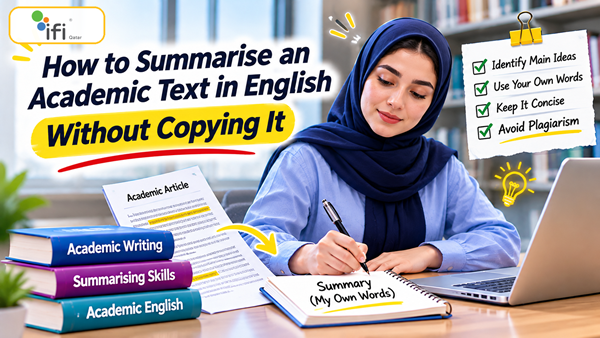
Summarising an academic text is an essential skill for university students, researchers and anyone studying in an English-speaking academic environment. Whether you are reading a journal article, a textbook chapter or a research paper, you may need to explain its main ideas in a shorter form while preserving the original meaning.
However, writing an effective academic summary is not always easy. You might understand the text but struggle to express its ideas in your own words. You may also be unsure which details to include, how much information to remove or how to avoid copying the author’s sentences.
The key is to understand the original text before attempting to rewrite it. A good summary identifies the central message, selects the most relevant supporting points and presents them clearly and concisely using your own language.
In this guide, you will learn how to summarise an academic text step by step, understand the difference between summarising and paraphrasing, explore practical examples and discover how to avoid plagiarism in academic writing.
What Is an Academic Summary?
An academic summary is a shorter version of an original academic text that presents its central ideas and most important supporting information.
It does not reproduce every detail, example or explanation. Instead, it focuses on the information readers need to understand the author’s main message.
For example, if you read a 2,000-word research article, your assignment might ask you to produce a summary of approximately 200–300 words. Your task is to identify the most important information and communicate it accurately without changing the author’s meaning.
What Should an Academic Summary Include?
Depending on the type and purpose of the text, an effective academic summary may include:
- The main topic or research question.
- The author’s central argument or position.
- The most important findings or supporting ideas.
- Relevant explanations or conclusions.
- Essential information about the research, if applicable.
A summary should not normally include your personal opinions, unrelated background information or minor details that do not contribute to the original text’s main message.
Why Is Summarising Important in Academic Writing?
Summarising is more than a technique for reducing the length of a text. It demonstrates that you can understand, evaluate and communicate academic information.
University students regularly use summaries when preparing assignments, writing literature reviews, researching topics and studying for examinations.
1. It Demonstrates Reading Comprehension
Before you can summarise a text effectively, you need to understand its purpose, argument and key points.
This encourages you to read actively rather than simply recognise individual words and sentences.
2. It Improves Academic Writing Skills
Summarising requires you to organise information, select appropriate vocabulary and construct clear sentences.
These abilities are also important when writing essays, reports, research papers and literature reviews.
3. It Helps You Avoid Unnecessary Repetition
Academic assignments often require students to use information from several sources. Summarising allows you to communicate relevant ideas without reproducing lengthy passages from the original material.
4. It Develops Critical Thinking
You need to distinguish between central arguments and supporting details.
This process helps you recognise which information is essential and which details can be excluded without losing the overall meaning.
5. It Supports Academic Integrity
Learning to express ideas independently helps you avoid inappropriate copying. It also teaches you when and how to acknowledge the original source.
Remember that using your own words does not automatically remove the need for a citation. If the ideas or findings come from another author, you generally need to acknowledge that source according to your institution’s referencing requirements.
Summarising vs Paraphrasing: What Is the Difference?
Summarising and paraphrasing are closely related academic writing skills, but they serve different purposes.
Summarising focuses on presenting the main ideas of a larger text in a shorter form. Paraphrasing restates a particular idea or passage using different wording and sentence structures, usually while retaining a similar level of detail.
| Feature | Summarising | Paraphrasing |
|---|---|---|
| Main purpose | Present the central ideas | Restate specific information |
| Length | Usually shorter than the original | Often similar to the original passage |
| Level of detail | Focuses on essential information | Preserves more of the original detail |
| Main focus | Overall meaning and key arguments | Meaning of a specific passage |
| Common use | Research summaries, literature reviews and study notes | Explaining evidence, concepts and individual arguments |
Example of Summarising
Original text:
“Regular physical activity can improve cardiovascular health, strengthen muscles and support mental well-being. Research has also associated consistent exercise with better sleep quality and a reduced risk of several chronic conditions.”
Summary:
“Regular exercise supports physical and mental health and may reduce the risk of certain health conditions.”
The summary combines the central ideas and removes individual supporting details.
Example of Paraphrasing
Original text:
“Regular physical activity can improve cardiovascular health, strengthen muscles and support mental well-being.”
Paraphrase:
“Taking part in exercise regularly can benefit the heart, develop muscular strength and contribute to better psychological health.”
The paraphrase retains more of the original information but expresses it differently.
Both techniques require accurate representation of the original meaning and appropriate source acknowledgement.
How to Summarise an Academic Text: 8 Practical Steps
The most reliable way to write an academic summary is to follow a structured process. Instead of rewriting sentences as soon as you read them, work through the following steps.
Step 1: Read the Entire Text First
Before writing anything, read the complete text to understand its overall purpose.
Do not stop to rewrite every unfamiliar sentence. Your first objective is to understand:
- What is the text about?
- What question or problem does it address?
- What is the author’s main argument?
- What conclusion does the author reach?
If the text is particularly long, you can begin by reading the title, introduction, headings and conclusion. However, you should still examine the relevant sections carefully before deciding what to include in your summary.
Practical tip: After reading, try to explain the text’s main message in one simple sentence. If you cannot do this, you may need to read it again.
Step 2: Identify the Main Idea
Every academic text has a central purpose or argument. Identifying it is one of the most important parts of summarising.
Look for sentences that explain:
- The main research question.
- The author’s central argument.
- The purpose of the discussion.
- The key finding or conclusion.
The main idea is not necessarily located in the first paragraph. In research articles, for example, you may need to examine the abstract, introduction, results and conclusion to understand the overall message.
Example:
If an article discusses the effects of online education, its central idea might be:
“Online education increases flexibility and access to learning, but its effectiveness depends on student engagement and the quality of instruction.”
This sentence captures the overall argument without including every supporting detail.
Step 3: Highlight Key Information
After identifying the main idea, read the text again and highlight the information that supports it.
Focus on:
- Important arguments.
- Main findings.
- Essential explanations.
- Significant comparisons.
- Relevant conclusions.
Avoid highlighting entire paragraphs. If almost every sentence is marked, it becomes difficult to distinguish essential information from supporting details.
A useful approach is to assign a purpose to each highlighted section.
For example:
| Information Type | What to Look For |
|---|---|
| Main argument | The author’s central position |
| Supporting point | An explanation that develops the argument |
| Evidence | Research findings, statistics or examples |
| Contrast | An alternative perspective or limitation |
| Conclusion | The final message or implication |
Step 4: Separate Main Ideas from Supporting Details
Not every piece of information deserves a place in your summary.
Academic texts often contain examples, statistics, background explanations and additional references. These details may be useful for understanding the original text, but they are not always necessary in a short summary.
Consider the following example:
Original information:
“Online learning allows students to access educational materials from different locations. For example, learners can attend virtual lectures from home, use digital libraries and participate in online discussion forums. These opportunities can make education more accessible to people who cannot regularly travel to a university campus.”
Main idea:
“Online learning can improve access to education by reducing geographical barriers.”
The individual examples support the main idea, but they do not all need to appear in a concise summary.
Step 5: Organise the Information in a Logical Order
Before writing, arrange the important points so your summary follows a clear structure.
A useful structure is:
- Introduce the topic or central argument.
- Present the most important supporting ideas.
- Explain the main findings or conclusion.
For example, if you are summarising a research article about online education, you might organise your notes as follows:
- Topic: Online education and student learning.
- Main argument: Online learning improves flexibility and access.
- Supporting point: Students can study from different locations.
- Limitation: Engagement and interaction may be challenging.
- Conclusion: Effective online learning requires appropriate teaching methods and student support.
This outline gives you a clear foundation for writing.
Step 6: Write the Summary Without Looking at the Original Text
Once you understand the text and have organised your notes, put the original document aside.
Try to explain its main ideas using your own words.
This technique helps prevent you from copying the author’s sentence structure or simply replacing a few words with synonyms.
For example:
Original sentence:
“Access to digital educational resources has expanded opportunities for independent learning among university students.”
Your summary:
“Digital learning materials have made it easier for university students to study independently.”
The second sentence communicates the same central idea using a different structure.
If you cannot explain an idea without looking at the original, return to the text, make sure you understand it and try again.
Step 7: Use Clear and Concise Academic Language
An academic summary should be professional, accurate and easy to understand.
Avoid unnecessary expressions, repeated information and overly complicated vocabulary.
Useful reporting verbs include:
| Reporting Verb | Common Function |
|---|---|
| Argues | Presents a position or argument |
| Explains | Makes an idea clear |
| Suggests | Presents a possible interpretation |
| Demonstrates | Shows something through evidence |
| Identifies | Points out an issue or factor |
| Highlights | Draws attention to an important point |
| Concludes | Presents a final judgement |
| Emphasises | Gives particular importance to an idea |
| Examines | Studies a subject or issue |
| Finds | Reports a research result |
For example:
- The author argues that…
- The study examines…
- The findings suggest that…
- The article highlights…
- The research identifies…
Choose reporting verbs carefully. For instance, do not use “proves” when a study only suggests an association or provides limited evidence.
Step 8: Compare Your Summary with the Original Text
After writing your first draft, review it carefully.
Ask yourself:
- Does my summary represent the author’s main argument accurately?
- Have I included the most important supporting ideas?
- Have I removed unnecessary examples and repetition?
- Have I used my own sentence structures?
- Have I avoided adding personal opinions?
- Have I acknowledged the original source where required?
- Is the summary clear and grammatically correct?
A summary should be shorter than the original, but it should not be so short that essential meaning is lost.
Practical Example: How to Summarise an Academic Text
The best way to understand summarising is to see how the process works with a complete example.
Imagine you are asked to summarise a short academic passage about technology in education.
Original Academic Text
“Technology has transformed the educational environment by providing students with greater access to information and learning resources. Digital platforms allow learners to study independently, communicate with instructors and collaborate with classmates regardless of geographical location. However, the effectiveness of technology-based education depends on several factors, including students’ digital literacy, access to reliable internet connections and the quality of online teaching methods. Without appropriate guidance and support, some learners may experience difficulties maintaining motivation and managing their study schedules.”
Step 1: Identify the Main Idea
The passage explains how technology affects education, including its benefits and limitations.
Step 2: Identify the Key Points
- Technology improves access to educational resources.
- Digital platforms support independent learning and communication.
- Online education depends on digital skills and reliable internet access.
- Some students may struggle with motivation and time management.
Step 3: Remove Less Important Details
You do not need to repeat every example or explain each factor in detail. Focus on the overall argument and the most important supporting points.
Step 4: Write the Summary in Your Own Words
Effective Academic Summary:
“Technology has expanded access to education by supporting independent learning and online communication. However, successful digital learning depends on students’ technical abilities, reliable internet access and effective teaching methods. Inadequate support may also create challenges related to motivation and time management.”
Why Is This a Good Summary?
This version is effective because it:
- Communicates the central argument.
- Includes the main benefits and limitations.
- Uses different sentence structures.
- Removes unnecessary examples.
- Preserves the original meaning.
- Avoids copying complete sentences.
The purpose is not to make every word different. It is to demonstrate that you understand the original text and can communicate its ideas independently.
How to Avoid Plagiarism When Summarising Academic Texts
Plagiarism occurs when someone presents another person’s words, ideas or work as their own without appropriate acknowledgement.
It is a serious academic integrity issue, particularly in university assignments and research writing.
Using your own words is important, but it is not the only requirement. You must also understand when a source needs to be cited.
1. Avoid Copying Complete Sentences
Do not copy a sentence from the original text and make only minor vocabulary changes.
For example:
Original:
“Social media platforms have significantly influenced communication patterns among young adults.”
Weak attempt:
“Social media websites have greatly affected communication habits among young adults.”
Although some words have changed, the sentence structure and much of the original wording remain very similar.
Better summary:
“Digital social networks have changed how younger generations communicate.”
2. Understand the Idea Before Rewriting It
Read the passage carefully, identify its meaning and then explain it without looking at the original sentence.
This helps you avoid producing a sentence that follows the source too closely.
3. Do Not Replace Words with Synonyms Only
Changing individual words does not necessarily produce an effective paraphrase or summary.
For example, replacing “important” with “significant” or “increase” with “rise” may leave the original structure unchanged.
Instead, reconsider how the information can be expressed as a complete idea.
4. Keep the Original Meaning Accurate
Avoid changing the author’s position, exaggerating findings or removing important limitations.
If a study reports that a particular factor is associated with an outcome, do not rewrite it as proof that the factor directly causes that outcome.
Accuracy is more important than making your summary sound sophisticated.
5. Cite the Original Source
When you use another author’s ideas, findings or arguments, acknowledge the source according to the required referencing style.
Common academic referencing systems include:
- APA
- MLA
- Harvard
- Chicago
The correct format depends on your university, department or assignment instructions.
A summary can be written entirely in your own words and still require a citation because the underlying ideas belong to the original author.
Useful English Expressions for Academic Summaries
Academic summaries often use reporting verbs and introductory expressions to communicate the original author’s ideas clearly.
Learning these expressions can make your writing more natural and organised.
| Expression | Example |
|---|---|
| The article discusses… | The article discusses the impact of digital technology on education. |
| The author argues that… | The author argues that access to education should be improved. |
| The study examines… | The study examines the relationship between exercise and mental health. |
| The research highlights… | The research highlights the importance of student engagement. |
| The findings suggest that… | The findings suggest that regular practice improves performance. |
| The article identifies… | The article identifies several challenges affecting online learning. |
| The author concludes that… | The author concludes that further research is needed. |
| Overall, the text suggests that… | Overall, the text suggests that technology can support independent learning. |
| The main focus of the text is… | The main focus of the text is the development of academic communication skills. |
| According to the author,… | According to the author, effective planning improves academic performance. |
Use these expressions naturally. Repeating the same introductory phrase in every sentence can make your writing sound mechanical.
Common Mistakes Students Make When Summarising Academic Texts
Even students with strong English skills can make mistakes when preparing academic summaries.
Understanding these problems can help you improve your writing.
| Common Mistake | Why It Is a Problem | How to Improve |
|---|---|---|
| Copying sentences directly | May lead to plagiarism | Express ideas using your own sentence structures |
| Changing only a few words | Does not demonstrate independent writing | Understand and reconstruct the idea |
| Including too many examples | Makes the summary unnecessarily long | Focus on central arguments |
| Adding personal opinions | Changes the purpose of the summary | Report the author’s ideas objectively |
| Removing essential information | Can distort the original meaning | Preserve the central argument and key findings |
| Using complicated vocabulary unnecessarily | Reduces clarity | Choose accurate and natural academic language |
| Ignoring citations | Fails to acknowledge the source | Follow the required referencing style |
| Writing without a clear structure | Makes ideas difficult to follow | Organise the summary logically |
One of the most important principles is to prioritise accuracy and clarity over complicated vocabulary.
A concise summary that communicates the author’s ideas correctly is more effective than a sophisticated-looking paragraph that changes the original meaning.
A Practical Checklist Before Submitting Your Academic Summary
Use this checklist to review your work before submitting an assignment.
-
I understand the original text and its main argument.
-
I have identified the most important supporting ideas.
-
I have removed unnecessary examples and repeated details.
-
I have written the summary using my own sentence structures.
-
I have preserved the author’s original meaning.
-
I have avoided adding personal opinions.
-
I have used clear and appropriate academic vocabulary.
-
I have checked grammar, spelling and punctuation.
-
I have included citations where required.
-
My summary meets the assignment’s word limit.
How to Improve Your Academic Summarising Skills
Becoming a confident academic writer takes regular practice. You should develop your reading comprehension, vocabulary, grammar and ability to organise information.
Here is a practical seven-day plan to help you improve.
| Day | Practice Activity | Main Skill |
|---|---|---|
| Day 1 | Read a short academic article and identify its central argument | Reading comprehension |
| Day 2 | Highlight the main ideas and supporting details | Information selection |
| Day 3 | Rewrite five sentences using different structures | Paraphrasing |
| Day 4 | Write a 100-word summary of a short passage | Concise writing |
| Day 5 | Practise using academic reporting verbs | Academic vocabulary |
| Day 6 | Review your summary and compare it with the original | Accuracy and editing |
| Day 7 | Summarise a new academic text independently | Integrated writing skills |
Practice Exercise: Summarise This Academic Passage
Read the following passage and try to summarise it in approximately 40–50 words.
Practice Text:
“Public libraries continue to play an important role in modern communities despite the increasing availability of digital information. They provide access to books, educational resources and public learning spaces. Many libraries also offer digital services, language programmes and activities that support lifelong learning. However, maintaining these services requires adequate funding, updated facilities and trained staff.”
Your task:
- Identify the main idea.
- Select three important supporting points.
- Remove unnecessary details.
- Write a short summary in your own words.
- Compare your summary with the original passage to check accuracy.
Example Answer:
“Public libraries remain valuable community resources by providing educational materials, learning spaces and digital services. They also support lifelong learning through various programmes, although maintaining these services requires sufficient funding, modern facilities and qualified staff.”
Notice how the example includes the central argument, important supporting information and the main limitation without reproducing the original passage.
How Academic English and Writing Courses Can Help You
Writing a strong academic summary requires several connected skills. You need to understand complex texts, recognise important arguments, use appropriate vocabulary and express information accurately.
If you struggle with any of these areas, structured English language learning can help you develop the skills required for academic communication.
Academic English and writing-focused learning can help you improve:
Academic Reading: Understanding arguments, identifying key information and interpreting complex texts.
Academic Vocabulary: Using appropriate formal expressions and reporting verbs.
Grammar and Sentence Structure: Writing accurate, varied and well-organised sentences.
Paraphrasing and Summarising: Expressing academic information independently without changing its meaning.
Academic Writing Organisation: Developing clear paragraphs, logical arguments and coherent written work.
Editing and Proofreading: Identifying grammar, vocabulary and structural problems before submitting assignments.
These abilities are useful not only for summarising texts but also for writing university essays, research reports and other academic assignments.
Frequently Asked Questions
How do you summarise an academic text in English?
Read the complete text, identify its main argument, highlight important supporting ideas and remove unnecessary details. Then write a shorter version using your own words and sentence structures. Finally, compare your summary with the original to check accuracy and acknowledge the source where required.
How long should an academic summary be?
The appropriate length depends on the assignment instructions and the length of the original text. Some summaries may be only a few sentences, while others may require several paragraphs. Always follow the specified word limit and include the most important information.
What is the difference between a summary and a paraphrase?
A summary presents the central ideas of a larger text in a shorter form. A paraphrase restates a specific passage using different wording and sentence structures, usually while retaining more of the original detail.
How can I summarise without copying?
Make sure you understand the original idea before writing. Put the source aside and explain the information using your own sentence structures. Avoid simply replacing individual words with synonyms, and check your draft against the original to ensure that the meaning remains accurate.
Does an academic summary need a citation?
Yes, when the summary uses ideas, arguments or findings from another author’s work, you generally need to cite the original source. The required format depends on your institution’s referencing guidelines.
Can I include my own opinion in an academic summary?
A standard academic summary should represent the original author’s ideas objectively. Personal opinions, criticism and evaluation should normally be presented separately unless the assignment specifically asks you to provide a critical summary.
What are the most useful reporting verbs for academic summaries?
Common reporting verbs include argues, explains, suggests, demonstrates, identifies, highlights, examines and concludes. Select verbs that accurately represent the author’s purpose and the strength of the evidence.
How can I improve my academic summarising skills?
Read academic texts regularly, practise identifying main ideas, develop your academic vocabulary and write short summaries. Reviewing your work and comparing it with the original can help you improve accuracy, clarity and independent writing.
Can an Academic English course help me write better summaries?
Yes. Academic English learning can help you develop reading comprehension, grammar, vocabulary, paraphrasing and writing organisation. These skills are directly relevant to producing accurate and well-structured academic summaries.
Develop Your Academic Writing Skills with IFI Qatar
The ability to summarise academic texts accurately is an important part of successful university study. It helps you work with research materials, prepare assignments and communicate complex information clearly.
However, effective summarising depends on more than knowing a few writing techniques. You need to understand academic texts, recognise their central arguments and express information using accurate and appropriate English.
At IFI Qatar, learners can strengthen their English language abilities through structured English language learning and preparation. Developing stronger reading, grammar, vocabulary and writing skills can help you become more confident when handling academic tasks.
Ready to improve your academic writing and communicate more effectively in English?
Explore English language learning opportunities at IFI Qatar and take the next step towards stronger academic communication skills.