

Currently Empty: ر.ق 0,00


IELTS
IELTS Listening Plan, Map and Diagram Labelling: Key Differences
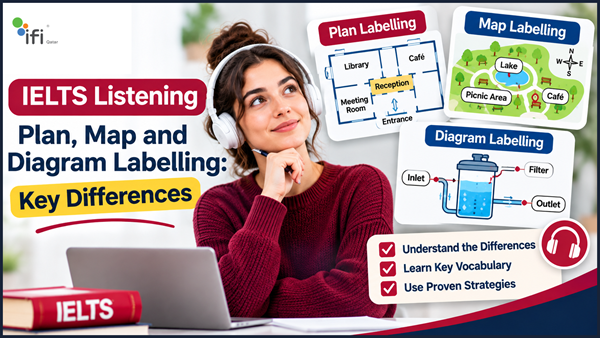
IELTS Listening plan, map and diagram labelling questions can be challenging because they require you to do more than understand individual words. You must follow spoken instructions, recognise directions, understand spatial relationships and connect the information you hear with a visual representation.
For example, you might hear a guide explaining the layout of a museum, a speaker describing facilities in a town park or a lecturer explaining the parts of a piece of equipment. While listening, you need to identify the correct locations or components and match them with the labels on the question paper.
Although these tasks look different, they belong to the same IELTS Listening question type: Plan/Map/Diagram Labelling.
Understanding the differences between the visuals is important because each one requires a slightly different approach. A building plan focuses on the arrangement of rooms and facilities, a map often involves geographical locations and directions, while a diagram may show the parts of an object or how a system is organised.
In this guide, you will learn how these questions work, how to distinguish between the three formats, which vocabulary to recognise and how to avoid common mistakes. You will also find practical examples and a practice exercise to help improve your IELTS Listening performance.
What Is IELTS Listening Plan, Map and Diagram Labelling?
Plan, map and diagram labelling is an IELTS Listening question type in which candidates complete a visual by identifying locations, objects or components mentioned in an audio recording.
You may be asked to:
- Identify rooms or facilities on a building plan.
- Locate specific places on a map.
- Match parts of a machine or object with the correct labels.
- Follow spoken directions to identify a particular position.
- Understand how different components are arranged or connected.
The task usually provides a visual with numbered gaps or labelled positions. You may also receive a list of possible answers, often represented by letters such as A, B, C and D.
You must listen carefully and select the correct option for each question.
What Skills Does This Question Type Test?
IELTS Listening labelling questions assess several connected skills:
Understanding spatial relationships: You need to recognise where something is located in relation to another object or place.
Following directions: You must understand instructions such as turn left, walk straight ahead, pass the entrance or continue towards the rear of the building.
Visual interpretation: You need to understand the layout or structure shown in the question.
Recognising paraphrasing: The recording may describe a location using different expressions from those printed on the visual.
Maintaining concentration: Missing one direction can make it difficult to follow the rest of the description.
The official IELTS format includes plan, map and diagram labelling as one question type. The number of questions can vary depending on the test.
What Is the Difference Between IELTS Plan, Map and Diagram Labelling?
Although all three formats test your ability to connect spoken information with a visual, the information presented in each task is different.
| Feature | Plan Labelling | Map Labelling | Diagram Labelling |
|---|---|---|---|
| Main visual | Building or site layout | Geographical or outdoor area | Object, equipment or system |
| Main focus | Rooms and facilities | Places and directions | Parts and components |
| Common context | Museums, schools, offices | Parks, towns, campuses | Machines, equipment, processes |
| Important skills | Understanding layout and relative positions | Following routes and geographical directions | Understanding descriptions and component relationships |
| Common vocabulary | Entrance, corridor, reception | North, opposite, crossroads | Connected to, attached to, upper section |
Let’s examine each format in more detail.
1. IELTS Listening Plan Labelling
Plan labelling questions usually present the layout of a building, indoor space or organised site.
You might see a floor plan of a library, a university building, a shopping centre, a museum or a conference facility.
The speaker may describe where different rooms and facilities are located, and you must identify the correct positions.
What Does a Plan Labelling Question Look Like?
Imagine that you receive a simple plan of a community centre.
The visual includes:
- Main entrance
- Reception
- Meeting rooms
- Café
- Computer room
- Sports hall
- Toilets
During the recording, a staff member explains where these facilities are located.
You might hear:
“The reception desk is immediately inside the main entrance. If you continue along the corridor, you will find the café on your right. The computer room is opposite the meeting rooms, near the back of the building.”
You must use the description to identify the correct locations.
Important Vocabulary for Plan Labelling
The following expressions are particularly useful:
| Vocabulary | Meaning |
|---|---|
| Entrance | The point where people enter |
| Exit | The point where people leave |
| Reception | The area where visitors are welcomed |
| Corridor | A passage connecting rooms |
| At the end of the corridor | At the furthest point along a corridor |
| Opposite | On the other side, facing something |
| Next to | Immediately beside something |
| Adjacent to | Directly beside or close to something |
| Behind | At the back of something |
| In front of | Before or ahead of something |
| On the left-hand side | Located to the left |
| On the right-hand side | Located to the right |
| In the corner | At the point where two sides meet |
| On the upper floor | On a floor above the current one |
How to Answer Plan Labelling Questions
Step 1: Identify the starting point.
Look for the main entrance, reception desk or another clearly marked location.
This helps you understand where the speaker begins the description.
Step 2: Understand the layout.
Check how the rooms and corridors are arranged. Identify which areas are next to each other and which are separated by walls or passages.
Step 3: Predict the direction vocabulary.
Before listening, remind yourself of expressions such as opposite, beside, behind, at the end of and on the right.
Step 4: Follow the description carefully.
Do not look at the visual randomly. Follow the speaker’s explanation from the starting point and connect each direction to the relevant location.
Step 5: Confirm the final position.
Sometimes the speaker mentions a location and then corrects or clarifies it. Listen until the description is complete before selecting your answer.
2. IELTS Listening Map Labelling
Map labelling questions usually involve a geographical area or an outdoor location.
You may be given a map of:
- A town or village.
- A public park.
- A university campus.
- A tourist attraction.
- A festival site.
- A residential area.
- A transport facility.
Unlike building plans, maps often require you to follow a route or understand directions across a wider area.
What Does a Map Labelling Question Look Like?
Imagine that a tour guide is describing a public park.
The map shows several locations:
- Main gate
- Visitor centre
- Lake
- Playground
- Picnic area
- Car park
- Café
The speaker might say:
“After entering through the main gate, walk towards the lake. The visitor centre is located just beyond the bridge, while the playground is to the north of the picnic area.”
You must follow the route and identify the correct positions.
Important Vocabulary for Map Labelling
Map questions often include direction and movement expressions.
| Vocabulary | Meaning |
|---|---|
| North | The upper direction on a standard north-facing map |
| South | The opposite direction to north |
| East | The direction to the right on a standard north-facing map |
| West | The direction to the left on a standard north-facing map |
| North-east | Between north and east |
| North-west | Between north and west |
| South-east | Between south and east |
| South-west | Between south and west |
| Turn left | Change direction towards the left |
| Turn right | Change direction towards the right |
| Go straight ahead | Continue without turning |
| Cross the road | Move from one side of the road to the other |
| Pass | Continue beyond a particular place |
| Follow the path | Continue along a marked route |
| At the junction | At the point where routes meet |
| At the crossroads | At the intersection of two roads |
| Alongside | Next to or beside something |
How to Answer Map Labelling Questions
Step 1: Find the starting point.
Look for a main entrance, road, station or another marked reference point.
If an arrow indicates the starting direction, pay attention to it.
Step 2: Check the compass.
If the map includes a compass, identify north, south, east and west before the recording starts.
Do not assume that the top of every map represents north unless the visual confirms it.
Step 3: Trace the route.
Use your finger or pencil to follow the directions as you listen.
For example:
Entrance → Bridge → Lake → Visitor Centre.
This can help you maintain your position throughout the recording.
Step 4: Listen for changes in direction.
Expressions such as turn left, continue past, opposite the entrance and just beyond the bridge can indicate important changes in location.
Step 5: Watch out for alternative locations.
The recording may mention several places before identifying the correct one.
Do not select an answer simply because you hear a familiar location name.
3. IELTS Listening Diagram Labelling
Diagram labelling questions generally involve a visual representation of an object, piece of equipment, structure or system.
Unlike map and plan questions, these tasks do not necessarily involve following a route through a physical space.
Instead, you need to understand how different components are positioned or connected.
What Does a Diagram Labelling Question Look Like?
Imagine that you are given a diagram of a water filtration system.
The visual contains:
- Water inlet
- Filter
- Storage tank
- Pump
- Outlet pipe
The speaker explains how water moves through the system and describes the function and position of different components.
You might hear:
“Water first enters the system through the inlet pipe. It then passes through the filter, which is positioned above the storage tank. Finally, the pump transfers the filtered water towards the outlet.”
You need to match the descriptions with the correct components.
Important Vocabulary for Diagram Labelling
Diagram questions often use words that describe parts, connections and physical positions.
| Vocabulary | Meaning |
|---|---|
| Component | An individual part of a larger system |
| Section | A particular part or area |
| Attached to | Connected or fixed to something |
| Connected to | Joined to another part |
| Located above | Positioned at a higher level |
| Beneath | Directly below |
| Surrounding | Positioned around something |
| Central | Located in the middle |
| Outer layer | The external part of an object |
| Inner section | The internal part of an object |
| Upper section | The top part |
| Lower section | The bottom part |
| At the base | At the bottom of something |
| Extends through | Continues from one area to another |
| Passes into | Moves inside something |
How to Answer Diagram Labelling Questions
Step 1: Identify the object or system.
Read the title and understand what the diagram represents.
Is it a machine, a natural structure, a scientific process or a piece of equipment?
Step 2: Examine the labelled parts.
Look at the arrows, numbers and possible answer options.
Notice which components are close together and which are separated.
Step 3: Predict the type of information.
The recording may describe the position, function or connection of a particular component.
For example, a missing label may refer to a part located beneath a container rather than a direction of movement.
Step 4: Listen for component relationships.
Pay attention to expressions such as connected to, positioned above, attached to and passes through.
These expressions help you understand the structure.
Step 5: Match the description with the visual.
Do not choose a component based only on its name. Make sure its position and relationship with the other parts match the recording.
Plan vs Map vs Diagram: Which Skills Should You Practise?
Although the three formats belong to the same IELTS Listening question type, candidates may find different aspects challenging.
| Skill | Plan | Map | Diagram |
|---|---|---|---|
| Following directions | High importance | High importance | Sometimes relevant |
| Understanding spatial relationships | Essential | Essential | Essential |
| Recognising compass directions | Sometimes | Often | Rarely |
| Understanding room layouts | Often | Rarely | No |
| Identifying components | Sometimes | Sometimes | Essential |
| Understanding movement or routes | Sometimes | Often | Depends on the diagram |
| Recognising technical vocabulary | Sometimes | Sometimes | Often |
The best way to prepare is to practise all three visual formats rather than focusing exclusively on maps.
The Most Important Direction Words for IELTS Listening Labelling Questions
Direction vocabulary is one of the most important areas to study before attempting plan and map labelling questions.
However, knowing the definitions is not enough. You must recognise these expressions quickly when they are spoken.
Position and Location Expressions
These expressions explain where something is located:
- Next to
- Opposite
- Behind
- In front of
- Between
- Beside
- Near
- Far from
- Above
- Below
- At the end of
- In the middle of
Movement and Route Expressions
These expressions describe how someone moves through an area:
- Go straight ahead
- Turn left
- Turn right
- Walk past
- Continue along
- Cross the bridge
- Follow the path
- Go through the entrance
- Take the first turning
- Head towards
Expressions That Can Change the Meaning
Some phrases are particularly important because they can change the final position.
For example:
Just beyond: Something is located a short distance after a particular point.
Immediately before: Something is located directly before another location.
On the opposite side: Something is located across from a reference point.
Further along: Something is located at a greater distance along a route.
Slightly to the left: Something is positioned left of a reference point, but not necessarily directly beside it.
At the far end: Something is located at the most distant end of an area or passage.
These expressions can help you distinguish between two locations that appear close together on a map or plan.
How to Prepare Before the IELTS Listening Recording Starts
The short preparation time before the recording begins is extremely valuable.
Use it to understand the visual and predict what you may hear.
1. Read the Instructions
Check whether you need to:
- Select letters from a list.
- Write words or phrases.
- Complete numbered locations.
- Choose answers from a set of options.
Follow the exact instructions and pay attention to any word limit.
2. Study the Title
The title often explains what the visual represents.
For example:
- Ground Floor of a Library
- Map of Greenfield Park
- Parts of a Water Pump
This information helps you predict the vocabulary and context of the recording.
3. Identify Important Reference Points
Look for obvious locations or components.
On a map, these might include a main road, entrance or bridge.
On a plan, they might include reception, a corridor or a staircase.
On a diagram, they might include a central component, a pipe or a container.
4. Check the Answer Options
If the task provides a list of possible labels, read them before listening.
Try to understand what each option represents.
This will help you recognise the correct label more quickly when you hear its description.
5. Predict Possible Distractors
Think about locations or components that could easily be confused.
For example, two rooms may be located on opposite sides of the same corridor, or two components may appear close together in a diagram.
Being aware of these possibilities helps you listen more carefully.
Common IELTS Listening Plan, Map and Diagram Labelling Mistakes
Many candidates lose marks because they select an answer too quickly or fail to follow the complete description.
Here are some common mistakes and how to avoid them.
1. Choosing the First Location You Hear
The speaker may mention an incorrect location before correcting the information.
For example:
“The information desk was originally planned for the entrance, but it has now been moved beside the main staircase.”
The correct location is beside the main staircase, not the entrance.
How to avoid it: Listen for correction expressions such as but, however, instead, actually and has been moved.
2. Confusing Left and Right
Candidates sometimes lose their position while following a route, especially when the speaker describes several turns.
How to avoid it: Identify the starting point and trace the route visually as the recording continues.
3. Ignoring the Starting Point
Without a clear starting reference, it is easy to misunderstand the entire route.
How to avoid it: Before listening, identify the entrance, starting arrow or first reference point.
4. Assuming North Is Always at the Top
Some maps may use a different orientation.
How to avoid it: Check the compass if one is provided. Never assume the map’s orientation without evidence.
5. Focusing Only on Individual Words
Hearing the word café or entrance does not automatically mean you have found the correct answer.
The surrounding information explains the actual position.
How to avoid it: Listen to the complete description, including the direction and relationship with nearby locations.
6. Confusing Similar Components
In diagram questions, two components may have similar names or functions.
How to avoid it: Study the visual carefully and pay attention to the exact relationship described in the recording.
7. Losing Concentration After Missing One Answer
If you miss a location, you may become distracted and miss the next one.
How to avoid it: Move on immediately. Focus on the next question instead of trying to recover information that has already been spoken.
8. Not Reviewing Incorrect Answers
Completing practice questions without analysing mistakes can slow your progress.
How to avoid it: Identify whether each error resulted from vocabulary, direction, visual interpretation, concentration or misunderstanding a correction.
IELTS Listening Plan, Map and Diagram Labelling Practice Exercise
The following original exercise combines plan, map and diagram labelling skills.
It is designed to help you practise identifying positions, understanding directions and recognising component relationships.
Practice 1: Plan Labelling
Situation: A guide is explaining the layout of a training centre.
Possible answers:
A. Reception
B. Computer Room
C. Library
D. Meeting Room
E. Café
F. Lecture Hall
Questions 1–3
Match each location with the correct letter.
- The room directly opposite the reception.
- The area located at the end of the main corridor.
- The room beside the café.
Listening Script:
Guide: When you enter the training centre, the reception desk is immediately in front of you. The computer room is directly opposite the reception area. If you walk down the main corridor, you will find the lecture hall at the end. The library is located next to the café.
Answers:
- B — Computer Room
- F — Lecture Hall
- C — Library
Explanation:
- Question 1 uses the expression directly opposite.
- Question 2 uses at the end of the main corridor.
- Question 3 uses next to.
The key is to connect the location expressions with the correct visual positions.
Practice 2: Map Labelling
Situation: A guide is describing facilities in a public park.
Possible answers:
A. Playground
B. Car Park
C. Café
D. Visitor Centre
E. Picnic Area
F. Sports Ground
Questions 4–6
Match each location with the correct letter.
- The facility located just beyond the main entrance.
- The area opposite the lake.
- The facility positioned to the north of the picnic area.
Listening Script:
Guide: Visitors entering through the main entrance will find the car park just beyond the entrance, on the right-hand side. The café is opposite the lake, while the sports ground is located to the north of the picnic area.
Answers:
- B — Car Park
- C — Café
- F — Sports Ground
Explanation:
- Question 4 tests the expression just beyond.
- Question 5 tests the meaning of opposite.
- Question 6 tests compass directions.
Remember that north must be interpreted using the compass shown on the map.
Practice 3: Diagram Labelling
Situation: A lecturer is explaining the main components of a simple water system.
Possible answers:
A. Water Inlet
B. Filter
C. Storage Tank
D. Pump
E. Outlet Pipe
Questions 7–9
Match each description with the correct component.
- The part through which water first enters the system.
- The component positioned above the storage tank.
- The part responsible for moving water towards the outlet.
Listening Script:
Lecturer: Water enters the system through the water inlet. It then passes through a filter positioned above the storage tank. After filtration, the pump moves the water towards the outlet pipe.
Answers:
- A — Water Inlet
- B — Filter
- D — Pump
Explanation:
- Question 7 tests the meaning of water enters.
- Question 8 tests the spatial relationship above.
- Question 9 tests the function of a component.
What Can You Learn From This Exercise?
| Questions | Format | Main Skill |
|---|---|---|
| 1–3 | Plan | Understanding room locations |
| 4–6 | Map | Following directions and compass points |
| 7–9 | Diagram | Identifying components and their functions |
If you struggled with Questions 1–6, spend more time practising direction vocabulary and following routes.
If Questions 7–9 were more difficult, focus on technical vocabulary and expressions describing the relationships between components.
How to Improve Your IELTS Listening Labelling Score
Improving your performance requires more than memorising direction words. You need to practise recognising them in spoken English and applying them to different visual formats.
1. Practise With Different Maps and Plans
Do not practise only one type of map.
Use different examples, including:
- Building floor plans.
- University campus maps.
- Public park layouts.
- Town maps.
- Museum plans.
- Shopping centre layouts.
This will help you become familiar with different visual structures.
2. Improve Your Direction Vocabulary
Create a vocabulary list containing position, movement and compass expressions.
Practise listening to these expressions in complete sentences rather than learning them only as isolated words.
For example:
- The café is directly opposite the entrance.
- Walk past the reception desk and turn left.
- The visitor centre is just beyond the bridge.
- The main hall is located on the upper floor.
3. Practise Listening Without Pausing
In the actual IELTS Listening test, recordings are played once.
Practise following spoken directions without stopping or replaying the recording.
If you miss one answer, continue listening and focus on the next piece of information.
4. Analyse Your Mistakes
After completing an exercise, identify exactly why you selected the wrong answer.
Ask yourself:
- Did I misunderstand a direction?
- Did I confuse two locations?
- Did I miss a correction?
- Did I lose my starting point?
- Did I misunderstand a component description?
- Did I select an answer before hearing the complete information?
This approach makes your next practice session more focused.
5. Complete Full IELTS Listening Mock Tests
Individual map and diagram exercises are useful for developing specific skills, but they do not measure your ability to concentrate throughout the entire Listening test.
A full mock test allows you to practise different question types across all four parts of the Listening section.
It can also help you understand how well you manage time, recognise paraphrasing and maintain concentration when the question formats change.
Why IELTS Listening Mock Tests Are Important
You may understand the vocabulary and know how to follow directions, but still struggle when these skills are tested under time pressure.
This is where IELTS Listening mock tests become valuable.
A structured mock test gives you an opportunity to practise a range of question types, including:
- Multiple-choice questions.
- Matching questions.
- Form and note completion.
- Table completion.
- Sentence completion.
- Plan, map and diagram labelling.
By completing a full practice test, you can identify whether your main difficulty is understanding spoken information, recognising paraphrasing, following directions or maintaining concentration.
What Should You Review After a Listening Mock Test?
Do not focus only on your total score.
Review your performance in more detail:
| Area to Review | What to Check |
|---|---|
| Direction vocabulary | Did you understand left, right, opposite and beyond? |
| Spatial relationships | Could you identify the correct position? |
| Distractors | Did you select an option mentioned but later corrected? |
| Concentration | Did you lose track of the recording? |
| Paraphrasing | Did the speaker describe a location differently from the visual? |
| Question types | Which formats caused the most difficulty? |
At IFI Qatar, candidates preparing for IELTS can explore Listening mock test options to practise different question types and assess their preparation under test-like conditions.
A mock test is a preparation tool, not an official IELTS result. Its value comes from understanding your mistakes and using that information to improve your next performance.
Frequently Asked Questions About IELTS Listening Plan, Map and Diagram Labelling
What is IELTS Listening plan, map and diagram labelling?
It is an IELTS Listening question type in which candidates complete a visual by matching information from an audio recording with locations, objects or components. The visual may be a building plan, geographical map or diagram of equipment.
What is the difference between plan and map labelling in IELTS Listening?
Plan labelling usually focuses on the arrangement of rooms and facilities within a building or organised site. Map labelling generally focuses on geographical locations, outdoor areas and directions between places.
What is diagram labelling in IELTS Listening?
Diagram labelling requires candidates to identify parts or components of an object, piece of equipment or system using information from the recording.
Are plan, map and diagram labelling separate IELTS question types?
No. They are different visual formats within the same IELTS Listening question category, officially referred to as Plan/Map/Diagram Labelling.
Which vocabulary should I learn for IELTS map labelling?
Focus on direction and position expressions such as north, south, east, west, opposite, beside, beyond, across from, turn left, turn right and go straight ahead.
How can I improve my IELTS Listening map labelling score?
Practise identifying the starting point, checking the compass, following routes and recognising expressions that describe locations. Complete timed exercises and review every incorrect answer.
Are diagram labelling questions difficult in IELTS Listening?
Difficulty depends on your familiarity with the subject and your ability to understand spatial relationships. Technical vocabulary and similar-looking components can make some questions challenging.
Do IELTS Listening map questions always follow a route?
Not necessarily. Some tasks involve following a route, while others describe the positions of different places in relation to one another. Read the visual carefully to understand what information you need.
Are IELTS Listening plan and map questions included in Academic and General Training?
Yes. IELTS Listening uses the same format for Academic and General Training candidates, and plan, map and diagram labelling can appear in either version.
How many plan, map or diagram questions are there in IELTS Listening?
The number of questions varies. IELTS does not specify a fixed number of plan, map or diagram labelling questions in every test.
Can an IELTS Listening mock test help me improve map and diagram labelling?
Yes. A mock test allows you to practise this question type alongside other Listening tasks under timed conditions. Reviewing your mistakes can help you identify problems with directions, vocabulary and concentration.
Improve Your IELTS Listening Skills With IFI Qatar
IELTS Listening plan, map and diagram labelling questions require a combination of listening accuracy, spatial awareness and the ability to follow spoken instructions.
The best preparation is not simply memorising direction vocabulary. You need to practise applying that vocabulary to different visuals, recognise corrections and follow the recording without losing your place.
Start with individual exercises to understand the three visual formats. Then complete full IELTS Listening mock tests to assess how well you can apply these skills under examination conditions.
At IFI Qatar, you can explore IELTS Listening mock test options to evaluate your performance, identify recurring mistakes and understand which areas need further practice.
Ready to test your IELTS Listening skills? Enquire about IELTS Listening mock tests at IFI Qatar and take a more structured approach to your preparation before the real exam.
Practise the directions. Understand the visuals. Improve your Listening performance.