

Currently Empty: ر.ق 0,00


IELTS
How to Write a Clear Paragraph in English: Topic Sentences and Supporting Details
Writing a clear paragraph is one of the most important skills you need to communicate effectively in English. Whether you are writing an email, completing a school assignment, preparing for an English exam or expressing your ideas at work, a well-organised paragraph helps readers understand your message.
However, many English learners struggle to organise their ideas. They may know what they want to say but find it difficult to decide how to begin, which details to include or how to connect their sentences naturally.
The solution is to understand the basic structure of a paragraph and practise using it consistently.
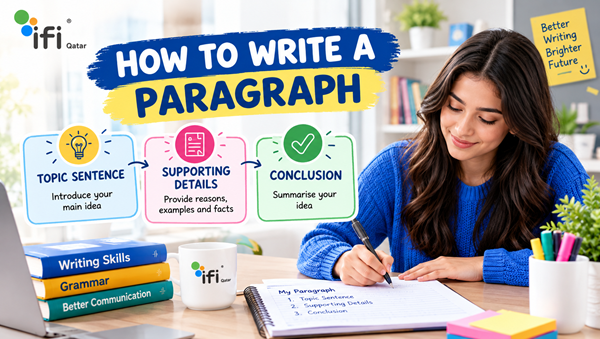
A clear English paragraph usually includes three key elements:
- Topic sentence: Introduces the main idea.
- Supporting sentences: Explain the idea with reasons, details, facts or examples.
- Concluding sentence: Brings the paragraph to a natural close when a conclusion is appropriate.
In this guide, you will learn how to write a paragraph in English step by step, discover useful examples, avoid common mistakes and practise building paragraphs of your own.
What Is a Paragraph in English?
A paragraph is a group of related sentences that develop one main idea. Each sentence should contribute to that idea rather than introduce an unrelated subject.
For example:
“Reading books regularly can improve your English. It introduces you to new vocabulary and shows you how sentences are structured. Reading also helps you recognise common expressions in different contexts. For these reasons, reading is a useful habit for English learners.”
This paragraph focuses on one central idea: reading books can improve English.
The first sentence introduces the topic. The next two sentences explain the benefits, and the final sentence summarises the main point.
A paragraph does not always need exactly four sentences. Some paragraphs are short, while others require more explanation. The appropriate length depends on the purpose, audience and type of writing.
The most important principle is unity: every sentence should support the paragraph’s main idea.
Why Is Paragraph Structure Important?
A well-structured paragraph makes your writing easier to understand because it gives your ideas a logical order.
Good paragraph structure helps you:
- Communicate your main point clearly.
- Explain ideas with relevant details.
- Organise information logically.
- Avoid unnecessary repetition.
- Connect sentences more naturally.
- Make your writing easier to read.
These skills are useful in academic assignments, professional emails, reports, personal statements and English proficiency exams.
The Three Main Parts of a Clear Paragraph
Although paragraph structure can vary depending on the writing task, a useful model for learners is the topic sentence, supporting sentences and concluding sentence.
1. Topic Sentence: Introduce Your Main Idea
The topic sentence tells readers what the paragraph is mainly about. It usually appears at the beginning, although experienced writers sometimes introduce the main idea later for a particular effect.
A strong topic sentence is clear, focused and specific enough to guide the rest of the paragraph.
Consider these examples:
Too general:
“Technology is important.”
This sentence introduces a broad subject but does not explain what the paragraph will discuss.
More focused:
“Technology has made communication faster and more convenient.”
This sentence gives readers a clearer idea of the paragraph’s direction.
Another example:
“Learning English through daily practice helps students develop confidence and accuracy.”
The main idea is that daily practice improves English learning. The supporting sentences can now explain how practice builds confidence and accuracy.
How to Write a Strong Topic Sentence
Follow these steps when writing your topic sentence.
Step 1: Choose one main idea.
Decide what you want to explain. Avoid trying to discuss several unrelated subjects in one paragraph.
For example, choose the benefits of exercise rather than exercise, technology, education and travel.
Step 2: Be specific.
A focused sentence gives you a clear direction for the rest of the paragraph.
Instead of:
“Exercise is good.”
Write:
“Regular exercise improves physical health and helps reduce stress.”
Step 3: Make sure you can support the idea.
Your topic sentence should introduce an idea that you can explain with reasons, examples or relevant information.
For example:
“Learning vocabulary in context helps English learners remember new words.”
You can support this statement by explaining how sentences, stories and conversations show words in meaningful situations.
Step 4: Keep it clear and direct.
You do not need complicated vocabulary or long sentences to write an effective topic sentence.
A simple, precise sentence is often more effective than a complicated sentence that obscures the main idea.
2. Supporting Sentences: Explain Your Main Idea
Supporting sentences develop the topic sentence. They provide the information readers need to understand why the main idea matters or how it works.
Without supporting details, a paragraph may feel incomplete.
For example:
Topic sentence:
“Learning English through daily practice helps students develop confidence and accuracy.”
Supporting sentences:
“Students can practise speaking for ten minutes each day by describing their routines or discussing familiar topics. Regular practice also helps them notice grammar mistakes and learn useful expressions. Over time, they may find it easier to express their ideas without translating every sentence from their first language.”
The supporting sentences explain how daily practice can help learners improve.
Types of Supporting Details
You can develop a paragraph using several types of supporting information.
Reasons
Explain why your main point is true or important.
Example:
“Planning your writing before you begin can save time because it helps you organise your ideas and avoid unnecessary repetition.”
Examples
Give readers a concrete illustration of your point.
Example:
“For example, students can improve their vocabulary by keeping a notebook of useful words from books, podcasts and conversations.”
Facts and evidence
Use accurate information to support your claim when appropriate.
Example:
“A course timetable that includes regular speaking, listening, reading and writing practice gives learners opportunities to develop several language skills.”
For academic or research-based writing, verify factual claims and cite reliable sources where required.
Explanations
Show how or why something happens.
Example:
“When learners review new vocabulary regularly, they have more opportunities to recall and use the words rather than simply recognise them.”
Descriptions
Provide relevant details that help readers understand a person, place, situation or process.
Example:
“The classroom has small discussion groups, a quiet reading area and a board where students can record new vocabulary.”
Choose the type of supporting detail that best fits your purpose. You do not need to use every type in every paragraph.
3. Concluding Sentence: Bring the Paragraph to a Close
A concluding sentence signals that the paragraph’s main idea has been developed sufficiently. It may summarise the point, reinforce its importance or show the result of the information presented.
For example:
Topic sentence:
“Planning your writing before you begin can make your paragraphs clearer.”
Supporting sentences:
“First, a short plan helps you identify the main idea. It also allows you to choose the most relevant examples and put them in a logical order. As a result, you are less likely to repeat the same point or include unrelated information.”
Concluding sentence:
“Taking a few minutes to plan can therefore make the writing process more organised and effective.”
The concluding sentence reinforces the main point without introducing a completely new subject.
Do All Paragraphs Need a Concluding Sentence?
No. A concluding sentence is useful in many instructional, academic and formal paragraphs, but it is not compulsory in every context.
A short paragraph in an email, for example, may end naturally with its final supporting detail. In longer essays, a paragraph may lead directly into the next point.
The important thing is to make sure the paragraph feels complete and its ideas are easy to follow.
How to Write a Paragraph in English Step by Step
Now that you understand the basic structure, you can use a simple process to write a paragraph of your own.
Step 1: Choose a Clear Topic
Start by deciding what you want to write about.
For example:
- The benefits of learning English.
- Why regular exercise is important.
- How technology helps students.
- The advantages of reading books.
- Ways to improve communication skills.
Choose a topic that is narrow enough to discuss in one paragraph.
For example, “Education” is very broad. “How online courses help busy adults learn English” gives you a more specific direction.
Step 2: Decide Your Main Point
Ask yourself:
What do I want the reader to understand about this topic?
Suppose your topic is online English courses.
Possible main points include:
- Online courses offer flexibility.
- Online courses help learners practise independently.
- Online courses can make English learning more accessible.
Choose one main point for the paragraph.
If you try to explain every advantage of online learning in detail, your paragraph may become unfocused. You can develop the other points in separate paragraphs.
Step 3: Write Your Topic Sentence
Turn your main point into one clear sentence.
For example:
“Online English courses give busy learners greater flexibility.”
This sentence establishes the paragraph’s purpose. The remaining sentences should explain how online courses provide flexibility.
Step 4: Brainstorm Supporting Details
Before writing the full paragraph, list two or three details that explain your main idea.
For the topic sentence above, you could write:
- Learners can study outside traditional classroom hours.
- They may be able to review recorded lessons.
- They can often organise practice around work or family responsibilities.
These points support the topic sentence because they explain different ways online courses can offer flexibility.
Step 5: Put Your Ideas in a Logical Order
Arrange your supporting details so that readers can follow your explanation easily.
For example:
- Explain the general benefit.
- Describe how it works in practice.
- Give a specific example or result.
Not every paragraph needs this exact sequence. Choose the order that makes your explanation clearest.
Step 6: Write Complete Sentences
Turn each supporting point into a complete sentence.
For example:
“Online English courses give busy learners greater flexibility. Students can schedule their study sessions around work and family responsibilities. They may also be able to review learning materials when they have extra time. For example, someone who works during the day might practise vocabulary in the evening and complete a listening activity at the weekend.”
Notice that each sentence contributes to the same central idea.
Step 7: Add a Suitable Ending
Read the paragraph and decide whether it needs a concluding sentence.
You could finish the example with:
“This flexibility can make it easier for learners to maintain a consistent study routine.”
The sentence reinforces the paragraph’s main point.
Step 8: Review and Edit Your Paragraph
Before you finish, check your work for clarity, grammar and organisation.
Ask yourself:
- Does the topic sentence clearly introduce the main idea?
- Does every supporting sentence relate to that idea?
- Have I explained my points sufficiently?
- Are my sentences in a logical order?
- Have I used suitable linking words?
- Are my grammar, spelling and punctuation correct?
- Have I repeated the same information unnecessarily?
Editing is an essential part of writing. Your first draft does not need to be perfect; the goal is to improve it through review.
A Complete Example of a Well-Written Paragraph
Let’s put the steps together.
Topic: The benefits of reading
Topic sentence:
“Reading regularly helps English learners develop several important language skills.”
Supporting sentence 1:
“It introduces them to new vocabulary and shows how words are used in different contexts.”
Supporting sentence 2:
“Reading also helps learners recognise common sentence structures and understand how ideas are connected.”
Supporting sentence 3:
“For example, someone who reads short English articles each day may gradually become more familiar with expressions used in everyday communication.”
Concluding sentence:
“By making reading part of their daily routine, learners can build a stronger foundation for using English.”
The Complete Paragraph
“Reading regularly helps English learners develop several important language skills. It introduces them to new vocabulary and shows how words are used in different contexts. Reading also helps learners recognise common sentence structures and understand how ideas are connected. For example, someone who reads short English articles each day may gradually become more familiar with expressions used in everyday communication. By making reading part of their daily routine, learners can build a stronger foundation for using English.”
Why Does This Paragraph Work?
The paragraph is effective because:
- Unity: Every sentence focuses on the benefits of reading.
- Clear topic sentence: The first sentence introduces the central idea.
- Relevant support: The middle sentences explain how reading helps learners.
- Specific example: The fourth sentence makes the explanation more concrete.
- Logical conclusion: The final sentence reinforces the main point.
This is a useful model for beginners and intermediate learners. However, not every paragraph needs five sentences. The number of sentences should depend on how much explanation the idea requires.
Useful Linking Words for Paragraph Writing
Linking words help readers understand the relationships between sentences. They can show addition, contrast, cause and effect, examples or sequence.
However, linking words should clarify relationships between ideas rather than simply make a paragraph sound more formal.
To Add Information
Use these expressions when introducing another relevant point:
- Also
- In addition
- Furthermore
- Moreover
Example:
“Reading improves vocabulary. In addition, it helps learners become familiar with common sentence structures.”
To Give Examples
Use these expressions to introduce an example:
- For example
- For instance
- Such as
- To illustrate
Example:
“Students can practise English in several ways. For example, they can listen to podcasts, read short articles or speak with classmates.”
To Show Cause and Effect
Use these expressions to explain a result or consequence:
- Therefore
- As a result
- Consequently
- Because of this
Example:
“She reviewed her notes every evening. As a result, she found it easier to remember the new vocabulary.”
To Show Contrast
Use these expressions when ideas differ or present opposing points:
- However
- Although
- On the other hand
- In contrast
Example:
“Studying alone allows learners to work at their own pace. However, group lessons can provide more opportunities for conversation.”
To Show Sequence
Use these expressions when describing steps or an order:
- First
- Next
- Then
- Finally
Example:
“First, choose a topic. Next, write your main idea. Then, add supporting details. Finally, review your paragraph.”
How Many Linking Words Should You Use?
Use linking words when they improve clarity. You do not need to begin every sentence with a transition.
Compare these examples.
Overuse:
“Firstly, reading improves vocabulary. Moreover, it develops grammar. Furthermore, it improves comprehension. In addition, it can be enjoyable.”
More natural:
“Reading improves vocabulary and helps learners recognise common grammatical patterns. It also develops comprehension, and many people find it an enjoyable way to practise English.”
The second version connects the ideas without relying on a transition at the beginning of every sentence.
Common Paragraph Writing Mistakes and How to Avoid Them
English learners often make similar mistakes when organising their ideas. Understanding these problems can help you improve your writing more quickly.
1. Writing Without a Clear Main Idea
A paragraph becomes confusing when it discusses several unrelated topics.
Unfocused example:
“English is useful. My favourite food is pizza. Many people travel abroad. Grammar is sometimes difficult.”
The sentences do not develop one central idea.
Improved example:
“Learning English can create opportunities for personal and professional development. It may help people communicate with international colleagues, access educational resources and participate in conversations with people from different backgrounds.”
The improved version focuses on the benefits of learning English.
2. Including Irrelevant Supporting Details
Every supporting sentence should help explain the topic sentence.
If your paragraph is about the benefits of exercise, a long explanation of your favourite television programme will probably distract the reader.
Before including a detail, ask:
Does this information help explain my main point?
If the answer is no, remove it or save it for another paragraph.
3. Repeating the Same Idea
Repetition can make writing longer without making it more informative.
Weak example:
“Reading is useful. It is beneficial for learners. It is a good activity for students.”
These sentences express almost the same idea.
Improved example:
“Reading helps learners expand their vocabulary, recognise sentence patterns and understand how English is used in different contexts.”
The improved sentence provides several distinct details.
4. Giving Opinions Without Explanation
A statement may be clear but still need support.
Weak example:
“Online learning is excellent.”
Improved example:
“Online learning can be convenient because students may be able to study at flexible times and review learning materials when necessary.”
The improved version explains why online learning can be convenient.
When making a broad claim, provide relevant reasons, examples or evidence instead of assuming that the reader will agree.
5. Using Linking Words Incorrectly
Linking words communicate specific relationships between ideas.
For example, however introduces a contrast, while therefore introduces a result.
Incorrect:
“She practised every day. However, her speaking became more confident.”
The relationship is not clearly expressed by however.
Better:
“She practised every day. As a result, she became more confident when speaking English.”
Use the transition that accurately represents the relationship between your sentences.
6. Writing Very Long Sentences
Long sentences can become difficult to follow when they contain too many ideas.
Difficult to follow:
“Students should read English every day because reading helps them learn new words and understand grammar and it also improves comprehension which is useful when they need to write assignments or communicate with other people.”
Clearer version:
“Students should read English every day because reading helps them learn new words and recognise grammatical patterns. It also improves comprehension, which is useful when completing assignments or communicating with other people.”
The revised version separates related ideas into manageable sentences.
7. Forgetting to Check Grammar and Punctuation
A well-organised paragraph can still be difficult to read if it contains frequent grammatical errors.
Pay particular attention to:
- Subject–verb agreement.
- Verb tense consistency.
- Articles such as a, an and the.
- Singular and plural nouns.
- Sentence boundaries.
- Capital letters and punctuation.
For example:
Incorrect: “Reading books help students improve their vocabulary.”
Correct: “Reading books helps students improve their vocabulary.”
The subject reading books is treated as a singular activity, so the verb is helps.
How to Make Your Paragraphs More Advanced
Once you can write clear basic paragraphs, you can improve them by developing your explanations, varying your sentence structures and choosing precise vocabulary.
Develop Your Ideas Further
Instead of making a statement and moving immediately to the next point, explain why the statement matters.
Basic:
“Exercise is important.”
More developed:
“Regular exercise supports physical health and can help people manage stress. Activities such as walking, cycling and swimming allow individuals to remain active without necessarily following a complicated fitness routine.”
The second version gives readers a clearer understanding of the main idea.
Use a Mix of Sentence Structures
Repeating the same sentence pattern can make writing sound monotonous.
For example:
“Reading improves vocabulary. Reading improves grammar. Reading improves comprehension.”
A more varied version would be:
“Reading helps learners expand their vocabulary, recognise grammatical patterns and develop comprehension. By encountering English in different contexts, they can also become more familiar with natural expressions.”
The revised version combines a list with a longer explanatory sentence.
Choose Precise Vocabulary
Use words that express your meaning accurately.
Instead of repeatedly using good, consider words such as:
- Effective
- Beneficial
- Practical
- Valuable
- Reliable
Choose vocabulary based on the meaning you intend to communicate. A more advanced word is not automatically better if it makes the sentence less natural or changes its meaning.
Maintain a Consistent Focus
Advanced writing is not simply about using longer sentences or difficult vocabulary. It is also about developing ideas logically and selecting relevant information.
A well-written paragraph should make the reader understand not only what you think, but also why your point is reasonable.
Paragraph Writing Practice: Exercises for English Learners
Use the following exercises to practise writing topic sentences, supporting details and complete paragraphs.
Exercise 1: Identify the Topic Sentence
Read the paragraph and identify the sentence that introduces the main idea.
“Walking regularly can benefit both physical and mental health. It provides a simple way to remain active without specialised equipment. Walking outdoors may also give people an opportunity to relax and enjoy their surroundings. For many people, a daily walk is an accessible way to include more physical activity in their routine.”
Question: Which sentence is the topic sentence?
Exercise 2: Choose the Best Supporting Detail
Topic sentence:
“Keeping a daily vocabulary notebook can help English learners remember new words.”
Which sentence provides the most relevant supporting detail?
A. Many people prefer blue notebooks.
B. Learners can record a new word, its meaning and an example sentence to review later.
C. Some notebooks have hard covers.
D. English has many different accents.
Exercise 3: Improve the Topic Sentence
Rewrite each general sentence to make it more focused.
- “Technology is good.”
- “Reading is important.”
- “Exercise is useful.”
- “English is difficult.”
- “Online learning is popular.”
Try to make each sentence specific enough to guide a paragraph.
For example:
General: “Reading is important.”
More focused: “Reading short English articles regularly helps learners develop vocabulary and reading comprehension.”
There may be several correct answers.
Exercise 4: Organise the Supporting Sentences
Put the following sentences in a logical order.
A. For example, students can practise speaking with a partner or record themselves answering simple questions.
B. Regular speaking practice helps English learners become more comfortable expressing their ideas.
C. These activities also help learners notice pronunciation problems and identify areas for improvement.
D. By practising consistently, learners can gradually develop greater confidence in everyday conversations.
Identify the topic sentence, the supporting details and the concluding sentence.
Exercise 5: Write Your Own Paragraph
Choose one topic and write a paragraph of approximately 80–120 words.
- The benefits of reading every day.
- How to improve English speaking skills.
- Why learning vocabulary in context is useful.
- The advantages of studying in a group.
- How technology can support education.
Your paragraph should include:
- One clear topic sentence.
- At least two relevant supporting details.
- One specific example, if appropriate.
- A concluding sentence, if it helps complete the paragraph.
After writing, check whether every sentence supports the main idea.
Exercise Answers
Exercise 1: The first sentence is the topic sentence because it introduces the main idea: walking can benefit physical and mental health.
Exercise 2: Option B is correct. It explains a practical way learners can use a vocabulary notebook to remember words.
Exercise 3: Answers will vary. Each revised sentence should introduce a focused idea that can be explained in one paragraph.
Exercise 4: The correct order is B → A → C → D.
- B introduces the main idea.
- A gives a specific example of speaking practice.
- C explains another benefit of the activities.
- D concludes by connecting regular practice with greater confidence.
Exercise 5: Answers will vary. Evaluate your paragraph using the checklist below.
Paragraph Writing Checklist
Before submitting or publishing your paragraph, use this checklist to review your work.
| Question | What to Check |
|---|---|
| Is the main idea clear? | The topic sentence introduces a focused point. |
| Are the supporting details relevant? | Each sentence develops the main idea. |
| Have I explained my ideas? | Important points include reasons, details or examples. |
| Is the information logically ordered? | Readers can follow the explanation easily. |
| Have I used linking words naturally? | Transitions clarify relationships between ideas. |
| Are my sentences grammatically correct? | Check tense, agreement, articles and sentence structure. |
| Have I avoided unnecessary repetition? | Each sentence contributes useful information. |
| Does the paragraph feel complete? | The final sentence or transition provides a natural ending. |
You can use this checklist for school assignments, professional writing, exam preparation and everyday English communication.
Frequently Asked Questions About Writing a Paragraph in English
How do you write a paragraph in English?
Start with a clear topic sentence that introduces one main idea. Add supporting sentences with relevant explanations, reasons or examples. Arrange the information logically, then add a concluding sentence if appropriate. Finally, review your paragraph for clarity, grammar and punctuation.
What are the three main parts of a paragraph?
A common paragraph structure includes a topic sentence, supporting sentences and a concluding sentence. The topic sentence introduces the main idea, supporting sentences develop it, and the conclusion reinforces the point or brings the paragraph to a natural close.
How many sentences should an English paragraph have?
There is no fixed number of sentences required for every paragraph. A short paragraph may contain three or four sentences, while a more developed paragraph may need more. The appropriate length depends on the purpose of the writing and how much explanation the main idea requires.
What is a topic sentence?
A topic sentence introduces the main idea of a paragraph. It helps readers understand what the paragraph will discuss and gives the writer a clear direction for selecting supporting details.
What are supporting details in a paragraph?
Supporting details are sentences that explain, develop or illustrate the main idea. They may include reasons, examples, descriptions, facts or explanations that help readers understand the topic sentence.
Does every paragraph need a concluding sentence?
No. A concluding sentence is useful when a paragraph needs a clear summary or final point, but it is not essential in every situation. Short paragraphs and paragraphs within longer texts may end naturally or lead into the next idea.
How can I make my English paragraphs clearer?
Focus on one main idea, use relevant supporting details, organise sentences logically and choose clear vocabulary. Avoid unnecessary repetition, use linking words only when they help, and review your writing for grammatical errors.
How can beginners improve their paragraph writing?
Beginners can start with familiar topics and use a simple structure: topic sentence, two or three supporting sentences and an optional conclusion. Regular practice, reading examples and reviewing mistakes can help them develop stronger writing skills.
Improve Your English Writing Skills With IFI Qatar
Learning to write clear paragraphs is an important step towards becoming a more confident English user. Once you understand how to organise a topic sentence, supporting details and a suitable conclusion, you can apply the same principles to emails, assignments, reports and longer pieces of writing.
At IFI Qatar, you can explore English courses designed to help you develop your language skills and communicate more effectively. Building a stronger foundation in grammar, vocabulary, sentence structure and writing organisation can help you express your ideas with greater clarity.
Whether you are a beginner learning to construct basic sentences or an intermediate learner working towards more organised writing, consistent practice and suitable instruction can help you progress.
Ready to improve your English writing? Contact IFI Qatar to explore available English courses and find a learning option that suits your current level and goals.