

Currently Empty: ر.ق 0,00


IELTS
IELTS Writing Task 1 Process Diagrams: A Step-by-Step Guide
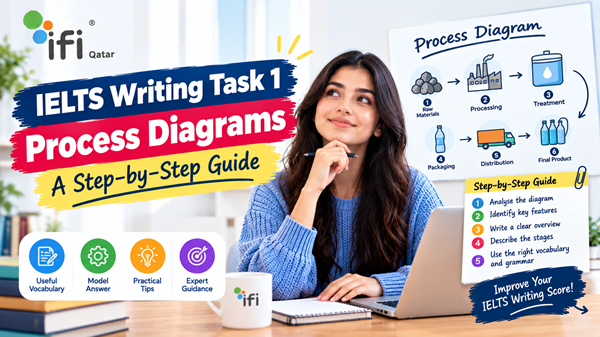
Process diagrams are one of the question types you may encounter in IELTS Academic Writing Task 1. They require you to describe how something is produced, how a natural process works, or how a sequence of stages leads from a starting point to an end result.
Unlike charts and graphs, process diagrams do not usually ask you to compare numerical data. Instead, you need to understand the stages, identify the main features, and explain how the process develops in a clear and logical order.
For many IELTS candidates, the challenge is not understanding the diagram itself. It is deciding what to include, choosing the right vocabulary, using appropriate verb tenses, and connecting the stages without repeating the same expressions.
The good news is that a clear structure and a reliable step-by-step method can make IELTS process diagram questions much easier to manage.
In this guide, you will learn how to analyse process diagrams, write an effective overview, describe stages in the correct order, use passive voice accurately, and organise your response within the time available. You will also find useful vocabulary, a model answer, and practical tips for improving your Writing Task 1 performance.
What Is an IELTS Process Diagram Task 1?
An IELTS process diagram is a visual representation of a series of stages or actions.
In IELTS Academic Writing Task 1, you may be asked to describe a process such as:
- How a manufactured product is made.
- How a natural substance is formed.
- How water is treated and supplied.
- How a renewable energy system operates.
- How a biological cycle develops.
- How a material is collected, processed, and recycled.
The diagram may contain labelled illustrations, arrows, numbered stages, or a combination of these elements.
Your task is to summarise the information by selecting the main features and explaining how the process works.
You should not simply list every label in the diagram. Instead, organise the information into a coherent description that allows the reader to understand the process from beginning to end.
Two Common Types of Process Diagrams
IELTS process diagrams generally fall into two broad categories.
1. Manufacturing or artificial processes
These explain how people produce, treat, or transform something.
Examples include:
- Producing cement.
- Manufacturing bricks.
- Recycling plastic bottles.
- Treating wastewater.
- Generating electricity.
Such processes often involve equipment, materials, and a sequence of production stages.
2. Natural processes
These describe events that occur in nature.
Examples include:
- The water cycle.
- The life cycle of an insect.
- The formation of a natural substance.
- The development of a plant.
Natural processes may include recurring cycles rather than a single beginning and end.
Recognising the type of process helps you decide which vocabulary, verb tenses, and organisational approach to use.
What Does IELTS Expect in a Process Diagram Answer?
IELTS Academic Writing Task 1 assesses your ability to summarise visual information accurately and effectively.
Your response is assessed using four criteria:
| Assessment criterion | What it means for a process diagram |
|---|---|
| Task Achievement | You describe the key stages accurately and provide a clear overview of the main features. |
| Coherence and Cohesion | You organise the stages logically and connect ideas clearly. |
| Lexical Resource | You use appropriate vocabulary to describe actions, materials, stages, and changes. |
| Grammatical Range and Accuracy | You use a suitable range of sentence structures with accurate grammar. |
Each criterion contributes to your Writing Task 1 performance.
A response can include sophisticated vocabulary and complex sentences but still be weak if it misses important stages or misrepresents the process.
Similarly, a complete description may be difficult to follow if the information is poorly organised.
The priority is to describe the process accurately, select the important information, and communicate it clearly.
How to Write an IELTS Process Diagram Task 1 Answer
A reliable response usually contains four paragraphs:
- Introduction.
- Overview.
- First group of process stages.
- Second group of process stages.
This structure is flexible enough for many diagrams while helping you present the information in a logical sequence.
Step 1: Analyse the Diagram Before Writing
Before you start writing, spend a few minutes understanding the diagram.
Look at the entire process rather than focusing immediately on individual labels.
Ask yourself:
- What is being produced or described?
- Where does the process begin?
- What happens at each stage?
- Which stages are connected?
- What is the final result?
- Does the process form a cycle?
- Are there any important changes in materials, temperature, location, or form?
For example, a diagram showing the production of a manufactured product might follow this sequence:
Raw materials → Preparation → Processing → Assembly → Final product
This sequence gives you a basic framework for your response.
You do not need to memorise every label immediately. First, understand how the stages relate to one another.
Step 2: Identify the Main Features
Your next task is to identify the most important characteristics of the process.
Depending on the diagram, these may include:
- The number or broad grouping of stages.
- The starting materials.
- Major transformations.
- Important machinery or equipment.
- The final product.
- A recycling or feedback stage.
- Whether the process is linear or cyclical.
You should distinguish between the main stages and minor details.
For example, if a process includes heating, cooling, filtering, and packaging, these actions may be central to the description. A small decorative detail in the illustration is unlikely to be important unless it communicates meaningful information.
A useful rule is to include information that helps the reader understand how the process works.
Step 3: Write a Clear Introduction
The introduction should paraphrase the task statement.
You do not need to explain every stage at this point. Simply identify what the diagram illustrates.
Suppose the task says:
The diagram illustrates the process used to recycle plastic bottles.
You could write:
The diagram shows how used plastic bottles are recycled into new products.
This version communicates the same basic idea using different wording.
Another example:
Task statement:
The diagram below shows how bricks are manufactured for the building industry.
Possible introduction:
The diagram illustrates the stages involved in producing bricks for construction.
Both introductions are concise and directly relevant to the task.
How to Paraphrase the Question
You can paraphrase by changing vocabulary, sentence structure, or both.
| Original expression | Possible paraphrase |
|---|---|
| Shows | Illustrates, presents, depicts |
| The process of making | The production of |
| How something is produced | The stages involved in producing something |
| The process used to recycle | How a material is recycled |
| The diagram below | The diagram |
However, paraphrasing should not change the meaning.
Do not replace a specific material or product with an inaccurate alternative simply to avoid repeating a word from the question.
Accuracy is more important than using as many synonyms as possible.
Step 4: Write an Effective Overview
The overview is one of the most important parts of your Task 1 response.
It summarises the main features of the process without describing every stage in detail.
For a linear process, your overview might identify the starting material, the general sequence, and the final outcome.
For a cyclical process, it might explain that the stages repeat in a continuous cycle.
For example:
Overall, the process consists of several stages, beginning with the collection of used plastic bottles and ending with the production of reusable materials or new products.
This overview gives the reader a general understanding of the process.
It does not list every machine or explain every action. Those details belong in the body paragraphs.
What Should You Include in the Overview?
Consider the following questions:
- What happens at the beginning?
- What is the final result?
- Is the process linear or cyclical?
- Are there any major phases?
- Does the process involve a significant transformation?
You should not attempt to include every observation.
Choose the main characteristics that best summarise the diagram.
Common Overview Mistakes
Mistake 1: Repeating the introduction
The introduction identifies what the diagram shows. The overview should explain the main characteristics of the process.
Mistake 2: Describing every stage
Detailed explanations belong in the body paragraphs.
Mistake 3: Giving an opinion
Avoid comments about whether the process is environmentally friendly, efficient, expensive, or beneficial unless the diagram explicitly provides that information.
Mistake 4: Inventing missing information
Do not claim that a process is automated, inexpensive, or environmentally sustainable unless the diagram supports that conclusion.
A good overview summarises what can be observed rather than what you assume.
Step 5: Organise the Stages into Body Paragraphs
After writing the introduction and overview, divide the stages into logical groups.
For a linear process, you might describe the early stages in Body Paragraph 1 and the later stages in Body Paragraph 2.
For example:
Body Paragraph 1: Collection, sorting, and preparation of the raw material.
Body Paragraph 2: Processing, transformation, and production of the final item.
This approach prevents your answer from becoming a long list of disconnected sentences.
However, the division should reflect the diagram. Do not force every process into two equal groups if another arrangement would be clearer.
Follow the Correct Sequence
Arrows usually indicate the direction in which a process develops.
Follow them carefully.
If one stage must happen before another, your writing should reflect that order.
Useful expressions include:
- Initially
- First
- Next
- Following this
- Subsequently
- Once this stage is complete
- Afterward
- Finally
You do not need to use a linking expression in every sentence. Clear sequencing and accurate descriptions are more important than repeatedly adding transition words.
Step 6: Use the Correct Verb Tense
Choosing the right tense depends on what the diagram describes.
The present simple is commonly appropriate for processes that explain how something generally works or is produced.
For example:
- The raw materials are collected.
- The mixture is heated.
- The liquid passes through a filter.
- The finished products are packaged.
For a natural process, the present simple may also be appropriate:
- Water evaporates from the surface.
- The vapour rises into the atmosphere.
- The water condenses to form clouds.
The past simple may be appropriate if the task describes a process that occurred at a particular time in the past.
The key is to use a tense that matches the information provided and maintain consistency.
Step 7: Use the Passive Voice Where Appropriate
The passive voice is particularly useful for manufacturing processes because the action or material is often more important than the person performing it.
Compare these sentences:
Active voice: Workers heat the mixture in a large container.
Passive voice: The mixture is heated in a large container.
Both sentences are grammatically correct. However, the passive version focuses on the process rather than the workers.
This is often useful in IELTS process descriptions.
How to Form the Passive Voice
The basic structure is:
Subject + appropriate form of “be” + past participle
Examples:
| Active voice | Passive voice |
|---|---|
| Workers collect the bottles. | The bottles are collected. |
| Machines crush the plastic. | The plastic is crushed. |
| The factory heats the material. | The material is heated. |
| Workers package the products. | The products are packaged. |
Remember that the form of be changes according to the tense.
Present simple passive:
The material is heated.
Past simple passive:
The material was heated.
Do not use the passive voice in every sentence simply because the task is a process diagram. Natural processes and actions with an important agent may be described more clearly in the active voice.
Choose the structure that communicates the information accurately.
Essential IELTS Process Diagram Vocabulary
A strong process description requires vocabulary that expresses actions, stages, transformations, and relationships.
You do not need to use complicated words in every sentence. Accurate, appropriate vocabulary is more valuable than unnecessarily sophisticated expressions.
1. Words for Describing Stages
These expressions help you show how the process develops.
| Expression | Example |
|---|---|
| Initially | Initially, the raw materials are collected. |
| Subsequently | Subsequently, the mixture is transferred to another container. |
| Following this | Following this, the material is heated. |
| At the next stage | At the next stage, the liquid is filtered. |
| Once completed | Once completed, the product is packaged. |
| Finally | Finally, the finished goods are delivered. |
Use these expressions naturally. Repeating the same transition in every sentence can make your writing mechanical.
2. Verbs for Manufacturing Processes
The following verbs are useful for describing production and treatment stages.
| Verb | Meaning or use | Example |
|---|---|---|
| Collect | Gather materials | Used bottles are collected. |
| Sort | Separate into categories | The bottles are sorted by material. |
| Crush | Break into smaller pieces | The plastic is crushed into fragments. |
| Grind | Reduce to smaller particles | The material is ground into a powder. |
| Heat | Raise the temperature | The mixture is heated. |
| Melt | Change from solid to liquid | The plastic is melted. |
| Filter | Remove unwanted particles | The liquid is filtered. |
| Mix | Combine substances | The ingredients are mixed together. |
| Transfer | Move to another location | The mixture is transferred to a tank. |
| Shape | Give a particular form | The material is shaped into blocks. |
| Cool | Reduce the temperature | The product is cooled. |
| Package | Prepare goods for distribution | The finished items are packaged. |
Use each verb only when it accurately describes the action shown in the diagram.
For instance, melt and dissolve do not mean the same thing. A solid melts when it changes into a liquid because of heat, whereas dissolving involves a substance becoming dispersed in a solvent.
Precise word choice helps you describe the process correctly.
3. Verbs for Natural Processes
Natural process diagrams often require vocabulary related to changes in form, movement, and development.
| Verb | Example |
|---|---|
| Evaporate | Water evaporates from the surface. |
| Condense | Water vapour condenses into droplets. |
| Absorb | The roots absorb water from the soil. |
| Release | The plant releases water vapour. |
| Germinate | The seed germinates under suitable conditions. |
| Develop | The organism develops into an adult. |
| Flow | Water flows into a reservoir. |
| Accumulate | Moisture accumulates in the atmosphere. |
| Form | Clouds form when water vapour condenses. |
| Repeat | The cycle repeats continuously. |
These verbs are particularly useful when describing natural cycles, plant development, and environmental processes.
4. Words for Describing Changes
Some diagrams show materials changing their physical form or condition.
Useful expressions include:
- Is converted into
- Is transformed into
- Changes into
- Is reduced to
- Is separated from
- Is combined with
- Is divided into
- Is turned into
Examples:
The raw material is converted into a liquid.
The liquid is separated from the solid particles.
The material is transformed into smaller pieces before processing.
Choose expressions that accurately reflect the relationship between the stages.
5. Vocabulary for Linear and Cyclical Processes
A linear process follows a sequence from beginning to end.
A cyclical process repeats, with the final stage connecting to an earlier stage.
| Process type | Useful expressions |
|---|---|
| Linear process | Begins with, proceeds to, passes through, ends with |
| Cyclical process | Forms a cycle, returns to, repeats, continues continuously |
| Starting stage | Initially, at the beginning, the process starts with |
| Final stage | Eventually, in the final stage, the process ends with |
For a cyclical process, do not describe the final stage as a permanent endpoint if the diagram shows that the cycle continues.
How to Describe Different Types of Process Diagrams
Although the general structure remains similar, different diagrams may require different approaches.
Manufacturing Process Diagrams
Manufacturing diagrams explain how materials are processed to create a product.
For example, a production process may include:
- Collecting raw materials.
- Sorting and preparing them.
- Processing the materials.
- Shaping or assembling the components.
- Inspecting and packaging the finished product.
When describing this type of diagram, focus on the transformation of materials and the sequence of operations.
The passive voice is often useful because the process is usually more important than the people performing it.
However, do not assume that every manufacturing process includes the same stages. Describe only what the diagram shows.
Natural Process Diagrams
Natural processes describe events such as the water cycle, seed germination, or an animal’s development.
When describing these diagrams:
- Identify the starting point if one is indicated.
- Explain the stages in the correct order.
- Use accurate scientific vocabulary where appropriate.
- Show how the stages relate to one another.
- Explain the recurring nature of a cycle if the diagram shows one.
The active voice may be suitable for natural processes.
For example:
Water evaporates from the surface of the sea.
This is more natural than forcing the sentence into the passive voice.
Cyclical Process Diagrams
A cyclical diagram shows a sequence that repeats.
The water cycle is a familiar example.
A simplified version may include evaporation, condensation, precipitation, and the collection of water.
Your overview should identify the recurring nature of the process.
For example:
Overall, the diagram illustrates a continuous natural cycle in which water evaporates, condenses, returns to the Earth’s surface, and eventually becomes available for further evaporation.
In the body paragraphs, explain the stages in the order indicated by the arrows.
Avoid treating the last stage as the absolute end of the process when it leads back to the beginning.
Diagrams with Multiple Branches
Some diagrams contain branches in which a material or process follows different paths.
In this situation, identify the main sequence first and then explain the branches clearly.
For example, a recycling process might show that different materials are separated and sent to different processing stages.
Use expressions such as:
- At this point, the material is divided into two groups.
- The first group is sent for further processing.
- Meanwhile, the second group undergoes a separate treatment.
- Both streams are eventually used to produce new materials.
Only use these descriptions when the diagram actually shows separate paths.
The objective is to make the relationships between the stages clear rather than force all the information into one linear sequence.
IELTS Process Diagram Sample Answer
The following example demonstrates how to apply the structure and language techniques discussed above.
The diagram is an original practice scenario, not an official IELTS question.
Practice Question
The diagram illustrates how plastic bottles are recycled.
Summarise the information by selecting and reporting the main features, and make comparisons where relevant.
Write at least 150 words.
Understanding the Diagram
Imagine that the diagram shows the following stages:
- Used plastic bottles are placed in recycling bins.
- The bottles are collected by a recycling truck.
- The bottles are sorted at a recycling facility.
- Suitable bottles are crushed into small pieces.
- The pieces are washed and processed.
- The processed plastic is used to manufacture new products.
Before writing, identify the main features:
- The process begins with the collection of used bottles.
- The bottles pass through several preparation and processing stages.
- The plastic is transformed into a material that can be used again.
- The process ends with the manufacture of new products.
These observations form the basis of the introduction, overview, and body paragraphs.
Model Answer
Introduction
The diagram illustrates the stages involved in recycling used plastic bottles and converting them into new products.
Overview
Overall, the process consists of several stages, beginning with the collection of discarded bottles and ending with the manufacture of new items. The bottles are first sorted and prepared before the plastic is processed for reuse.
Body Paragraph 1
Initially, used plastic bottles are placed in designated recycling bins and collected by a recycling truck. They are then transported to a recycling facility, where they are sorted. Bottles suitable for recycling are separated from other waste before being crushed into small pieces. This reduces their size and prepares the material for the next stage.
Body Paragraph 2
Following this, the plastic fragments are washed to remove unwanted substances. The cleaned material is then processed into a form suitable for manufacturing. Finally, the recycled plastic is used to produce new items, allowing the material to be reused rather than discarded.
Why Is This Answer Effective?
The model answer demonstrates several useful techniques.
1. It contains a clear introduction.
The opening sentence paraphrases the task and identifies the subject of the diagram.
2. It provides an overview.
The overview explains the starting point, the main sequence, and the final outcome without listing every detail.
3. It follows the process in order.
The body paragraphs describe the stages sequentially, making the process easy to understand.
4. It uses appropriate passive structures.
Expressions such as are placed, are collected, are sorted, and are processed focus on the materials and the actions performed on them.
5. It uses linking expressions naturally.
Words such as initially, following this, and finally help guide the reader through the process.
6. It avoids unsupported claims.
The answer describes the stages in the hypothetical diagram without inventing temperatures, machinery, costs, or other details.
The example also exceeds the minimum requirement of 150 words, as a complete IELTS Academic Writing Task 1 response should.
Common Mistakes in IELTS Process Diagram Task 1
Understanding what to avoid is just as important as learning how to structure your answer.
Mistake 1: Missing the Overview
Some candidates describe every stage but fail to summarise the main features.
This can weaken Task Achievement because the response does not clearly communicate the overall process.
How to improve: Before writing, identify the beginning, end, and overall pattern of the diagram. Use these observations to create a concise overview.
Mistake 2: Listing Stages Without Explaining Their Relationships
A response may read like a list:
First, the bottles are collected. Next, they are sorted. Then, they are crushed. After that, they are washed.
Although the stages may be accurate, the writing can become repetitive and disconnected.
How to improve: Combine related stages into meaningful sentences and explain how one stage leads to another.
For example:
After collection, the bottles are sorted and crushed into smaller pieces before being washed for further processing.
This sentence connects several related actions while preserving the sequence.
Mistake 3: Using the Wrong Verb Tense
Switching between tenses without a reason can make your description confusing.
For example:
The material is collected, and then workers heated it before it is packaged.
The tense changes unnecessarily.
How to improve: Decide which tense suits the process and maintain it consistently unless the diagram requires a change.
Mistake 4: Overusing the Passive Voice
The passive voice is useful, but using it in every sentence can make your writing awkward.
How to improve: Use passive structures when the action or material is the main focus. Use active structures when they describe a natural process more clearly or when the agent is important.
Mistake 5: Repeating the Same Linking Words
Starting every sentence with then, next, or after that makes the response sound repetitive.
How to improve: Vary your sentence structures and use linking expressions only when they improve clarity.
You can combine stages with clauses such as:
Once the material has been sorted, it is transferred to a processing unit.
Mistake 6: Adding Information That Is Not in the Diagram
Candidates sometimes assume that a process includes specific machinery, chemicals, temperatures, or purposes.
These assumptions may be incorrect.
How to improve: Base your description on the visual information provided. Do not add technical details unless they are shown or clearly stated.
Mistake 7: Using Inaccurate Vocabulary
Choosing an advanced word does not automatically improve your score.
For example, using evaporate when a material is actually being heated until it melts changes the meaning.
How to improve: Learn process vocabulary in context and choose verbs that describe the actual action.
Mistake 8: Writing Too Little or Too Much
IELTS Academic Writing Task 1 requires at least 150 words.
A very short answer may omit important stages, while an unnecessarily long response can waste time and increase the risk of errors.
How to improve: Aim for a complete response of around 160–190 words when the diagram allows it. This is a practical guideline, not an official word-count target.
Focus on covering the main features rather than reaching a particular length.
How Much Time Should You Spend on a Process Diagram?
IELTS Academic Writing Task 1 is generally approached with approximately 20 minutes of the available Writing time.
A practical approach is to divide your time into three stages.
| Stage | Suggested time | Main task |
|---|---|---|
| Analyse and plan | 3–4 minutes | Understand the stages and identify the overview |
| Write | 12–14 minutes | Draft the introduction, overview, and body paragraphs |
| Review | 2–3 minutes | Check grammar, vocabulary, spelling, and completeness |
These timings are flexible. Some diagrams are straightforward, while others contain multiple branches or complicated stages.
The aim is to avoid spending so much time analysing the image that you have too little time to write and check your answer.
What Should You Check Before Finishing?
Use the final minutes to review the following:
- Have I included an introduction?
- Is my overview clear?
- Have I described the major stages?
- Does the sequence match the diagram?
- Have I used appropriate verb tenses?
- Are my passive structures grammatically correct?
- Have I checked articles, prepositions, and subject–verb agreement?
- Have I used accurate vocabulary?
- Is my response at least 150 words?
A brief final check can help you catch errors that are easy to overlook while writing.
How to Improve Your IELTS Process Diagram Writing Score
Learning a template can help you organise your response, but a template alone will not improve every aspect of your Writing performance.
You also need to practise interpreting diagrams, selecting relevant information, and using accurate language.
1. Practise Different Process Types
Do not practise only manufacturing diagrams.
Include natural cycles, linear processes, and diagrams with multiple branches.
This will help you adapt your writing strategy to different visual structures.
2. Build a Personal Vocabulary List
Record useful verbs, sequencing expressions, and passive structures.
For each new expression, write an example sentence based on a process diagram.
For instance:
- Is converted into: The raw material is converted into a usable substance.
- Passes through: The liquid passes through a filtration system.
- Is divided into: The material is divided into separate categories.
Review the vocabulary regularly and focus on accurate usage rather than memorising long lists without context.
3. Compare Your Answer with a Model Response
After completing a practice question, compare your answer with a reliable model.
Look for differences in:
- The overview.
- The selection of key stages.
- The order of information.
- Sentence structure.
- Vocabulary.
- Grammar and accuracy.
Do not copy the model answer word for word. Use it to identify techniques that you can apply to your own writing.
4. Review Your Mistakes Systematically
Keep a record of recurring errors.
| Problem | Example | Improvement strategy |
|---|---|---|
| Missing overview | The answer begins with the first stage | Write one or two overview sentences before the body |
| Repetitive linking | Every sentence begins with “then” | Practise combining related stages |
| Incorrect tense | Unnecessary shifts between present and past | Check tense consistency |
| Passive voice errors | Incorrect form of “be” | Practise passive sentence structures |
| Inaccurate details | Adding information not shown | Check every claim against the diagram |
| Grammar mistakes | Incorrect articles or prepositions | Review recurring grammar errors |
This approach helps you turn individual corrections into a more effective preparation plan.
5. Practise Under Timed Conditions
Practising without a time limit is useful when learning a new question type.
However, you also need to practise completing a full response within the time available in the real examination.
Set a timer, analyse the diagram, write your response, and review it briefly.
After several attempts, assess whether you can maintain accuracy without spending too long on any one stage.
Why Professional IELTS Writing Assessment Can Help
Self-study is valuable, but it can be difficult to recognise all the weaknesses in your own writing.
You may notice spelling mistakes but overlook problems with your overview. You may use complex grammar but make errors in sentence construction. Or you may describe every stage accurately without selecting and organising the main features effectively.
A structured Writing assessment can help you understand these issues more clearly.
What Should an IELTS Writing Assessment Evaluate?
When reviewing a process diagram response, useful feedback should consider the four IELTS Writing Task 1 assessment criteria.
Task Achievement
- Have you identified the main features?
- Is the overview clear and relevant?
- Are the stages accurately described?
- Have you avoided unsupported information?
Coherence and Cohesion
- Is the response organised logically?
- Are the stages presented in the correct sequence?
- Do the sentences connect naturally?
- Is the information divided into appropriate paragraphs?
Lexical Resource
- Is the process vocabulary accurate?
- Are the verbs appropriate for the actions shown?
- Is there unnecessary repetition?
- Have you used paraphrasing effectively?
Grammatical Range and Accuracy
- Are verb tenses appropriate?
- Is the passive voice used correctly?
- Are articles and prepositions accurate?
- Do complex sentences remain clear and grammatically correct?
Feedback should identify both strengths and areas for improvement.
For example, rather than simply saying that your grammar needs work, useful feedback might explain that you repeatedly omit articles before singular countable nouns or use incorrect verb forms in passive constructions.
Specific feedback gives you something concrete to practise.
How to Use Feedback to Improve
After receiving an assessment, follow this process:
- Identify the two or three most important weaknesses.
- Review the relevant grammar or vocabulary.
- Rewrite the sentences containing errors.
- Practise another process diagram using the same techniques.
- Compare your new response with your earlier work.
- Seek further feedback if the same problems continue.
The goal is not merely to collect corrections. It is to understand why the mistakes occurred and prevent them from recurring.
At IFI Qatar, you can enquire about available IELTS Writing assessment options to help identify weaknesses in your Task 1 responses and plan your next stage of preparation.
Frequently Asked Questions About IELTS Process Diagram Task 1
What is an IELTS process diagram in Writing Task 1?
An IELTS process diagram is a visual representation of stages involved in a manufacturing procedure, natural process, or another sequence of events. You need to summarise the main features and explain how the process develops.
How many paragraphs should I write for a process diagram?
A practical structure is four paragraphs: an introduction, an overview, and two body paragraphs. However, the structure should reflect the complexity of the diagram rather than follow a rigid template.
Is an overview necessary for IELTS process diagrams?
Yes. A clear overview is important because it summarises the main features of the process. It should explain the overall pattern, such as where the process begins and ends or whether it forms a continuous cycle.
Should I use the passive voice in process diagrams?
The passive voice is often useful for manufacturing processes because it focuses on the materials and actions rather than the people performing them. However, the active voice can be more natural for some natural processes. Choose the structure that accurately describes the diagram.
Which tense should I use for IELTS process diagrams?
The present simple is commonly used to describe general processes. For example, the material is heated or water evaporates. If the diagram describes events at a specific time in the past, the past tense may be appropriate.
How many words should I write for IELTS Writing Task 1?
You must write at least 150 words. A response of around 160–190 words is a practical target for many process diagrams, although the ideal length depends on the information presented.
How can I improve my IELTS process diagram vocabulary?
Learn verbs that describe actions and transformations, such as crush, melt, filter, transfer, and convert. Practise using them in sentences and make sure each word accurately describes the stage shown.
Can I use a template for IELTS process diagrams?
A basic structure can help you organise your answer, but a memorised template cannot replace accurate analysis. Adapt your introduction, overview, and body paragraphs to the specific process shown in the diagram.
What are the most common mistakes in process diagram questions?
Common mistakes include omitting the overview, describing stages out of order, repeating linking expressions, using incorrect verb tenses, making passive voice errors, and adding information that is not shown in the diagram.
How can I check whether my IELTS Writing Task 1 answer is good enough?
Review your answer against the four assessment criteria: Task Achievement, Coherence and Cohesion, Lexical Resource, and Grammatical Range and Accuracy. Check whether you have covered the main stages, provided an overview, used accurate vocabulary, and maintained grammatical control. A professional assessment can help identify weaknesses that may be difficult to recognise yourself.
Final Checklist for IELTS Process Diagram Task 1
Before submitting your answer, make sure you have completed the following steps:
- Analyse: Identify the starting point, main stages, and final result.
- Plan: Group the stages into a logical sequence.
- Introduce: Paraphrase the task statement.
- Summarise: Write a clear overview of the main features.
- Describe: Explain the stages accurately in the correct order.
- Connect: Use appropriate linking expressions.
- Check grammar: Review tenses, passive constructions, articles, and prepositions.
- Check vocabulary: Make sure each verb describes the correct action.
- Review: Remove unsupported information and unnecessary repetition.
- Check length: Ensure that you have written at least 150 words.
Following this checklist can make your approach more consistent and help you identify areas that need further practice.
Improve Your IELTS Writing Task 1 Performance
IELTS process diagrams become easier to handle when you understand how to analyse the stages, identify the main features, and organise your response clearly.
The most effective approach is to combine a reliable structure with accurate vocabulary, appropriate grammar, and regular practice.
Remember that a high-quality response does not need to sound complicated. It needs to communicate the process accurately, highlight the important features, and guide the reader through the stages in a logical order.
If you are preparing for IELTS in Qatar, practising different process diagrams can help you become more confident with this question type. Reviewing your responses against the IELTS assessment criteria can also help you understand which areas need attention.
At IFI Qatar, enquire about available IELTS Writing assessment services to receive guidance on improving your Task 1 responses. Use the feedback to identify recurring mistakes, strengthen your writing technique, and prepare more effectively for your next IELTS test.
Your next step is simple: choose a process diagram, write your answer under timed conditions, review it carefully, and focus your next practice session on the weaknesses you identify.