

Currently Empty: ر.ق 0,00


IELTS
IELTS Listening Distractors: How to Avoid Wrong Answers
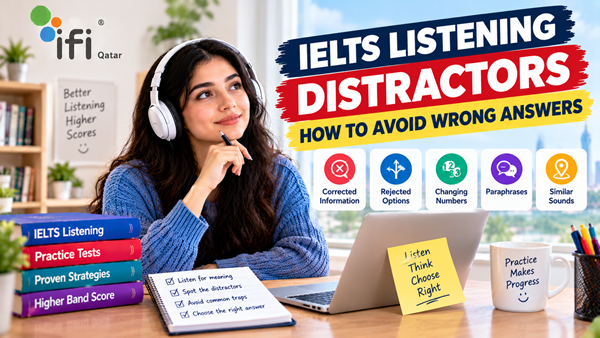
Have you ever heard the correct answer during an IELTS Listening practice test, written it down, and then discovered that it was wrong?
This often happens because of IELTS Listening distractors—words, numbers, or statements that initially sound like the correct answer but are later corrected, replaced, or contradicted by the speaker.
For example, you might hear a speaker say, “The appointment was originally scheduled for Tuesday, but we’ve moved it to Thursday.” If you write down Tuesday because you heard it first, you will lose the mark. The correct answer is Thursday.
Distractors are particularly challenging because you may understand the conversation perfectly well and still choose the wrong answer. The problem is not always your English level. Sometimes, it is the way you process information while listening under time pressure.
The good news is that you can learn to recognise common distractor patterns and avoid many of these mistakes with targeted practice.
In this guide, you will learn what IELTS Listening distractors are, the most common types, how they appear in different question formats, and practical techniques to help you choose the correct answer more consistently.
What Are IELTS Listening Distractors?
IELTS Listening distractors are pieces of information in a recording that can mislead you into selecting an incorrect answer.
They may include an initial answer that is later corrected, an option that is discussed but rejected, a number that changes, or a detail that sounds relevant but does not answer the question.
Consider this example:
Question: What time will the guided tour begin?
Recording: “The tour was supposed to start at 9:30, but because of the delay, we’ll begin at 10:15.”
Possible answers:
- 9:30
- 10:00
- 10:15
The speaker mentions 9:30 first, but then changes the arrangement. The correct answer is 10:15.
A common mistake is to select the first time you hear instead of following the speaker’s complete explanation.
Distractors test more than your ability to recognise words. They also require you to understand changes, corrections, comparisons, and the speaker’s final meaning.
Why Does IELTS Use Distractors?
Real conversations do not always present information in a simple, predictable order.
People change their minds, correct themselves, compare alternatives, and provide additional details before making a decision.
IELTS Listening includes conversations and monologues in which candidates need to follow the meaning rather than simply recognise individual words.
Understanding how speakers communicate information can therefore help you identify the answer more accurately.
The 7 Most Common IELTS Listening Distractors
Recognising common distractor patterns is one of the most effective ways to improve your Listening performance.
1. Correcting an Earlier Answer
This is one of the most recognisable distractor patterns.
The speaker mentions one answer and then corrects it.
Example:
“The meeting was originally planned for Monday, but we’ve decided to hold it on Wednesday instead.”
Question: Which day will the meeting take place?
Correct answer: Wednesday.
Why candidates get it wrong: They hear Monday, immediately connect it to the question, and stop listening carefully.
How to avoid the mistake: When you hear a possible answer, keep listening until the speaker finishes explaining the situation.
Pay attention to expressions such as:
- Actually
- Sorry, I mean
- Rather
- Instead
- We have changed it to
- Not X, but Y
- Originally … but now …
These expressions often signal that information is being corrected or replaced.
However, do not assume that every sentence containing actually introduces a correction. Always interpret the expression in context.
2. Changing Numbers, Dates, and Times
Numbers are common sources of mistakes because they can be mentioned quickly, repeated, or changed during a conversation.
Example:
“The registration fee is £45 for returning students. For new students, however, it is £60.”
Question: How much must a new student pay?
Correct answer: £60.
The first amount is relevant to the conversation, but it applies to a different group.
Distractors involving numbers may include:
- Prices
- Telephone numbers
- Dates
- Times
- Room numbers
- Quantities
- Ages
- Measurements
How to avoid the mistake:
Before the recording begins, identify exactly what the question asks you to write down.
If the question asks for the fee for new students, do not select the first price you hear. Wait until the speaker connects a specific amount to the correct category.
Also, listen for changes in units and numerical meaning. For example, fifteen and fifty can sound similar when spoken quickly, so use the surrounding information to confirm what you heard.
3. Mentioning Several Options Before Making a Choice
Speakers often discuss several possibilities before deciding which one they prefer.
Example:
“We considered the city centre because it is convenient, and the university area was another possibility. In the end, we chose the lakeside location because it was quieter.”
Question: Where did they decide to hold the event?
Correct answer: The lakeside location.
The city centre and university area are mentioned, but neither is the final choice.
How to avoid the mistake:
Distinguish between options that are discussed and the option that is selected.
Listen for expressions such as:
- We decided on
- We eventually chose
- We settled on
- In the end
- We went with
- Our final choice was
These phrases can indicate the speaker’s decision, although the correct answer always depends on the complete context.
4. Negative Statements and Rejected Options
A speaker may mention an option specifically to explain why it will not be used.
Example:
“We initially considered travelling by train, but the tickets were too expensive, so we booked a coach instead.”
Question: How will they travel?
Correct answer: By coach.
A candidate who hears train and stops processing the sentence may select the wrong answer.
How to avoid the mistake:
Pay attention to negative expressions and statements that reject an option.
Examples include:
- We decided against
- We couldn’t use
- It wasn’t suitable
- We ruled out
- We didn’t choose
- It was no longer available
Do not focus exclusively on the noun that matches an option. Understand whether the speaker accepts, rejects, or replaces it.
5. Similar Words and Paraphrasing
IELTS Listening questions do not always repeat the exact wording used in the recording.
The question may describe an idea using one expression, while the speaker communicates the same idea with different words.
For example:
Question: Why does the student prefer the evening class?
Recording: “I work until five, so the later session fits my schedule much better.”
The recording does not repeat the phrase prefer the evening class. Instead, the speaker explains that the later session fits their schedule.
Correct answer: It fits the student’s schedule.
This is not necessarily a distractor in the strict sense. It is a paraphrasing challenge that can make a relevant answer difficult to recognise.
How to avoid the mistake:
Before listening, identify the meaning of the question rather than memorising its exact words.
For example:
| Question wording | Possible wording in the recording |
|---|---|
| The cost is too high | It is too expensive |
| The location is convenient | It is easy to get to |
| The student disagrees | The student does not share that view |
| The service is unavailable | They cannot provide it |
| The course was postponed | It was put off until later |
| The student prefers an option | The student would rather choose it |
Practising paraphrases helps you recognise the intended meaning even when the wording changes.
6. Answers That Are Relevant but Do Not Answer the Question
Sometimes, the recording contains a detail that is clearly related to the question but does not provide the information requested.
Example:
“The library is next to the main entrance, and the computer room is on the second floor. The language laboratory is located at the end of the corridor on the first floor.”
Question: Where is the language laboratory?
Correct answer: At the end of the corridor on the first floor.
A candidate might choose the main entrance because it is mentioned first and sounds like a location-related answer.
However, it describes the library, not the language laboratory.
How to avoid the mistake:
Identify the subject of each statement.
Ask yourself:
- Which person or place is being described?
- Does this information refer to the subject in the question?
- Does it answer the specific question, or is it simply related to the topic?
This is particularly important in conversations involving several people, locations, courses, or facilities.
7. Similar-Sounding Words and Easily Confused Information
Some answers are difficult because the speaker uses words that sound similar or provides information that is easy to confuse.
For example, fifteen and fifty can be difficult to distinguish in fast speech.
Likewise, a speaker may mention Tuesday the 13th and later correct the date to Thursday the 15th.
How to avoid the mistake:
Use the context to check the meaning of what you hear.
If you are listening for a price, consider whether the amount matches the question and the category being discussed. If you are listening for a date, follow the speaker’s explanation and any subsequent corrections.
After completing a practice test, review the recording and identify the exact point at which you confused the information.
Repeated exposure to the same type of mistake can help you recognise the pattern more quickly in future tests.
How to Recognise Distractors Before Choosing an Answer
The most effective way to deal with distractors is to develop a consistent listening process.
Instead of reacting to the first matching word, use the following steps.
Step 1: Read the Questions Before Listening
IELTS Listening gives you time to read the questions before the relevant recording begins.
Use that time to understand what information you need.
For example:
Question: What is the final price of the course?
Before listening, identify the key requirements:
- You need a price.
- The price must be the final amount.
- An initial or discounted price may not be the answer if the speaker later changes it.
This preparation gives your listening a clear purpose.
Step 2: Predict the Type of Answer
You may not be able to predict the exact answer, but you can often predict the type of information required.
| Question | Likely answer type |
|---|---|
| When will the course begin? | A date or time |
| Where will the meeting take place? | A place or location |
| How much does the service cost? | An amount of money |
| Why did the student change the course? | A reason |
| Which option did they choose? | An option or category |
| How many people will attend? | A number |
Predicting the answer type helps you focus on relevant information.
It also makes it easier to recognise when a number, place, or option does not answer the question.
Step 3: Listen for Meaning, Not Just Keywords
Suppose the question asks why a student chose a particular course.
You hear the words teacher, schedule, cost, and location.
Recognising these words is not enough. You need to understand which factor explains the student’s decision.
The teacher may have been excellent, but the timetable might have been the deciding factor.
Follow the meaning of the sentence instead of selecting an answer simply because you recognise a related word.
Step 4: Keep Listening After Hearing a Possible Answer
This is particularly important when you hear:
- A number that may be corrected.
- A choice that may be rejected.
- An option that may be replaced.
- A statement followed by but or however.
- A speaker who appears to reconsider their decision.
Do not assume that the first plausible answer is final.
Listen to the complete relevant statement before making your decision.
Step 5: Confirm the Answer Against the Question
Before committing to an answer, check whether it satisfies the question precisely.
If the question asks for a final price, an original price may not be sufficient.
If it asks where a particular room is located, the location of a nearby room will not answer it.
If it asks why someone made a decision, a description of what they did may not explain the reason.
The correct answer must match both the recording and the question.
IELTS Listening Distractors in Different Question Types
Distractors can appear in several IELTS Listening question formats. Understanding how they affect each format can help you prepare more effectively.
Multiple-Choice Questions
Multiple-choice questions often require you to distinguish between several plausible options.
A speaker may mention all three options, explain the advantages of each, and then choose one.
For example:
Question: Why did the student choose the new accommodation?
A. It was cheaper.
B. It was closer to the university.
C. It included meals.
Recording:
“The first place was certainly cheaper, but it was quite far from campus. I also considered the residence that included meals. However, I eventually chose the second apartment because I can walk to the university in ten minutes.”
Correct answer: B. It was closer to the university.
The recording mentions all three options, but only one explains the student’s final decision.
Strategy: Listen for the relationship between each option and the question. Do not select an answer just because the speaker mentions it.
Form Completion
Form completion questions often require specific details such as names, dates, prices, or contact information.
These questions can be challenging when the speaker corrects a detail or gives different information for different people.
Example:
“The appointment was booked for 2:30 p.m. Sorry, that’s the original time. The new appointment is at 3:15 p.m.”
If the form asks for the new appointment time, the answer is 3:15 p.m.
Strategy: Identify exactly what the form requests and listen for corrections or changes before writing the answer.
Also, follow the word limit in the instructions. A correct detail may still be marked wrong if your response does not meet the task requirements.
Sentence Completion
Sentence completion questions require you to identify information that fits grammatically and logically into a sentence.
For example:
“The main reason the student selected the course was its ______.”
The recording might mention the course fee, the teacher, and the timetable. Your task is to identify which information completes the sentence according to the speaker’s meaning.
Strategy: Read the entire sentence before listening. Consider what type of word or phrase is required, then confirm that the information you hear fits the sentence and answers the question.
Matching Questions
Matching questions may require you to connect people, places, opinions, or features with a list of options.
A speaker may mention several options while discussing different people.
Example:
- Student A — evening classes
- Student B — weekend classes
- Student C — online classes
If the recording discusses all three formats, focus on which person is associated with each one.
Strategy: Keep track of who is speaking and whose preference is being described. A correct option for one person may be a distractor when answering for another.
Map and Plan Labelling
Map labelling questions require you to follow spoken directions and identify locations.
Distractors can occur when the speaker mentions a landmark before describing the destination or changes direction during the explanation.
For example:
“Walk past the reception desk. The café is on your left, but the meeting room is directly opposite the lifts.”
If the question asks for the meeting room, the café is a relevant landmark but not the answer.
Strategy: Follow the sequence of directions and distinguish between landmarks and the destination itself.
IELTS Listening Practice: Can You Identify the Distractor?
The following exercises are designed to help you practise identifying the correct answer after hearing misleading information.
Read each question and recording script. Try to answer before checking the explanation.
These are original practice examples, not official IELTS questions.
Practice Question 1: A Changed Appointment
Question: What time is the appointment?
Recording script:
“Your appointment was originally booked for 11:00 a.m. However, the doctor needs more time with the previous patient, so your new appointment is at 11:45.”
Choose the correct answer:
A. 11:00 a.m.
B. 11:30 a.m.
C. 11:45 a.m.
Correct answer: C. 11:45 a.m.
Explanation: The speaker gives the original time and then confirms the new appointment time. The word originally signals that the first time is not the final answer.
Practice Question 2: Choosing a Course
Question: Why did the student choose the evening course?
Recording script:
“The morning course looked interesting, and the afternoon class was slightly cheaper. In the end, I chose the evening course because I can attend after work.”
Choose the correct answer:
A. It was the cheapest option.
B. It fitted the student’s work schedule.
C. It covered more subjects.
Correct answer: B. It fitted the student’s work schedule.
Explanation: The recording mentions the morning course and the cheaper afternoon class, but the student’s final choice is based on being able to attend after work.
Practice Question 3: A Changed Price
Question: How much does the membership cost for a new customer?
Recording script:
“Existing members pay £35 per month. For new customers, the standard monthly fee is £50, although a promotional discount is available for the first month.”
Choose the correct answer:
A. £35
B. £50
C. £15
Correct answer: B. £50, assuming the question asks for the standard monthly fee.
Explanation: The £35 fee applies to existing members. The question specifically asks about new customers. The promotional discount is mentioned separately, so the question’s wording determines which amount is required.
Practice Question 4: A Location
Question: Where is the computer room?
Recording script:
“The library is on the ground floor, just beside reception. The computer room is on the first floor, opposite the main staircase.”
Choose the correct answer:
A. Beside reception.
B. On the ground floor.
C. Opposite the main staircase on the first floor.
Correct answer: C. Opposite the main staircase on the first floor.
Explanation: The first location describes the library. The speaker then identifies the computer room’s location.
Practice Question 5: A Rejected Option
Question: How will the group travel to the conference?
Recording script:
“We considered hiring a car, but parking near the conference centre is expensive. Taking the train would have been convenient, but the tickets sold out. We’ve decided to travel by coach.”
Choose the correct answer:
A. By car.
B. By train.
C. By coach.
Correct answer: C. By coach.
Explanation: Both the car and train are discussed, but the speaker rejects or rules out those options before confirming the final arrangement.
Practice Question 6: Identifying a Preference
Question: What does the woman like most about the new library?
Recording script:
“The location is convenient, and the building has plenty of natural light. But what I really appreciate is how quiet the study rooms are, especially in the afternoon.”
Choose the correct answer:
A. Its convenient location.
B. Its natural light.
C. Its quiet study rooms.
Correct answer: C. Its quiet study rooms.
Explanation: The speaker mentions several positive features, then emphasises the quiet study rooms as the most appreciated feature.
How to Learn from These Practice Questions
After completing the exercises, review not only whether your answer was correct but also why you selected it.
If you chose the first time, price, or location mentioned, you may need to practise following the complete statement.
If you selected an option that was discussed but later rejected, work on recognising the speaker’s final decision.
If you confused information about different people or places, practise tracking the subject of each statement.
The aim is to recognise your own distractor patterns so you can address them during future practice.
Common IELTS Listening Mistakes That Lead to Wrong Answers
Understanding distractors is only part of improving your Listening score. You also need to recognise habits that make you more likely to fall for them.
Writing an Answer Too Early
When you hear a word that matches an option, you may immediately write it down and stop paying attention to the rest of the sentence.
This is risky when the speaker later corrects the information.
What to do instead: Treat an initial answer as provisional when the context suggests that more information is coming.
Ignoring Contrast Words
Words such as but, however, and although often introduce a contrast.
For example:
“The hotel was comfortable, but it was too far from the conference centre.”
If the question asks why the speaker did not choose the hotel, the second part of the sentence is particularly important.
What to do instead: Pay attention to how the speaker connects ideas, not just the vocabulary they use.
Choosing an Answer Because It Sounds Familiar
You may hear a word from one of the answer choices and assume that it must be correct.
However, IELTS questions can include plausible distractors that are mentioned in the recording.
What to do instead: Confirm the relationship between the information and the question before selecting an answer.
Losing Track of the Speaker
In conversations involving two or more people, you may confuse one person’s opinion with another person’s preference.
What to do instead: Pay attention to who is speaking and whether the question refers to a particular person.
Panicking After Missing One Answer
If you miss a detail, you may continue thinking about it and lose track of the next question.
What to do instead: Make a reasonable note if possible, move on, and focus on the next item. You can review your answers after the recording if the test format allows it.
Do not let one uncertain answer affect your concentration for the rest of the section.
A Practical Method for Reviewing IELTS Listening Mistakes
Completing practice tests is useful, but reviewing your errors is what helps you understand why you are losing marks.
After each practice session, follow these steps.
Step 1: Check Your Answers
Use the answer key to identify which questions you answered incorrectly.
Do not stop at calculating your raw score.
Step 2: Replay the Relevant Recording
Listen again to the section containing the wrong answer.
Identify the exact phrase that caused confusion.
Was the first answer corrected? Did the speaker reject an option? Did you confuse a location with a landmark?
Step 3: Read the Transcript
If a transcript is available, use it to identify the words or sentence structure you missed.
Pay attention to:
- Corrections.
- Contrast expressions.
- Negative statements.
- Paraphrases.
- References to different people or places.
- Changes in numbers, dates, or times.
Step 4: Classify the Mistake
Record the type of mistake in a simple table.
| Question | Your answer | Correct answer | Mistake type | Next action |
|---|---|---|---|---|
| 1 | 11:00 | 11:45 | Changed time | Practise corrections |
| 2 | Morning course | Evening course | Final preference | Track the speaker’s decision |
| 3 | £35 | £50 | Wrong category | Identify who the price applies to |
| 4 | Reception | First floor opposite stairs | Wrong location | Follow directions carefully |
These examples are illustrative. Replace them with your own mistakes after completing a practice test.
Step 5: Practise the Weakness Separately
If most of your errors involve corrected numbers, practise short recordings with dates, times, and prices.
If you struggle with multiple-choice questions, practise identifying the speaker’s final decision.
If you frequently confuse people or places, focus on tracking the subject of each statement.
Targeted practice is usually more useful than repeatedly completing full tests without analysing your mistakes.
How IELTS Listening Mock Tests Can Help You Avoid Distractors
A Listening mock test can help you understand how well you recognise information under realistic time pressure.
When you practise in a timed setting, you have to read the questions, follow the recording, identify the answer, and move on without spending too long on one item.
This makes mock testing useful for identifying patterns that may not be obvious during relaxed practice.
Measure Your Performance Under Time Pressure
You may recognise distractors when studying a transcript but struggle to identify them while listening at normal speed.
A timed mock test helps you evaluate how effectively you process information in real time.
Identify Your Most Common Error Types
A practice result can show which questions you answered incorrectly, but detailed review is needed to understand why.
For example, you might consistently lose marks on:
- Multiple-choice questions.
- Form completion.
- Map labelling.
- Numbers and dates.
- Questions involving corrections or changes.
Once you know your weakest areas, you can build a more focused study plan.
Practise Moving On After an Uncertain Answer
Listening requires concentration across the entire recording.
If you spend too much time thinking about an earlier question, you may miss the next answer.
Mock tests allow you to practise maintaining focus and moving forward when you are uncertain.
Use Results to Guide Your Next Practice Session
After each mock test, record your score and the types of mistakes you made.
Then choose one or two weaknesses to work on before your next test.
The goal is not simply to complete more Listening tests. It is to become more accurate at recognising the information that determines each answer.
A 7-Day Practice Plan for IELTS Listening Distractors
If you regularly lose marks because of distractors, use this seven-day plan to practise the relevant skills.
This is a flexible example. Adapt the time and activities to your current level and preparation schedule.
Day 1: Identify Your Baseline
Complete a Listening practice test under timed conditions.
Record your score and note any questions where you selected an answer too early.
Day 2: Practise Corrections and Changes
Use short listening exercises involving changed appointments, prices, dates, or arrangements.
Focus on identifying the information that remains valid after a correction.
Day 3: Work on Multiple-Choice Questions
Practise questions in which several options are mentioned.
After listening, explain why the correct option matches the question and why the other options are incorrect.
Day 4: Improve Paraphrase Recognition
Choose short recordings and identify expressions that communicate the same meaning as the question.
For example, compare too expensive with beyond my budget or convenient with easy to get to.
Day 5: Practise Form Completion and Numbers
Focus on prices, times, dates, quantities, and names.
Listen for the information requested and pay attention to corrections and changes.
Day 6: Review Your Error Log
Look back at the previous five days.
Identify the distractor types that still cause difficulty and repeat targeted exercises for those areas.
Day 7: Take Another Timed Practice Test
Complete another Listening test and compare your performance with the baseline.
Review any remaining mistakes and decide what to practise next.
One week may help you recognise patterns, but it does not guarantee a particular score improvement. Consistent practice and careful review are more important than following a fixed schedule.
Frequently Asked Questions About IELTS Listening Distractors
What are distractors in IELTS Listening?
Distractors are details in a recording that can lead candidates to choose an incorrect answer. They may involve corrected information, rejected options, similar-sounding details, or information that is relevant to the conversation but does not answer the question.
How can I avoid distractors in IELTS Listening?
Read the questions before listening, predict the type of information required, and follow the meaning of the complete statement. Pay particular attention to corrections, contrasts, and changes of decision. Always check that your answer matches the question.
Should I choose the first answer I hear in IELTS Listening?
Not automatically. The speaker may correct an earlier statement, reject an option, or provide additional information. Continue listening until you understand which detail answers the question.
Which IELTS Listening question types contain distractors?
Distractors can appear in multiple-choice, form completion, sentence completion, matching, map labelling, and other Listening question types. The challenge is to identify the relevant information rather than select the first plausible detail.
How can I improve my IELTS Listening accuracy?
Practise regularly under timed conditions, review incorrect answers, and replay difficult sections. Use transcripts when available to identify missed corrections, paraphrases, and changes in meaning. Targeted practice can help you address recurring weaknesses.
Do distractors make IELTS Listening more difficult?
They can make some questions more challenging because the recording may contain several plausible details. However, learning to recognise corrections, contrasts, and final decisions can help you process the information more accurately.
Can IELTS Listening mock tests help me recognise distractors?
Yes. A suitable mock test gives you an opportunity to practise under time pressure and identify question types that cause difficulty. Reviewing your mistakes afterwards is essential for understanding why you selected the wrong answers.
What should I do if I miss an IELTS Listening answer?
If you cannot identify an answer, avoid spending too long thinking about it while the recording continues. Make a note if appropriate, move to the next question, and maintain your concentration. Review the missed answer after the test.
Is recognising keywords enough to answer IELTS Listening questions?
No. Keywords can help you locate relevant information, but you also need to understand the speaker’s meaning. An option may be mentioned in the recording and still be incorrect because it is rejected, corrected, or unrelated to the question being asked.
Improve Your IELTS Listening with Focused Practice
IELTS Listening distractors can cause you to lose marks even when you understand much of the recording. The key is to move beyond recognising individual words and learn to follow how speakers explain, correct, compare, and change information.
To improve your accuracy:
- Read the questions before listening.
- Predict the information you need.
- Listen for corrections and changes.
- Distinguish between discussed options and final decisions.
- Confirm that the answer matches the question.
- Review mistakes and practise the relevant skills.
If you are preparing for IELTS in Qatar, a Listening mock test can help you assess your performance under timed conditions and identify areas that need further practice.
At IFI Qatar, you can enquire about available IELTS mock test options to find out which practice opportunities are suitable for your preparation goals.
Stop guessing at the first answer you hear. Learn to recognise distractors, review your mistakes, and practise with a clear strategy. Contact IFI Qatar to enquire about IELTS Listening mock tests and take the next step towards improving your Listening performance.