

Currently Empty: ر.ق 0,00


IELTS
English Conditional Sentences: Zero, First, Second and Third Conditionals
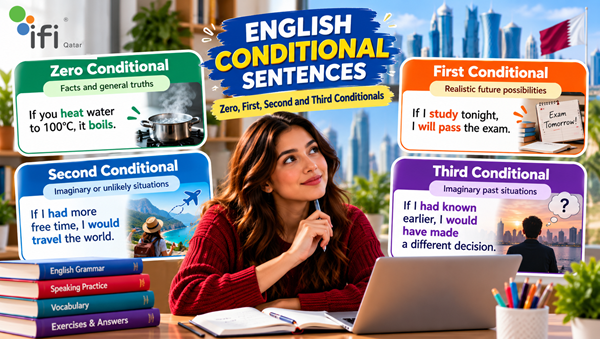
What would you do if you could live anywhere in the world? What happens if you heat water to 100°C? And what would you have done differently if you had known the truth earlier?
These questions use English conditional sentences to describe facts, possible situations, imaginary scenarios, and events that did not happen in the past. Conditionals are an essential part of everyday English because they help you explain consequences, discuss possibilities, give advice, and imagine alternative outcomes.
However, choosing the correct conditional structure can be confusing. Should you say “If I study, I will pass” or “If I studied, I would pass”? And why do we say “If I had known” when talking about an unreal past situation?
In this guide, you will learn the four main types of conditional sentences, understand when to use each one, explore practical examples, and practise with exercises and answers.
What Are English Conditional Sentences?
English conditional sentences describe a condition and its possible result. They usually contain two parts:
- The if-clause: Introduces the condition.
- The main clause: Explains the result of that condition.
For example:
“If it rains, we will stay at home.”
In this sentence:
- Condition: If it rains
- Result: We will stay at home
The relationship between these two parts determines which conditional structure you should use.
Conditional sentences can describe facts, realistic future possibilities, imaginary situations, or alternative outcomes in the past.
The Four Main Types of Conditional Sentences
There are four commonly taught types of English conditionals.
| Conditional Type | Main Use | Example |
|---|---|---|
| Zero conditional | General facts and predictable results | If you heat ice, it melts. |
| First conditional | Realistic future possibilities | If I study tonight, I will feel more prepared tomorrow. |
| Second conditional | Imaginary or unlikely present and future situations | If I had more free time, I would learn another language. |
| Third conditional | Imaginary alternatives to past events | If I had studied harder, I would have passed the exam. |
The most important difference is how the speaker views the situation: as a general fact, a realistic possibility, an imaginary situation, or an alternative past.
Zero Conditional: Facts and General Truths
The zero conditional is used to describe general truths, scientific facts, habits, and situations in which one event consistently leads to another.
Zero Conditional Structure
The basic structure is:
If + present simple, present simple.
Examples:
- If you heat water to 100°C at standard atmospheric pressure, it boils.
- If you mix blue and yellow, you get green.
- If people don’t drink enough water, they may become dehydrated.
- If I drink coffee late at night, I have trouble sleeping.
In these examples, the condition describes something that generally produces a particular result.
When to Use the Zero Conditional
Use the zero conditional when you want to talk about:
1. Scientific facts
- If water reaches its freezing point under standard conditions, it freezes.
- If plants don’t receive enough light, their growth may slow down.
2. General truths
- If you don’t eat, you become hungry.
- If you drop a glass on a hard floor, it may break.
3. Habits and routines
- If I finish work early, I go for a walk.
- If she feels stressed, she listens to music.
The zero conditional can also describe regular personal habits, not just scientific facts.
Zero Conditional Examples in Everyday English
| Condition | Result |
|---|---|
| If I wake up late, | I miss the bus. |
| If you press this button, | the machine starts. |
| If students practise regularly, | they usually improve. |
| If my phone battery gets low, | I charge it. |
Notice that both parts usually use the present simple.
Can You Use When Instead of If?
Yes. In many zero conditional sentences, when can replace if because the result is expected whenever the condition occurs.
- If I get home late, I order dinner.
- When I get home late, I order dinner.
The second sentence may suggest that the situation happens regularly.
Remember: The zero conditional focuses on general patterns, facts, and repeated results rather than one specific future possibility.
First Conditional: Realistic Future Possibilities
The first conditional describes a future situation that is realistic or possible and its likely result.
First Conditional Structure
The basic structure is:
If + present simple, will + base verb.
Examples:
- If I study tonight, I will be better prepared for the exam.
- If it rains tomorrow, we will cancel the picnic.
- If she practises speaking every day, she will become more confident.
- If they arrive early, we will have time for coffee.
The condition may or may not happen, but the speaker considers it a realistic possibility.
When to Use the First Conditional
Use the first conditional to discuss:
1. Plans and future possibilities
- If I finish work on time, I will meet my friends.
- If the weather improves, we will go to the beach.
2. Promises and offers
- If you need help, I will explain the instructions.
- If you finish your homework, I will help you check your answers.
3. Warnings and consequences
- If you don’t leave now, you will miss the train.
- If you don’t save your work, you may lose your changes.
You can use modal verbs such as may, might, can, and should in the result clause when they express the intended meaning.
For example:
“If you finish early, you can join us.”
First Conditional Examples in Everyday English
| Condition | Result |
|---|---|
| If I pass the exam, | I will celebrate. |
| If she calls me, | I will answer. |
| If we leave now, | we might arrive on time. |
| If you practise regularly, | you can improve your speaking skills. |
An Important First Conditional Rule
In the standard first conditional pattern, use the present simple in the if-clause, not will.
Incorrect: If I will have time, I will call you.
Correct: If I have time, I will call you.
The word will normally belongs in the main clause when expressing a future result.
However, will can appear in an if-clause in certain contexts, such as when it expresses willingness rather than simply predicting a future event. For everyday conditional practice, start with the standard structure.
Second Conditional: Imaginary or Unlikely Situations
The second conditional is used to imagine situations that are unreal, hypothetical, or unlikely in the present or future.
It is especially useful when discussing dreams, giving advice, or imagining what you would do in a different situation.
Second Conditional Structure
The basic structure is:
If + past simple, would + base verb.
Examples:
- If I had more free time, I would learn Spanish.
- If she lived closer, she would visit us more often.
- If I won the lottery, I would travel around the world.
- If he knew the answer, he would tell us.
Although the if-clause uses the past simple form, the sentence usually refers to an imaginary present or future situation, not a completed past event.
When to Use the Second Conditional
Use the second conditional to discuss:
1. Unreal or unlikely situations
- If I lived on an island, I would spend more time swimming.
- If I had a private jet, I would travel every weekend.
2. Dreams and imaginary possibilities
- If I could speak five languages, I would work internationally.
- If I owned a café, I would serve homemade desserts.
3. Giving advice
A common way to give advice is to use the expression If I were you.
Examples:
- If I were you, I would practise English every day.
- If I were you, I would speak to the teacher before the exam.
- If I were you, I wouldn’t worry too much about making small mistakes.
Why Do We Say “If I Were You”?
In hypothetical sentences, English commonly uses were instead of was, especially in formal English and conventional expressions.
For example:
- If I were you, I would accept the offer.
- If she were here, she would know what to do.
- If he were more confident, he would speak more often.
You may also hear was in informal conversation, particularly with I, he, she, and it. However, “If I were you” is the standard expression to learn for giving advice.
Second Conditional Examples in Everyday English
| Condition | Result |
|---|---|
| If I had more money, | I would buy a new laptop. |
| If she knew his number, | she would call him. |
| If we lived near the sea, | we would go swimming more often. |
| If I could change one thing, | I would spend more time with my family. |
Remember: The second conditional is about imagining a different reality, not simply describing a likely future event.
Compare:
- First conditional: If I have enough money, I will buy a laptop.
This is a realistic possibility. - Second conditional: If I had enough money, I would buy a laptop.
This suggests that I do not have enough money now, or that the situation is less likely.
Third Conditional: Imaginary Past Situations
The third conditional is used to imagine a different outcome for something that happened, or did not happen, in the past.
People often use it to express regret, reflect on decisions, or discuss how the past might have turned out differently.
Third Conditional Structure
The basic structure is:
If + past perfect, would have + past participle.
Examples:
- If I had studied harder, I would have passed the exam.
- If she had left earlier, she would have caught the train.
- If we had booked a table, we wouldn’t have waited so long.
- If he had listened carefully, he would have understood the instructions.
In each example, the condition refers to an unreal past situation. The result describes what might have happened under different circumstances.
When to Use the Third Conditional
Use the third conditional to discuss:
1. Regrets
- If I had practised more, I would have performed better.
- If I hadn’t stayed up so late, I wouldn’t have felt tired the next morning.
2. Missed opportunities
- If she had applied for the job, she might have been selected.
- If we had bought tickets earlier, we could have attended the concert.
3. Alternative past outcomes
- If the driver had taken another road, we would have arrived sooner.
- If they had checked the weather forecast, they might have avoided the storm.
These sentences do not change the actual past. They describe an imagined alternative.
Third Conditional Examples in Everyday English
| Past Condition | Imagined Result |
|---|---|
| If I had set an alarm, | I would have woken up on time. |
| If she had studied medicine, | she might have become a doctor. |
| If we had left earlier, | we could have avoided the traffic. |
| If he hadn’t forgotten his passport, | he wouldn’t have missed his flight. |
How to Form Negative Third Conditional Sentences
You can make either clause negative, depending on the intended meaning.
Examples:
- If I hadn’t missed the bus, I would have arrived on time.
- If she had checked her email, she wouldn’t have missed the invitation.
- If they hadn’t taken a taxi, they might have arrived late.
The negative forms are:
- had not → hadn’t
- would not have → wouldn’t have
Remember that the third conditional requires a past participle after had and after would have.
Incorrect: If I had knew, I would have helped.
Correct: If I had known, I would have helped.
Mixed Conditionals: Combining Past and Present
Mixed conditionals combine elements of different conditional patterns. They are useful when a past situation has a present result, or when a current situation affects an imagined past outcome.
Two common patterns are particularly useful to learn.
1. Past Condition With a Present Result
Use this pattern when an unreal past situation affects the present.
Structure: If + past perfect, would + base verb.
Examples:
- If I had gone to bed earlier, I wouldn’t be so tired now.
- If she had accepted the job, she would live in London now.
- If we had saved more money, we would have fewer financial worries today.
In these sentences, the condition refers to the past, while the result concerns the present.
2. Present Condition With an Imaginary Past Result
This pattern is less common but can be useful when a present characteristic or situation explains an imagined past outcome.
Structure: If + past simple, would have + past participle.
Examples:
- If I were more organised, I would have finished the project on time.
- If he spoke French, he would have understood the announcement.
- If she were more confident, she might have applied for the position.
These sentences connect a hypothetical present characteristic with a different possible outcome in the past.
Mixed Conditionals vs Third Conditional
Compare:
- Third conditional: If I had studied harder, I would have passed the exam.
- Mixed conditional: If I had studied medicine, I would be a doctor now.
The first sentence describes an alternative past outcome. The second connects an imagined past decision with a present situation.
Mixed conditionals are more advanced, so focus on mastering the four main conditional types before practising them extensively.
English Conditional Sentences: Comparison Table
Use this table to review the structures and meanings of the four main conditional types.
| Type | If-Clause | Main Clause | Main Use | Example |
|---|---|---|---|---|
| Zero | Present simple | Present simple | Facts and general truths | If you heat ice, it melts. |
| First | Present simple | Will + base verb | Realistic future possibilities | If I study, I will improve. |
| Second | Past simple | Would + base verb | Imaginary present or future | If I had more time, I would travel. |
| Third | Past perfect | Would have + past participle | Imaginary past outcomes | If I had studied, I would have passed. |
The most effective way to remember these structures is to connect the grammar with the meaning.
- Zero: What generally happens?
- First: What could realistically happen?
- Second: What would happen in an imaginary situation?
- Third: What would have happened if the past had been different?
Common Mistakes With English Conditional Sentences
Conditional sentences can be confusing because the verb forms do not always match the time reference in a straightforward way. These are some common mistakes to avoid.
Mistake 1: Using Will in the Standard First Conditional If-Clause
Incorrect: If it will rain tomorrow, we will stay home.
Correct: If it rains tomorrow, we will stay home.
In the standard first conditional, use the present simple in the if-clause and will in the main clause.
Mistake 2: Using Would in the Standard Second Conditional If-Clause
Incorrect: If I would have more time, I would learn French.
Correct: If I had more time, I would learn French.
The standard second conditional uses the past simple in the if-clause.
Mistake 3: Confusing Second and Third Conditionals
Incorrect for an unreal past situation: If I studied harder yesterday, I would pass the exam yesterday.
Correct: If I had studied harder, I would have passed the exam.
The third conditional is used for unreal past conditions and their imagined past results.
Mistake 4: Using the Wrong Verb Form in the Third Conditional
Incorrect: If she had went earlier, she would have caught the train.
Correct: If she had gone earlier, she would have caught the train.
Use the past participle after had and would have.
Mistake 5: Forgetting the Difference Between Real and Imaginary Situations
Compare:
- If I have time tomorrow, I will call you.
- If I had more time, I would call you more often.
The first sentence describes a realistic future possibility. The second describes an imagined situation in which the speaker has more time.
Mistake 6: Assuming Every Conditional Sentence Must Use If
Although if is very common, other expressions can introduce conditions or alternatives.
For example:
- Unless you hurry, you will miss the bus.
- As long as you practise, you can improve.
- Even if it rains, we will go for a walk.
Unless usually means if not, so:
“Unless you hurry, you will miss the bus” means approximately the same as “If you don’t hurry, you will miss the bus.”
Conditional Sentences Practice: Exercises With Answers
Test your understanding of the four main conditional types by completing the exercises below.
Exercise 1: Complete the Sentences
Use the correct form of the verbs in brackets.
- If you ________ (heat) ice, it ________ (melt).
- If I ________ (finish) work early tomorrow, I ________ (meet) my friends.
- If she ________ (have) more confidence, she ________ (speak) English more often.
- If they ________ (leave) earlier, they ________ (catch) the train.
- If you ________ (not water) plants, they often ________ (die).
- If he ________ (study) harder, he ________ (get) a better result next time.
- If I ________ (be) you, I ________ (talk) to the teacher.
- If we ________ (book) the tickets earlier, we ________ (pay) less.
- If she ________ (know) the answer, she ________ (tell) us.
- If I ________ (not forget) my umbrella yesterday, I ________ (not get) wet.
Exercise 2: Identify the Conditional Type
Decide whether each sentence is a zero, first, second, or third conditional.
- If you mix red and white, you get pink.
- If I see him tomorrow, I will give him your message.
- If I lived closer to work, I would walk every day.
- If they had checked the address, they wouldn’t have got lost.
- If she practises every day, she will improve her pronunciation.
- If I had known about the meeting, I would have attended.
- If people don’t get enough sleep, they often feel tired.
- If I could speak Japanese, I would apply for that job.
Exercise 3: Correct the Mistakes
Rewrite each sentence correctly.
- If I will see her, I will tell her.
- If I would be rich, I would travel the world.
- If he had studied, he would pass the exam yesterday.
- If she had knew the truth, she would have helped.
- If you heat water, it will boiled.
- If I had left earlier, I would catch the train yesterday.
Exercise 4: Write Your Own Conditional Sentences
Complete these prompts with your own ideas.
- Zero conditional: If I don’t get enough sleep, …
- First conditional: If I have time this weekend, …
- Second conditional: If I could live anywhere in the world, …
- Third conditional: If I had studied harder at school, …
- Mixed conditional: If I had learned English earlier, … now.
Try to make each sentence realistic for the conditional type you are practising.
Answer Key
Exercise 1 Answers
- If you heat ice, it melts.
- If I finish work early tomorrow, I will meet my friends.
- If she had more confidence, she would speak English more often.
- If they had left earlier, they would have caught the train.
- If you don’t water plants, they often die.
- If he studies harder, he will get a better result next time.
- If I were you, I would talk to the teacher.
- If we had booked the tickets earlier, we would have paid less.
- If she knew the answer, she would tell us.
- If I hadn’t forgotten my umbrella yesterday, I wouldn’t have got wet.
Exercise 2 Answers
- Zero conditional
- First conditional
- Second conditional
- Third conditional
- First conditional
- Third conditional
- Zero conditional
- Second conditional
Exercise 3 Answers
- If I see her, I will tell her.
- If I were rich, I would travel the world.
- If he had studied, he would have passed the exam yesterday.
- If she had known the truth, she would have helped.
- If you heat water, it boils.
- If I had left earlier, I would have caught the train yesterday.
Exercise 4 Sample Answers
Answers will vary. Here are some examples:
- If I don’t get enough sleep, I feel tired the next day.
- If I have time this weekend, I will visit my family.
- If I could live anywhere in the world, I would live near the sea.
- If I had studied harder at school, I would have achieved better grades.
- If I had learned English earlier, I would feel more confident speaking it now.
How to Use Conditional Sentences More Confidently in Conversation
Understanding the grammar rules is a good start, but you also need to use conditional sentences when speaking and writing.
Try these practical activities to make the structures easier to remember.
1. Talk About Everyday Facts
Use the zero conditional to describe things that happen regularly.
For example:
- If I drink too much coffee, I can’t sleep.
- If I exercise in the morning, I feel more energetic.
- If I practise English regularly, I remember more vocabulary.
These examples help you connect grammar with familiar experiences.
2. Make Plans for the Future
Use the first conditional to talk about possible future events.
Ask yourself:
- What will you do if you finish work early?
- What will happen if you miss the bus?
- What will you do if you pass your next English test?
Answer each question with a complete sentence.
3. Imagine Different Situations
Use the second conditional to explore imaginary possibilities.
For example:
- What would you do if you could work anywhere?
- What would you buy if you won a million dollars?
- Where would you live if you could choose any country?
These questions are also useful for practising conversational English and developing longer answers.
4. Reflect on Past Decisions
Use the third conditional to discuss alternative outcomes.
For example:
- What would you have done if you had missed your flight?
- What would have happened if you had chosen a different course?
- How would your life have changed if you had learned another language earlier?
You can use these questions for speaking practice, journalling, or classroom discussions.
5. Practise With Feedback
Write five conditional sentences each day. Identify the type of each sentence, check the verb forms, and read the sentences aloud.
When possible, ask a teacher or learning partner to review your work. Feedback can help you recognise repeated errors and apply the correct structures more naturally.
Improve Your English Grammar With IFI Qatar
Conditional sentences help you express possibilities, explain consequences, give advice, and discuss situations that could have turned out differently. They are useful in everyday conversations, academic writing, professional communication, and English proficiency preparation.
At IFI Qatar, you can explore English learning options in Doha or online, depending on your goals and course availability. Practical grammar instruction combined with speaking and writing activities can help you move beyond memorising rules and start applying them in real communication.
Whether you want to improve your everyday English, communicate more confidently at work, or strengthen your grammar for further study, consider discussing your current level and learning priorities with the team.
Ready to improve your practical English grammar? Contact IFI Qatar to explore available English courses and find a learning option that supports your goals.
Frequently Asked Questions About English Conditional Sentences
What are the four main types of English conditional sentences?
The four main types are zero, first, second, and third conditional. The zero conditional describes general facts, the first describes realistic future possibilities, the second describes imaginary present or future situations, and the third describes alternative outcomes in the past.
What is the structure of the zero conditional?
The zero conditional usually follows the structure if + present simple, present simple. For example, “If you heat ice, it melts.” It is used for general truths, scientific facts, habits, and predictable results.
What is the difference between the first and second conditional?
The first conditional describes a realistic future possibility, such as “If I have time, I will call you.” The second conditional describes an imaginary or less likely situation, such as “If I had more time, I would travel more.”
When should I use the third conditional?
Use the third conditional to imagine a different result for a past event. Its standard structure is if + past perfect, would have + past participle. For example, “If I had left earlier, I would have caught the train.”
Can I use will after if?
In the standard first conditional, the if-clause normally uses the present simple rather than will. For example, say “If it rains, we will stay home.” However, will can appear in an if-clause in certain contexts, such as when expressing willingness.
What is the difference between conditional sentences and mixed conditionals?
The four main conditional types each have a common structure and use. Mixed conditionals combine different patterns to connect an unreal past situation with a present result, or a hypothetical present situation with an imagined past outcome.
What does unless mean in a conditional sentence?
Unless generally means if not. For example, “Unless you hurry, you will miss the bus” means approximately the same as “If you don’t hurry, you will miss the bus.”
How can I practise English conditional sentences?
Start by learning the structure and meaning of each type. Complete grammar exercises, write your own examples, answer hypothetical questions aloud, and practise using conditionals in conversations. Reviewing mistakes and receiving feedback can help you improve accuracy.
Final Thoughts
English conditional sentences allow you to communicate much more than simple facts. They help you describe general truths, talk about future possibilities, imagine different situations, and reflect on the past.
Remember the basic structures:
- Zero conditional: If + present simple, present simple.
- First conditional: If + present simple, will + base verb.
- Second conditional: If + past simple, would + base verb.
- Third conditional: If + past perfect, would have + past participle.
Learn what each structure means rather than memorising formulas alone. Practise with examples from your own life, complete the exercises in this guide, and use conditional questions in everyday conversations.
With regular practice, you can become more confident in choosing the right conditional structure and expressing your ideas clearly in English.
If you would like structured support, explore practical English grammar courses at IFI Qatar and continue developing the skills you need for confident communication.