

Currently Empty: ر.ق 0,00


IELTS
How to Turn Your IELTS Mock Test Report into an Improvement Plan
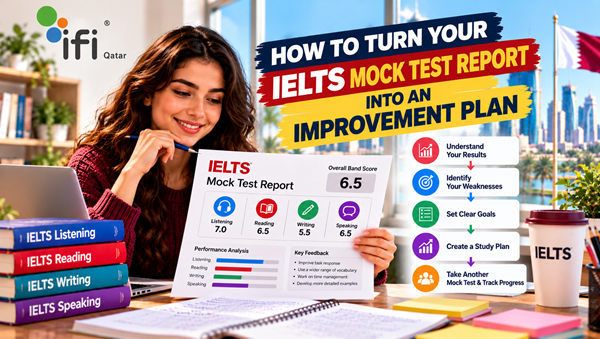
Taking an IELTS mock test is an important step in your preparation, but the real value comes from understanding your results and using them to improve. A score tells you how you performed in a particular test. A detailed review helps you understand why you achieved that result, which skills need attention, and what you should do next.
Your IELTS mock test report can become a practical roadmap for improving your Listening, Reading, Writing, and Speaking performance. Instead of repeating practice tests without a clear strategy, you can use the information in your report to set priorities, choose targeted exercises, and measure your progress over time.
The most effective way to use an IELTS mock test report is to identify your biggest weaknesses, investigate the reasons behind them, and turn your findings into specific, measurable study goals.
In this guide, you will learn how to interpret your results, analyse each IELTS skill, build a personalised improvement plan, and decide when another mock test or professional coaching could help you move towards your target band score.
What Is an IELTS Mock Test Report?
An IELTS mock test report summarises your performance in a practice test. Depending on the provider, it may include individual skill scores, an estimated overall band score, feedback on your answers, and recommendations for improvement.
A basic report may show only your results in Listening, Reading, Writing, and Speaking. A more detailed assessment may explain why you lost marks and identify specific areas that need further practice.
The information available depends on the assessment service, so check what your report includes before booking a mock test.
What Information Should You Look For?
When reviewing your IELTS mock test report, look for the following details:
- Overall band estimate: An indication of your combined performance across the four skills.
- Individual skill scores: Your estimated performance in Listening, Reading, Writing, and Speaking.
- Raw scores: The number of correct answers in Listening and Reading, where available.
- Assessment feedback: Comments about your Writing and Speaking performance, if provided.
- Recurring errors: Mistakes that appear repeatedly across questions or tasks.
- Areas for improvement: Specific skills or strategies that require additional attention.
Not every report contains all these elements. If your report provides only numerical scores, you may need to review your answers, use assessment criteria, or seek additional feedback to understand the causes of your mistakes.
Why Your Report Matters More Than the Score Alone
Two candidates can receive the same estimated band score but need very different preparation strategies.
For example, one candidate might struggle with Reading because they spend too long on individual questions. Another might manage their time effectively but misunderstand complex sentences.
Both candidates may need to improve Reading, but their study plans should be different.
A useful report helps you move beyond the question, “What score did I get?” and focus on a more valuable question: “What should I change to perform better next time?”
Step 1: Compare Your Results with Your Target IELTS Band
Before planning your next study session, establish the difference between your current performance and your target.
Your target may be an overall band score or a minimum score in one or more individual skills. This distinction matters because achieving your overall goal does not always mean meeting every requirement set by a university, employer, or immigration authority.
Calculate the Gap in Each Skill
Start by recording your current estimated scores and your target scores.
For example, suppose your goal is an overall Band 7.0 and your mock test report shows the following results:
| IELTS skill | Mock test score | Target score | Initial priority |
|---|---|---|---|
| Listening | 7.0 | 7.0 | Maintain performance |
| Reading | 6.5 | 7.0 | Moderate |
| Writing | 5.5 | 6.5 | High |
| Speaking | 6.5 | 7.0 | Moderate |
In this example, Writing has the largest gap between the current score and the target.
That does not automatically mean every study session should focus exclusively on Writing. You should also consider how much time you have, the nature of your mistakes, and whether the other skills require maintenance.
However, the table gives you a useful starting point for deciding where additional effort may have the greatest benefit.
Understand Your Overall Band Score
IELTS overall band scores are calculated by averaging the four individual skill scores and rounding the result according to the IELTS scoring rules. The overall score and the individual component scores are reported separately.
For example, a candidate with estimated scores of 7.0 in Listening, 6.5 in Reading, 5.5 in Writing, and 6.5 in Speaking has an average of 6.375. Under the IELTS rounding rules, an average ending in .375 is rounded to the nearest half band, giving an overall score of 6.5.
However, a mock test estimate is not an official result. Different providers may use different assessment methods, particularly for Writing and Speaking.
Always check the score requirements that apply to your intended application rather than relying only on the overall score.
Step 2: Identify Your Strongest and Weakest IELTS Skills
Once you have compared your scores with your target, review the four skills individually.
Your lowest score is an obvious starting point, but it is not the only factor that matters. You should also consider recurring errors, the reliability of the assessment, and how much improvement is realistic within your preparation timeline.
Analyse Your Listening Results
Listening results can help you identify whether you are struggling with understanding spoken English, recognising specific information, or completing questions accurately under time pressure.
Review your incorrect answers and look for patterns.
Ask yourself:
- Did I miss important details because the speaker talked quickly?
- Did I misunderstand a paraphrase?
- Did I lose concentration during a longer recording?
- Did I struggle with maps, multiple-choice questions, or matching tasks?
- Did I make spelling or word-form mistakes?
- Did I lose track of the recording while thinking about an earlier answer?
For example, if you repeatedly lose marks in map labelling questions, your main weakness may involve following directions and understanding spatial relationships.
If you understand the recording but frequently miss answers because of spelling errors, repeating entire Listening tests may not be the most efficient solution. You may benefit more from targeted spelling and answer-checking exercises.
Analyse Your Reading Results
Reading performance depends on more than vocabulary knowledge. Time management, understanding paragraph structure, recognising paraphrases, and selecting relevant information can all influence your result.
Review your incorrect answers and consider the following questions:
- Did I understand the main idea of the passage?
- Did I spend too long on one question?
- Did I choose an answer because it repeated a word from the text?
- Did I confuse the main idea with a supporting detail?
- Did I misunderstand a statement or the writer’s position?
- Did I leave questions unanswered because I ran out of time?
Suppose your report shows repeated errors in Matching Headings questions. You may need to practise identifying the main idea of each paragraph rather than focusing on individual keywords.
If your main difficulty is time management, practise setting time limits and moving on when a question becomes too demanding.
Analyse Your Writing Results
Writing often requires more detailed feedback than a numerical score can provide.
IELTS Writing is assessed using four criteria: Task Achievement for Task 1, Task Response for Task 2, Coherence and Cohesion, Lexical Resource, and Grammatical Range and Accuracy. Each task is assessed independently, and Task 2 carries more weight in the overall Writing score.
When reviewing your report, examine the feedback for both tasks if it is available.
Ask yourself:
- Did I address every part of the question?
- Were my ideas relevant and sufficiently developed?
- Was my response organised logically?
- Did I use vocabulary accurately and naturally?
- Did repeated grammatical errors affect clarity?
- Did I manage the time available for both tasks?
For Academic Task 1, you may need to improve your overview, selection of key features, or comparisons.
For General Training Task 1, you may need to focus on covering all the required points and using an appropriate tone.
For Task 2, your main weakness may involve developing arguments, maintaining a clear position, organising paragraphs, or using grammar accurately.
The best improvement plan depends on the actual feedback rather than assumptions based solely on your score.
Analyse Your Speaking Results
Speaking assessments consider Fluency and Coherence, Lexical Resource, Grammatical Range and Accuracy, and Pronunciation. These criteria provide a framework for understanding different aspects of spoken performance.
If your mock test report includes criterion-based feedback, use it to identify specific weaknesses.
Ask yourself:
- Do I hesitate frequently while searching for words?
- Are my answers too short or insufficiently developed?
- Do I repeat the same vocabulary?
- Can I explain my ideas clearly?
- Do grammatical errors make my meaning difficult to follow?
- Is my pronunciation clear and easy to understand?
For example, if you can answer questions accurately but struggle to extend your responses, practise adding explanations, reasons, and relevant examples.
If your feedback identifies pronunciation issues, focus on the specific features affecting intelligibility rather than trying to imitate a particular accent.
Step 3: Look for Patterns Instead of Isolated Mistakes
One incorrect answer does not necessarily reveal a major weakness. The more useful question is whether similar mistakes occur repeatedly.
A pattern can help you identify the underlying skill that needs improvement.
Create an Error Analysis Table
After reviewing your report, record the mistakes that occurred and the actions you can take to address them.
| IELTS skill | Observed problem | Possible underlying cause | Recommended practice |
|---|---|---|---|
| Listening | Missed details in conversations | Difficulty recognising paraphrases | Practise listening for synonyms and equivalent expressions |
| Listening | Incorrect map answers | Difficulty following directions | Review direction vocabulary and practise map labelling |
| Reading | Incorrect Matching Headings answers | Confusing main ideas with details | Summarise paragraphs in one sentence |
| Reading | Unanswered questions near the end | Poor time management | Practise timed passages and question prioritisation |
| Writing | Ideas are relevant but underdeveloped | Limited explanation and support | Practise expanding main ideas with reasons and examples |
| Writing | Frequent sentence errors | Weak control of grammar | Review recurring errors and rewrite incorrect sentences |
| Speaking | Frequent hesitation | Difficulty retrieving vocabulary quickly | Practise structured answers and topic-based speaking |
| Speaking | Answers lack development | Limited explanation | Add reasons, examples, and supporting details |
These are examples rather than universal diagnoses. Use the evidence in your own report to determine which explanations apply to you.
Separate Knowledge Gaps from Test-Taking Problems
A useful improvement plan distinguishes between two broad types of weaknesses.
Knowledge gaps involve the language skills or understanding needed to answer correctly. Examples include limited vocabulary, difficulty understanding complex sentences, and recurring grammatical errors.
Test-taking problems involve how you apply your knowledge under exam conditions. Examples include spending too long on one question, failing to follow instructions, or losing concentration during a timed test.
The distinction matters because each problem requires a different response.
If you do not understand a passage, more vocabulary or reading-comprehension practice may be necessary. If you understand it but run out of time, you may need a different timing strategy.
Step 4: Turn Your Findings into Specific Study Goals
After identifying your main weaknesses, turn them into clear goals.
A general goal such as “improve Reading” does not tell you what to practise or how to measure progress.
A more useful goal identifies a particular skill, an action, and a way to review the outcome.
Use Measurable Goals
Compare these examples:
| General goal | More actionable goal |
|---|---|
| Improve Listening | Complete three map labelling exercises and review every incorrect answer this week |
| Improve Reading | Practise Matching Headings questions and write a one-sentence summary for each paragraph |
| Improve Writing | Write two Task 2 essays and review them against the four IELTS Writing criteria |
| Improve Speaking | Record several practice answers and review fluency, organisation, vocabulary, grammar, and clarity |
The second column gives you a clear action rather than an outcome you cannot directly control.
You cannot guarantee that a particular number of practice exercises will increase your band score. However, you can control how consistently you practise, review errors, and apply feedback.
Prioritise Two or Three Weaknesses at a Time
Trying to fix every weakness simultaneously can make your preparation difficult to manage.
Instead, choose a small number of priorities based on:
- The gap between your current score and target.
- How frequently the problem occurs.
- Whether it affects several questions or tasks.
- The time available before your official exam.
- Whether you can address it independently or need additional guidance.
You can maintain your stronger skills with regular practice while dedicating more time to the areas that need attention.
Step 5: Build a Weekly IELTS Improvement Plan
A weekly plan translates your assessment into a realistic study routine.
Your schedule should reflect your current performance, target score, available time, and the type of practice most likely to address your weaknesses.
Example of a Seven-Day Study Plan
Suppose your mock test report identifies Writing and Reading as your main priorities, while Listening and Speaking are closer to your target.
You could use the following example schedule:
| Day | Main activity | Purpose |
|---|---|---|
| Monday | Review Writing feedback and rewrite one weak paragraph | Apply assessment feedback |
| Tuesday | Practise Reading Matching Headings questions | Improve main-idea recognition |
| Wednesday | Complete a Writing Task 2 under timed conditions | Develop task management and essay structure |
| Thursday | Complete a Listening practice exercise | Maintain listening accuracy |
| Friday | Review Reading errors and practise similar questions | Reduce recurring mistakes |
| Saturday | Practise Speaking and record answers | Maintain fluency and identify language issues |
| Sunday | Review the week’s progress and plan the next week | Evaluate consistency and adjust priorities |
This is an example, not a mandatory schedule. If your main weakness is Listening, your plan should allocate more time to Listening practice instead.
The important point is that each activity should have a clear purpose connected to your assessment results.
Make Time for Reviewing Your Practice
Do not measure progress only by the number of questions you complete.
Reserve time to understand incorrect answers, correct repeated errors, and apply feedback.
For Writing and Speaking, this may involve reviewing assessment criteria and rewriting or repeating a response. For Listening and Reading, it may involve identifying the exact point where your interpretation differed from the correct answer.
A smaller amount of carefully reviewed practice can be more useful than completing many exercises without analysing the results.
Step 6: Know When to Seek IELTS Coaching
Independent study can be effective when you understand your weaknesses and know how to address them.
However, there are situations where professional feedback may help you make better use of your preparation time.
Consider Coaching If Your Score Has Stopped Improving
If you have completed several practice tests but continue receiving similar results, your current approach may not be addressing the underlying problem.
For example, you may be writing multiple essays without realising that your arguments lack development. Or you may repeatedly lose Reading marks because you rely on matching keywords rather than understanding the passage.
A suitably qualified IELTS teacher can help identify these patterns and recommend more targeted practice.
Seek Feedback When Self-Assessment Is Difficult
Writing and Speaking can be particularly difficult to assess independently.
You may recognise spelling mistakes in an essay but struggle to determine whether your arguments are sufficiently developed. Similarly, you may feel comfortable speaking English without recognising issues in fluency, coherence, or pronunciation.
A structured assessment can provide an additional perspective on your performance and help you understand what to prioritise.
Choose Support That Matches Your Needs
Before enquiring about IELTS coaching, consider what type of help would be most useful.
You may need:
- Writing assessment with criterion-based feedback.
- Speaking practice and performance feedback.
- Targeted Reading or Listening lessons.
- A study plan based on your mock test results.
- Follow-up assessments to measure progress.
Ask what the service includes and how feedback will be provided. The most suitable option is one that addresses your actual weaknesses rather than simply adding more practice to your schedule.
Step 7: Decide When to Take Your Next IELTS Mock Test
After a period of focused practice, another mock test can help you evaluate whether your preparation is working.
However, taking another test immediately after reviewing your report may not give you enough time to make meaningful changes.
Do Not Repeat Mock Tests Without a Plan
Repeated tests can help you become familiar with the exam format, but they are not a substitute for targeted learning.
If you take another mock test without addressing the mistakes identified in your previous report, you may receive a similar result without understanding why.
Before booking your next test, make sure you have:
- Identified your main weaknesses.
- Completed focused practice in those areas.
- Reviewed the feedback from your previous assessment.
- Applied at least some of the recommended changes.
- Established what you want to measure in the next test.
This approach makes your next report more useful because you can compare your performance against specific goals.
Compare Your Reports to Measure Progress
When you receive your next report, compare it with the previous one.
Look at individual skill scores, recurring errors, timing, and criterion-based feedback where available.
For example, you may find that your Reading score remains unchanged, but you now complete all three passages within the available time. That improvement may indicate progress in timing even though your estimated band has not changed.
Similarly, your Writing score may remain stable while feedback indicates fewer grammatical errors but continued weaknesses in Task Response. This tells you that your next preparation phase should focus more closely on developing ideas and addressing the task.
A useful comparison examines both the score and the reasons behind it.
Example: Turning an IELTS Mock Test Report into an Improvement Plan
Consider a candidate preparing for an overall Band 7.0.
Their mock test report contains the following estimated results:
| Skill | Estimated band | Main finding |
|---|---|---|
| Listening | 7.0 | Generally accurate, with occasional detail errors |
| Reading | 6.0 | Several errors in Matching Headings and incomplete final passage |
| Writing | 5.5 | Ideas need further development and grammatical errors recur |
| Speaking | 6.5 | Responses are generally clear but sometimes lack detail |
The candidate should not automatically divide study time equally between all four skills.
Instead, they can use the report to create a more targeted plan.
Priority 1: Improve Writing
The candidate reviews both Writing tasks and identifies recurring issues with idea development and grammar.
Their action plan is to practise planning essays, developing supporting explanations, and reviewing grammar errors. They also seek criterion-based feedback to determine whether their revisions address the main weaknesses.
Priority 2: Improve Reading Accuracy and Timing
The candidate reviews incorrect Matching Headings answers and discovers that they often select headings based on individual keywords.
They begin summarising each paragraph in one sentence before selecting a heading. They also practise timed passages to improve their ability to complete the test efficiently.
Priority 3: Maintain Listening and Speaking
Listening is relatively close to the candidate’s target, so they continue regular practice while reviewing missed details.
For Speaking, they practise extending answers with explanations and relevant examples rather than giving short responses.
Follow-Up Assessment
After a period of focused preparation, the candidate takes another mock test.
The new report helps them determine whether the targeted exercises are working and whether their next study phase should focus on the same weaknesses or a different priority.
The key lesson is that a mock test report should influence the next stage of preparation. It should not simply be filed away after the score has been recorded.
Frequently Asked Questions About IELTS Mock Test Reports
What is an IELTS mock test report?
An IELTS mock test report summarises your performance in a practice exam. Depending on the provider, it may include estimated scores for Listening, Reading, Writing, and Speaking, along with feedback and recommendations for improvement.
How do I use my IELTS mock test report to improve my score?
Compare your results with your target, identify recurring mistakes, and prioritise the skills that need the most attention. Turn these findings into specific study goals, complete targeted practice, and use another mock test to evaluate your progress.
Should I focus on my lowest IELTS band score first?
Your lowest score is a useful starting point, but it should not be the only factor in your decision. Consider the gap between your current and target scores, the frequency of your mistakes, the reliability of the assessment, and the time available before your exam.
How long should I study before taking another mock test?
There is no fixed waiting period that works for everyone. Allow enough time to practise the skills identified in your previous report and apply the feedback. Your next test should help you evaluate progress rather than simply repeat the same assessment.
Why is my IELTS mock test score not improving?
Your score may remain unchanged if your preparation does not address the underlying causes of your mistakes. Reviewing your answers, identifying recurring errors, practising specific skills, and obtaining feedback where needed can help you develop a more effective approach.
Can I create an IELTS improvement plan without a teacher?
Yes. You can review your scores, analyse incorrect answers, set measurable goals, and organise your own study schedule. However, professional feedback may be useful when you struggle to assess Writing or Speaking accurately or cannot identify why your performance has stopped improving.
Are IELTS mock test reports accurate?
Their usefulness depends on the quality of the test and the assessment method. Listening and Reading results can be compared with answer keys, while Writing and Speaking estimates may depend more heavily on the assessment process and feedback provided. A mock test report is an indicator of practice performance, not a guarantee of your official result.
Should I take another IELTS mock test if I did not reach my target band?
A follow-up mock test can be useful after you have worked on the weaknesses identified in your previous report. Review the results first, complete targeted practice, and then use another assessment to evaluate your progress.
Can IELTS coaching help me understand my mock test results?
IELTS coaching may help you interpret assessment feedback, identify recurring weaknesses, and develop a more focused study plan. Before choosing a service, check whether it includes the type of feedback or skill-specific support you need.
Turn Your IELTS Mock Test Results into Progress with IFI Qatar
Your IELTS mock test report is most valuable when it leads to clear action. By understanding your results, identifying recurring errors, and prioritising the right skills, you can make your preparation more focused and measure progress more effectively.
Start by reviewing your current report and selecting two or three areas for improvement. Build a realistic weekly plan, practise the skills that need attention, and review your mistakes before taking another mock test.
If you are unsure why your score has stopped improving, additional assessment or coaching may help you identify what to work on next.
Preparing for IELTS in Qatar? Explore the IELTS mock-test and preparation options available through IFI Qatar, or enquire about suitable coaching support if you need help turning your results into a focused improvement plan.
Your next mock test should do more than produce another score. It should help you understand what has improved, what still needs attention, and what to do next.