

Currently Empty: ر.ق 0,00


IELTS
What to Do After Failing an IELTS Practice Test
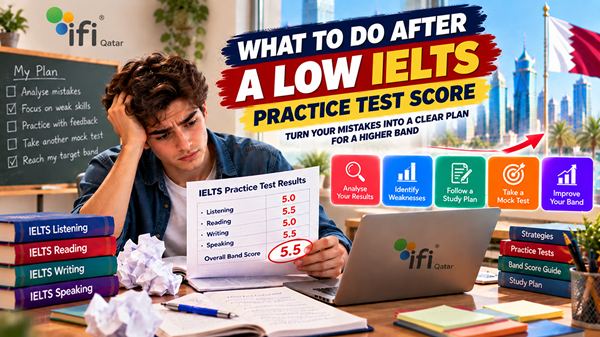
Getting a low score on an IELTS practice test can be frustrating, especially when you have spent weeks studying and expected a better result. You may start questioning your English level, wondering whether your target band is realistic or worrying that you are not ready for your official IELTS exam.
However, a disappointing practice score does not mean you have failed at IELTS preparation. It gives you information about your current performance and shows where your next study efforts should go.
If you have received an IELTS practice test low score, the most useful response is not to take another test immediately or memorise more vocabulary without a plan. Instead, identify why you lost marks, determine which skills need the most attention and use your results to build a more focused preparation strategy.
This guide explains exactly what to do after a low IELTS mock test score, how to improve your weakest skills and when another mock test can help you measure your progress.
What Does a Low IELTS Practice Test Score Really Mean?
A low mock test score is a snapshot of your performance under particular conditions. It is not necessarily a reliable prediction of your final IELTS result, and it does not tell you everything about your English ability.
Your score may reflect several factors, including language proficiency, unfamiliarity with the test format, poor time management, concentration problems or difficulty understanding the assessment criteria.
Before changing your study routine, establish what your result actually tells you.
Distinguish Between a Low Practice Score and an Official IELTS Result
An IELTS practice test is designed to help you prepare and evaluate your performance. Its usefulness depends on the quality of the questions, how closely the test follows the official format and how accurately your answers are assessed.
A short online quiz, for example, may help you practise particular question types, but it cannot provide the same level of insight as a full-length assessment covering Listening, Reading, Writing and Speaking.
Your official IELTS result is assessed and reported through the IELTS testing system. A practice score should be treated as an estimate, not a guarantee of the score you will receive in the real exam.
Check How Far You Are From Your Target Band
Before deciding what to improve, compare your current performance with the score you need.
Suppose your target is an overall Band 7.0, but your latest practice results suggest an overall score of 6.0. You should examine your individual skill scores before deciding what to study.
You may be relatively strong in Listening and Reading but struggle with Writing. Alternatively, your English may be adequate for your target, but you may lose marks because you cannot finish tasks on time.
Also check whether your university, employer or other receiving organisation requires minimum scores in individual skills. An acceptable overall band may not be sufficient if one section falls below the required minimum.
Step 1: Analyse Your IELTS Mock Test Results
The first step after an IELTS practice test low score is to understand where the marks were lost.
Do not simply write down your overall band and move on. Review each section separately and look for patterns in your mistakes.
Review Your Listening Mistakes
Listening errors can happen for several reasons. You may miss information while reading the questions, misunderstand a paraphrase, choose an incorrect option after hearing a distractor or lose marks because of spelling and word-limit mistakes.
After checking your answers, ask yourself:
- Did I understand the recording but select the wrong answer?
- Did I miss important information because I lost concentration?
- Did I struggle to recognise paraphrases?
- Did I make spelling or word-form errors?
- Did I lose track of the recording while thinking about an earlier question?
Write down the main reasons for your mistakes. If most of your errors involve distractors, for example, practise listening for changes of opinion and corrections rather than repeating entire tests without a specific goal.
Review Your Reading Mistakes
A low Reading score may indicate vocabulary difficulties, slow reading speed, problems locating information or confusion about question instructions.
Review each incorrect answer and determine whether the problem was understanding the passage, interpreting the question or managing your time.
Pay particular attention to:
- True, False and Not Given questions.
- Matching headings and matching information.
- Multiple-choice questions.
- Sentence, summary and note completion.
- Questions you left unanswered because time ran out.
If you understood the passage but selected an answer that was not supported by the text, practise finding direct evidence for each answer. If you repeatedly run out of time, work on scanning, skimming and allocating time more effectively.
Review Your Writing Performance
Writing can be difficult to assess independently because a response may communicate its main idea while still falling short of the required band.
IELTS Writing is assessed using four criteria: task achievement or task response, coherence and cohesion, lexical resource, and grammatical range and accuracy. Task 2 carries more weight than Task 1 in the Writing score.
Use the official IELTS Writing assessment resources to understand what examiners look for.
When reviewing your response, ask:
- Did I answer every part of the question?
- Did I develop my ideas with relevant explanations and examples?
- Is the organisation of my response logical?
- Did I use vocabulary accurately and appropriately?
- Are grammatical errors affecting clarity?
- Did I manage my time and meet the task requirements?
If you cannot confidently assess your own Writing, consider getting feedback from a qualified teacher or an assessment service that explains your weaknesses against IELTS criteria.
Review Your Speaking Performance
Speaking difficulties are not always caused by a lack of vocabulary. You may know enough English to express your ideas but struggle to organise your answers, speak fluently or pronounce words clearly.
Record yourself answering IELTS-style questions and review your responses.
Check whether you:
- Pause frequently because you cannot develop an answer.
- Repeat the same words and expressions.
- Give very short answers without explanation.
- Lose coherence when discussing unfamiliar topics.
- Make grammatical errors that affect meaning.
- Have pronunciation problems that make your speech difficult to understand.
IELTS Speaking is assessed using fluency and coherence, lexical resource, grammatical range and accuracy, and pronunciation. Reviewing these criteria can help you identify the specific areas that need improvement.
Step 2: Identify the Main Reason for Your Low IELTS Score
Once you have reviewed your mistakes, group them into categories. This helps you distinguish between a language problem and a test-taking problem.
| Main problem | What it may look like | Recommended focus |
|---|---|---|
| Limited vocabulary | You cannot understand key words or paraphrased information | Learn vocabulary in context and practise paraphrase recognition |
| Weak grammar | Frequent errors affect Writing or Speaking clarity | Review recurring grammar errors and apply them in complete responses |
| Poor time management | You leave questions unanswered or rush the final tasks | Practise with time limits and plan how to allocate time |
| Unfamiliarity with question types | You misunderstand instructions or choose unsuitable strategies | Learn the format and practise each question type |
| Weak Writing organisation | Your ideas lack development or logical progression | Practise planning, paragraph structure and idea development |
| Speaking hesitation | You struggle to extend answers naturally | Practise speaking in timed responses and review recordings |
| Concentration problems | You miss information despite understanding the topic | Practise sustained attention under realistic test conditions |
You may have more than one problem. That is normal. The goal is to identify the issues that have the greatest impact on your current result and address them in a sensible order.
Step 3: Create a Study Plan Based on Your Weakest Skills
After identifying the main causes of your low score, build a preparation plan around those findings.
A useful plan should include a specific skill, a clear activity, a way to measure progress and a date for reviewing your results.
If Listening Is Your Weakest Skill
Spend time reviewing recordings and transcripts rather than completing listening exercises without checking your mistakes.
A focused session could include:
- Complete a set of Listening questions under timed conditions.
- Check your answers and identify the incorrect ones.
- Listen again to the relevant sections.
- Read the transcript to identify missed words, paraphrases or distractors.
- Repeat the exercise with a different set of questions.
Track your raw score and the types of errors you make. For Listening, a raw score is the number of correct answers out of 40, which can be converted to an approximate band score.
If Reading Is Your Weakest Skill
Practise the question types that cause the most difficulty and learn to support answers with evidence from the passage.
Avoid translating every sentence into your first language. Instead, practise identifying the main idea, locating relevant details and recognising how the question paraphrases the text.
Use timed exercises to improve efficiency, but occasionally practise without strict time pressure when you need to understand a difficult passage or question type.
If Writing Is Your Weakest Skill
Do not try to improve Writing by memorising complete essays or adding complicated vocabulary to every sentence.
Focus on answering the task accurately, organising ideas logically, supporting your arguments and improving grammatical accuracy.
A practical routine is to plan a response, write it under timed conditions, review it against the official criteria and rewrite the weakest sections. Feedback from a qualified assessor can help you identify problems you may overlook yourself.
If Speaking Is Your Weakest Skill
Practise speaking regularly, but make the exercises specific.
For example, record a two-minute response to an IELTS Speaking Part 2 topic, listen to the recording and note where you hesitate, repeat vocabulary or lose the logical flow of your answer.
Repeat the task after reviewing your notes. The aim is to communicate more clearly and naturally, not to memorise a scripted answer.
Step 4: Avoid Common Mistakes After a Low IELTS Practice Test Score
Your response to a disappointing result can influence how efficiently you prepare for your next assessment.
Do Not Take Another Full Mock Test Immediately Without Reviewing Your Errors
Repeated testing can help you become familiar with the format, but it is less useful if you make the same mistakes every time.
Review the first test, identify your weaknesses and complete targeted practice before taking another full assessment.
Do Not Study All Four Skills Equally by Default
Balanced preparation is important, but your available study time should reflect your needs.
If Listening and Reading are already close to your required scores while Writing remains significantly lower, spending most of your additional study time on your strongest sections may not be the best use of your effort.
Prioritise the skills that are holding you back, while maintaining the others through regular practice.
Do Not Assume You Need More Advanced Vocabulary
A low score does not automatically mean that you need more difficult words. In Writing and Speaking, inaccurate or unnatural vocabulary can make communication less effective.
Focus on using words precisely, developing relevant ideas and producing clear language before trying to make every response sound advanced.
Do Not Ignore the Official Assessment Criteria
Understanding how IELTS evaluates performance helps you direct your practice towards the right goals.
Use official sample tasks, answer keys and assessment guidance where available. The official IELTS preparation resources provide practice materials and information about test tasks.
Do Not Book Your Next Test Based on One Score Alone
A single practice test may be affected by fatigue, unfamiliar questions or other temporary factors.
Review more than one result when possible and look for a consistent pattern. If your scores remain below your target, identify the remaining gaps before deciding whether you are ready for the official exam.
Step 5: When Should You Take Another IELTS Mock Test?
There is no universal waiting period between IELTS mock tests. The right time depends on what you learned from your previous assessment and whether you have completed enough focused practice to evaluate progress.
A useful approach is to take your next full mock test when you have worked on the main weaknesses revealed by your previous result.
Take Another Mock Test When You Need to Measure Progress
A second mock test can help you determine whether your preparation is making a difference.
Use a test that matches your intended IELTS type and format, and complete it under realistic timing conditions. Compare the new results with your previous assessment, including individual skill scores and recurring mistakes.
If your score improves, identify which changes helped. If it does not, review whether your preparation addressed the actual cause of the problem.
Consider a Mock Test With Detailed Feedback
If you repeatedly receive low scores but cannot explain why, another test without meaningful analysis may not give you the information you need.
A mock-test service with appropriate feedback can help you understand your performance, particularly in Writing and Speaking, where assessment involves multiple criteria.
Before booking, confirm what the service includes. Check whether it assesses all four skills, how the scores are estimated and whether feedback or improvement recommendations are provided.
Step 6: Choose an IELTS Mock Test That Helps You Improve
The right mock test should do more than give you another score. It should help you evaluate your readiness and decide what to do next.
When comparing IELTS mock-test options, consider the following:
- Test format: Does the mock test match your intended IELTS Academic or General Training exam?
- Skill coverage: Does it assess all four skills or only selected sections?
- Realistic timing: Can you practise under conditions similar to the test?
- Scoring method: Is it clear how your results are calculated?
- Writing and Speaking feedback: Can you understand the weaknesses behind your scores?
- Actionable recommendations: Will the results help you plan your next preparation steps?
- Booking details: Are the available dates, fees and service arrangements suitable for you?
Do not choose a mock test based on price alone. A lower-cost test may be suitable for practising question types, while an assessment with more detailed feedback may be more useful when you need to understand persistent weaknesses.
How IFI Qatar Can Help You Assess Your IELTS Readiness
If you are preparing for IELTS in Doha or elsewhere in Qatar and your practice scores are consistently below your target, consider exploring the mock-test options available through IFI Qatar.
Before booking, confirm the available test format, skills assessed, scoring information, feedback options and current session details. Choose an assessment that fits the questions you need answered about your performance.
A clear understanding of your current level can help you make more informed decisions about your preparation, rather than continuing to practise without knowing whether you are addressing the right problems.
A Practical 7-Day Plan After a Low IELTS Practice Test Score
The following is an example of a short review cycle. Adjust it according to your available study time and the weaknesses revealed by your assessment.
| Day | Main activity | Intended outcome |
|---|---|---|
| Day 1 | Review your mock test and categorise mistakes | Identify the main reasons for your low score |
| Day 2 | Practise your weakest Listening or Reading question types | Improve accuracy and understand recurring errors |
| Day 3 | Complete focused Writing practice and review the assessment criteria | Identify issues with task response, organisation or language |
| Day 4 | Practise Speaking responses and review a recording | Identify problems with fluency, coherence or pronunciation |
| Day 5 | Continue targeted practice on the weakest skill | Reinforce the areas needing improvement |
| Day 6 | Complete timed exercises and review mistakes | Check whether your strategies work under time pressure |
| Day 7 | Review progress and decide whether another mock test is appropriate | Choose the next step based on evidence rather than frustration |
Seven days may be enough to review mistakes and make a start on targeted practice, but it is not a guarantee that your band score will increase within a week. Meaningful progress depends on your starting level, the nature of your weaknesses and the amount and quality of practice you complete.
Frequently Asked Questions About a Low IELTS Practice Test Score
Is it normal to get a low score on an IELTS practice test?
Yes. Practice tests can reveal weaknesses that you have not yet identified, especially when you first experience the test format or complete all four skills under timed conditions. The important step is to understand the reasons for your result and use them to guide your preparation.
What should I do first after getting a low IELTS mock test score?
Start by reviewing your answers and individual skill results. Identify whether your main difficulties involve language ability, question types, timing or assessment criteria. Then choose targeted exercises that address those problems before taking another full mock test.
How can I improve my IELTS band score after a low practice result?
Focus on your weakest skills, review incorrect answers, practise under appropriate conditions and seek feedback when you cannot assess your performance independently. Track your results over time to see whether your preparation is addressing the problems you identified.
Should I take another IELTS mock test immediately?
Not necessarily. If you have not reviewed your mistakes or completed targeted practice, another test may reproduce the same problems. Review your previous result first, work on the main weaknesses and take another full assessment when you have a reason to measure progress.
Can an IELTS mock test predict my official IELTS score?
A good-quality mock test can provide a useful estimate of your current performance, but it cannot guarantee your official result. The usefulness of the estimate depends on the test format, assessment method and how closely the conditions reflect the actual exam.
Should I get professional feedback if my IELTS Writing score is low?
Professional feedback can be useful when you cannot identify why your Writing performance is below your target. Feedback should relate to IELTS assessment criteria and explain what you need to improve, rather than simply giving you a band estimate.
Where can I take an IELTS mock test in Qatar?
IFI Qatar offers IELTS preparation and mock-test services. Contact the centre to confirm current availability, the test format, assessment coverage and whether feedback is included in the option you choose.
Turn Your Low Practice Score Into a Clearer Preparation Plan
A low IELTS practice test score can be disappointing, but it can also show you where to focus your efforts. Review your results, identify recurring mistakes and prioritise the skills that are preventing you from reaching your target band.
If you are unsure what to improve next, an appropriate mock test with clear scoring information and useful feedback may help you make better preparation decisions.
Ready to assess your IELTS readiness? Explore the mock-test options at IFI Qatar, confirm which assessment suits your needs and take the next step towards a more focused IELTS preparation plan.