

Currently Empty: ر.ق 0,00


IELTS
Computer-Based IELTS: What to Expect on Test Day
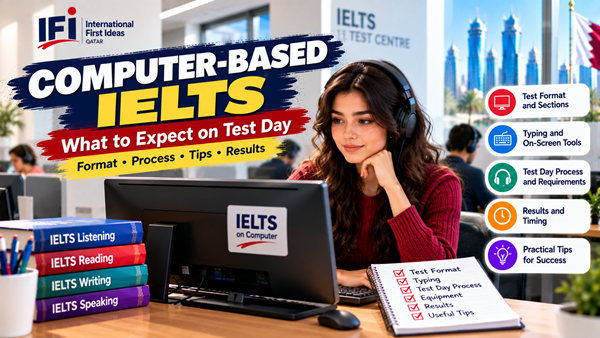
If you are planning to take the IELTS exam, you may be wondering what happens during a computer-based IELTS test. Will you type every answer? Do you still speak to an examiner? How much time do you get for each section, and what should you practise before your test date?
Understanding the test-day process can make the experience less stressful and help you prepare with greater confidence.
In computer-delivered IELTS, Listening, Reading and Writing are completed on a computer at an official test centre. Speaking is conducted separately with an IELTS examiner. Depending on the available test session, candidates in selected markets may also have the option to complete the Writing component by hand while taking the rest of the test on a computer.
This guide explains what to expect before, during and after the computer-based IELTS test, including the test format, timing, equipment, identification requirements and practical preparation tips. If you are planning to take IELTS in Qatar, it will also help you understand what to check before booking your test.
What Is the Computer-Based IELTS Test?
The computer-based IELTS test is an official IELTS test delivered using a computer at an authorised test centre. It assesses the same four English language skills as IELTS traditionally has: Listening, Reading, Writing and Speaking.
The main difference is how you interact with the test. Instead of writing your Listening, Reading and Writing answers on paper, you enter them on a computer.
The computer-based test is available for both IELTS Academic and IELTS General Training. Your choice between these test types should depend on the requirements of the university, employer, professional body or other organisation receiving your results.
How Does IELTS on Computer Work?
The test generally follows this structure:
| Test component | What you do | Duration |
|---|---|---|
| Listening | Listen to recordings and enter your answers on screen | Approximately 30 minutes |
| Reading | Read passages and answer questions on screen | 60 minutes |
| Writing | Complete two tasks using the selected Writing format | 60 minutes |
| Speaking | Answer questions and discuss topics with an examiner | 11–14 minutes |
Listening, Reading and Writing are completed consecutively, without breaks between these components. Your Speaking test arrangements will be confirmed by your test centre.
The computer-based format does not mean that IELTS becomes a different English test. The assessed skills, core task types and scoring principles remain the same.
Is Computer-Based IELTS Different from Paper-Based IELTS?
IELTS announced a transition away from traditional paper-based testing from mid-2026, with implementation timelines varying by market. In selected markets, a Writing on Paper option is being introduced for candidates who prefer to handwrite their Writing responses.
For candidates booking IELTS in Qatar, the relevant options may therefore be IELTS on Computer with Writing on Computer or IELTS on Computer with Writing on Paper, depending on the sessions currently available.
IELTS on Computer: Writing on Computer
With this option, you complete Listening, Reading and Writing using a computer. You type your Writing responses and use the available on-screen functions to work through the tasks.
This option may suit you if you:
- Type comfortably and accurately.
- Prefer editing text on a screen.
- Find it easy to organise paragraphs digitally.
- Want to practise in the same format you will use on test day.
IELTS on Computer: Writing on Paper
With this option, Listening and Reading are still completed on a computer. The Writing questions appear on screen, but you write your responses by hand on an official answer sheet.
This may be helpful if you express yourself more comfortably through handwriting than typing.
However, Writing on Paper is not the same as the traditional fully paper-based IELTS test. It is an alternative Writing arrangement within computer-delivered IELTS and is available only in selected markets and sessions. It is not available for IELTS for UKVI.
Before booking in Qatar, check the exact format displayed for your preferred test session. Do not assume that Writing on Paper is available on every date or at every centre.
What Happens Before Your Computer-Based IELTS Test?
Preparing for test day begins before you enter the examination room. Checking your booking details, preparing your identification and understanding the centre’s instructions can help you avoid preventable problems.
1. Check Your Booking Confirmation
Read your confirmation email carefully. It should provide the details you need to prepare for your test, including the test date, reporting time, location and relevant instructions.
Check whether the Speaking test has a separate appointment time or is scheduled as part of the same day’s arrangements.
If anything is unclear, contact the test centre before test day rather than waiting until you arrive.
2. Prepare Your Identification Document
Bring the original, valid identification document that you used when registering for IELTS.
The exact accepted document depends on the test centre’s requirements and your registration. Do not assume that a photocopy, photograph or expired document will be accepted.
For candidates taking IELTS at IFI Qatar, the centre’s current instructions should be checked before attending.
3. Arrive Early
Plan your journey so that you arrive at the test centre with sufficient time to complete check-in and identity verification.
IFI Qatar advises candidates to arrive approximately 20–30 minutes before their scheduled test time. Follow the arrival time stated in your own booking confirmation, as test-day procedures may vary.
Late arrival can put your test participation at risk.
4. Know What You Can Bring
Test centres restrict personal belongings inside the examination room to protect test security.
Your identification document is essential. The centre will provide the required test equipment and stationery according to the test format.
Personal electronics, watches, bags and other belongings generally need to be stored outside the test room in the designated area. Check the instructions provided by your centre rather than bringing unnecessary items.
What to Expect During the Computer-Based IELTS Listening Test
The Listening section tests your ability to understand spoken English in different situations. You will listen to recordings and answer 40 questions across four parts.
In the computer-based test, you enter your answers directly on screen, so you do not need a separate answer-transfer period of the kind used in the traditional paper-based Listening format.
How the Listening Test Works
The recordings include everyday conversations and more complex discussions or talks. You will encounter different question types, which may include:
- Multiple-choice questions
- Form and note completion
- Matching information
- Map or diagram labelling
- Sentence completion
- Summary completion
- Short-answer questions
The recordings are played once. You should therefore use the time available to read the questions, anticipate the information you need and follow the recording carefully.
Tips for Computer-Based IELTS Listening
Check your headphones before the test begins. Make sure you can hear the recording clearly. If you notice an audio problem, raise your hand and inform the invigilator immediately.
Read the questions in advance. Identify whether you need a name, date, number, location or other detail.
Use the available review time. The computer-delivered Listening format includes time to check answers, with the timing differing from the traditional paper-based test. Follow the on-screen instructions and the invigilator’s guidance.
Check spelling and word limits. A correct idea may still lose a mark if the answer does not follow the question’s instructions.
Before test day, practise using computer-based Listening materials so you are familiar with entering answers on screen.
What to Expect During the Computer-Based IELTS Reading Test
The Reading section lasts 60 minutes and contains 40 questions. You read the passages on screen and enter your answers using the computer.
IELTS Academic and IELTS General Training have different Reading content, so make sure your practice materials match the test you intend to take.
Reading on a Computer Screen
You may need to move between passages and questions, locate details within a text and compare statements with the information presented.
Depending on the platform, available functions may include highlighting text, making notes or navigating between questions. Familiarise yourself with the tools offered in the official computer-based practice experience rather than assuming that every function works in the same way as your everyday computer applications.
How to Manage Reading Time
Because the Reading test lasts 60 minutes, you need to manage your time carefully.
Try these strategies:
- Scan for names, dates, figures and other identifying details.
- Skim each passage to understand its main ideas and structure.
- Read the question instructions before selecting an answer.
- Avoid spending too long on a single difficult question.
- Keep an eye on the timer.
- Enter your answers as you progress rather than leaving them all until the end.
A computer screen may change how you navigate the text, but the fundamental Reading skills remain the same. Practise locating information accurately while working within the time limit.
What to Expect During the Computer-Based IELTS Writing Test
The Writing section lasts 60 minutes and consists of two tasks. In the standard computer-delivered format, you type your responses using the keyboard.
If you select an available Writing on Paper option, you will instead handwrite your responses on the supplied answer sheet while the questions appear on screen.
Writing Task 1 and Task 2
For IELTS Academic, Task 1 involves describing, summarising or explaining visual information, such as a graph, table, chart or process. For General Training, Task 1 requires you to write a letter in response to a situation.
Task 2 requires an essay discussing an opinion, argument, problem or issue.
The minimum word counts remain the same across the relevant delivery options:
- Task 1: at least 150 words.
- Task 2: at least 250 words.
A useful time allocation is approximately 20 minutes for Task 1 and 40 minutes for Task 2. Task 2 carries more weight in the Writing score.
Advantages of Typing Your IELTS Writing Answers
Typing can be helpful if you are comfortable with a keyboard. You can revise wording, move sentences, correct spelling and reorganise paragraphs without rewriting an entire page.
However, typing does not automatically improve your Writing score. Your response is assessed on how well you address the task, organise ideas, use vocabulary and demonstrate grammatical range and accuracy.
How to Prepare for Computer-Based IELTS Writing
Practise writing complete responses on a computer under timed conditions.
Focus on the following:
- Improve typing accuracy so you do not lose time correcting avoidable errors.
- Learn to organise your introduction, body paragraphs and conclusion.
- Practise editing sentences without repeatedly rewriting them.
- Check punctuation, spelling and grammar before submitting.
- Monitor your word count, but prioritise relevant and well-developed ideas.
- Practise both Writing tasks within the full 60-minute limit.
If you are considering Writing on Paper, check its availability for your test date and practise handwriting your responses within the same time limit.
What to Expect During the IELTS Speaking Test
The Speaking test is conducted separately from the computer-based Listening, Reading and Writing components. You speak with an IELTS examiner rather than typing your answers.
The interview lasts 11–14 minutes and contains three parts.
Speaking Part 1: Introduction and Interview
The examiner asks questions about familiar subjects such as your work, studies, hometown, interests or daily life.
Answer naturally and clearly. A direct response followed by a relevant detail or explanation is usually more useful than a memorised speech.
Speaking Part 2: Individual Long Turn
You receive a task card with a topic and prompts. You have one minute to prepare and then speak for up to two minutes.
Practise organising your response quickly, using notes to guide your ideas and speaking at length without losing focus.
Speaking Part 3: Discussion
The examiner asks broader questions related to the Part 2 topic. You may need to explain opinions, compare ideas, discuss causes and consequences or consider possible future developments.
The Speaking assessment criteria remain the same regardless of whether the other test sections are completed on a computer.
Your test centre will confirm the arrangements for your Speaking session. Depending on the centre and session, it may be scheduled before or after the other sections, and the delivery arrangements should be verified in your confirmation.
How to Use the Computer-Based IELTS Interface
Being comfortable with the test interface can help you focus on the questions rather than the technology.
Before your official exam, use the official IELTS computer-based familiarisation experience to practise the layout and available functions.
Practise moving between questions and identifying which ones you have answered. Learn how to return to an earlier question when the interface permits it.
Do not assume that every question type uses exactly the same navigation controls.
Practise Highlighting and Note-Taking
Some computer-based IELTS interfaces provide tools for highlighting text and making notes. These can be useful when working through Reading passages or keeping track of important information.
Practise using the available functions without spending too much time on them. They should support your test strategy, not distract you from answering questions.
Get Comfortable with the Timer
Timed practice helps you understand how quickly you need to work through each section.
The goal is not to rush every question. It is to allocate your time sensibly, recognise when a question is taking too long and maintain a steady pace throughout the test.
When Will You Receive Your Computer-Based IELTS Results?
Computer-delivered IELTS results are generally available faster than traditional paper-based results were.
Official IELTS guidance states that results for IELTS on Computer are typically available within 1–2 days. However, the time can vary according to the delivery option and the arrangements applicable to your test.
For example, IELTS on Computer with Writing on Paper has a published results window of up to five days. Current test-centre guidance should be checked when booking.
Your result will include your Listening, Reading, Writing and Speaking scores and your overall band score.
Remember that faster results do not mean the test is easier or that scoring standards are different. The purpose of computer delivery is to provide a different way to take the test, not to change what IELTS assesses.
If you need your result for a university application, professional registration or another deadline, allow sufficient time for result processing and any additional requirements of the organisation receiving your score.
Is Computer-Based IELTS Easier Than Paper-Based IELTS?
Neither delivery method is inherently easier in terms of the English skills assessed. IELTS has stated that moving to computer delivery does not change the skills assessed or how results should be interpreted.
Your experience may depend on your personal strengths and familiarity with the format.
Computer-based IELTS may feel more comfortable if you type quickly, prefer reading on a screen and find digital editing convenient.
Writing on Paper, where available, may suit candidates who find handwriting more natural for essays.
However, familiarity with a format should not be confused with a guaranteed higher band score. Your result depends on your performance against the IELTS assessment criteria.
The best approach is to practise using the format available for your chosen test session and make your booking decision based on your requirements, preferences and the options actually offered.
Computer-Based IELTS Test-Day Checklist
Use this checklist before your test date to make sure you are prepared.
-
I have checked my booking confirmation and reporting time.
-
I know the exact location of my test centre.
-
I have prepared the original, valid identification document used for registration.
-
I know whether my Writing responses will be typed or handwritten.
-
I have practised Listening, Reading and Writing using computer-based materials.
-
I have completed timed practice for both Writing tasks.
-
I understand the Speaking test structure.
-
I know which belongings are permitted inside the test room.
-
I have planned my journey so that I arrive early.
-
I have checked the current result timeline and my application deadline.
Completing this checklist will not guarantee a particular band score, but it can help you avoid unnecessary surprises on test day.
Should You Take a Computer-Based IELTS Mock Test Before Booking?
If you have never taken IELTS on a computer, a mock test can help you become familiar with the test format before your official exam.
It can also reveal practical issues that are difficult to identify by studying question types alone, such as typing speed, screen navigation, time management and concentration during a full test.
A computer-based mock test can help you:
- Practise working through Listening and Reading on screen.
- Complete Writing tasks within the time limit.
- Identify the question types that cause the most difficulty.
- Understand how well you manage time across the test.
- Build a more focused preparation plan.
For the best experience, choose a mock test that matches your intended IELTS version and delivery format.
IFI Qatar offers IELTS mock-test options for candidates preparing for the official exam. Check the current service details to confirm what is included, whether feedback is available and how to book.
A mock test is a preparation tool, not a guarantee of your official result. Use the feedback and performance data to decide what to practise next.
Book Your IELTS Test with IFI Qatar
Understanding the computer-based IELTS test can help you choose a suitable session and prepare for the experience ahead.
Before booking, confirm whether you need IELTS Academic or General Training, check the available test dates and review the exact Writing format offered for your preferred session. If you have a university, employment or immigration deadline, allow enough time for preparation and results.
If you are planning to take IELTS in Doha or elsewhere in Qatar, IFI Qatar provides IELTS testing and preparation services.
Ready to book your test? Review the current IELTS booking options and choose a session that matches your requirements.
Not confident about the computer format yet? Consider completing a computer-based IELTS mock test first. Practising under realistic conditions can help you identify areas for improvement and approach test day with greater confidence.
Prepare for the format, understand your options and make your booking decision with the right information.