

Currently Empty: ر.ق 0,00


IELTS
English Language Levels Explained: From A1 Beginner to C2 Proficiency
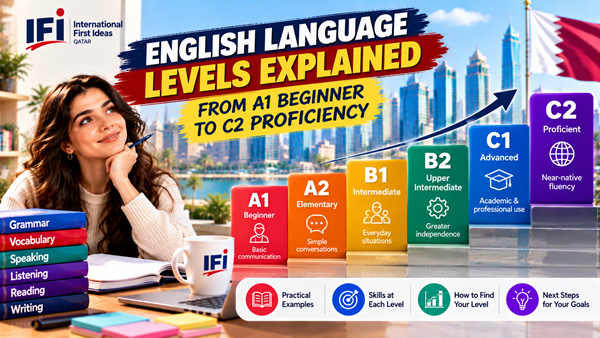
How good is your English? Can you introduce yourself and manage simple conversations, or can you discuss complex topics, write professional reports and understand detailed academic texts with confidence?
Understanding English language levels can help you answer these questions and choose the right next step in your learning journey.
The Common European Framework of Reference for Languages (CEFR) provides an internationally recognised framework for describing language proficiency. It divides language ability into six main levels, from A1 for beginners to C2 for highly proficient users.
In this guide, you will learn what each English level means, what you can typically do at each stage, how the levels differ, and how to identify the most suitable starting point for your English course. If you are studying or working in Qatar, understanding your current level can also help you choose a course that matches your personal, academic or professional goals.
What Are English Language Levels?
English language levels describe how effectively a person can understand and use English in real-life situations. They help learners, teachers, training providers and employers communicate about language ability using a shared reference system.
One of the most widely used systems is the Common European Framework of Reference for Languages (CEFR), developed by the Council of Europe.
The CEFR uses six main proficiency levels:
- A1 – Beginner: You can understand and use very basic English.
- A2 – Elementary: You can communicate in simple, familiar situations.
- B1 – Intermediate: You can manage many everyday situations and discuss familiar topics.
- B2 – Upper Intermediate: You can communicate with greater independence and understand more complex material.
- C1 – Advanced: You can use English flexibly for academic, social and professional purposes.
- C2 – Proficient: You can understand and express complex ideas with a high degree of precision.
These levels are grouped into three broad categories: Basic User (A1–A2), Independent User (B1–B2) and Proficient User (C1–C2).
Importantly, CEFR levels are based on what learners can do with a language, rather than simply how many grammar rules or vocabulary words they know.
English Language Levels at a Glance: A1 to C2
The following table summarises the six English proficiency levels and the abilities typically associated with each one.
| CEFR level | Common description | Typical abilities |
|---|---|---|
| A1 | Beginner | Understands familiar words, basic expressions and simple personal questions |
| A2 | Elementary | Handles routine exchanges about everyday needs and familiar subjects |
| B1 | Intermediate | Understands the main points of clear speech and produces connected language on familiar topics |
| B2 | Upper Intermediate | Understands complex material on many topics and communicates with greater fluency |
| C1 | Advanced | Uses English flexibly in demanding academic, social and professional situations |
| C2 | Proficient | Understands virtually everything heard or read and communicates with precision |
These descriptions are general guidelines, not a substitute for a formal assessment. Your proficiency may differ across speaking, listening, reading and writing.
A1 English Level: Beginner
A1 is the first main CEFR level. At this stage, learners develop the basic vocabulary, expressions and sentence structures needed to communicate in simple situations.
You do not need to speak fluently at A1. The main goal is to understand and produce basic English when the context is familiar and the other person speaks clearly.
What Can You Do at A1?
At A1, you can typically:
- Introduce yourself and provide basic personal information.
- Ask and answer simple questions about your name, nationality, family and home.
- Understand familiar words and everyday expressions.
- Recognise basic information on signs, forms and simple notices.
- Use short sentences to express basic needs.
- Participate in simple conversations when the other person speaks slowly and is willing to help.
For example, you might say:
“Hello, my name is Ahmed. I am from Qatar. I work in an office, and I am learning English.”
You may still need help understanding unfamiliar vocabulary or responding when someone speaks quickly.
What Should A1 Learners Study?
A1 learners should focus on building a strong foundation.
Useful learning priorities include:
- Everyday vocabulary, such as family, food, work, numbers and time.
- Basic grammar, including the verb “to be”, simple present tense and personal pronouns.
- Common questions and short answers.
- Listening to slow, clear English.
- Reading simple sentences and short messages.
- Practising pronunciation and basic conversations.
At this stage, consistent practice is more useful than trying to memorise advanced vocabulary before you can confidently use basic sentences.
A2 English Level: Elementary
A2 is the second basic level. Learners at this stage can understand frequently used expressions and communicate about familiar aspects of daily life.
You may still make grammatical mistakes, but you can manage more routine situations without relying entirely on translation.
What Can You Do at A2?
At A2, you can typically:
- Talk about your family, job, education and daily routine.
- Describe your home and immediate surroundings.
- Ask for directions and understand simple instructions.
- Handle basic shopping, travel and service-related conversations.
- Understand short messages and straightforward texts.
- Write simple notes, emails and personal messages.
- Describe familiar experiences using basic sentences.
For example:
“I usually travel to work by bus. I start work at eight o’clock and finish at four. In the evening, I study English because I want to improve my communication skills.”
You can communicate more independently than at A1, although unfamiliar situations and complex explanations may remain challenging.
What Should A2 Learners Study?
A2 learners should work on expanding their vocabulary and connecting sentences more naturally.
Focus on:
- Past, present and future forms.
- Everyday conversation and question formation.
- Common adjectives, adverbs and prepositions.
- Reading short articles and practical documents.
- Listening to conversations about familiar topics.
- Writing connected sentences rather than isolated phrases.
- Developing confidence in speaking without translating every sentence.
Progress at this stage comes from using English regularly in realistic situations.
B1 English Level: Intermediate
B1 is the first independent-user level. At this stage, you can handle many everyday situations, understand the main points of clear speech and express ideas about familiar topics.
You may not understand every word in a conversation, but you can often follow the overall message and respond appropriately.
What Can You Do at B1?
At B1, you can typically:
- Understand the main points of clear discussions about familiar subjects.
- Manage many situations encountered while travelling.
- Explain experiences, plans, hopes and ambitions.
- Give reasons for opinions and decisions.
- Describe events and tell stories in connected language.
- Write straightforward texts on familiar topics.
- Participate in conversations about work, education and leisure.
For example:
“I would like to improve my English because it could help me apply for better job opportunities. I can communicate about everyday topics, but I sometimes find professional meetings difficult, especially when people speak quickly.”
This response expresses a reason, identifies a difficulty and connects ideas in a way that goes beyond basic communication.
What Should B1 Learners Study?
B1 learners should move from basic communication towards more independent and accurate language use.
Priorities include:
- Expanding vocabulary for work, education and social situations.
- Improving tense consistency and sentence structure.
- Learning to explain opinions with supporting reasons.
- Understanding the main ideas in longer conversations.
- Reading articles on familiar topics.
- Writing organised paragraphs and connected texts.
- Practising conversations that require explanation rather than short answers.
If you are at B1, regular speaking and writing practice can help you identify gaps that may not be obvious during simple conversations.
B2 English Level: Upper Intermediate
B2 is an important milestone for learners who want to use English more independently in academic, professional and social environments.
At this level, you can understand the main ideas of complex texts, interact with a reasonable degree of fluency and explain your viewpoint on a range of topics.
However, B2 does not mean that every aspect of English is effortless. You may still struggle with unfamiliar accents, subtle meanings or highly specialised language.
What Can You Do at B2?
At B2, you can typically:
- Understand the main ideas of complex texts on concrete and abstract topics.
- Follow technical discussions within your area of expertise.
- Communicate with enough fluency for many regular interactions.
- Explain and defend opinions with supporting arguments.
- Compare alternatives and discuss advantages and disadvantages.
- Write clear, detailed texts on a range of subjects.
- Participate in discussions without needing every sentence to be simplified.
For example:
“Although online learning offers greater flexibility, it requires learners to manage their time effectively. I believe a blended approach can be more effective because it combines independent study with opportunities for direct feedback.”
This response presents a viewpoint, acknowledges a contrasting consideration and explains a reason.
What Should B2 Learners Study?
B2 learners should focus on accuracy, fluency, depth and flexibility.
Useful priorities include:
- Understanding longer articles and discussions.
- Using a wider range of vocabulary accurately.
- Developing more complex sentence structures.
- Organising essays, reports and presentations clearly.
- Supporting arguments with examples and explanations.
- Understanding implied meanings and different viewpoints.
- Practising spontaneous communication in unfamiliar situations.
If you are preparing for university study or professional responsibilities in English, B2 may be a useful milestone. However, the level you need depends on the specific requirements of your institution, employer or professional body.
C1 English Level: Advanced
C1 is an advanced level at which learners can use English flexibly and effectively for academic, professional and social purposes.
You can generally understand demanding texts, recognise implied meaning and communicate complex ideas without frequently searching for basic expressions.
What Can You Do at C1?
At C1, you can typically:
- Understand a wide range of demanding, longer texts.
- Recognise implicit meaning and subtle differences in language.
- Express ideas fluently without frequent pauses to find words.
- Use English effectively in academic and professional settings.
- Produce clear, detailed and well-structured writing.
- Adapt your language to different audiences and situations.
- Discuss complex topics and develop arguments in depth.
For example:
“While technological advances have made information more accessible, access alone does not guarantee understanding. Learners must also develop the ability to evaluate sources critically, distinguish evidence from opinion and apply information appropriately.”
This example demonstrates the ability to develop a complex idea using precise language and a clear logical relationship between points.
What Should C1 Learners Study?
At C1, learning often involves refining language use rather than mastering basic structures.
Focus on:
- Understanding nuanced meanings and implied arguments.
- Using vocabulary precisely and appropriately.
- Improving style, register and tone.
- Producing well-structured academic and professional writing.
- Following complex discussions and presentations.
- Developing persuasive arguments.
- Recognising subtle differences between similar expressions.
C1 learners may benefit from targeted feedback on their writing and speaking because small improvements in clarity, precision and organisation can make a meaningful difference.
C2 English Level: Proficient
C2 is the highest main CEFR level. It describes users who can understand virtually everything they hear or read and express themselves with a high degree of precision.
C2 should not be interpreted as perfect English or as proof that a learner knows every word in the language. Even highly proficient users may encounter unfamiliar terminology or specialist subjects.
What Can You Do at C2?
At C2, you can typically:
- Understand virtually all types of spoken and written English, subject to factors such as accent familiarity.
- Summarise information from different spoken and written sources.
- Reconstruct arguments and present them coherently.
- Express subtle differences in meaning.
- Communicate spontaneously and fluently.
- Adapt your language effectively to complex situations.
- Produce sophisticated, well-organised texts with an appropriate style.
For example:
“Any evaluation of remote work should account not only for productivity but also for employee autonomy, organisational culture and the long-term implications for collaboration. The evidence may support different conclusions depending on the nature of the work and the criteria used to measure success.”
At this level, the emphasis is on precision, nuance, flexibility and the ability to communicate complex ideas effectively.
How Can C2 Learners Continue Improving?
Even at C2, continued development is possible.
Useful activities include reading demanding literature and specialist publications, analysing complex arguments, refining professional writing, exploring unfamiliar accents and developing expertise in language used within a particular field.
The goal is not simply to learn more words. It is to use language with greater precision, control and awareness of context.
How Do English Language Levels Differ Across the Four Skills?
A CEFR level provides an overall reference point, but your abilities may not be equally developed across all four skills.
For example, you might understand English conversations comfortably but find it difficult to write a structured essay. Alternatively, you may read complex articles successfully but hesitate when speaking spontaneously.
The four main skills are:
Listening
Listening measures how well you understand spoken English, including the main message, relevant details, viewpoints and implied meaning.
At lower levels, you may rely on familiar words and clear, slow speech. At higher levels, you can follow longer discussions, more complex arguments and a wider range of spoken material.
Speaking
Speaking involves expressing ideas, responding to others and communicating clearly in different situations.
Progression generally involves moving from short, memorised expressions to connected explanations, spontaneous discussions and precise communication of complex ideas.
Reading
Reading includes understanding written information, identifying main ideas, locating details and interpreting arguments.
At beginner levels, learners may understand familiar words and short sentences. At higher levels, they can analyse longer texts, recognise implied meanings and evaluate complex arguments.
Writing
Writing assesses how well you communicate ideas in written form, including organisation, vocabulary, grammar and appropriate style.
Learners progress from filling in forms and writing simple messages to producing connected texts, detailed reports and sophisticated arguments.
A useful assessment should therefore consider more than your ability to answer a few grammar questions.
How Can You Find Your Current English Level?
The most practical way to identify your English language level is to combine an initial self-assessment with an appropriate placement assessment.
Self-assessment can help you recognise your strengths, but it may not reveal gaps in grammar, listening comprehension, writing accuracy or spontaneous speaking.
Use the following steps to make a more informed decision.
Step 1: Review the CEFR Descriptions
Read the descriptions of A1, A2, B1, B2, C1 and C2. Focus on the activities you can perform independently, rather than the level you would like to achieve.
Ask yourself whether you can understand everyday conversations, explain your opinions, follow complex discussions and write clearly for different purposes.
Step 2: Evaluate Each Skill Separately
Consider your listening, speaking, reading and writing abilities individually.
For example, you might be comfortable reading B2-level material but need more speaking practice. Identifying this difference can help you choose a course that addresses your actual needs.
Step 3: Complete an English Placement Assessment
An English placement assessment can provide a more structured indication of your current ability and help determine the most suitable course level.
Depending on the assessment, it may evaluate grammar, vocabulary, reading, listening, writing or speaking. Check which skills are included before interpreting the result.
A placement assessment is not necessarily an official CEFR certification. Its purpose is to help guide your learning and course placement.
Step 4: Choose a Course That Matches Your Needs
Once you have a clearer understanding of your level, choose learning objectives that are challenging but achievable.
A beginner may need structured lessons in grammar and everyday communication, while an upper-intermediate learner may benefit more from advanced discussion, writing practice and detailed feedback.
The right starting point can make your learning more focused and help you avoid spending time on material that is either too easy or too difficult.
How Long Does It Take to Move from One English Level to Another?
There is no fixed amount of time required to progress from one CEFR level to the next. Your progress depends on several factors, including your starting level, study frequency, exposure to English, quality of instruction and opportunities to practise.
The amount of guided learning required can also vary considerably between learners and between individual skills.
Your progress may be influenced by:
- Study consistency: Regular practice generally makes it easier to retain and apply new language.
- Learning environment: Frequent opportunities to use English can support faster development.
- Quality of feedback: Correcting recurring mistakes can help you improve more efficiently.
- Learning goals: A learner focused on workplace conversations may need different practice from someone preparing for academic study.
- Individual strengths: Some learners develop reading skills faster than listening or speaking.
Rather than relying on a fixed timeline, track what you can do now and reassess your progress periodically.
For example, instead of setting only a goal such as “reach B2”, you could aim to deliver a clear five-minute presentation, understand the main arguments in an article or write a well-organised essay with fewer recurring grammar errors.
These practical goals make progress easier to observe.
Why an English Placement Assessment Matters Before Joining a Course
Choosing an English course without understanding your current level can lead to frustration.
A course that is too easy may not challenge you enough, while a course that is too advanced may introduce material before you have developed the necessary foundation.
An English placement assessment can help you:
- Identify a suitable starting level.
- Recognise areas where you need additional support.
- Select a course that matches your learning goals.
- Establish realistic short-term learning objectives.
- Build a clearer plan for progressing to the next level.
For learners in Qatar, this can be especially useful when English improvement is connected to university applications, career development, workplace communication or preparation for an English proficiency exam.
Not sure whether you are A2, B1 or B2? Consider an English placement assessment before choosing your next course.
At IFI Qatar, you can enquire about English learning options and the appropriate assessment route for your needs. Ask which skills are assessed, how the result is interpreted and which course options are available for your target level.
Frequently Asked Questions About English Language Levels
What are the six English language levels?
The six main CEFR levels are A1, A2, B1, B2, C1 and C2. A1 and A2 represent basic users, B1 and B2 represent independent users, and C1 and C2 represent proficient users.
Is B1 English considered intermediate?
Yes. B1 is commonly described as the intermediate level. Learners can generally understand the main points of clear communication on familiar subjects and manage many everyday situations.
Is B2 English considered fluent?
B2 learners can usually communicate with a reasonable degree of fluency and spontaneity. However, fluency can vary by situation and skill, and B2 does not mean that every conversation or complex text will be easy.
What is the difference between C1 and C2 English?
C1 learners can use English flexibly and effectively in demanding academic, professional and social situations. C2 learners can generally understand almost everything they hear or read and communicate with greater precision, nuance and control.
Can I have different English levels in speaking and writing?
Yes. Language skills do not always develop at the same rate. You may be stronger in reading than speaking, for example. A useful assessment should help identify these differences rather than relying only on your confidence in one skill.
How can I know my English level for free?
You can start by reviewing CEFR descriptions and trying reputable self-assessment tools. However, an online quiz may not assess every skill or provide a formal CEFR certification. If you need course placement, ask about a structured English placement assessment.
Is an English placement assessment the same as IELTS?
No. An English placement assessment is generally used to help identify an appropriate learning level or course. IELTS is an English proficiency test used by organisations for purposes such as education, employment or migration, depending on their requirements.
Which English level do I need for university?
The required level depends on the university, programme and language requirements. Some institutions specify an IELTS score or another recognised qualification rather than a CEFR level. Always check the exact requirements of the institution to which you are applying.
Find Your English Level and Plan Your Next Step
Knowing your English language level gives you a clearer starting point for improvement. Whether you are learning basic expressions at A1, developing independence at B1 or refining advanced communication at C1, the most effective next step is one that matches your current abilities.
You do not need to guess your level or enrol in a course simply because its description sounds suitable.
Start with an English placement assessment. Use the result to understand your strengths, identify areas for improvement and explore the learning options that match your goals.
Contact IFI Qatar to enquire about English assessment and course options. With a clearer understanding of your current level, you can build a more focused learning plan and work towards your next milestone with confidence.