

Currently Empty: ر.ق 0,00


IELTS
Common English Mistakes IELTS Students Make: 20 Errors to Avoid
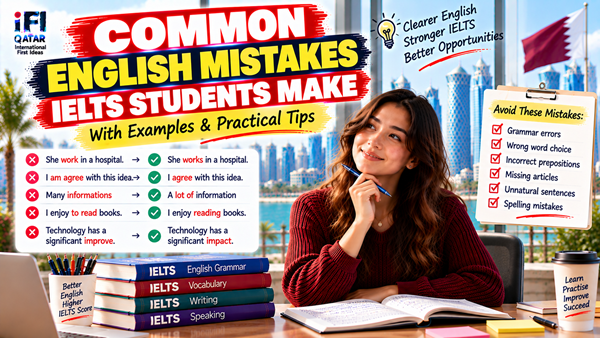
Preparing for IELTS involves more than learning vocabulary, memorising sample answers or practising with mock tests. You also need to communicate accurately and naturally in English. Even students with a good level of English can lose marks because of repeated grammar errors, incorrect word choices, awkward sentence structures and misunderstandings about how English is used.
These common English mistakes IELTS students make can affect both Speaking and Writing. Some errors are easy to correct once you recognise the pattern, while others require consistent practice and feedback.
The good news is that you do not need perfect English to achieve a strong IELTS score. You need to understand the areas where you make mistakes, learn the correct forms and apply them consistently.
In this guide, you will discover 20 frequent English mistakes, see how to correct them and learn practical ways to improve your accuracy before your IELTS exam.
Why Do English Mistakes Matter in IELTS?
English mistakes matter because IELTS assesses how effectively you use the language, not simply how many words you know.
In IELTS Speaking, grammatical range and accuracy are assessed alongside fluency and coherence, lexical resource, and pronunciation. In IELTS Writing, grammatical range and accuracy are assessed alongside task achievement or task response, coherence and cohesion, and lexical resource.
Frequent errors can make your meaning less clear, even when your ideas are relevant and well developed.
For example:
- Incorrect: People is becoming more dependent on technology.
- Correct: People are becoming more dependent on technology.
The first sentence communicates the general idea, but the subject and verb do not agree. The second sentence is grammatically correct and communicates the same message more effectively.
Correcting recurring errors can help you communicate with greater clarity and demonstrate better control of English.
20 Common English Mistakes IELTS Students Should Avoid
The following examples cover grammar, vocabulary, sentence structure and natural English usage. Review the explanations and try to identify which mistakes you make most frequently.
1. Subject-Verb Agreement Errors
Subject-verb agreement is one of the most common English grammar problems. The verb must match its subject in number and person.
Incorrect: She work in a hospital.
Correct: She works in a hospital.
Incorrect: People believes that education is important.
Correct: People believe that education is important.
This mistake often occurs when students focus on the words near the verb rather than identifying the main subject.
How to avoid this mistake
Before completing a sentence, identify the subject and check whether it is singular or plural.
Pay particular attention to third-person singular subjects in the present simple tense, which usually require an -s or -es ending.
Examples:
- He studies English every evening.
- My brother lives in Doha.
- Many students prefer online lessons.
- Technology plays an important role in modern education.
During IELTS Writing, check subject-verb agreement when reviewing your introduction, topic sentences and conclusion.
2. Incorrect Use of Articles: A, An and The
Articles can be difficult for English learners because their use does not always match the rules of other languages.
Use a before a singular countable noun beginning with a consonant sound, and an before a singular countable noun beginning with a vowel sound. Use the when referring to something specific or already identified.
Incorrect: I want to become engineer.
Correct: I want to become an engineer.
Incorrect: The education is important for everyone.
More natural: Education is important for everyone.
In the second example, education is discussed as a general concept, so the definite article is usually unnecessary.
How to avoid this mistake
Learn articles together with nouns rather than treating them as separate grammar rules.
For example:
- a university
- an opportunity
- a useful skill
- the environment
- the internet
Remember that the choice between a and an depends on pronunciation, not simply the first written letter.
3. Confusing Present Simple and Present Continuous
Students sometimes use the present continuous for habits or the present simple for actions happening at the moment.
Incorrect: I am going to work every day by bus.
Correct: I go to work by bus every day.
Incorrect: I study for my exam right now.
Correct: I am studying for my exam right now.
The present simple generally describes routines, facts and repeated actions. The present continuous commonly describes actions happening now or temporary situations.
How to avoid this mistake
Look for time expressions that indicate the intended meaning.
| Time expression | Common tense |
|---|---|
| Every day | Present simple |
| Usually | Present simple |
| Often | Present simple |
| At the moment | Present continuous |
| Right now | Present continuous |
| This week, for a temporary situation | Present continuous |
For IELTS Speaking Part 1, practise describing your routines using the present simple. When discussing what you are doing at the moment, use the present continuous where appropriate.
4. Making Mistakes with Past Tense
When describing past experiences, students sometimes use the present tense or an incorrect past form.
Incorrect: Yesterday, I go to the shopping centre.
Correct: Yesterday, I went to the shopping centre.
Incorrect: I have visited my grandparents last weekend.
Correct: I visited my grandparents last weekend.
The second correction is important because a finished time expression such as last weekend normally calls for the past simple, not the present perfect.
How to avoid this mistake
Learn common irregular verbs and practise telling short stories about past events.
Examples include:
- go → went
- see → saw
- buy → bought
- take → took
- write → wrote
- meet → met
This is particularly useful for IELTS Speaking Part 2, where you may need to describe a memorable event, a person you met or a place you visited.
5. Incorrect Use of Present Perfect and Past Simple
The present perfect and past simple have different functions. Confusing them can make the timing of an action unclear.
Incorrect: I have finished university in 2022.
Correct: I finished university in 2022.
Correct: I have studied English for three years.
The past simple is generally used for completed actions at a definite past time. The present perfect often connects a past action or situation with the present.
How to avoid this mistake
Ask yourself whether you are referring to a completed event at a specific time or describing an experience or situation connected to the present.
Compare these examples:
- I visited London last year.
- I have visited London several times.
- She started learning English in 2023.
- She has been learning English for three years.
Choosing the right tense helps your answers sound clearer and more natural.
6. Incorrect Prepositions
Prepositions are a frequent source of errors because many English expressions follow fixed patterns.
Incorrect: I am interested on science.
Correct: I am interested in science.
Incorrect: It depends of the situation.
Correct: It depends on the situation.
Incorrect: I discussed about the problem.
Correct: I discussed the problem.
The correct preposition often depends on the word that comes before it. In some cases, no preposition is needed.
Common preposition combinations to learn
| Incorrect or less natural | Correct form |
|---|---|
| Interested on | Interested in |
| Depend of | Depend on |
| Good in something | Good at something |
| Married with someone | Married to someone |
| Discuss about something | Discuss something |
| Responsible of | Responsible for |
| Arrive to a city | Arrive in a city |
| Arrive to a building | Arrive at a building |
How to avoid this mistake
Learn verbs, adjectives and nouns together with their common prepositions. Keep a record of the combinations you frequently get wrong and use each one in your own sentences.
7. Confusing Countable and Uncountable Nouns
Some English nouns can be counted individually, while others are normally treated as uncountable. Using the wrong form can lead to errors with articles, plurals and quantifiers.
Incorrect: I need some informations about the course.
Correct: I need some information about the course.
Incorrect: There are many traffics in the city.
Correct: There is a lot of traffic in the city.
Other commonly misused uncountable nouns include advice, equipment, furniture and research.
How to avoid this mistake
Learn whether a noun is countable or uncountable when you learn its meaning.
For example:
- some advice
- a piece of advice
- much information
- several suggestions
- a lot of research
- two pieces of equipment
This distinction is particularly important in IELTS Writing Task 2, where students frequently discuss education, technology, transport, employment and public policy.
8. Using the Wrong Word Form
A sentence may contain the correct general idea but still be grammatically incorrect because the wrong form of a word is used.
Incorrect: Technology has a significant improve on education.
Correct: Technology has a significant impact on education.
Incorrect: Education is importance for children.
Correct: Education is important for children.
Incorrect: The government should development public transport.
Correct: The government should develop public transport.
How to avoid this mistake
Learn common word families and practise recognising nouns, verbs, adjectives and adverbs.
| Noun | Verb | Adjective | Adverb |
|---|---|---|---|
| Success | Succeed | Successful | Successfully |
| Improvement | Improve | Improved | — |
| Importance | — | Important | Importantly |
| Development | Develop | Developed | — |
| Difference | Differ | Different | Differently |
Not every word family contains all four forms, and some forms have different meanings or uses. Learn each form in context rather than memorising the table alone.
9. Confusing Adjectives and Adverbs
Adjectives describe nouns, while adverbs commonly modify verbs, adjectives or other adverbs.
Incorrect: She speaks English fluent.
Correct: She speaks English fluently.
Incorrect: It was a carefully decision.
Correct: It was a careful decision.
However, not every word ending in -ly is an adverb, and not every adverb ends in -ly. The role of the word in the sentence matters.
How to avoid this mistake
Check what you are describing.
- A careful student.
- A carefully written essay.
- A fluent speaker.
- She speaks fluently.
This distinction can improve the precision of your vocabulary and the grammatical accuracy of your IELTS responses.
10. Translating Directly from Your First Language
Direct translation often produces sentences that are understandable but unnatural or grammatically incorrect in English.
Less natural: I have 25 years.
Natural English: I am 25 years old.
Incorrect: I very like this city.
Correct: I really like this city.
Incorrect: I am agree with this opinion.
Correct: I agree with this opinion.
The problem is not that your first language is unhelpful. It is that English has its own sentence patterns and expressions that cannot always be translated word for word.
How to avoid this mistake
Learn common English phrases as complete expressions.
For example:
- I agree with this view.
- I strongly believe that…
- In my opinion…
- One of the main reasons is that…
- I have a strong interest in…
- I find it difficult to…
- I am looking forward to…
Practise using these expressions in different contexts rather than translating every sentence from your first language.
11. Using Unnatural or Incorrect Collocations
A collocation is a combination of words that commonly occur together. Using natural collocations makes your English sound more fluent and precise.
Incorrect: Do a decision.
Correct: Make a decision.
Incorrect: Strong rain.
Correct: Heavy rain.
Incorrect: Big traffic.
Correct: Heavy traffic.
Incorrect: Make homework.
Correct: Do homework.
Useful collocations for IELTS
| Collocation | Example sentence |
|---|---|
| Make a decision | Students should make informed decisions about their education. |
| Conduct research | Researchers conduct research to understand social problems. |
| Raise awareness | Schools can raise awareness of environmental issues. |
| Play a role | Technology plays an important role in communication. |
| Take responsibility | Individuals should take responsibility for their actions. |
| Reach a conclusion | The report reaches a clear conclusion. |
| Pose a challenge | Rising costs pose a challenge for many families. |
| Have an impact | Public transport can have a positive impact on cities. |
How to avoid this mistake
When learning a new word, check which verbs, adjectives or prepositions commonly appear with it. Record complete phrases and practise using them in your own speaking and writing.
Natural collocations can improve lexical precision without forcing you to use unnecessarily complicated vocabulary.
12. Using Vocabulary That Is Too Complicated
Some IELTS candidates believe that advanced English means using the longest or most unusual words they know. This can lead to inaccurate word choices and sentences that are difficult to understand.
Awkward: The governmental implementation of multifaceted amelioration is indispensable for societal betterment.
Clearer: The government needs to introduce effective measures to improve society.
The second sentence communicates the idea more directly.
How to avoid this mistake
Choose vocabulary that expresses your meaning accurately. Use advanced words when they are appropriate, not simply to make a sentence sound impressive.
For IELTS, focus on:
- Accurate meaning.
- Appropriate word choice.
- Natural collocations.
- Variety without repetition.
- Correct spelling and word forms.
A clear, precise sentence is usually more effective than a complicated sentence containing errors.
13. Repeating the Same Words Too Often
Repeated vocabulary can make your speaking or writing sound limited, particularly when you rely on a few general words such as good, bad, important and very.
For example:
Repetitive: Technology is very important. It is very useful and has a very good effect on people.
Improved: Technology plays an important role in modern life. It makes communication easier and can improve access to education and healthcare.
The improved version communicates more specific ideas instead of replacing every repeated word with an unrelated synonym.
How to avoid this mistake
Build vocabulary around common IELTS themes, including:
- Education.
- Technology.
- Environment.
- Health.
- Employment.
- Transport.
- Society and culture.
Learn expressions that allow you to explain different aspects of a topic. For example, instead of repeatedly using important, you might use essential, significant, valuable or a key factor, depending on the context.
Do not replace words mechanically. A synonym should preserve the intended meaning.
14. Writing Run-On Sentences
A run-on sentence occurs when two or more independent clauses are joined incorrectly. This can make an IELTS essay difficult to follow.
Incorrect: Many people work from home it saves them time.
Correct: Many people work from home because it saves them time.
Also correct: Many people work from home. It saves them time.
How to avoid this mistake
Learn to connect ideas using appropriate conjunctions and punctuation.
Useful linking words include:
- Because.
- Although.
- However.
- Therefore.
- While.
- In addition.
- As a result.
For example:
Although online learning is convenient, some students benefit from face-to-face interaction.
Use linking expressions to show a genuine relationship between ideas. Adding a connector does not automatically make a sentence logical.
15. Using Sentence Fragments
A sentence fragment is an incomplete sentence presented as though it were a complete one.
Incorrect: Because public transport is affordable.
Correct: Public transport is popular because it is affordable.
Also correct: Because public transport is affordable, many people use it.
The word because introduces a dependent clause. In standard usage, that clause needs to be connected to a main clause to form a complete sentence.
How to avoid this mistake
Check that each sentence expresses a complete thought. Look for a subject and a main verb, and make sure dependent clauses are connected appropriately.
This is especially important when writing long IELTS Task 2 sentences. If a sentence becomes difficult to control, divide it into two shorter sentences.
16. Using Linking Words Incorrectly
Linking words help organise an argument, but using them incorrectly can weaken the logical flow of an essay.
Incorrect: I enjoy living in the city. However, it offers many job opportunities.
Better: I enjoy living in the city because it offers many job opportunities.
In the first version, however suggests a contrast that the second sentence does not provide.
Another example:
Awkward: Moreover, public transport is affordable. Moreover, it reduces traffic congestion.
Improved: Public transport is affordable. In addition, it can reduce traffic congestion.
How to avoid this mistake
Choose a linking word based on the relationship between the ideas.
| Relationship | Useful expressions |
|---|---|
| Adding information | Furthermore, in addition, moreover |
| Showing contrast | However, although, whereas |
| Explaining a reason | Because, since, as |
| Showing a result | Therefore, consequently, as a result |
| Giving an example | For example, for instance |
| Concluding | In conclusion, overall |
Use linking words naturally. A clear relationship between sentences matters more than the number of connectors you include.
17. Using Incorrect Comparatives and Superlatives
Comparisons are common in IELTS Speaking and Writing, especially when discussing cities, lifestyles, technology, education and environmental issues.
Incorrect: This method is more easier than the other one.
Correct: This method is easier than the other one.
Incorrect: It is the most cheapest option.
Correct: It is the cheapest option.
Incorrect: My city is more big than Doha.
Correct: My city is bigger than Doha.
How to avoid this mistake
Learn the common comparative and superlative forms.
- Small → smaller → the smallest.
- Easy → easier → the easiest.
- Important → more important → the most important.
- Expensive → more expensive → the most expensive.
- Good → better → the best.
- Bad → worse → the worst.
Remember that you normally do not use more with an adjective that already has an -er comparative form.
18. Misusing Modal Verbs
Modal verbs such as can, could, should, must and might help express ability, advice, obligation and possibility. They are useful in IELTS, but their grammar must be correct.
Incorrect: People should to exercise regularly.
Correct: People should exercise regularly.
Incorrect: The government must provides better services.
Correct: The government must provide better services.
Incorrect: Students can improves their vocabulary through reading.
Correct: Students can improve their vocabulary through reading.
How to avoid this mistake
In standard affirmative sentences, a modal verb is generally followed by the base form of the main verb.
Examples:
- People should reduce waste.
- Governments must protect public health.
- Technology can improve access to information.
- Schools could provide additional support.
- These changes might benefit local communities.
Practise these patterns when giving recommendations or discussing possible solutions in IELTS Writing Task 2.
19. Using Incorrect Gerund and Infinitive Forms
Some verbs are followed by a gerund (the -ing form), while others are followed by an infinitive with to. Using the wrong structure can make a sentence grammatically incorrect.
Incorrect: I enjoy to read books.
Correct: I enjoy reading books.
Incorrect: I want learning English.
Correct: I want to learn English.
Incorrect: She suggested to take a break.
Correct: She suggested taking a break.
Common patterns to learn
| Structure | Example |
|---|---|
| Enjoy + gerund | I enjoy learning languages. |
| Avoid + gerund | Students should avoid making the same mistake. |
| Suggest + gerund | I suggest practising every day. |
| Want + infinitive | I want to improve my English. |
| Decide + infinitive | She decided to take the exam. |
| Plan + infinitive | They plan to study abroad. |
Some verbs can take both forms, sometimes with a change in meaning. Learn common patterns in context and review the combinations that cause you difficulty.
20. Neglecting Spelling and Punctuation
Small spelling and punctuation errors can make your writing less clear and may affect how accurately you communicate your ideas.
Common problems include missing full stops, incorrect capitalisation, misspelled words and confusing similar forms.
Incorrect: i believe education is important because it create opportunities
Correct: I believe education is important because it creates opportunities.
Incorrect: Their are many reasons to learn English.
Correct: There are many reasons to learn English.
How to avoid this mistake
Reserve a short period at the end of your IELTS Writing test for checking your work, if possible.
Look for:
- Missing full stops and commas.
- Incorrect capital letters.
- Subject-verb agreement errors.
- Common spelling mistakes.
- Confusion between their, there and they’re.
- Confusion between your and you’re.
- Incorrect singular and plural forms.
For computer-delivered IELTS, use the editing tools available in the test interface carefully, but do not rely on spellcheck alone to identify grammatical errors.
How Do English Mistakes Affect IELTS Speaking and Writing?
The impact of a mistake depends on its frequency, severity and effect on communication. An occasional error does not automatically prevent a candidate from achieving a strong score. However, repeated errors can make it harder to demonstrate consistent control of English.
English mistakes in IELTS Speaking
In Speaking, candidates may struggle with:
- Using the correct tense when describing experiences.
- Maintaining subject-verb agreement.
- Choosing natural vocabulary and collocations.
- Producing complete sentences while speaking fluently.
- Pronouncing words clearly enough to communicate their meaning.
For example, instead of saying:
My favourite hobby is read because it make me relax.
Say:
My favourite hobby is reading because it helps me relax.
The corrected sentence uses the appropriate gerund after is, correct subject-verb agreement and a natural expression.
English mistakes in IELTS Writing
In Writing, recurring language errors can affect grammatical accuracy and lexical resource. Unclear sentence structures may also make the argument harder to follow.
Common issues include:
- Incorrect verb tenses.
- Article and preposition errors.
- Inaccurate word forms.
- Repetitive or inappropriate vocabulary.
- Run-on sentences and sentence fragments.
- Incorrect use of linking expressions.
For example:
Incorrect: Government should invest more money on education because it help people to get better job.
Correct: The government should invest more money in education because it helps people find better jobs.
The corrected sentence uses a natural preposition, correct subject-verb agreement and a more appropriate verb structure.
A Simple Daily Routine to Correct Your English Mistakes
Recognising mistakes is only the first step. To improve your English for IELTS, you need to identify recurring problems and practise correcting them.
The following routine can help you build a consistent learning habit.
Step 1: Write down your recurring mistakes
Keep a notebook or digital document with three columns:
| Your mistake | Correct form | Your example |
|---|---|---|
| She work hard. | She works hard. | She works hard to improve her English. |
| Interested on music | Interested in music | I am interested in learning music. |
| Many information | A lot of information | I found a lot of information online. |
Add mistakes from your speaking practice, writing exercises and feedback.
Step 2: Identify the reason for each error
Do not simply memorise the correction. Ask why the original sentence was wrong.
For example, if you repeatedly write people believes, review the difference between singular and plural subjects. If you often use the wrong preposition, learn the complete word combination.
Understanding the reason makes it easier to apply the correction in new situations.
Step 3: Create new sentences
Use each corrected structure in three or four original sentences.
If your problem is present simple subject-verb agreement, practise sentences such as:
- Technology affects communication.
- Exercise improves physical health.
- Education creates new opportunities.
- Public transport reduces the number of cars on the road.
This helps turn a rule into a habit.
Step 4: Practise speaking and writing
Use the corrected structures in a short speaking response or paragraph.
For example, choose the topic of education and speak for one minute about why learning English is useful. Then write a short paragraph on the same topic.
Compare your work with your mistake log and identify which errors you still make.
Step 5: Review your progress every week
At the end of each week, check whether the same mistakes are becoming less frequent.
Choose two or three priority areas for the next week instead of trying to correct everything at once.
A targeted approach makes your practice more manageable and helps you focus on the problems that have the greatest effect on your communication.
How Can You Improve Your English Before IELTS?
Improving your English for IELTS requires a balance of language learning, regular practice and feedback.
Here are five practical ways to make progress.
Read English texts at the right level
Read articles, short stories and educational texts that you can understand without translating every sentence. Pay attention to sentence structure, collocations and how writers express relationships between ideas.
Listen to natural English
Use English podcasts, interviews and educational videos to become familiar with natural expressions and sentence patterns. Notice how speakers explain opinions, give examples and connect ideas.
Practise speaking regularly
Record yourself answering IELTS-style questions. Listen to your responses and identify recurring grammar errors, awkward expressions and unclear sentences.
Do not stop after every small mistake. Focus first on maintaining communication, then review your performance and practise the structures you need to improve.
Write short paragraphs and review them
Choose familiar IELTS topics and write a paragraph expressing your opinion. Check grammar, vocabulary, sentence structure and punctuation.
Whenever possible, ask a qualified teacher to identify errors you may not recognise yourself.
Consider a structured English course
If you repeatedly make the same mistakes despite practising, guided instruction can help you understand the underlying rules and apply them more consistently.
An English course can provide structured lessons, opportunities to practise speaking and writing, and feedback suited to your current level.
Frequently Asked Questions About Common English Mistakes in IELTS
What are the most common English mistakes IELTS students make?
Frequent mistakes include subject-verb agreement errors, incorrect verb tenses, article and preposition mistakes, confusion between countable and uncountable nouns, inaccurate word forms and unnatural collocations. Sentence structure, spelling and punctuation can also affect the clarity of IELTS Writing responses.
Do grammar mistakes lower your IELTS score?
Grammar is one of the assessed areas in IELTS Speaking and Writing. Frequent errors can affect your performance, particularly when they make your meaning unclear or demonstrate limited grammatical control. The impact depends on the nature and frequency of the errors and your overall performance across the assessment criteria.
How can I improve my English grammar for IELTS?
Identify your most frequent mistakes, review the relevant grammar rules, create original example sentences and apply the corrections in speaking and writing practice. Keep a mistake log and review it regularly. Feedback from a qualified teacher can help you recognise errors that you may overlook yourself.
Is vocabulary more important than grammar in IELTS?
Neither should be ignored. IELTS assesses both lexical resource and grammatical range and accuracy in Speaking and Writing. Strong vocabulary cannot fully compensate for persistent grammar problems, and accurate grammar alone does not demonstrate a wide or precise vocabulary.
How can I stop making the same English mistakes?
First, identify the pattern behind each recurring error. Then practise the correct structure in several different sentences and use it in real speaking or writing tasks. Review your work regularly and focus on a small number of priority mistakes at a time.
Can I get a high IELTS score if I make English mistakes?
Yes. IELTS does not require every response to be completely error-free. Your score depends on how well your performance meets the assessment criteria. However, reducing recurring errors and communicating accurately can help you demonstrate your English ability more effectively.
Should I memorise advanced vocabulary to improve my IELTS score?
Memorising useful vocabulary can help, but words must be used accurately and naturally. Focus on meaning, collocations, word forms and context rather than using complicated words simply to sound advanced.
Is an English course useful for IELTS preparation?
An English course can be useful if you need to strengthen your grammar, vocabulary, sentence structure or speaking confidence before taking IELTS. A course with practice activities and individual feedback can help you identify your weaknesses and work on them systematically.
Improve Your English with IFI Qatar
Correcting common English mistakes is an important step towards communicating more confidently in IELTS Speaking and Writing. You do not need to master every grammar rule at once. Start by identifying the errors you make most often, practise the correct forms and review your progress consistently.
If you are preparing for IELTS in Qatar and want to strengthen your English before your exam, explore the English learning and IELTS preparation options available at IFI Qatar.
A structured learning plan can help you build a stronger foundation, improve your accuracy and prepare more effectively for your target IELTS score.
Ready to improve your English? Contact IFI Qatar to learn more about available English courses and IELTS preparation options.