

Currently Empty: ر.ق 0,00


IELTS
Most Common IELTS Speaking Topics in 2026: Parts 1, 2 & 3
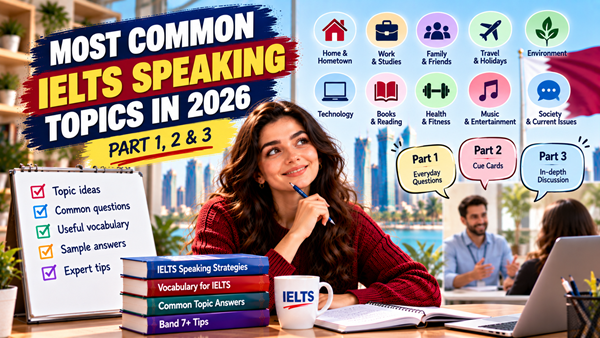
If you are preparing for the IELTS Speaking test, one of the best ways to build confidence is to practise a wide range of IELTS Speaking topics rather than memorising answers to a small number of questions.
The Speaking test is designed to assess how naturally and effectively you communicate in English. You may be asked about familiar subjects such as your home, studies, work and interests in Part 1, speak about a particular topic in Part 2, and then discuss broader or more abstract ideas in Part 3. The complete Speaking test lasts 11–14 minutes and has three parts.
This guide covers the most useful and commonly reported IELTS Speaking topics for 2026, including topics related to:
- Hometown and where you live
- Home and accommodation
- Work and studies
- Family and friends
- Hobbies and free time
- Food and cooking
- Travel and holidays
- Technology and the internet
- Social media
- Health and fitness
- Environment
- Books and reading
- Music and entertainment
- Shopping and money
- Sports
- Education
- Future plans and ambitions
- People, places and memorable experiences
- Society and modern life
Important: IELTS does not publish an official list of guaranteed Speaking questions for a particular year. The topics below are best treated as high-value preparation themes based on the official Speaking format and recurring topic reports. Exact questions and wording can vary by test and examiner.
IELTS Speaking Test Format
Before studying individual topics, it is important to understand how the Speaking test works.
The IELTS Speaking test is the same for Academic and General Training. It is a recorded, face-to-face interview with a certified examiner and consists of three parts.
IELTS Speaking Part 1
Part 1 lasts approximately 4–5 minutes.
The examiner asks questions about familiar topics such as your home, family, work, studies, interests and everyday experiences.
The purpose is to assess how naturally you can respond to questions about familiar subjects.
IELTS Speaking Part 2
Part 2 is the individual long turn.
You receive a task card and have one minute to prepare. You then speak for up to two minutes. The examiner may ask one or two short questions after your long turn.
The topics can involve:
- A person
- A place
- An object
- An event
- An experience
- An activity
- A skill
- A decision
- A memorable situation
IELTS Speaking Part 3
Part 3 lasts approximately 4–5 minutes.
The examiner asks more general and abstract questions related to the Part 2 topic. You may need to explain opinions, compare ideas, discuss causes and effects, make predictions and evaluate different viewpoints.
This is why preparing only personal answers is not enough. You also need to develop the ability to discuss wider issues.
Most Common IELTS Speaking Part 1 Topics in 2026
Part 1 focuses on familiar topics and everyday experiences. Common preparation themes include home, hometown, work, studies, family, hobbies, food, travel, technology and interests. These are consistent with the official description of Part 1 as a section covering familiar subjects.
IELTS Speaking Topic: Hometown
Hometown is one of the most useful topics to prepare because it allows you to practise describing places, giving opinions and talking about change.
Common questions:
- Where is your hometown?
- What do you like about your hometown?
- What is your hometown famous for?
- Has your hometown changed in recent years?
- Would you like to continue living there?
- What could be improved in your hometown?
- Is your hometown a good place for young people?
Useful vocabulary:
- multicultural city
- residential area
- modern infrastructure
- traditional neighbourhood
- public facilities
- tourist attraction
- rapidly developing
- peaceful atmosphere
- convenient location
IELTS Speaking Topic: Home and Accommodation
Questions about where you live are another important Part 1 preparation area.
Common questions:
- Do you live in a house or an apartment?
- What do you like about your home?
- Which room do you spend the most time in?
- What would you like to change about your home?
- Do you prefer living alone or with other people?
- Would you like to move to a different home in the future?
Useful vocabulary:
- spacious
- comfortable
- well-equipped
- convenient
- residential building
- living area
- natural light
- quiet neighbourhood
IELTS Speaking Topic: Work and Jobs
Work-related questions are particularly relevant for candidates who are employed or have recently started working.
Common questions:
- What do you do?
- Why did you choose your job?
- What do you enjoy about your work?
- What is the most challenging part of your job?
- Would you like to change your career?
- What job would you like to have in the future?
Useful vocabulary:
- career path
- job satisfaction
- professional development
- work-life balance
- challenging responsibilities
- working environment
- career opportunities
- gain experience
IELTS Speaking Topic: Studies and Education
Students can expect questions about their studies, subjects, teachers and future educational plans.
Common questions:
- What are you studying?
- Why did you choose this subject?
- What do you enjoy most about your studies?
- Is there anything difficult about your course?
- Who was your favourite teacher?
- Would you like to study something else in the future?
Useful vocabulary:
- academic subject
- higher education
- practical skills
- academic performance
- learning environment
- study programme
- career prospects
- gain knowledge
IELTS Speaking Topic: Family and Friends
Personal relationships are natural subjects for Part 1.
Common questions:
- Do you have a large family?
- Who are you closest to in your family?
- How often do you spend time with your friends?
- What do you usually do together?
- Is it easy to make friends?
- Do you prefer having many friends or a few close friends?
Useful vocabulary:
- close relationship
- spend quality time
- childhood friend
- social circle
- mutual interests
- supportive
- get along well
- keep in touch
IELTS Speaking Topic: Hobbies and Free Time
Hobbies are useful because they allow you to talk about preferences, routines and personal experiences.
Common questions:
- What do you do in your free time?
- Do you have any hobbies?
- How did you become interested in your hobby?
- Do you prefer indoor or outdoor activities?
- Have your hobbies changed over time?
- What hobby would you like to try?
Useful vocabulary:
- leisure activity
- creative outlet
- relaxing pastime
- spend time outdoors
- develop a skill
- take up a hobby
- unwind after work
- recreational activity
IELTS Speaking Topic: Food and Cooking
Food is a common everyday topic and is particularly useful for practising descriptive language.
Common questions:
- What is your favourite food?
- Do you enjoy cooking?
- What kind of food do you usually eat?
- Is there a popular dish in your country?
- Do you prefer eating at home or in restaurants?
- Have your eating habits changed?
Useful vocabulary:
- traditional dish
- home-cooked meal
- balanced diet
- local cuisine
- ingredients
- eating habits
- nutritious
- flavourful
IELTS Speaking Topic: Travel and Holidays
Travel allows candidates to talk about experiences, preferences and future plans.
Common questions:
- Do you enjoy travelling?
- Where did you go on your last holiday?
- What kind of places do you like visiting?
- Do you prefer travelling alone or with others?
- What is your favourite travel memory?
- Where would you like to travel in the future?
Useful vocabulary:
- memorable trip
- tourist destination
- cultural experience
- sightseeing
- travel itinerary
- explore a new place
- local culture
- breathtaking scenery
IELTS Speaking Topic: Technology
Technology remains a valuable topic for Speaking preparation because it can lead from personal questions to wider discussions about modern society.
Common questions:
- How often do you use technology?
- What device do you use most?
- Has technology changed your daily life?
- Do you prefer using a phone or a computer?
- Is there any technology you could not live without?
- Do you think people depend too much on technology?
Useful vocabulary:
- digital device
- technological development
- online services
- digital communication
- artificial intelligence
- productivity
- screen time
- technological dependence
IELTS Speaking Topic: Social Media
Social media can appear as a familiar personal topic or lead to broader questions about communication and society.
Common questions:
- Do you use social media?
- Which social media platforms do you use?
- How often do you check social media?
- Do you think social media is useful?
- What are the disadvantages of social media?
- Has social media changed communication?
Useful vocabulary:
- social networking
- online community
- digital communication
- online privacy
- social interaction
- share content
- stay connected
- influence public opinion
IELTS Speaking Topic: Health and Fitness
Health questions can involve routines, lifestyle choices and personal preferences.
Common questions:
- Do you exercise regularly?
- What do you do to stay healthy?
- Do you prefer exercising alone or with others?
- Is healthy food expensive in your country?
- What do people do to maintain a healthy lifestyle?
Useful vocabulary:
- healthy lifestyle
- physical activity
- regular exercise
- balanced diet
- mental well-being
- fitness routine
- healthy habits
- sedentary lifestyle
IELTS Speaking Topic: Books and Reading
Books and reading are useful topics for practising descriptions and personal opinions.
Common questions:
- Do you enjoy reading?
- What kind of books do you like?
- Did you read much as a child?
- Do you prefer printed books or e-books?
- Is reading still popular among young people?
Useful vocabulary:
- fiction
- non-fiction
- novel
- reading habit
- printed book
- digital format
- thought-provoking
- broaden my knowledge
IELTS Speaking Topic: Music
Music questions allow you to discuss preferences, memories and cultural experiences.
Common questions:
- What kind of music do you like?
- When do you usually listen to music?
- Did you listen to music as a child?
- Do you prefer live music or recorded music?
- Has your taste in music changed?
Useful vocabulary:
- musical taste
- live performance
- music genre
- relaxing melody
- traditional music
- memorable song
- listen to music
- attend a concert
IELTS Speaking Topic: Shopping and Money
Shopping questions can focus on habits, preferences and consumer behaviour.
Common questions:
- Do you enjoy shopping?
- What do you usually buy?
- Do you prefer shopping online or in stores?
- Do you compare prices before buying something?
- Have your shopping habits changed?
Useful vocabulary:
- online shopping
- consumer behaviour
- reasonable price
- compare prices
- impulse purchase
- shopping habits
- value for money
- customer service
IELTS Speaking Topic: Sports
Sports can be discussed from both a personal and social perspective.
Common questions:
- Do you play any sports?
- What is your favourite sport?
- Did you play sports as a child?
- Do you prefer watching or playing sports?
- Why are sports popular?
Useful vocabulary:
- physical activity
- team sport
- individual sport
- competitive
- professional athlete
- stay active
- sports facility
- international competition
IELTS Speaking Topic: Weather and Seasons
Weather is a straightforward Part 1 topic that can help you practise describing preferences.
Common questions:
- What is the weather like where you live?
- What is your favourite season?
- Do you prefer hot or cold weather?
- Does the weather affect your mood?
- What do you usually do on rainy days?
Useful vocabulary:
- extremely hot
- mild weather
- pleasant temperature
- humid climate
- seasonal changes
- outdoor activities
- weather conditions
IELTS Speaking Topic: Daily Routines
Questions about routines are useful for practising the present simple and time expressions.
Common questions:
- What is your typical day like?
- What do you usually do in the morning?
- Do you have a busy routine?
- Has your daily routine changed recently?
- What part of the day do you enjoy most?
Useful vocabulary:
- daily routine
- morning routine
- busy schedule
- commute to work
- take a break
- get things done
- manage my time
Most Common IELTS Speaking Part 2 Topics in 2026
Part 2 requires you to speak continuously about a topic for up to two minutes after one minute of preparation. The official IELTS format explains that the task card provides points to guide your talk and asks you to explain one aspect of the topic.
Recent candidate-reported topic round-ups for 2026 have included recurring themes involving people, places, experiences, activities, objects, travel, technology and memorable events. These reports are not official IELTS question lists, so they should be used for practice rather than prediction.
IELTS Speaking Cue Card Topic: Describe a Person
Possible cue cards include:
- Describe a person who has influenced you.
- Describe a friend you enjoy spending time with.
- Describe someone who taught you an important skill.
- Describe a person you admire.
- Describe someone who helped you in the past.
Useful language:
- Someone I really look up to is…
- I have known this person for…
- What I admire most about them is…
- They had a significant influence on me because…
- One thing I learned from them was…
IELTS Speaking Cue Card Topic: Describe a Place
Possible topics include:
- Describe a place you enjoy visiting.
- Describe a city you would like to live in.
- Describe a beautiful place you have visited.
- Describe a place that is important to you.
- Describe a quiet place where you like to relax.
Useful language:
- It is located in…
- The first thing that comes to mind is…
- What makes this place special is…
- The atmosphere is…
- I particularly enjoyed…
IELTS Speaking Cue Card Topic: Describe an Experience
Experience-based cue cards are useful because you can practise telling a clear story.
Possible topics include:
- Describe a memorable trip.
- Describe a time you helped someone.
- Describe a time you learned something new.
- Describe a difficult decision you made.
- Describe a time when you were surprised.
- Describe an exciting experience.
Useful language:
- It happened when…
- At first…
- A few minutes later…
- What happened next was…
- Looking back, I think…
- The experience taught me that…
IELTS Speaking Cue Card Topic: Describe an Object
Object-based topics may ask you to describe something you own, received or use regularly.
Possible topics include:
- Describe something you bought recently.
- Describe a useful piece of technology.
- Describe a gift you received.
- Describe something that is important to you.
- Describe an object you use every day.
Useful language:
- I have had it for…
- I use it mainly for…
- It is particularly useful because…
- What I like about it is…
- It has sentimental value because…
IELTS Speaking Cue Card Topic: Describe an Event
Event topics are useful for practising sequencing and past tenses.
Possible topics include:
- Describe a celebration you enjoyed.
- Describe an important event in your life.
- Describe a festival you attended.
- Describe a memorable family event.
- Describe a public event you enjoyed.
Useful language:
- The event took place…
- It was attended by…
- The atmosphere was…
- One thing that stood out was…
- Overall, it was a memorable experience.
IELTS Speaking Cue Card Topic: Describe a Skill
Skill-related questions can cover personal development, education and practical abilities.
Possible topics include:
- Describe a skill you would like to learn.
- Describe a skill you learned from someone.
- Describe an important skill for young people.
- Describe something you learned recently.
- Describe a skill that is useful in your work.
Useful language:
- I have always wanted to learn…
- It would be useful because…
- I first became interested in it when…
- It requires patience and practice.
- I hope to become more proficient at it.
IELTS Speaking Cue Card Topic: Describe a Book, Film or Song
Media-related topics are useful because they allow you to practise describing content and explaining personal opinions.
Possible topics include:
- Describe a book you enjoyed.
- Describe a film that influenced you.
- Describe a song you like.
- Describe a TV programme you enjoy.
- Describe a story you remember.
Useful language:
- It was created by…
- The main theme is…
- What I found interesting was…
- It had a strong impact on me.
- I would recommend it because…
Most Common IELTS Speaking Part 3 Topics in 2026
Part 3 is different from Part 1 because the questions become more general and abstract.
The examiner may ask you to explain, compare, evaluate, predict or speculate. Official IELTS describes Part 3 as a discussion in which candidates analyse, discuss and speculate about issues related to the Part 2 topic.
IELTS Speaking Topic: Technology and Artificial Intelligence
Possible Part 3 questions include:
- How has technology changed people’s lives?
- Do you think artificial intelligence will change employment?
- Should children have unlimited access to technology?
- What are the disadvantages of technological development?
- Will people become more dependent on AI?
IELTS Speaking Topic: Education
Possible questions include:
- What makes a good education system?
- Should schools focus more on practical skills?
- Is online education as effective as classroom education?
- How has technology changed education?
- What skills will students need in the future?
IELTS Speaking Topic: Environment
Possible questions include:
- What are the biggest environmental problems today?
- Who should be responsible for protecting the environment?
- Should governments introduce stricter environmental laws?
- How can individuals reduce waste?
- Will environmental problems become more serious in the future?
IELTS Speaking Topic: Health
Possible questions include:
- Why do some people have unhealthy lifestyles?
- Should governments encourage people to exercise?
- How has modern life affected people’s health?
- Should schools teach children more about nutrition?
- Is mental health becoming more important?
IELTS Speaking Topic: Work and Careers
Possible questions include:
- What makes people satisfied with their jobs?
- Is work-life balance more important than salary?
- How might technology change employment?
- Should people change careers during their working lives?
- What skills will employers need in the future?
IELTS Speaking Topic: Travel and Tourism
Possible questions include:
- What are the benefits of international tourism?
- Can tourism damage local communities?
- How can governments promote sustainable tourism?
- Why do people like travelling?
- Will technology change the way people travel?
IELTS Speaking Topic: Social Media and Communication
Possible questions include:
- Has social media improved communication?
- What are the disadvantages of online communication?
- Should children have social media accounts?
- How does social media influence public opinion?
- Will face-to-face communication become less common?
IELTS Speaking Topic: Society and Communities
Possible questions include:
- Why are strong communities important?
- How have cities changed people’s relationships?
- What can governments do to improve communities?
- Why do some people prefer living in large cities?
- Is modern life making people more isolated?
How to Answer IELTS Speaking Questions Naturally
Knowing the topics is only one part of preparation.
Your answers also need to sound natural.
Give a Direct Answer First
Avoid spending too long repeating the question.
For example:
Question: Do you enjoy travelling?
Better opening:
“Yes, definitely. I really enjoy travelling because it gives me a chance to experience different cultures and take a break from my normal routine.”
The answer immediately communicates your position and then gives a reason.
Extend Your Answers
For Part 1, a useful structure is:
Answer → Reason → Example
For example:
“I enjoy cooking because it helps me relax after a busy day. I usually cook simple meals during the week, but at weekends I sometimes try new recipes.”
This is more useful than giving a one-word response.
Use Personal Examples
Personal examples make answers easier to develop.
Instead of saying:
“Technology is useful.”
You could say:
“Technology is extremely useful in my daily life because I use my laptop for work, online learning and communication. Without it, many of my daily tasks would take much longer.”
Develop Your Ideas in Part 3
Part 3 requires deeper answers.
A useful structure is:
Opinion → Reason → Example → Result
For example:
“I think schools should teach more practical skills because students need to use those skills outside the classroom. For example, basic financial management could help young people make better decisions when they start working. As a result, education could prepare students for both academic and professional life.”
IELTS Speaking Vocabulary for Common Topics
You do not need to memorise hundreds of difficult words.
Instead, build vocabulary around the topics you are most likely to discuss.
Vocabulary for People and Relationships
Useful expressions include:
- close friend
- role model
- supportive person
- mutual respect
- strong relationship
- get along well
- keep in touch
- have a lot in common
Vocabulary for Places and Cities
Useful expressions include:
- modern infrastructure
- residential area
- public transport
- tourist attraction
- peaceful neighbourhood
- crowded city centre
- convenient location
- rapidly developing city
Vocabulary for Experiences
Useful expressions include:
- memorable experience
- unforgettable moment
- unexpected situation
- valuable lesson
- challenging experience
- sense of achievement
- step outside my comfort zone
- learn from my mistakes
Vocabulary for Opinions and Discussions
Useful expressions include:
- from my perspective
- in my opinion
- I would argue that…
- one possible reason is…
- there is no doubt that…
- to some extent
- on the other hand
- as a result
How to Prepare for IELTS Speaking Topics in 2026
The best approach is not to memorise a separate speech for every possible topic.
Instead, create flexible language and ideas that can be adapted to different questions.
Build a Topic Vocabulary Bank
Create sections for:
- People
- Places
- Experiences
- Education
- Work
- Technology
- Travel
- Health
- Environment
- Food
- Hobbies
- Society
For each topic, collect useful vocabulary, collocations and personal examples.
Practise the Same Topic in Parts 1, 2 and 3
This is one of the most effective ways to prepare.
For example, choose technology.
Part 1: How often do you use your phone?
Part 2: Describe a piece of technology that is important to you.
Part 3: How will artificial intelligence affect people’s lives?
The topic is similar, but the required language and level of analysis are different.
Record Yourself
Recording your answers can reveal problems that are difficult to notice while speaking.
Listen for:
- Long pauses
- Repeated words
- Grammar mistakes
- Unnatural pronunciation
- Limited vocabulary
- Short answers
- Overuse of fillers
Then repeat the answer and try to improve one specific area.
Practise Without Memorising
Memorised answers can sound unnatural and may not work when the examiner changes the question.
IELTS preparation should focus on developing flexible language, ideas and speaking strategies rather than memorising complete scripts.
Official IELTS guidance also recommends practising a range of topics and developing the ability to speak at length rather than relying on prepared responses.
IELTS Speaking Topics: Mistakes to Avoid
Knowing common topics is useful, but there are several mistakes that can reduce the value of your preparation.
Memorising Complete Answers
A memorised answer may not match the actual question.
It can also make your speech sound unnatural.
Learn useful expressions and ideas instead of memorising complete paragraphs.
Using Difficult Words Incorrectly
Advanced vocabulary is not automatically better vocabulary.
A simple word used accurately is better than an impressive word used incorrectly.
Giving Very Short Answers
Part 1 questions still require enough language to demonstrate your ability.
Instead of:
“Yes, I do.”
Try:
“Yes, I do. I usually read in the evening because it helps me relax after work.”
Giving the Same Answer to Different Questions
If you use one memorised story for every topic, your answer may become difficult to adapt.
Prepare several personal experiences that can be connected naturally to different questions.
Ignoring Part 3
Some candidates spend most of their preparation time on Part 1 and Part 2.
However, Part 3 requires you to discuss ideas at a more abstract level, so it deserves dedicated practice.
A 7-Day IELTS Speaking Topics Practice Plan
A focused weekly plan can help you cover a broad range of topics without trying to memorise everything.
Day 1: Personal Topics
Practise:
- Hometown
- Home
- Family
- Friends
- Daily routine
Record five Part 1 answers.
Day 2: Education and Work
Practise:
- Studies
- Teachers
- Education
- Jobs
- Career plans
Then complete one Part 2 cue card.
Day 3: Lifestyle Topics
Practise:
- Food
- Cooking
- Health
- Sports
- Hobbies
Focus on natural vocabulary and examples.
Day 4: Travel and Places
Practise:
- Travel
- Holidays
- Cities
- Places
- Transport
Complete one two-minute Part 2 response.
Day 5: Technology and Media
Practise:
- Technology
- Internet
- Social media
- Artificial intelligence
- Books and entertainment
Then answer three Part 3 questions.
Day 6: Society and Environment
Practise:
- Environment
- Education
- Society
- Communities
- Modern life
Focus on explaining causes, effects and solutions.
Day 7: Full Speaking Practice
Complete a simulated Speaking test:
- Part 1: 4–5 minutes
- Part 2: 1 minute preparation + up to 2 minutes speaking
- Part 3: 4–5 minutes
Afterwards, review your fluency, vocabulary, grammar and pronunciation.
How to Use IELTS Speaking Topics to Reach Band 7+
If your target is Band 7 or above, simply knowing many topics is not enough.
You need to develop the ability to speak fluently, flexibly and accurately.
Improve Fluency and Coherence
Practise speaking without long pauses.
Use linking expressions naturally, but avoid forcing them into every sentence.
Useful expressions include:
- Actually…
- To be honest…
- The main reason is…
- For example…
- Having said that…
- In contrast…
- As a result…
Improve Lexical Resource
Focus on:
- Topic-specific vocabulary
- Collocations
- Paraphrasing
- Less common but appropriate expressions
- Natural word combinations
Do not try to use an idiom in every answer simply because you have memorised it.
Improve Grammatical Range and Accuracy
Use a mixture of:
- Simple sentences
- Compound sentences
- Complex sentences
- Conditionals
- Relative clauses
- Comparisons
- Different verb tenses
Accuracy remains more important than using complicated grammar unnecessarily.
Improve Pronunciation
You do not need to imitate a British or American accent.
Your goal is to speak clearly and make your pronunciation easy to understand.
Work on:
- Word stress
- Sentence stress
- Intonation
- Individual sounds
- Connected speech
Are These the Exact IELTS Speaking Topics for 2026?
No.
There is no official IELTS list of guaranteed Speaking questions for 2026.
The topics in this guide are high-value preparation themes, based on the official IELTS Speaking structure and recurring topic reports. Recent candidate-reported lists also show recurring themes such as hometown, work or studies, hobbies, food, travel, photos and technology, but these reports should not be treated as official exam predictions.
The safest preparation strategy is therefore to learn how to speak about a wide range of themes rather than attempting to predict one exact question.
Frequently Asked Questions About IELTS Speaking Topics
What are the most common IELTS Speaking topics?
Common preparation topics include hometown, home, work, studies, family, friends, hobbies, food, travel, technology, social media, health, sports, books, music, shopping, weather and daily routines.
For Part 2 and Part 3, useful themes also include people, places, experiences, education, technology, environment, work, travel and wider social issues.
How many IELTS Speaking topics should I prepare?
There is no fixed number of topics you must prepare.
Instead of trying to memorise hundreds of questions, prepare broad topic areas and learn how to develop answers naturally.
Are IELTS Speaking topics the same every year?
The broad themes can recur, but the exact questions can change.
That is why preparing flexible language and ideas is more effective than memorising answers to predicted questions.
Are IELTS Speaking topics the same for Academic and General Training?
Yes. The IELTS Speaking test is the same for Academic and General Training. The Speaking test has three parts and lasts 11–14 minutes.
What topics are common in IELTS Speaking Part 1?
Part 1 focuses on familiar topics such as home, family, work, studies and interests. Other everyday topics may include food, hobbies, travel, technology, sports and daily routines.
What topics are common in IELTS Speaking Part 2?
Part 2 can involve describing a person, place, object, event, experience, activity, skill or memorable situation.
The important skill is being able to speak continuously and organise your ideas logically.
What topics are common in IELTS Speaking Part 3?
Part 3 usually develops the Part 2 theme into broader questions about society, education, technology, environment, work, culture or other related issues.
You may be asked to explain reasons, compare ideas, discuss advantages and disadvantages or predict future developments.
Should I memorise IELTS Speaking answers?
No.
It is better to prepare ideas, vocabulary, collocations and flexible structures that you can adapt to different questions.
How can I practise IELTS Speaking topics at home?
Choose one topic, prepare a small vocabulary bank, answer several Part 1 questions, complete one Part 2 cue card and then discuss two or three related Part 3 questions.
Recording yourself can make this practice much more effective.
Improve Your IELTS Speaking With Professional Preparation
Knowing the most common IELTS Speaking topics gives you a useful starting point, but strong performance comes from knowing how to develop ideas, use vocabulary naturally and respond flexibly when the examiner changes direction.
If you are preparing for IELTS in Qatar, structured practice with an experienced IELTS instructor can help you identify weaknesses in:
- Fluency and coherence
- Vocabulary
- Grammar
- Pronunciation
- Part 2 organisation
- Part 3 discussion skills
At IFI Qatar, you can combine topic-based practice with structured IELTS Speaking preparation, feedback and mock-test practice.
Ready to improve your IELTS Speaking performance? Explore IFI Qatar’s IELTS preparation courses and get targeted support for your target band score.
Final Tips for IELTS Speaking Topics in 2026
The most effective way to prepare for IELTS Speaking is not to predict the exact question.
Instead:
- Prepare broad topic areas.
- Build useful vocabulary for each topic.
- Practise Part 1, Part 2 and Part 3 separately.
- Use personal examples to develop your answers.
- Practise speaking without memorising complete scripts.
- Record yourself and review your performance.
- Work on fluency, vocabulary, grammar and pronunciation together.
- Practise discussing unfamiliar angles of familiar topics.
The more flexible you become, the less important the exact question becomes.
Your goal is not to know every possible IELTS Speaking question.
Your goal is to be able to speak confidently about almost any familiar topic the examiner gives you.