

Currently Empty: ر.ق 0,00


IELTS
IELTS Reading Vocabulary You Need to Know: Essential Words, Synonyms and Strategies
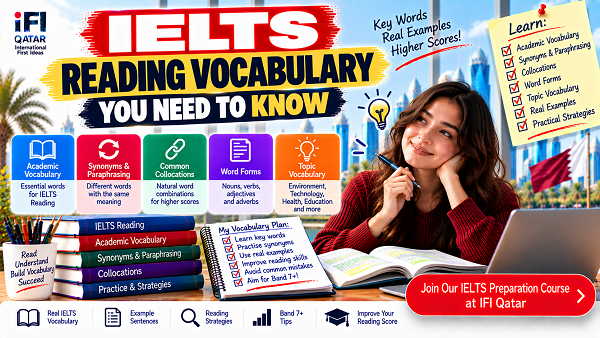
Building strong IELTS Reading vocabulary is one of the most effective ways to become a faster and more confident reader.
However, preparing for IELTS Reading is not about memorising a huge dictionary of difficult English words.
The real challenge is being able to recognise a word when it appears in a different form, understand its meaning from context, identify synonyms and paraphrases, and distinguish between similar words when answering questions.
For example, a question may use the word increase, while the passage uses:
- rise
- grow
- climb
- expand
- surge
- increase significantly
If you only search for the exact word from the question, you may miss the answer.
This guide explains the vocabulary skills you need for IELTS Reading, including essential academic words, common synonyms, useful collocations, topic vocabulary, word forms, paraphrasing and practical vocabulary-building techniques.
Why IELTS Reading Vocabulary Matters
Vocabulary affects how quickly and accurately you understand a Reading passage.
You may know the grammar of a sentence but still struggle to understand it because several important words are unfamiliar.
For example:
The rapid expansion of urban areas has resulted in significant environmental consequences.
A learner who understands rapid, expansion, urban areas, resulted in, significant and consequences can understand the main idea quickly.
A learner who knows only the individual grammar structure may still struggle because the meaning depends heavily on vocabulary.
Vocabulary is particularly important because IELTS Reading tests your ability to understand:
- Main ideas
- Specific information
- Relationships between ideas
- Examples
- Comparisons
- Opinions and claims
- Causes and effects
- Descriptions
- Arguments
- Paraphrased information
The Academic Reading test currently consists of three sections, 40 questions and 60 minutes. The texts can come from sources such as books, journals, magazines, newspapers and online resources and may use narrative, descriptive or argumentative styles.
This means you need more than everyday conversational English.
Do You Need to Know Every Word in an IELTS Reading Passage?
No.
One of the biggest mistakes IELTS students make is trying to understand every single word before answering questions.
You may encounter unfamiliar vocabulary even if you have a strong English level.
The goal is not:
“I must understand every word.”
The better goal is:
“I must understand enough of the text to answer the questions accurately.”
If you see an unfamiliar word, first ask:
- Is this word essential to the question?
- Can I understand its meaning from the surrounding sentence?
- Is it a synonym of something I already know?
- Is it an example or supporting detail?
- Does the overall paragraph still make sense without knowing the exact definition?
Learning to continue reading despite an unfamiliar word is an important Reading skill.
The Most Important Types of IELTS Reading Vocabulary
Instead of memorising random vocabulary lists, organise your vocabulary into useful categories.
Academic Vocabulary
Academic vocabulary appears frequently in IELTS passages, particularly Academic Reading.
Examples include:
| Word | Meaning | Example |
|---|---|---|
| significant | important or considerable | a significant increase |
| evidence | information supporting an idea | scientific evidence |
| factor | something contributing to a result | a major factor |
| approach | a method or way of dealing with something | a new approach |
| impact | effect or influence | a significant impact |
| indicate | show or suggest | the results indicate |
| assess | evaluate | researchers assessed the results |
| establish | prove or create | the study established a connection |
| require | need | the process requires careful planning |
| occur | happen | the change occurred gradually |
| decline | decrease | the population declined |
| emerge | appear or develop | new technologies emerged |
| obtain | get or acquire | researchers obtained new data |
| contribute | help to cause something | several factors contributed |
| demonstrate | show clearly | the study demonstrated a difference |
You do not need to memorise these words in isolation.
Learn them in sentences and combinations.
For example:
significant increase
significant difference
significant impact
significant change
This makes the vocabulary much easier to recognise in a real passage.
IELTS Reading Synonyms You Should Know
IELTS frequently tests your ability to recognise paraphrased language.
A question may use one word while the passage uses another expression with a similar meaning.
Common Synonym Groups
| Common Word | Possible IELTS Synonyms |
|---|---|
| increase | rise, grow, climb, expand |
| decrease | decline, fall, drop, reduce |
| important | significant, crucial, essential, vital |
| problem | issue, challenge, difficulty, concern |
| result | outcome, consequence, effect |
| reason | cause, factor, explanation |
| show | indicate, demonstrate, reveal, illustrate |
| help | assist, support, facilitate |
| change | alter, modify, transform, shift |
| use | employ, utilise, apply |
| improve | enhance, strengthen, develop |
| reduce | decrease, lower, minimise, cut |
| create | produce, generate, establish |
| large | substantial, considerable, extensive |
| small | limited, minor, slight |
| different | distinct, diverse, varied |
| common | widespread, prevalent, frequent |
| rare | uncommon, unusual, infrequent |
| possible | potential, feasible, viable |
| difficult | challenging, demanding, complex |
Remember that synonyms are not always interchangeable in every sentence.
For example, reduce, minimise and decrease are related, but their grammatical patterns and contexts can differ.
The goal is to recognise meaning, not simply replace every word with another word.
IELTS Reading Paraphrasing: The Skill That Can Change Your Score
Paraphrasing is one of the most important vocabulary skills for IELTS Reading.
Consider this question:
The number of people living in cities has increased significantly.
The passage might say:
Urban populations have experienced substantial growth in recent decades.
The wording is different, but the meaning is closely related.
The key changes are:
people living in cities → urban populations
increased → experienced growth
significantly → substantial
If you only look for exact matches, you may miss the answer.
Common Paraphrasing Patterns
Noun → Verb
an increase in prices
prices increased
Verb → Noun
the population declined
a decline in the population
Adjective → Noun
significant changes
changes of significance
Phrase → Synonym
because of
due to / as a result of
Active → Passive
Scientists conducted the study.
The study was conducted by scientists.
The meaning remains similar even though the structure changes.
IELTS Reading Word Forms You Need to Recognise
Sometimes the passage and question use different forms of the same word.
For example:
analyse → analysis → analytical
develop → development → developmental
economy → economic → economically
environment → environmental → environmentally
significant → significance → significantly
different → difference → differently
If you know only one form, you may not immediately recognise the others.
Example
Question:
The study found a significant difference between the two groups.
Passage:
The researchers identified considerable differences between participants.
The key vocabulary is related:
significant → considerable
difference → differences
found → identified
Learning word families makes these relationships easier to recognise.
High-Value IELTS Reading Collocations
A collocation is a combination of words that naturally appear together.
Learning collocations is more useful than memorising isolated words.
Research and Science
- conduct research
- scientific evidence
- research findings
- collect data
- analyse data
- experimental results
- scientific method
- research study
- previous research
- academic research
Environment
- climate change
- environmental impact
- natural resources
- renewable energy
- fossil fuels
- carbon emissions
- environmental damage
- wildlife conservation
- sustainable development
- natural habitat
Education
- higher education
- academic performance
- educational institutions
- learning outcomes
- teaching methods
- educational opportunities
- literacy rate
- academic achievement
- school environment
- formal education
Technology
- technological development
- technological advancement
- digital technology
- artificial intelligence
- technological innovation
- online platform
- digital communication
- data collection
- technological change
- internet access
Society
- social change
- population growth
- social inequality
- living standards
- public services
- economic development
- cultural differences
- social behaviour
- urban population
- community development
Learning these combinations helps you recognise meaning more quickly when reading.
Essential IELTS Reading Vocabulary by Topic
IELTS Reading passages can cover a wide variety of subjects. You should therefore build vocabulary around common themes rather than memorising a single fixed list.
Environment Vocabulary
Important words include:
- ecosystem
- biodiversity
- habitat
- conservation
- pollution
- emissions
- deforestation
- sustainability
- renewable
- resources
- climate
- species
- extinction
- agriculture
- ecosystem
Useful combinations:
protect biodiversity
conserve natural habitats
reduce carbon emissions
promote sustainable development
preserve endangered species
Science and Research Vocabulary
Useful words include:
- experiment
- research
- evidence
- findings
- hypothesis
- theory
- analysis
- observation
- data
- researchers
- discovery
- innovation
- laboratory
- experiment
- scientific method
Useful combinations:
conduct an experiment
collect data
analyse findings
scientific evidence
research indicates
previous studies suggest
Education Vocabulary
Learn words such as:
- curriculum
- assessment
- academic
- institution
- university
- qualification
- literacy
- education
- learning
- teaching
- classroom
- student performance
- educational policy
Useful combinations:
academic achievement
educational institution
learning outcomes
teaching methods
higher education
educational policy
Technology Vocabulary
Important words include:
- innovation
- device
- digital
- artificial intelligence
- automation
- software
- algorithm
- network
- communication
- technology
- development
- application
Useful combinations:
technological advancement
digital transformation
artificial intelligence
technological innovation
automated systems
Health Vocabulary
Useful words include:
- disease
- treatment
- prevention
- diagnosis
- healthcare
- symptoms
- patients
- research
- nutrition
- obesity
- lifestyle
- physical activity
- mental health
Useful combinations:
prevent disease
improve healthcare
receive treatment
public health
healthy lifestyle
physical activity
IELTS Reading Vocabulary for Different Question Types
Vocabulary is connected to question strategy.
Different question types require you to notice different kinds of language.
Multiple Choice
For multiple-choice questions, look for:
- Synonyms
- Paraphrases
- Examples
- Qualifiers
- Contrasting ideas
Do not choose an answer simply because it contains a word that appears in the passage.
The correct answer may express the same idea using completely different wording.
True, False, Not Given
For True/False/Not Given questions, vocabulary precision is extremely important.
You need to distinguish between:
- Same meaning
- Contradictory meaning
- Information that is not mentioned
For example:
Statement:
Most researchers support the theory.
Passage:
Several researchers have questioned the theory.
This is not simply a vocabulary match. You must understand the relationship between support and question.
Matching Headings
Matching headings requires you to identify the main idea of a paragraph.
You may see:
The advantages of early education
while the paragraph uses:
Children who receive formal learning opportunities at a young age often demonstrate stronger academic development later in life.
The paragraph may never use the word advantages.
You need to recognise the overall meaning.
Summary Completion
Summary completion often requires careful attention to:
- Word forms
- Collocations
- Grammar
- Synonyms
- Context
If the instruction says:
NO MORE THAN TWO WORDS
you must follow that limit exactly.
The official IELTS Reading format includes summary, note, sentence, table and flow-chart completion tasks, among other question types, and the instructions specify the permitted number of words or numbers.
How to Learn IELTS Reading Vocabulary Faster
Reading vocabulary improves through repeated exposure, not one-time memorisation.
Learn Words in Context
Instead of memorising:
significant = important
learn:
a significant increase
a significant difference
a significant impact
significant evidence
Then create your own sentence.
Build a Personal Vocabulary Notebook
Use four columns:
| Word | Meaning | Collocation | Example |
|---|---|---|---|
| emerge | appear/develop | emerge as a trend | A new trend emerged. |
| substantial | large/considerable | substantial increase | There was a substantial increase. |
| decline | decrease | gradual decline | The population experienced a gradual decline. |
| assess | evaluate | assess the impact | Researchers assessed the impact. |
This approach is more useful than copying hundreds of words from a dictionary.
Record Synonyms Together
For example:
Increase
- rise
- grow
- climb
- expand
- surge
Decrease
- decline
- fall
- drop
- decrease
- diminish
Important
- significant
- crucial
- essential
- vital
- considerable
This makes paraphrases easier to recognise.
Learn Word Families
Create groups such as:
Develop
- develop
- development
- developed
- developing
- developmental
Economy
- economy
- economic
- economical
- economically
Environment
- environment
- environmental
- environmentally
This helps you recognise different forms in passages.
How to Use Context to Understand Unknown Words
You will almost certainly encounter unfamiliar words during IELTS Reading.
Instead of immediately stopping, use context.
Look at the Sentence Around the Word
Example:
The new technology was initially considered prohibitively expensive, meaning that only wealthy organisations could afford to implement it.
Even if you do not know prohibitively, the second part suggests that the technology was extremely expensive.
Look for Examples
A passage may define a difficult term through examples.
Several forms of renewable energy, such as solar, wind and hydroelectric power, are increasingly being adopted.
The examples help you understand the broader category.
Look for Contrast
Words such as:
- however
- although
- whereas
- while
- in contrast
- unlike
can help you infer meaning.
Look for Cause and Effect
Words such as:
- because
- therefore
- consequently
- resulting in
- due to
- as a result
can provide clues about the relationship between ideas.
Common IELTS Reading Vocabulary Mistakes
Memorising Huge Lists Without Context
Knowing 1,000 words does not guarantee a high Reading score if you cannot recognise them in context.
Quality matters more than the number of words memorised.
Focusing Only on Difficult Words
Some of the most useful IELTS vocabulary is not extremely advanced.
Words such as:
- increase
- decline
- evidence
- factor
- impact
- approach
- result
- significant
appear in many academic contexts and are worth mastering.
Ignoring Synonyms
If you only search for the exact word in the question, you may miss the relevant part of the passage.
Always ask:
What other word or phrase could express the same idea?
Learning Words Without Grammar
A word can change meaning depending on how it is used.
For example:
conduct research
but:
conduct an experiment
Learning vocabulary with its common grammatical patterns and collocations is much more effective.
Guessing Without Checking Context
A word may have several meanings.
For example:
issue
can mean:
- a problem
- a topic
- a publication
- to officially provide something
Always use the surrounding sentence to determine the meaning.
A 7-Day IELTS Reading Vocabulary Study Plan
Day 1: Academic Vocabulary
Learn 15–20 high-frequency academic words.
Focus on:
- Meaning
- Word form
- Collocation
- Example sentence
Day 2: Synonyms
Create synonym groups for:
- Increase
- Decrease
- Important
- Problem
- Result
- Change
- Show
- Improve
Day 3: Word Families
Study 10 common word families.
For example:
analyse → analysis → analytical → analytically
Day 4: Topic Vocabulary
Choose one topic:
- Environment
- Education
- Technology
- Health
- Science
Learn 15–20 useful words in context.
Day 5: Paraphrasing Practice
Take sentences from an IELTS Reading passage and identify:
- Original word
- Synonym
- Word-form change
- Structural change
Day 6: Timed Reading Practice
Complete a Reading passage under time pressure.
Record every vocabulary problem you encounter.
Do not immediately memorise every unknown word.
First decide which words actually affected your ability to answer questions.
Day 7: Review and Testing
Review your vocabulary notebook.
Then test yourself without looking at the answers.
For each word, try to remember:
- Meaning
- Synonym
- Word family
- Collocation
- Example
How Many IELTS Reading Words Should You Learn?
There is no official number of vocabulary words that guarantees a particular IELTS Reading band.
Instead of setting a target such as “I must learn 5,000 words,” focus on whether you can:
- Understand academic texts efficiently
- Recognise common paraphrases
- Infer meaning from context
- Identify word families
- Understand collocations
- Distinguish similar meanings
- Read without translating every sentence
A smaller vocabulary that you can recognise quickly and accurately is more useful during the test than a huge list of words that you have only seen once.
IELTS Reading Vocabulary and Your Band Score
Vocabulary is not a separate Reading score category in the same way it is assessed in IELTS Writing.
Your Reading score is based on your performance across the 40 questions.
IELTS states that each correct Reading answer receives one mark, with the total converted to the 9-band scale. The exact number of correct answers needed for a particular band can vary between test versions.
This is why vocabulary study should always be connected to actual Reading practice.
Do not spend all your preparation time memorising words.
A balanced preparation plan should include:
- Vocabulary
- Skimming
- Scanning
- Paraphrase recognition
- Question-type strategies
- Timed practice
- Error analysis
- Full Reading tests
A Practical IELTS Reading Vocabulary Checklist
Before your IELTS exam, make sure you can:
- Recognise common academic vocabulary.
- Identify synonyms quickly.
- Understand common paraphrases.
- Recognise different word forms.
- Understand frequent collocations.
- Guess the meaning of unfamiliar words from context.
- Distinguish between similar words.
- Understand cause-and-effect vocabulary.
- Recognise comparison and contrast language.
- Understand vocabulary related to common IELTS topics.
- Follow word limits in completion questions.
- Read without translating every sentence.
Frequently Asked Questions About IELTS Reading Vocabulary
What vocabulary do I need for IELTS Reading?
You need a broad vocabulary that includes academic words, common topic vocabulary, synonyms, collocations, word families and paraphrasing patterns. You do not need to memorise every difficult word that could appear in a passage.
How can I improve my IELTS Reading vocabulary?
Read regularly, learn vocabulary in context, build synonym groups, study word families and keep a personal vocabulary notebook. Most importantly, use new vocabulary while completing real IELTS Reading practice.
Is IELTS Reading vocabulary different from general English vocabulary?
There is significant overlap, but IELTS Reading frequently uses academic and topic-specific language. Academic Reading passages may cover scientific, educational, environmental, technological and social topics.
Should I memorise an IELTS Reading vocabulary list?
A vocabulary list can be useful, but memorising isolated words is not enough. Learn each word with its meaning, word family, common collocations, synonyms and an example sentence.
How important are synonyms in IELTS Reading?
Synonyms are extremely important because questions and passages may express the same idea using different words. Recognising paraphrases helps you locate and understand relevant information.
What should I do if I do not know a word in the IELTS Reading test?
Do not panic. Read the surrounding sentence and paragraph, look for examples or contrasts, and decide whether the word is actually necessary for answering the question. If it is not essential, continue reading.
How can I learn IELTS Reading vocabulary quickly?
Focus on high-frequency academic words, common synonyms and vocabulary related to recurring topics. Study words in context and review them repeatedly instead of trying to memorise a very large list at once.
Does a larger vocabulary guarantee a higher IELTS Reading score?
No. Vocabulary is only one part of successful Reading performance. You also need to understand question types, locate information efficiently, recognise paraphrases and manage your time effectively.
Final Thoughts on IELTS Reading Vocabulary
Strong IELTS Reading vocabulary is not about knowing the most complicated English words.
It is about being able to recognise meaning quickly.
When you see:
a substantial increase
you should be able to connect it with:
a significant rise
When you see:
urban populations expanded rapidly
you should understand that it may correspond to:
the number of people living in cities increased considerably
This ability to recognise relationships between words is one of the most valuable vocabulary skills you can develop for IELTS Reading.
Build your vocabulary around academic words, synonyms, paraphrases, collocations, word families and common IELTS topics. Then practise using real Reading passages so that your vocabulary becomes an active reading skill rather than a memorised list.
Most importantly, combine vocabulary study with timed Reading practice, error analysis and question-type strategies.
That combination will help you read more efficiently, understand difficult passages with greater confidence and prepare more effectively for your target IELTS band.
Prepare for IELTS with a Complete Preparation Course
Vocabulary is only one part of IELTS Reading success. To improve your overall performance, you also need to practise question types, reading strategies, timing and full mock tests.
Join an IELTS Preparation Course at IFI Qatar to build your Reading skills with structured lessons, targeted practice and expert guidance across the four IELTS skills.
Ready to prepare more effectively for IELTS? Start your IELTS preparation with IFI Qatar.