

Currently Empty: ر.ق 0,00


IELTS
IELTS Task 2 Problem Solution Essay Examples: Structure, Tips and Sample Answers
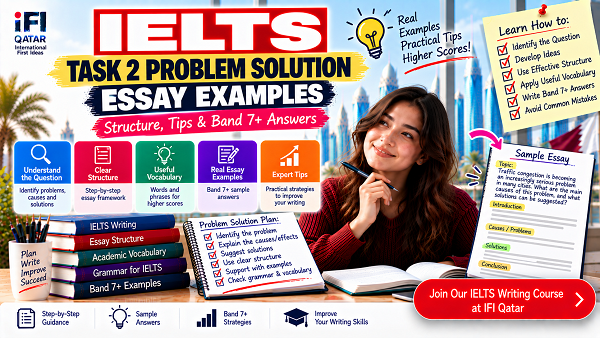
An IELTS problem solution essay asks you to identify a problem, explain its causes or effects, and propose one or more realistic solutions.
This type of IELTS Writing Task 2 question can seem straightforward, but many candidates lose marks because they do not fully answer every part of the question. Some focus too heavily on describing the problem, while others list solutions without explaining why those solutions would work.
A high-quality response needs more than a list of problems and solutions. Your ideas should be relevant, logically organised, clearly developed and supported with appropriate examples.
In this guide, you will learn how to identify a problem solution question, plan your essay, structure each paragraph, use useful vocabulary and study complete sample answers.
What Is an IELTS Problem Solution Essay?
A problem solution essay is a type of IELTS Writing Task 2 essay in which you are asked to discuss a problem and suggest ways to address it.
Typical questions may ask you to:
- Explain the causes of a problem.
- Describe the problems created by a situation.
- Suggest solutions.
- Explain how a problem can be solved.
- Discuss both problems and possible solutions.
For example:
In many cities, traffic congestion is becoming increasingly serious.
What are the main causes of this problem, and what measures can be taken to solve it?
This question contains two clear tasks:
- Explain the main causes.
- Suggest solutions.
You need to address both.
IELTS Task 2 requires a minimum of 250 words and approximately 40 minutes is recommended for the task. Your response is assessed according to Task Response, Coherence and Cohesion, Lexical Resource, and Grammatical Range and Accuracy. Task 2 also carries more weight than Task 1 in the overall Writing score.
How to Identify an IELTS Problem Solution Question
The wording of the question is your first clue.
Look for phrases such as:
- What problems does this cause?
- What are the causes of this problem?
- What solutions can you suggest?
- What measures can be taken?
- How can this problem be solved?
- What can be done to address this issue?
- What are the main problems and what solutions can you suggest?
Common Problem Solution Question Patterns
There are several common patterns.
Pattern 1: Problems + Solutions
Many people are suffering from stress because of their jobs. What problems can this cause, and what solutions can you suggest?
You need to discuss problems and solutions.
Pattern 2: Causes + Solutions
Traffic congestion is becoming a serious problem in many cities. What are the main causes of this problem, and what measures can be taken to solve it?
You need to explain causes and propose solutions.
Pattern 3: Problems + Measures
Many young people spend too much time using social media. What problems can this cause, and what measures could be taken to address this issue?
You need to explain consequences and possible measures.
Why Question Analysis Matters
Do not decide what type of essay you are writing simply because the topic looks familiar.
IELTS specifically advises candidates to read the question carefully, identify all parts of the task and respond directly rather than trying to fit a memorised essay to a question.
Before writing, underline the key instructions.
For example:
Many countries are experiencing an increase in childhood obesity.
What are the main causes of this problem?
What solutions can be suggested?
Your plan should therefore contain:
Causes → Solutions
Not:
Advantages → Disadvantages
Not:
Your opinion → Opposing opinion
The exact task determines your essay.
IELTS Problem Solution Essay Structure
A clear four-paragraph structure works well for many problem solution questions:
- Introduction
- Body Paragraph 1 – Problems or Causes
- Body Paragraph 2 – Solutions
- Conclusion
However, you can use more than four paragraphs when the question requires additional development.
Introduction
Your introduction should normally do two things:
- Paraphrase the topic.
- Clearly state what the essay will discuss.
Example:
Traffic congestion has become a major concern in many urban areas, largely because of population growth and the increasing number of private vehicles. This essay will examine the main causes of this problem and suggest practical measures that governments can take to reduce it.
This introduction establishes:
- The topic
- The main issue
- The causes
- The direction of the essay
Body Paragraph 1: Problems or Causes
A strong problem or cause paragraph should not simply list several points.
Instead, use a clear structure:
Main idea → Explanation → Example → Result
Example:
One of the main causes of traffic congestion is the growing dependence on private cars. As urban populations increase, more people choose to drive because public transportation may not provide sufficient coverage or convenience. For example, commuters who live in suburban areas may have limited access to reliable buses or trains and therefore rely on their own vehicles. As a result, large numbers of cars enter city centres during peak hours, causing severe delays.
Notice how the main idea is developed rather than simply mentioned.
Body Paragraph 2: Solutions
Use a similar structure:
Solution → Explanation → Implementation → Expected result
Example:
One effective solution would be to improve public transportation networks. Governments could invest in reliable bus and metro systems and ensure that services connect residential areas with major employment centres. If public transport were affordable, frequent and convenient, more commuters would have an incentive to leave their cars at home. This could significantly reduce the number of vehicles on the roads during peak periods.
This is much stronger than:
Governments should improve public transport. This would solve the problem.
The second version gives a solution but does not adequately explain how or why it would work.
How to Write a Strong Introduction
Your introduction does not need to be long.
A useful formula is:
Paraphrase + Essay roadmap
For example:
The rapid growth of urban populations has contributed to increasingly severe traffic problems in many cities. This essay will examine the main causes of traffic congestion and discuss several measures that could be implemented to address it.
Avoid Overly General Introductions
Weak:
Nowadays, there are many problems in the world. Traffic is one of them.
This introduction is:
- Too general
- Repetitive
- Informal
- Not focused enough
Better:
Rapid urbanisation and increasing car ownership have made traffic congestion a serious issue in many cities.
This immediately addresses the topic.
How to Develop Problems and Causes
The biggest mistake in a problem solution essay is often underdeveloped ideas.
Consider this sentence:
One problem is pollution.
This is too basic.
Ask yourself:
Why?
Increased traffic produces more vehicle emissions.
Then:
So what?
These emissions can contribute to poor air quality.
Then:
Who is affected?
Residents living near busy roads may be exposed to higher levels of air pollution.
Now the idea is developed:
One major consequence of heavy traffic is increased air pollution. Large numbers of vehicles release exhaust emissions, which can significantly reduce air quality in densely populated areas. Residents who live close to major roads may therefore face greater exposure to harmful pollutants, potentially creating long-term health concerns.
This is the level of development you should aim for.
How to Develop Effective Solutions
A good solution should be:
- Realistic
- Relevant
- Specific
- Clearly explained
- Directly connected to the problem
For example, if the problem is excessive car use, a weak solution is:
People should use cars less.
A stronger solution is:
Governments could encourage people to use public transportation by expanding metro and bus networks, reducing fares and improving service frequency.
An even more developed version explains the expected outcome:
Governments could encourage people to use public transportation by expanding metro and bus networks, reducing fares and improving service frequency. These measures would make public transport a more convenient alternative to private vehicles, potentially reducing the number of cars entering congested areas during peak hours.
IELTS Problem Solution Essay Example 1: Traffic Congestion
IELTS Writing Task 2 Question
Traffic congestion is becoming an increasingly serious problem in many cities.
What are the main causes of this problem, and what solutions can be suggested?
Sample Answer
Traffic congestion has become a major challenge in many urban areas, particularly as populations grow and private car ownership increases. This essay will discuss the main causes of this issue and suggest several measures that could help reduce congestion.
One major cause of traffic congestion is the growing number of private vehicles on the roads. As cities expand, many people choose to drive because cars provide greater flexibility and convenience, particularly when public transportation is unreliable or unavailable. In addition, urban development often encourages people to live further away from their workplaces, which increases the need for daily commuting. Consequently, large numbers of vehicles enter city centres at approximately the same time, creating severe delays during peak hours.
Another important factor is inadequate public transportation. In some cities, buses and trains are overcrowded, infrequent or poorly connected to residential areas. As a result, even people who would prefer to use public transport may decide that driving is a more practical option. This increases the number of vehicles on already congested roads.
Several measures could be taken to address this problem. First, governments should invest in efficient public transportation systems that provide frequent and affordable services. If commuters had access to reliable alternatives to private cars, more people would be likely to leave their vehicles at home. Second, authorities could introduce measures such as congestion charges or higher parking fees in busy city centres. These policies would discourage unnecessary car journeys while generating revenue that could be invested in public transportation.
In conclusion, traffic congestion is largely caused by increasing car ownership, urban expansion and inadequate public transport. Improving public transportation while introducing policies that discourage excessive car use could significantly reduce congestion in major cities.
Why This Sample Works
The sample answer is effective because it does not merely list causes and solutions.
It:
- Directly answers both parts of the question.
- Has a clear position and direction.
- Uses logically organised paragraphs.
- Explains the relationship between causes and consequences.
- Explains how proposed solutions could work.
- Uses relevant examples and reasoning.
- Maintains an academic tone.
- Uses a variety of grammatical structures.
The important lesson is development.
The candidate does not simply say:
Public transport is bad.
Instead, the essay explains:
Public transport is unreliable → people choose cars → more vehicles enter the roads → congestion becomes worse.
That logical chain makes the argument much stronger.
IELTS Problem Solution Essay Example 2: Childhood Obesity
IELTS Writing Task 2 Question
Childhood obesity is becoming increasingly common in many countries.
What are the main causes of this problem, and what measures could be taken to solve it?
Sample Answer
Childhood obesity has become a growing concern in many countries, with increasingly large numbers of children being affected by unhealthy lifestyles. This essay will examine the main causes of this trend and discuss measures that parents, schools and governments could take to address it.
One significant cause of childhood obesity is the widespread availability of unhealthy food. Children are frequently exposed to advertisements for products that contain high levels of sugar, salt and fat, while fast food is often relatively inexpensive and convenient. At the same time, many children consume fewer nutritious meals at home because parents may have limited time to prepare fresh food. Another contributing factor is a lack of physical activity. The increasing use of smartphones, computers and other digital devices means that many children spend several hours each day sitting rather than exercising.
There are several ways to tackle this issue. One effective measure would be for schools to provide healthier meals and include more physical activity in the school day. This could help children develop healthy habits at an early age. Governments could also regulate advertising aimed at children, particularly advertisements for products with high levels of sugar and fat. In addition, parents should encourage children to participate in outdoor activities and limit their recreational screen time. If these measures were implemented consistently, children would be more likely to maintain healthier lifestyles.
In conclusion, childhood obesity is mainly associated with unhealthy diets and insufficient physical activity. A combination of healthier school meals, stronger regulation of food advertising and greater parental involvement could help reduce the prevalence of this problem.
IELTS Problem Solution Essay Example 3: Environmental Pollution
IELTS Writing Task 2 Question
Environmental pollution is increasing in many parts of the world.
What are the main problems caused by pollution, and what can individuals and governments do to address them?
Sample Answer
Environmental pollution has become a serious global concern, affecting both human health and natural ecosystems. This essay will discuss the main problems caused by pollution and examine several actions that individuals and governments can take to reduce its impact.
One of the most serious consequences of pollution is its effect on public health. Air pollution from vehicles, factories and other sources can reduce air quality in urban areas, increasing people’s exposure to harmful substances. Water pollution is also a major concern because industrial waste, chemicals and plastic can contaminate rivers and oceans. These problems can damage ecosystems and make some natural resources unsafe for human use.
Governments can address these issues by introducing stricter environmental regulations and investing in cleaner technologies. For example, factories could be required to meet higher emissions standards, while financial incentives could encourage businesses to adopt renewable energy and less polluting production methods. Individuals also have an important role to play. They can reduce unnecessary car journeys, recycle household waste and avoid products that contain excessive amounts of single-use plastic. Although individual actions alone cannot solve environmental problems, widespread changes in consumer behaviour can complement government policies.
In conclusion, pollution can seriously affect public health and the natural environment. Governments should strengthen environmental regulations and support cleaner technologies, while individuals can contribute by making more sustainable choices in their daily lives.
Problem Solution Essay Vocabulary
Using appropriate vocabulary can help you express causes, problems and solutions more precisely.
Vocabulary for Introducing Problems
Useful expressions include:
- a growing concern
- a serious issue
- a major challenge
- an increasingly common problem
- a significant concern
- a widespread issue
- a pressing problem
- a growing threat
Examples:
Traffic congestion has become a pressing problem in many urban areas.
Childhood obesity is an increasingly common health concern.
Vocabulary for Explaining Causes
Useful expressions include:
- one of the main causes is…
- one contributing factor is…
- this can be attributed to…
- this is largely due to…
- this is partly because…
- a major reason for this is…
- another factor is…
- this results from…
Example:
One contributing factor is the growing dependence on private vehicles.
Vocabulary for Describing Effects
Useful expressions include:
- this can lead to…
- this can result in…
- as a consequence…
- as a result…
- consequently…
- this may cause…
- this can have a significant impact on…
- one possible consequence is…
Example:
Excessive screen time can lead to reduced physical activity among children.
Vocabulary for Introducing Solutions
Useful expressions include:
- one effective solution would be…
- one possible measure is…
- governments could…
- authorities should consider…
- a practical approach would be…
- this problem could be addressed by…
- one way to tackle this issue is…
- a long-term solution would be…
Example:
One effective solution would be to improve the quality and availability of public transportation.
Vocabulary for Explaining How Solutions Work
This is particularly important for developing your ideas.
Useful structures include:
- This would allow…
- This could encourage…
- This would make it easier for…
- As a result, people would be more likely to…
- This could reduce…
- This would discourage…
- Such a measure could help to…
- This would create an incentive for…
Example:
Lower public transport fares would make buses and trains more affordable, which could encourage more commuters to leave their cars at home.
How to Write a Band 7+ Problem Solution Essay
A higher-band response needs more than advanced vocabulary.
Focus on four areas.
Develop Your Ideas Fully
Do not stop after stating your main idea.
Use:
Point → Explanation → Example → Result
For example:
Point: One major cause of air pollution is traffic.
Explanation: Large numbers of vehicles release harmful emissions.
Example: This is particularly noticeable in densely populated cities.
Result: As a result, residents may experience poorer air quality.
This creates a complete argument.
Make Solutions Specific
Avoid vague statements such as:
The government should do something about this problem.
Instead:
Governments could introduce higher parking fees in city centres and use the additional revenue to improve public transportation.
The second version tells the reader:
- What governments should do
- Where they should do it
- What the policy would achieve
Connect Solutions to Problems
Your solution should directly address the problem you identified.
For example:
Problem: People drive because public transport is unreliable.
Solution: Improve the frequency and reliability of buses and trains.
This creates a clear logical connection.
Use Grammar for Meaning, Not Decoration
Useful structures include:
- Conditionals
- Relative clauses
- Passive voice
- Cause-and-effect clauses
- Concession clauses
- Modal verbs
For example:
If governments invested more heavily in public transportation, fewer commuters would rely on private vehicles.
This is more useful than forcing an unnecessarily complicated grammatical structure into the essay.
Common Mistakes in IELTS Problem Solution Essays
Writing About the Wrong Question
If the question asks for causes and solutions, do not spend an entire paragraph discussing advantages and disadvantages.
Always identify the exact task before planning.
Listing Problems Without Explaining Them
Weak:
Traffic causes pollution, stress and delays.
Better:
Heavy traffic contributes to air pollution because thousands of vehicles release exhaust emissions into densely populated areas. It can also increase stress among commuters who spend long periods travelling to and from work.
Giving Unrealistic Solutions
Avoid solutions that are impossible or too broad.
Weak:
Governments should completely eliminate traffic.
Better:
Governments could reduce congestion by expanding public transport and introducing restrictions on private vehicles in the busiest areas.
Using Memorised Essays
Memorising a complete essay is risky.
The official IELTS guidance specifically warns against formulaic or memorised responses that do not properly address the question.
Instead, learn:
- Essay structures
- Useful vocabulary
- Idea-development techniques
- Grammar patterns
- Planning strategies
Then adapt them to the actual question.
Repeating the Same Solution
Do not write:
Governments should improve public transport.
Then:
Another solution is for governments to make public transport better.
These are essentially the same idea.
Instead, provide different solutions that address different aspects of the problem.
How to Plan an IELTS Problem Solution Essay in 5 Minutes
You do not need to write a detailed plan.
Use a quick four-step process.
Step 1: Identify the Problem
Ask:
What exactly is the issue?
Step 2: Identify the Task
Ask:
Do I need causes, problems, solutions or a combination?
Step 3: Choose Two Strong Ideas
Choose ideas that are:
- Relevant
- Easy to explain
- Easy to support
- Directly connected to the question
Step 4: Create a Simple Chain
For each idea, write:
Cause → Effect
or
Solution → Result
For example:
More cars → more emissions → poorer air quality
Then:
Better public transport → fewer cars → less congestion and pollution
This simple planning method can make your essay much easier to write.
Recommended 40-Minute Time Plan
Because IELTS Task 2 should be completed in approximately 40 minutes, time management matters.
A practical approach is:
5 minutes: Analyse and plan
25–28 minutes: Write
7–10 minutes: Check and improve
During proofreading, check:
- Have I answered every part of the question?
- Is each paragraph focused on one main idea?
- Are my solutions realistic?
- Have I explained my ideas?
- Are my examples relevant?
- Have I repeated vocabulary unnecessarily?
- Are my verb tenses correct?
- Have I made subject-verb agreement errors?
- Have I checked articles and prepositions?
- Have I used punctuation correctly?
IELTS Problem Solution Essay Structure Template
You can use the following framework when practising:
Introduction
[Paraphrase the problem]. This essay will examine [main problem/cause] and discuss [main solution/solutions].
Body Paragraph 1
One major problem/cause is [main idea].
This is because [explanation].
For example, [example].
As a result, [effect].
Body Paragraph 2
One effective solution would be [solution].
This could be achieved by [explanation].
For example, [example].
As a result, [expected outcome].
Conclusion
In conclusion, [summarise the main problem/cause]. The most effective way to address this issue would be [main solution], supported by [additional measure].
Do not copy this template word for word in the exam. Use it as a planning framework and adapt your language naturally to the specific question.
Frequently Asked Questions About IELTS Problem Solution Essays
What is an IELTS problem solution essay?
An IELTS problem solution essay is a Writing Task 2 essay that asks you to discuss a problem, its causes or effects, and/or possible solutions. The exact requirements depend on the wording of the question.
How many paragraphs should a problem solution essay have?
A four-paragraph structure can work well: introduction, problem or causes paragraph, solutions paragraph and conclusion. However, the best structure depends on the exact question and how many ideas need to be developed.
How do I start an IELTS problem solution essay?
Start by paraphrasing the problem in the question and then clearly state what your essay will discuss. Avoid overly general statements and memorised introductions.
How many solutions should I give in IELTS Writing Task 2?
There is no official required number of solutions. It is usually better to develop one or two strong, relevant solutions fully than to list several ideas without explanation.
Can I give examples from my own experience?
Yes. Relevant examples can be used to support ideas. However, the example should clearly relate to the argument rather than being included simply to increase the word count.
How can I get Band 7 in a problem solution essay?
Focus on answering every part of the question, developing and supporting your main ideas, organising your essay logically, using appropriate vocabulary and demonstrating a range of grammatical structures accurately.
Should I give my opinion in a problem solution essay?
It depends on the question. If the question asks only for problems and solutions, you do not need to turn the essay into an opinion essay. However, you should clearly answer exactly what the prompt asks.
Is a problem solution essay the same as a causes and solutions essay?
They are closely related, but the exact task wording matters. Some questions ask you to explain causes and solutions, while others ask about problems and measures. Always identify the specific requirements before planning.
Final Checklist for an IELTS Problem Solution Essay
Before finishing your essay, check the following:
Task Response
- Have I answered every part of the question?
- Are my ideas directly relevant?
- Have I explained my main ideas?
- Have I included relevant examples or supporting details?
Coherence and Cohesion
- Does each paragraph have one clear purpose?
- Are my ideas logically connected?
- Have I used linking devices naturally?
Lexical Resource
- Have I used precise vocabulary?
- Have I avoided unnecessary repetition?
- Are my collocations natural?
Grammar
- Have I used a range of sentence structures?
- Are my complex sentences accurate?
- Have I checked verb forms?
- Have I checked articles and prepositions?
Overall
- Is my essay at least 250 words?
- Is it written as connected prose?
- Have I answered the actual question rather than a memorised version of it?
- Have I left enough time to proofread?
Conclusion
Writing a strong IELTS problem solution essay is not about memorising a perfect sample answer.
The key is to understand the question, identify exactly what you need to discuss, choose a small number of strong ideas and develop each one logically.
A reliable structure is:
Problem or Cause → Explanation → Example → Effect
and:
Solution → Explanation → Example → Expected Result
When you combine clear organisation with relevant vocabulary, accurate grammar and well-developed ideas, your essay becomes much easier for the examiner to follow.
The best way to improve is to practise different problem solution topics, compare your responses with strong models and receive detailed feedback on Task Response, Coherence and Cohesion, vocabulary and grammar.
Improve Your IELTS Writing with Expert Guidance
Understanding the structure of a problem solution essay is only the beginning. To consistently produce Band 7+ Writing, you need regular practice, detailed correction and guidance on how to develop your ideas and improve your grammar and vocabulary.
Join an IELTS Writing Course at IFI Qatar and practise Task 2 essay structures with expert guidance, targeted feedback and practical strategies designed to help you write more clearly and confidently.
Ready to improve your IELTS Writing score? Start your IELTS preparation with IFI Qatar.