

Currently Empty: ر.ق 0,00


IELTS
IELTS Sentence Structures for High Scores: Complete Guide
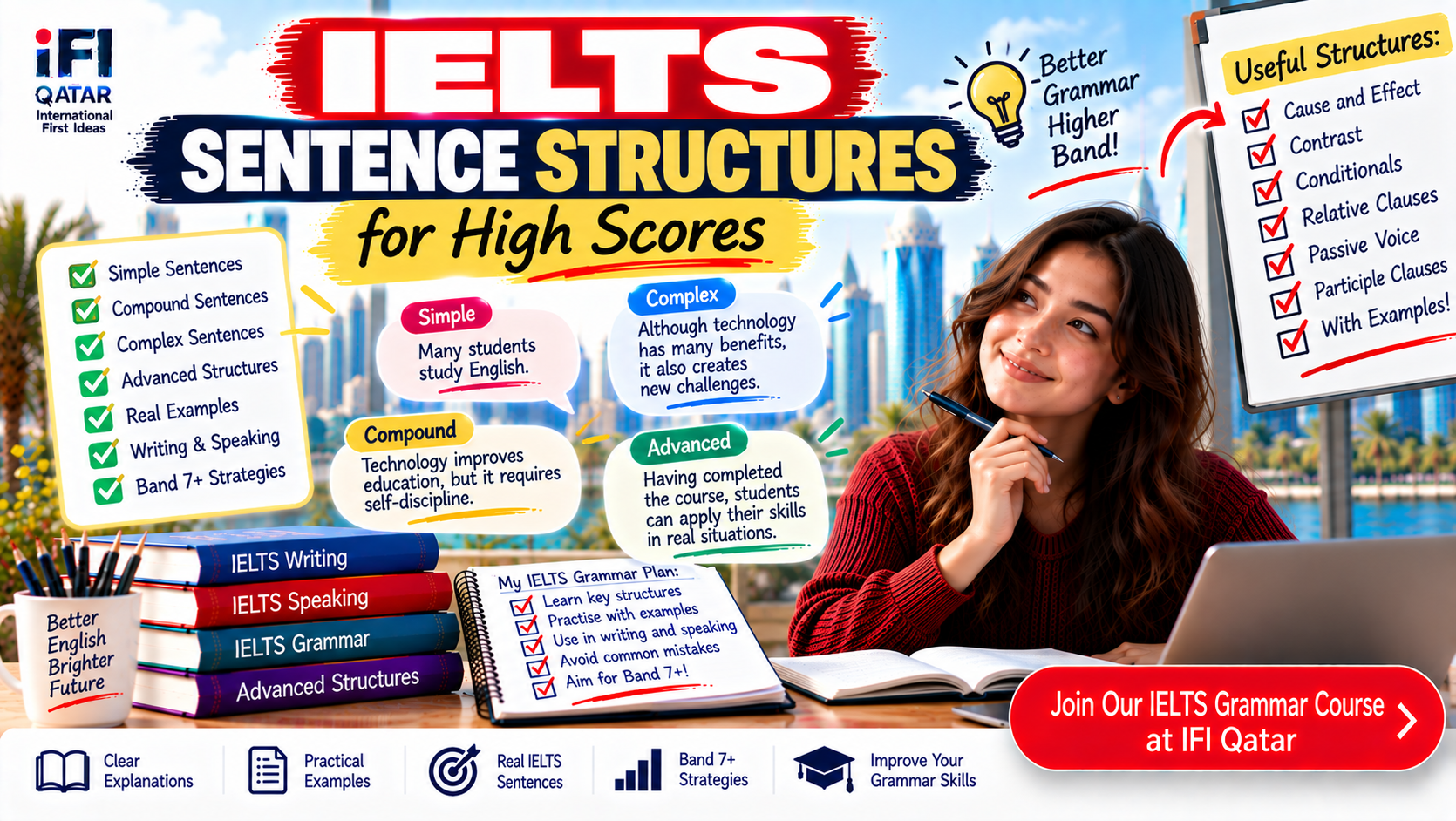
Using the right IELTS sentence structures can make a significant difference to the quality of your Writing and Speaking performance. However, getting a higher band score is not simply about writing longer sentences or using complicated grammar.
The real goal is to use a range of sentence structures accurately, flexibly and appropriately.
For example, a strong IELTS candidate should be able to move naturally between simple, compound and complex sentences instead of writing every idea in the same pattern. More advanced candidates can also use structures such as relative clauses, conditionals, passive constructions, concessive clauses and participle clauses when they genuinely improve the meaning.
This guide explains the most important sentence structures for IELTS, shows you how to use them correctly, and gives you practical examples for both Writing and Speaking.
Why Sentence Structures Matter in IELTS
Sentence structure is closely connected to the Grammatical Range and Accuracy criterion used in IELTS Writing and Speaking.
In IELTS Writing, examiners assess both the range of grammatical structures you use and how accurately and appropriately you use them. Official IELTS guidance notes that candidates need a range of sentence forms, including simple and complex sentences, while higher bands require effective use of complex structures.
The same principle applies to Speaking. The official Speaking band descriptors state that Band 7 candidates use a range of structures flexibly, while Band 8 candidates demonstrate a wide range of structures with the majority of sentences error-free.
This means that sentence structure affects your score in two important ways:
- Range: How many different grammatical structures can you use?
- Accuracy: How correctly can you use them?
- Flexibility: Can you choose an appropriate structure for different ideas?
- Control: Can you use more advanced structures without creating frequent errors?
A complicated sentence full of mistakes is not necessarily better than a clear sentence that communicates the idea accurately.
The Main Types of IELTS Sentence Structures
Before learning advanced structures, you need to understand the four basic sentence types:
- Simple sentences
- Compound sentences
- Complex sentences
- Compound-complex sentences
A high-scoring IELTS response normally combines different sentence types rather than relying on only one.
Simple Sentences
A simple sentence contains one independent clause.
Basic structure:
Subject + Verb + Object
Examples:
- Many students study English.
- Technology affects education.
- IELTS requires regular practice.
- Online learning offers greater flexibility.
Simple sentences are not bad for IELTS. In fact, they are useful when you want to make an important point clear.
Compare:
Many students use online courses.
This is simple and clear.
However, if an entire essay consists of sentences with the same basic pattern, your grammatical range will be limited.
Compound Sentences
A compound sentence connects two independent clauses, usually with a coordinating conjunction.
Common coordinating conjunctions include:
and, but, so, or, yet, for, nor
Structure:
Independent clause + conjunction + independent clause
Examples:
- Many students work during the day, so they study IELTS in the evening.
- Online courses are convenient, but they require self-discipline.
- IELTS preparation can be challenging, yet regular practice produces noticeable improvements.
Compound sentences are useful for connecting related ideas and showing relationships such as contrast, result and addition.
Complex Sentences
A complex sentence contains a main clause and at least one dependent clause.
This is one of the most important sentence structures for IELTS candidates.
Structure:
Main clause + dependent clause
or
Dependent clause + main clause
Examples:
- Many students take IELTS because they need an English qualification.
- Although the exam can be challenging, effective preparation can improve performance.
- Students can improve their vocabulary if they practise using new words regularly.
Complex sentences allow you to express relationships between ideas, such as:
- Cause
- Effect
- Contrast
- Condition
- Time
- Reason
- Purpose
Compound-Complex Sentences
A compound-complex sentence combines features of compound and complex sentences.
Example:
Although online courses are convenient, some students prefer classroom learning, and they often achieve better results when they can interact directly with a teacher.
This structure can demonstrate a higher level of grammatical control, but it should not be used simply to make sentences longer.
If you cannot control the grammar accurately, a shorter sentence is usually the better choice.
The Most Useful IELTS Sentence Structures for Band 7+
You do not need to memorise hundreds of complicated patterns. Instead, focus on a practical set of structures that you can use accurately in different contexts.
Cause and Effect Sentences
Cause-and-effect structures are particularly useful in IELTS Writing Task 2.
Useful patterns include:
Because + cause, result
Because many people work long hours, they have less time for physical exercise.
Cause + therefore + result
Many employees work remotely; therefore, companies can reduce their office costs.
Cause + which means that + result
More people are choosing online education, which means that universities must adapt their teaching methods.
One reason why + subject + verb + is that…
One reason why online education has become popular is that it allows students to study from almost anywhere.
These structures are useful when explaining why something happens and what consequences it produces.
Contrast Sentences
Contrast is essential for many IELTS Writing Task 2 questions.
Useful structures include:
Although + clause, main clause
Although technology has created many opportunities, it has also introduced new challenges.
While + clause, main clause
While some people prefer traditional classrooms, others believe that online education is more flexible.
Despite + noun/gerund, main clause
Despite the high cost of university education, many students consider it a worthwhile investment.
In spite of + noun/gerund, main clause
In spite of the increasing availability of online resources, many students still prefer face-to-face instruction.
Remember the grammatical difference:
Although it is expensive, many students choose the course.
But:
Despite the high cost, many students choose the course.
Do not write:
Despite it is expensive, many students choose the course. ❌
Conditional Sentences
Conditionals are useful when discussing possible consequences, policies and hypothetical situations.
First conditional:
If governments invest more in public transport, traffic congestion will decrease.
Second conditional:
If universities offered more flexible programmes, more working adults could continue their education.
Third conditional:
If governments had invested in public transport earlier, some major cities might have avoided severe congestion.
For IELTS, second conditionals are especially useful when discussing hypothetical policies or situations.
For example:
If schools provided more practical financial education, young people would be better prepared to manage their money.
Relative Clauses
Relative clauses allow you to add information without creating several short sentences.
Common relative pronouns include:
- who
- which
- that
- where
- whose
Basic example:
Students who practise regularly are more likely to improve.
Another example:
Online education, which has become increasingly popular, allows students to study from different locations.
Relative clauses are particularly useful in IELTS Writing because they allow you to combine related ideas more naturally.
Compare:
Many students use online platforms. These platforms provide flexible lessons.
Better:
Many students use online platforms that provide flexible lessons.
Passive Voice
The passive voice is particularly useful in Academic Writing when the action is more important than the person performing it.
Active:
Researchers conducted the study in 2025.
Passive:
The study was conducted in 2025.
Useful passive structures include:
- is/are + past participle
- was/were + past participle
- has/have been + past participle
- will be + past participle
- can be + past participle
Examples:
New technologies are being introduced into classrooms.
The results were analysed by researchers.
More effective policies could be implemented to reduce pollution.
However, do not use passive voice in every sentence. Choose it when it is natural and appropriate.
Participle Clauses
Participle clauses can make writing more concise and sophisticated when used correctly.
Present participle:
Living in a large city, many people have access to better employment opportunities.
Past participle:
Designed to reduce traffic, the new metro system has improved transportation in the city.
Another example:
Having completed the course, students can apply the skills they have learned in real-world situations.
These structures can be useful for reducing repetition, but they require careful attention to the subject.
Incorrect:
Walking through the city, the new buildings were impressive. ❌
The buildings cannot walk.
Better:
Walking through the city, I was impressed by the new buildings. ✓
IELTS Sentence Structures for Writing Task 2
Writing Task 2 gives you many opportunities to demonstrate grammatical range.
Official IELTS Writing assessment includes Grammatical Range and Accuracy as one of the four assessment criteria. At Band 7, candidates are expected to use a variety of complex structures with some flexibility and accuracy, while Band 8 requires a wide range of structures used flexibly and accurately, with the majority of sentences error-free.
Introduction Sentence Structures
Your introduction should be clear rather than unnecessarily complicated.
Useful patterns include:
It is often argued that…
Example:
It is often argued that governments should provide free university education to all citizens.
Another useful structure is:
While some people believe that X, others argue that Y.
Example:
While some people believe that technology has improved communication, others argue that it has reduced the quality of human interaction.
For an opinion essay:
I strongly believe that…
Example:
I strongly believe that governments should invest more heavily in public transportation.
Opinion Sentence Structures
Useful structures include:
I believe that…
In my view,…
From my perspective,…
I would argue that…
There is a strong case for…
Example:
I would argue that investing in public transport is a more effective way to reduce congestion than expanding existing roads.
Avoid repeating the same phrase throughout the essay.
Instead of writing:
I believe…
I believe…
I believe…
Use different structures naturally.
Giving Reasons
Useful patterns:
One of the main reasons is that…
This is largely because…
The primary reason for this is that…
This can be attributed to the fact that…
Example:
One of the main reasons why people choose to work remotely is that they can achieve greater flexibility in their daily schedules.
Giving Examples
Useful structures include:
For example,…
For instance,…
This can be seen in…
A good example of this is…
Example:
A good example of this is the growing number of companies that allow employees to work from home several days a week.
Discussing Results
Useful patterns:
As a result,…
Consequently,…
This can lead to…
This may result in…
One possible consequence is that…
Example:
Excessive use of social media can reduce face-to-face interaction. As a result, some young people may struggle to develop strong interpersonal skills.
Giving Concessions
A concession allows you to recognise an opposing point before explaining your own position.
Useful structures:
Although X, Y.
While X, Y.
Despite X, Y.
Even though X, Y.
Example:
Although online education offers considerable flexibility, it may not provide the same level of interaction as traditional classroom learning.
This structure is particularly useful when discussing advantages and disadvantages or presenting a balanced argument.
IELTS Sentence Structures for Academic Writing Task 1
Sentence structure is also important in Academic Writing Task 1.
You often need to describe:
- Trends
- Comparisons
- Changes
- Differences
- Similarities
- Processes
Describing Trends
The number of students increased significantly between 2015 and 2020.
The proportion of people using public transport declined gradually over the period.
For more advanced descriptions:
The number of international students increased steadily before reaching a peak in 2020.
Making Comparisons
The figure for online learners was significantly higher than that for classroom learners.
While the percentage of younger participants increased, the proportion of older participants remained relatively stable.
Compared with 2010, the number of visitors was considerably higher in 2020.
Describing Changes Over Time
Having remained stable for several years, the figure rose sharply in 2019.
The percentage initially increased before falling slightly towards the end of the period.
These structures can help you avoid writing a series of disconnected sentences.
IELTS Sentence Structures for Speaking
Sentence variety is important in Speaking as well as Writing.
The official IELTS Speaking criteria include Grammatical Range and Accuracy, and the Band 7 descriptor refers to using a range of structures flexibly, with frequent error-free sentences. Band 8 requires a wide range of structures used flexibly, with the majority of sentences error-free.
Part 1 Sentence Structures
For simple personal questions, you can use:
I usually…
I tend to…
I have always…
I would say that…
Example:
I would say that I am quite interested in cooking because it gives me a chance to relax after a busy day.
Notice that the answer is not simply:
I like cooking.
The longer response naturally demonstrates more grammatical range.
Part 2 Sentence Structures
In Part 2, you need to speak for an extended period, so sentence variety becomes particularly useful.
Use:
One reason why I remember this experience is that…
What made it particularly memorable was…
Having spent several hours there,…
Although I initially felt nervous,…
Example:
Although I initially felt nervous about travelling alone, the experience eventually gave me much more confidence.
Part 3 Sentence Structures
Part 3 requires more developed answers, so structures for explaining opinions, causes and hypothetical situations are useful.
For example:
I think this is largely because…
One possible explanation is that…
If this trend continues,…
Although there are some disadvantages,…
From a broader perspective,…
Example:
If this trend continues, more companies may allow employees to work remotely, which could fundamentally change the way people think about traditional offices.
Band 6 vs Band 7 vs Band 8 Sentence Structures
Understanding the difference between bands can help you study more effectively.
| Level | Typical Sentence Use | Main Focus |
|---|---|---|
| Band 5–6 | Mostly simple structures with some complex sentences | Clarity and basic control |
| Band 7 | Variety of simple and complex structures used flexibly | Range + accuracy |
| Band 8 | Wide range of structures used accurately and flexibly | Control + precision |
| Band 9 | Very wide range with exceptional control | Precision + flexibility |
The important point is that Band 8 does not mean using the longest possible sentences.
For example:
Basic:
Many people use social media. It is convenient. It helps them communicate.
More developed:
Many people use social media because it allows them to communicate with friends and family regardless of distance.
More advanced:
Although social media allows people to maintain relationships across long distances, excessive reliance on digital communication may reduce opportunities for meaningful face-to-face interaction.
The third example is more structurally varied, but it is only useful because the grammar remains controlled and the meaning is clear.
How to Combine Sentence Structures Naturally
A strong IELTS paragraph should not contain five identical sentence patterns.
Consider this example:
Online education has become increasingly popular. It is flexible. Students can study from home. They can also work at the same time. This is useful for adults.
The ideas are understandable, but the sentence structures are repetitive.
A more developed version would be:
Online education has become increasingly popular because it offers students greater flexibility. Those who have full-time jobs can study from home, which allows them to continue their education without leaving the workforce. Although this approach requires considerable self-discipline, it can be particularly beneficial for working adults.
This version combines:
- Simple structures
- Complex sentences
- Relative clauses
- Concession
- Cause-and-effect relationships
That is much closer to the kind of grammatical variety you should aim for.
Common IELTS Sentence Structure Mistakes
Learning advanced structures is useful only if you can control them.
Writing Sentence Fragments
Incorrect:
Because many students need IELTS for university.
This is not a complete sentence.
Correct:
Because many students need IELTS for university, they begin preparing several months in advance.
Run-On Sentences
Incorrect:
Many students want to study abroad they need a high IELTS score they therefore start preparing early.
Better:
Many students want to study abroad, so they start preparing for IELTS early.
Or:
Because many students want to study abroad, they start preparing for IELTS well in advance.
Incorrect Comma Usage
Incorrect:
Although IELTS can be challenging, but regular practice can improve performance.
Use either although or but, not both.
Correct:
Although IELTS can be challenging, regular practice can improve performance.
Or:
IELTS can be challenging, but regular practice can improve performance.
Overusing Complex Sentences
A common misconception is that every sentence should be complex.
This can make your writing:
- Difficult to read
- Less natural
- More error-prone
- Less precise
A strong response combines different structures according to the meaning.
Using Structures You Cannot Control
Do not memorise advanced grammar simply because it looks impressive.
For example, if you frequently make mistakes with inversion, it is better to use a simpler structure correctly than to force an incorrect advanced construction into your essay.
The official Band 8 Writing descriptor specifically emphasises flexible and accurate use of a wide range of structures, not complexity for its own sake.
How to Improve Your IELTS Sentence Structures
Improving sentence structure requires controlled practice rather than simply memorising grammar rules.
Start With One Basic Sentence
Write a simple sentence:
People use technology.
Then expand it.
Add a reason:
People use technology because it makes everyday tasks easier.
Add a relative clause:
People use technology that allows them to complete everyday tasks more efficiently.
Add contrast:
Although technology makes everyday tasks easier, excessive reliance on it can create new problems.
This exercise teaches you how to develop grammatical flexibility.
Practise Sentence Transformation
Take one sentence and rewrite it using different structures.
Original:
Online courses are convenient.
Cause:
Online courses are popular because they are convenient.
Contrast:
Although online courses are convenient, some students prefer traditional classrooms.
Conditional:
If online courses were not convenient, fewer students would choose them.
Relative clause:
Online courses, which are often highly flexible, are particularly attractive to working adults.
This is one of the most effective ways to develop sentence variety.
Keep an Error Log
Create a grammar notebook with four columns:
| Your Error | Correct Version | Grammar Point | Your New Example |
|---|---|---|---|
| Despite it is expensive | Despite the high cost | Despite + noun | Despite the high cost, demand remains high. |
| People can improves | People can improve | Modal + base verb | Students can improve their grammar. |
| Although…, but… | Although… | Concession | Although it is difficult, it is useful. |
Review your most common errors every few days.
Practise One Structure at a Time
Instead of trying to learn ten advanced structures in one day, focus on one.
For example:
Day 1: Relative clauses
Day 2: Conditionals
Day 3: Passive voice
Day 4: Concession
Day 5: Cause and effect
Day 6: Participle clauses
Day 7: Mixed practice
Then use the structures in both Writing and Speaking.
A 7-Day IELTS Sentence Structure Practice Plan
Day 1: Simple and Compound Sentences
Write 15 sentences about:
- Education
- Technology
- Health
- Work
- Environment
Focus on correct punctuation and conjunctions.
Day 2: Complex Sentences
Practise:
- Because
- Although
- While
- If
- When
- Since
Write at least two examples for each.
Day 3: Relative Clauses
Practise:
- who
- which
- that
- where
- whose
Then rewrite short sentences using relative clauses.
Day 4: Conditionals
Practise first, second and third conditional structures.
Focus particularly on hypothetical ideas that can appear in IELTS Part 3 and Writing Task 2.
Day 5: Passive Voice and Participle Clauses
Write examples related to:
- Education
- Technology
- Environment
- Scientific research
- Public transport
Day 6: Sentence Variety
Write one IELTS Task 2 body paragraph using at least:
- One simple sentence
- One compound sentence
- Two complex sentences
- One relative clause
Do not force structures where they do not fit.
Day 7: Timed Practice and Correction
Write a short IELTS response under time pressure.
Then check:
- Sentence variety
- Subject-verb agreement
- Verb tense
- Articles
- Prepositions
- Clauses
- Punctuation
- Complex sentence accuracy
Rewrite your incorrect sentences.
IELTS Sentence Structure Checklist
Before submitting your Writing Task 2 response, ask yourself:
Sentence Variety
- Have I used more than one sentence pattern?
- Do I have both simple and complex sentences?
- Have I used complex structures naturally?
Accuracy
- Are my subjects and verbs correctly matched?
- Are my verb tenses accurate?
- Are my articles correct?
- Are my clauses complete?
- Have I checked punctuation?
Flexibility
- Can I express cause and effect?
- Can I express contrast?
- Can I discuss hypothetical situations?
- Can I add information using relative clauses?
Naturalness
- Am I using advanced structures because they fit the meaning?
- Have I avoided unnecessarily long sentences?
- Are my sentences easy to understand?
Remember: accuracy comes before complexity.
Frequently Asked Questions About IELTS Sentence Structures
What sentence structures should I use for IELTS?
You should use a combination of simple, compound and complex sentences, together with more advanced structures such as relative clauses, conditionals, passive voice and concessive clauses when appropriate.
Do I need complex sentences to get Band 7?
Complex sentence structures are important for demonstrating grammatical range at higher bands, but simply using complex sentences does not guarantee Band 7. They need to be used accurately, flexibly and appropriately.
How many complex sentences should I use in IELTS Writing?
There is no official required number. IELTS assesses the overall quality, range and accuracy of your grammar rather than rewarding a specific number of complex sentences.
Are long sentences better for IELTS?
No. A long sentence is not automatically an advanced sentence. A shorter sentence that is accurate and precise can be much more effective than a long sentence containing several grammatical errors.
What are the best sentence structures for IELTS Writing Task 2?
Useful structures include cause-and-effect sentences, contrast clauses, conditional sentences, relative clauses, concession structures and sentences used to explain examples and consequences.
What sentence structures are useful for IELTS Speaking?
For Speaking, useful structures include reason clauses, conditionals, relative clauses, concessive structures and extended sentences that allow you to explain and develop your ideas naturally.
How can I improve my IELTS sentence structure?
Practise transforming simple sentences into compound and complex sentences, study your recurring grammar errors, write regularly, practise speaking with varied structures, and get feedback on your accuracy.
Can memorised sentence structures improve my IELTS score?
Memorised structures can help you understand grammatical patterns, but they should not be inserted mechanically into every answer. Your grammar should fit the question and communicate your ideas naturally.
Final Tips for Using IELTS Sentence Structures
The best approach to IELTS grammar is not to make every sentence complicated. Instead, aim for controlled variety.
A strong candidate can write:
Many people work remotely.
Then develop the idea:
Many people work remotely because modern technology allows them to communicate with colleagues from almost anywhere.
Then add another relationship:
Although many people work remotely because modern technology allows them to communicate from almost anywhere, some employees still prefer traditional offices because they value face-to-face interaction.
Each version has a different purpose.
For a higher IELTS score, your goal should be to understand when and why to use each structure rather than simply memorising complicated grammar patterns.
Build a strong foundation with simple and compound sentences, develop your control of complex clauses, and gradually introduce advanced structures such as conditionals, relative clauses, passive constructions and participle clauses.
Most importantly, remember that accurate and natural grammar is more valuable than complicated grammar that you cannot control.
Improve Your IELTS Grammar with Expert Guidance
Understanding sentence structures is only the first step. To use advanced grammar confidently in IELTS, you need regular practice, correction and feedback.
Join an IELTS Grammar Course at IFI Qatar to strengthen your grammatical range and accuracy, practise high-level sentence structures, identify recurring errors and develop the confidence to use advanced English naturally in your IELTS Writing and Speaking responses.
Ready to improve your grammar and aim for a higher IELTS band? Start your IELTS preparation with IFI Qatar.