

Currently Empty: ر.ق 0,00


IELTS
IELTS Problem Solution Essay Structure Explained
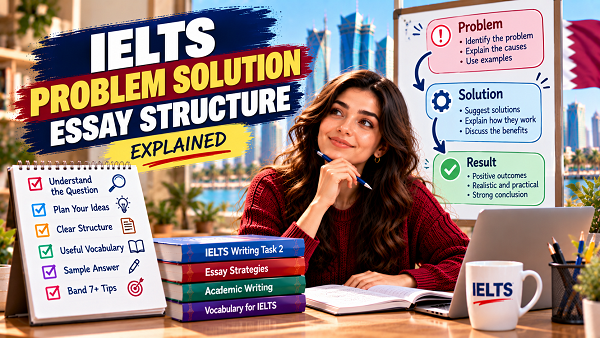
The IELTS problem solution essay is one of the most important IELTS Writing Task 2 formats to understand if you want to write a clear, well-organised response under exam conditions.
In this type of essay, you are usually asked to identify or explain the causes or problems associated with an issue and then suggest one or more appropriate solutions.
A strong response does not simply list problems and solutions. You need to answer every part of the question, develop your ideas, organise them logically and support them with relevant explanations or examples.
IELTS Writing Task 2 requires a minimum of 250 words and approximately 40 minutes. Your response is assessed using four criteria: Task Response, Coherence and Cohesion, Lexical Resource, and Grammatical Range and Accuracy. Task 2 also carries more weight than Task 1 in the overall Writing score.
This guide explains the IELTS problem solution essay structure step by step, including how to analyse the question, organise your paragraphs, develop ideas, use appropriate vocabulary and avoid common mistakes.
What Is an IELTS Problem Solution Essay?
An IELTS problem solution essay asks you to discuss an issue by explaining its problems, causes or effects and then suggesting solutions.
A typical question might look like this:
Many cities are experiencing increasing levels of traffic congestion. What are the main problems caused by this situation, and what solutions can you suggest?
To answer this question effectively, you need to address both parts:
- What problems does traffic congestion cause?
- What solutions could address those problems?
Another question might focus on causes and solutions:
Many young people are becoming increasingly dependent on smartphones. What are the reasons for this, and what measures can be taken to address the problem?
In this case, your response needs to explain:
- Why the problem exists
- What can be done about it
The exact wording varies, so you should always analyse the question rather than relying on a memorised essay.
IELTS specifically advises candidates to understand what the individual question is asking and respond directly to it rather than forcing a memorised response into a particular essay category.
How Is an IELTS Problem Solution Essay Scored?
Understanding the scoring criteria is essential because a good structure alone does not guarantee a high band score.
Your Task 2 essay is assessed according to four criteria.
Task Response
Task Response measures how fully and appropriately you answer the question.
For a problem solution essay, this means:
- Addressing every part of the prompt
- Identifying relevant problems or causes
- Providing appropriate solutions
- Developing your main ideas
- Supporting ideas with explanations and examples
- Maintaining a clear and relevant response
If the question asks for both problems and solutions, discussing only the problems can significantly weaken your Task Response.
Official IELTS guidance emphasises that candidates should answer all parts of the task and develop and support their main ideas.
Coherence and Cohesion
This criterion evaluates how logically you organise your ideas and how effectively you connect them.
A strong essay should have:
- A clear overall structure
- Logical paragraphing
- One main focus in each body paragraph
- Logical progression of ideas
- Appropriate cohesive devices
- Clear relationships between ideas
You do not need to put a linking word at the beginning of every sentence. Good cohesion comes from logical organisation as well as appropriate use of linking devices.
Lexical Resource
Lexical Resource refers to your vocabulary.
For a strong problem solution essay, you should demonstrate:
- A useful range of topic-specific vocabulary
- Accurate word choice
- Appropriate collocations
- Ability to paraphrase
- Natural use of formal or neutral language
- Accurate spelling and word formation
Using complicated vocabulary incorrectly is usually less effective than using precise vocabulary accurately.
Grammatical Range and Accuracy
This criterion considers both the range and accuracy of your grammatical structures.
You can demonstrate range through:
- Complex sentences
- Relative clauses
- Conditional structures
- Passive voice
- Cause-and-effect structures
- Concession clauses
- Modal verbs
However, grammatical variety should not come at the expense of accuracy.
What Is the Best IELTS Problem Solution Essay Structure?
A practical structure for this type of essay is:
Introduction
- Paraphrase the topic
- State what the essay will discuss
Body Paragraph 1
- Explain the main problem or cause
- Explain why it occurs or what it leads to
- Give an example
Body Paragraph 2
- Present the main solution
- Explain how it could work
- Give an example or expected result
Conclusion
- Summarise the main problem and solution
- Avoid introducing new ideas
This four-paragraph structure is not an official IELTS requirement. It is simply a practical way to organise a response clearly within the time available.
The important issue is not the number of paragraphs itself, but whether your response addresses the task fully and organises your ideas effectively.
How to Analyse an IELTS Problem Solution Essay Question
Before writing, spend a few minutes understanding exactly what the question requires.
Step 1: Identify the General Topic
First, identify the broad subject.
For example:
Many cities have problems with air pollution.
The general topic is:
Urban air pollution
Step 2: Identify the Specific Problem
Do not write about the entire topic of pollution.
Look carefully at what the question actually asks.
For example:
What are the main causes of this problem and what solutions can be suggested?
The specific focus is:
Causes + Solutions
Step 3: Identify Every Question Part
Look for words such as:
- What are the problems?
- What are the causes?
- Why does this happen?
- What solutions can be suggested?
- What measures can be taken?
- How can this problem be addressed?
Underline the key instructions mentally before you begin planning.
Step 4: Choose Your Main Ideas
Do not try to include five or six different problems.
Choose one or two strong ideas that you can explain properly.
For example:
Problem: Heavy reliance on private cars
Explanation: More people use cars because public transport is inconvenient
Effect: Roads become overcrowded during peak hours
Solution: Improve public transport and make it more reliable
This gives you a complete chain of reasoning rather than a simple list.
How to Write the IELTS Problem Solution Essay Introduction
Your introduction should be concise and directly relevant.
A useful structure is:
Sentence 1: Paraphrase the topic.
Sentence 2: Introduce the main focus of the essay.
For example:
Question:
Many cities are suffering from serious traffic congestion. What are the main causes of this problem and what solutions can be taken?
Introduction:
Traffic congestion has become a major issue in many urban areas, largely because of increasing dependence on private vehicles and inadequate public transport. This essay will examine the main causes of this problem and discuss practical measures that could help reduce it.
This introduction works because it:
- Introduces the topic
- Paraphrases the question
- Identifies the main causes
- Signals that solutions will be discussed
- Avoids unnecessary background information
Should You Give Your Opinion?
It depends on the wording of the question.
If the task asks you to discuss problems and solutions, you should focus primarily on those requirements.
If the question explicitly asks for your opinion, you should make your position clear.
Do not add an artificial opinion simply because you have memorised an IELTS essay template.
How to Write Body Paragraph 1: Problems or Causes
Your first body paragraph should normally focus on the problem, problems or causes requested by the question.
A useful development pattern is:
Main idea → Explanation → Result → Example
Start With a Clear Topic Sentence
Your first sentence should immediately introduce the main problem.
For example:
One major problem associated with traffic congestion is the significant amount of time commuters lose travelling to and from work.
Explain the Problem
Do not stop after identifying the problem.
Explain why it happens.
When large numbers of people use private cars during peak hours, roads become overcrowded and vehicles move much more slowly.
Explain the Consequence
Show why the problem matters.
As a result, employees may spend hours travelling each day, reducing their productivity and increasing stress.
Add an Example
A relevant example can make your idea more convincing.
For example, workers living in suburban areas may have to leave home considerably earlier simply to avoid the worst congestion.
The paragraph now develops one central idea instead of presenting several disconnected statements.
How to Write Body Paragraph 2: Solutions
The second body paragraph should provide practical solutions that directly respond to the problems you identified.
A useful structure is:
Solution → How it works → Expected result → Example
Introduce the Solution
One effective solution would be to improve the quality and accessibility of public transportation.
Explain How It Works
Governments could increase the frequency of buses and trains, expand routes and introduce more reliable services during peak hours.
Explain the Result
If public transport becomes faster and more convenient, fewer people may feel the need to commute by car.
Add an Example
For instance, dedicated bus lanes could allow public transport to avoid congested roads and provide commuters with a more predictable journey.
Notice the connection between the problem and the solution.
The solution is not random. It directly addresses the cause of the problem.
Should You Put Problems and Solutions in Separate Paragraphs?
In many cases, separating the problems and solutions into different body paragraphs is a clear and practical approach.
For example:
Body Paragraph 1: Main problems or causes
Body Paragraph 2: Solutions
However, this is not an absolute rule.
If a question requires you to discuss several problems and corresponding solutions, you may organise the response differently.
The priority should always be clarity, logical progression and complete task coverage.
How to Develop Ideas in an IELTS Problem Solution Essay
One of the biggest differences between a weak and strong IELTS essay is the depth of idea development.
Instead of writing:
Pollution is harmful. Governments should reduce pollution.
Develop the reasoning:
One major consequence of air pollution is its impact on public health. When people are regularly exposed to polluted air, they may face a greater risk of respiratory problems, particularly in densely populated urban areas. Governments could address this issue by introducing stricter emissions standards for vehicles and factories. Such measures would reduce the amount of harmful substances released into the atmosphere and could therefore improve air quality over time.
The second version explains:
Problem → Cause → Effect → Solution → Result
That is much stronger for Task Response.
Use the Why–How–Result Method
When you have an idea, ask three questions:
Why is this a problem?
How does it affect people or society?
What result could the solution produce?
This simple method can help you develop ideas naturally.
IELTS Problem Solution Essay Vocabulary
You do not need to memorise hundreds of complicated words.
Instead, build vocabulary around useful functions.
Introducing Problems
Useful expressions include:
- a major problem is
- one significant issue is
- a growing concern is
- one of the main challenges is
- this issue has become increasingly common
- a serious consequence is
Explaining Causes
Useful expressions include:
- this is mainly because
- one reason for this is
- this can be attributed to
- this is largely due to
- a contributing factor is
- this problem stems from
Explaining Effects
Useful expressions include:
- as a result
- consequently
- this can lead to
- this may result in
- one consequence is
- this can have a negative impact on
Introducing Solutions
Useful expressions include:
- one possible solution is
- an effective measure would be
- governments could
- one way to address this issue is
- this problem could be tackled by
- a practical approach would be
Explaining Solutions
Useful expressions include:
- this would help to
- this could reduce
- this could prevent
- this would encourage
- this would enable
- as a result
Use these expressions naturally. Do not insert linking phrases simply to make your essay sound more academic.
Useful Collocations for IELTS Problem Solution Essays
Learning collocations can help you express ideas more naturally.
| Problem/Solution Area | Useful Collocations |
|---|---|
| Environment | reduce carbon emissions |
| Environment | protect natural resources |
| Traffic | ease traffic congestion |
| Education | improve access to education |
| Health | promote public health |
| Crime | prevent criminal activity |
| Employment | create job opportunities |
| Technology | regulate digital platforms |
| Government | introduce stricter regulations |
| Society | raise public awareness |
| Housing | provide affordable housing |
| Transport | improve public transportation |
For example:
Governments should introduce stricter regulations to reduce carbon emissions.
This is more natural than simply combining individual advanced words without considering how they normally work together.
Grammar Structures for an IELTS Problem Solution Essay
A strong problem solution essay benefits from a range of accurate structures.
Cause and Effect
Excessive use of private vehicles can contribute to severe traffic congestion.
As public transport becomes unreliable, more people may choose to drive.
Passive Voice
Stricter environmental regulations could be introduced to reduce industrial emissions.
Conditional Sentences
If governments improve public transportation, fewer commuters may rely on private cars.
Relative Clauses
Public transport systems that are affordable and reliable are more likely to attract commuters.
Modal Verbs
Use:
- could
- should
- may
- might
- can
- would
For example:
Governments could provide financial incentives for companies that adopt environmentally friendly practices.
Concession Structures
Although increasing public transport capacity may require significant investment, the long-term benefits could outweigh the initial costs.
The goal is not to use every structure in one essay.
Use grammatical variety where it helps communicate your ideas clearly.
Common IELTS Problem Solution Essay Mistakes
Writing Only About the Problem
If the question asks for both problems and solutions, you must address both.
Listing Ideas Without Explaining Them
A paragraph containing five short ideas is usually weaker than one containing two well-developed ideas.
Giving Unrealistic Solutions
Your solutions should be logically connected to the problem.
For example, suggesting that governments “completely eliminate traffic” is unrealistic.
A better approach is to suggest reducing congestion through improved public transport, infrastructure or traffic management.
Using Memorised Essays
A memorised essay may not answer the specific question.
IELTS guidance explicitly warns candidates against relying on formulaic responses that do not appropriately address the task.
Using Too Many Linking Words
Do not write:
Firstly, moreover, furthermore, in addition, therefore…
in every paragraph.
Good cohesion is about logical relationships, not the number of linking expressions.
Using Advanced Vocabulary Incorrectly
A precise, familiar word used correctly is better than an impressive word used incorrectly.
Giving Fake Statistics
You do not need invented statistics to support your ideas.
A realistic example is often enough.
Writing a Conclusion With New Ideas
Your conclusion should summarise your response rather than introduce another solution that you have not discussed.
IELTS Problem Solution Essay Example Question
Consider this IELTS Writing Task 2 question:
Many cities around the world are experiencing increasing levels of traffic congestion. What are the main causes of this problem, and what solutions can be suggested?
Quick Plan
Topic: Traffic congestion
Causes:
- Increasing private car ownership
- Inadequate public transport
Solutions:
- Improve public transport
- Introduce policies that discourage unnecessary car use
Introduction
Traffic congestion has become a serious problem in many urban areas, largely as a result of rising car ownership and inadequate public transportation systems. This essay will examine the main causes of this issue and suggest practical measures that could help reduce congestion.
Body Paragraph 1
One major cause of traffic congestion is the growing number of private vehicles on urban roads. As cities expand and household incomes increase, more people can afford to own cars and may choose to drive rather than use public transportation. This becomes particularly problematic during peak hours, when thousands of commuters travel at the same time. In addition, public transport may be unavailable or unreliable in some areas, making private vehicles a more convenient option.
Body Paragraph 2
Improving public transportation would be one effective way to address this problem. Governments could increase the frequency of buses and trains, expand their coverage and improve their reliability. If commuters had access to convenient and affordable alternatives to private cars, more of them might be willing to leave their vehicles at home. Authorities could also introduce measures such as congestion charges or restricted parking in busy areas, encouraging people to consider alternative forms of transport.
Conclusion
In conclusion, traffic congestion is mainly caused by the growing use of private vehicles and weaknesses in public transportation. Expanding reliable public transport and introducing measures that discourage unnecessary car use could help cities reduce congestion and create more efficient urban transport systems.
This is a model for analysing structure and idea development, not an essay that candidates should memorise.
Why This IELTS Problem Solution Essay Structure Works
The example follows a clear progression.
The Introduction Sets Up the Response
The reader immediately understands:
- What the problem is
- What caused it
- What the essay will discuss
Body Paragraph 1 Has One Main Focus
The paragraph explains the causes of traffic congestion and develops them logically.
Body Paragraph 2 Directly Responds
The solutions address the causes discussed previously.
The Conclusion Summarises
The conclusion brings the response together without introducing unrelated ideas.
This kind of logical progression supports the Coherence and Cohesion criterion.
How to Plan an IELTS Problem Solution Essay in 5 Minutes
You do not need a complicated planning system.
Try this:
Minute 1: Understand the Question
Identify:
- Topic
- Problem
- Causes
- Required solutions
- Any additional instructions
Minute 2: Choose Your Main Ideas
Choose one or two strong problems or causes.
Then choose one or two practical solutions.
Minute 3: Develop Your Ideas
For each main idea, write a few notes:
Cause → Why → Effect → Example
Solution → How → Result → Example
Minutes 4–5: Organise Your Paragraphs
Decide:
Introduction: topic + overview
Body 1: problems/causes
Body 2: solutions
Conclusion: summary
Then start writing.
How to Manage Your 40 Minutes
IELTS recommends spending approximately 40 minutes on Writing Task 2.
A practical time allocation is:
| Stage | Time |
|---|---|
| Analyse the question | 2–3 minutes |
| Plan | 2–3 minutes |
| Write | 29–31 minutes |
| Check | 4–5 minutes |
Do not spend ten minutes planning.
You need enough planning time to establish your ideas, but you also need enough time to write and check the complete essay.
How Many Words Should an IELTS Problem Solution Essay Have?
Your IELTS Writing Task 2 response must contain at least 250 words.
However, the goal should not simply be to reach 250 words.
A strong essay should contain enough development to answer the question fully.
A practical target is often around 270–320 words, provided you can maintain relevance, organisation and accuracy.
Writing substantially more is not automatically better. A very long response can create additional opportunities for irrelevant ideas, repetition and language errors.
How to Get a Higher Band in an IELTS Problem Solution Essay
If you want to move beyond basic Task 2 writing, focus on four areas.
Improve Task Response
Ask:
- Did I answer every part?
- Are my problems relevant?
- Are my solutions realistic?
- Did I explain my ideas?
- Did I provide appropriate examples?
Improve Coherence and Cohesion
Ask:
- Does every paragraph have a clear purpose?
- Does each paragraph have a central idea?
- Do my ideas progress logically?
- Are my linking devices natural?
Improve Vocabulary
Ask:
- Am I repeating the same words?
- Are my word choices accurate?
- Do I use topic-specific collocations?
- Can I paraphrase naturally?
Improve Grammar
Ask:
- Do I use a mixture of sentence structures?
- Are my complex sentences accurate?
- Do grammar errors interfere with meaning?
- Do I check subject-verb agreement, articles and verb forms?
IELTS Task 2 performance is judged across all four criteria, and the official band descriptors make clear that higher-band responses require relevant, developed ideas, logical organisation, flexible vocabulary and a suitable range of accurate grammatical structures.
IELTS Problem Solution Essay Checklist
Before submitting your essay, check the following:
Task Response
-
Did I answer every part of the question?
-
Did I explain the main problems or causes?
-
Did I provide relevant solutions?
-
Did I develop my main ideas?
-
Did I include relevant examples?
Coherence and Cohesion
-
Is my essay logically organised?
-
Does each body paragraph have a clear focus?
-
Are my ideas connected naturally?
-
Did I avoid excessive linking words?
Vocabulary
-
Did I use accurate topic vocabulary?
-
Did I avoid unnecessary repetition?
-
Did I use collocations naturally?
-
Did I check spelling and word formation?
Grammar
-
Did I use different sentence structures?
-
Are my complex sentences accurate?
-
Did I check articles and prepositions?
-
Did I check subject-verb agreement?
-
Did I check verb tenses?
Final Check
-
At least 250 words
-
No bullet points in the actual exam response
-
No memorised essay that does not fit the question
-
No new idea in the conclusion
-
Every paragraph contributes to answering the question
IELTS states that Task 2 responses should be written as a connected piece of text rather than notes or bullet points.
Frequently Asked Questions About IELTS Problem Solution Essays
What is an IELTS problem solution essay?
An IELTS problem solution essay is a Task 2 essay in which you may be asked to explain a problem, its causes or effects and suggest ways to address it.
What is the structure of an IELTS problem solution essay?
A practical structure is an introduction, a body paragraph discussing the main problems or causes, a body paragraph presenting solutions and a conclusion.
How many paragraphs should a problem solution essay have?
There is no official requirement for a specific number of paragraphs. A four-paragraph structure is a practical option for many candidates because it provides a clear organisation.
How many words should I write?
You must write at least 250 words for IELTS Writing Task 2.
Should I discuss causes and solutions in separate paragraphs?
Usually, separating them can make your response easier to organise and follow. However, the best structure depends on the exact wording of the question.
Do I need examples in a problem solution essay?
Relevant examples can help you develop and support your ideas. They do not need to contain statistics or complicated research.
Can I use a memorised problem solution essay?
It is better to learn how to develop ideas and organise your response than to memorise a complete essay. IELTS specifically advises candidates to respond to the actual prompt rather than use a formulaic response that may not fit the question.
What vocabulary should I use in a problem solution essay?
Focus on accurate topic vocabulary, natural collocations and language for explaining problems, causes, effects and solutions. Accuracy and appropriacy are more important than using unnecessarily complicated words.
How can I get Band 7 in an IELTS problem solution essay?
You should aim to address the task clearly, develop and support relevant ideas, organise the essay logically, use vocabulary flexibly and accurately, and demonstrate a suitable range of grammatical structures with good control.
Is the problem solution essay the same for IELTS Academic and General Training?
Writing Task 2 is an essay in both Academic and General Training. Both require at least 250 words and approximately 40 minutes, and Task 2 is assessed using the same four main criteria.
Improve Your IELTS Writing With Structured Training
Understanding the IELTS problem solution essay structure is an important first step, but knowing the structure is not enough to achieve a strong Writing score.
You also need to practise:
- Analysing unfamiliar questions
- Developing relevant ideas
- Writing under time pressure
- Using accurate vocabulary
- Building complex but controlled sentences
- Improving coherence and cohesion
- Identifying recurring grammar mistakes
- Getting detailed feedback on your essays
Regular, targeted Writing practice can help you move from simply knowing the structure to using it naturally under exam conditions.
If you are preparing for IELTS in Qatar, structured IELTS Writing training can give you the opportunity to practise Task 2 with guidance and feedback rather than preparing entirely on your own.
Want to improve your IELTS Writing with expert guidance? Explore IFI Qatar’s IELTS preparation and Writing training options.
Final Tips for IELTS Problem Solution Essay Structure
The most important lesson is simple: do not treat the problem solution essay as a template to memorise.
Instead, learn a repeatable process:
Understand the question → identify the problems → choose practical solutions → develop your ideas → organise your paragraphs → check your language.
A strong IELTS problem solution essay is not the one with the most complicated vocabulary or the longest introduction.
It is the one that answers the actual question clearly, develops relevant ideas and presents them in accurate, logical and well-connected English.
With regular practice and detailed feedback, the structure can become automatic, allowing you to spend more of your exam time focusing on your ideas and language.