

Currently Empty: ر.ق 0,00


IELTS
How Many IELTS Mock Tests Should You Take Before the Exam?
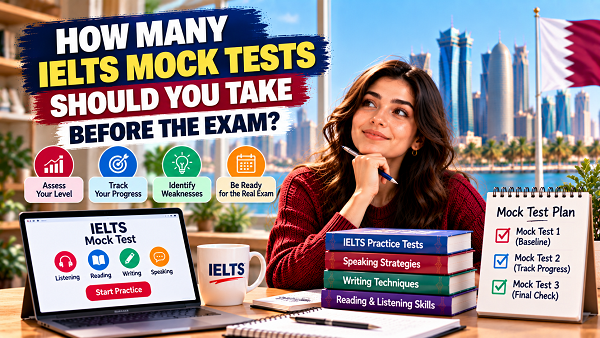
If you are preparing for IELTS, one of the most common questions is: how many IELTS mock tests should you take before the real exam?
There is no official number that every candidate must complete. The right number depends on your current English level, target band score, preparation time and the weaknesses you need to improve.
For most candidates, three well-planned full IELTS mock tests can be a practical starting point: one at the beginning of preparation, one during preparation and one close to the real exam. Candidates with a longer preparation period or a significant gap between their current and target score may benefit from additional assessments.
The important point is that taking more mock tests does not automatically mean better preparation. A mock test becomes valuable when you analyse the result, identify the reason behind your mistakes and use that information to guide your next stage of practice.
Official IELTS preparation materials recommend using practice tests to become familiar with the test format, experience different task types, practise under timed conditions and review answers.
If you are preparing for IELTS in Qatar, a structured mock-test programme can also help you understand whether you are ready for your target test date and which skills require more focused preparation.
How Many IELTS Mock Tests Should You Take?
There is no fixed number of IELTS mock tests that guarantees a particular band score.
However, a practical preparation strategy for many candidates is:
| Preparation Stage | Recommended Mock Tests | Main Purpose |
|---|---|---|
| Beginning of preparation | 1 | Establish your baseline |
| Middle of preparation | 1–2 | Measure progress |
| Final stage | 1 | Check exam readiness |
| Total | 3–4 | Build a useful performance picture |
This does not mean that every candidate needs exactly three or four tests.
Someone preparing for six months may benefit from several assessments at different stages. A candidate with only two weeks remaining may have limited value in taking many full tests because there is not enough time to act on the results.
The best approach is to think of a mock test as a diagnostic checkpoint, not simply another practice activity.
Why Three Mock Tests Can Be a Useful Starting Point
A three-test structure gives you three important measurements:
Mock Test 1: Where am I now?
Mock Test 2: Is my preparation working?
Mock Test 3: Am I ready for the real exam?
Between each test, you should spend time working on the weaknesses identified in your previous result.
Taking five tests without reviewing your mistakes can be less useful than taking three tests and carefully analysing each one.
When Should You Take Your First IELTS Mock Test?
Your first IELTS mock test should ideally be taken before you have spent too much time preparing.
The purpose is not to achieve a high score.
The purpose is to discover your starting point.
A baseline mock test can help you identify:
- Your approximate level in each skill
- Your strongest IELTS skill
- Your weakest IELTS skill
- Your common question-type mistakes
- Your time-management problems
- Your Writing weaknesses
- Your Speaking weaknesses
- Whether your target band is currently realistic
- Which areas deserve the most study time
For example, imagine a candidate wants an overall Band 7.
Their first mock test produces:
| Skill | Result |
|---|---|
| Listening | 7.0 |
| Reading | 6.5 |
| Writing | 5.5 |
| Speaking | 6.0 |
The candidate does not simply need “more IELTS practice”.
The results suggest that Writing is currently the biggest priority, followed by Speaking.
That information should influence the next stage of preparation.
What If Your First Mock Test Score Is Low?
Do not panic.
A diagnostic test is supposed to show you what needs improvement.
A low result can actually be useful because it prevents you from assuming that you are ready before you have enough evidence.
Instead of repeating another full mock test immediately, identify the problems behind the score and start targeted preparation.
When Should You Take Your Second IELTS Mock Test?
Your second mock test should come after a meaningful period of targeted preparation.
There is little benefit in taking another full test the day after your baseline test if you have not changed your preparation.
Instead, use the first result to create a study plan.
For example:
Baseline result: Writing 5.5
Main problems:
- Weak idea development
- Repetitive vocabulary
- Grammar errors
- Poor paragraph organisation
Targeted preparation:
- Practise Task 2 planning
- Write body paragraphs
- Study useful collocations
- Review recurring grammar mistakes
- Receive Writing feedback
- Complete timed essays
Then take your second mock test.
The goal is to discover whether your targeted work has actually improved your performance.
What Should You Compare Between Mock Tests?
Do not compare only your overall band.
Compare:
- Listening score
- Reading score
- Writing performance
- Speaking performance
- Question types
- Number of mistakes
- Time management
- Recurring errors
- Fluency
- Vocabulary range and accuracy
- Grammar accuracy
- Confidence under timed conditions
For Listening and Reading, look at the types of questions you consistently get wrong.
For Writing and Speaking, look at the assessment criteria and feedback rather than focusing only on an estimated band.
When Should You Take Your Final IELTS Mock Test?
Your final full mock test should generally be taken close enough to your real IELTS exam to provide a meaningful readiness check, but early enough that you can still correct important weaknesses.
The exact timing depends on your preparation schedule.
A final mock test can help you identify last-minute problems such as:
- Running out of time in Reading
- Losing concentration during Listening
- Writing too slowly
- Failing to complete Writing Task 2 effectively
- Giving very short Speaking answers
- Hesitating too much in Speaking Part 3
- Making repeated grammar mistakes
- Losing marks through careless errors
- Struggling with the pressure of a full test
The purpose of this final assessment is not simply to make you feel confident.
It should answer a more important question:
“What still needs to be fixed before my official IELTS test?”
How Many IELTS Mock Tests Should You Take Based on Your Preparation Time?
Your preparation timeline should influence your mock-test schedule.
If You Have 2–4 Weeks to Prepare
You may have enough time for approximately 2–3 full mock tests, depending on your current level.
A practical schedule could be:
Week 1: Diagnostic mock test
Week 2: Targeted preparation + second mock test
Final week: Final mock test and exam strategy review
The most important factor is avoiding back-to-back tests without enough time to improve.
If You Have 1–2 Months to Prepare
A 3–4 mock-test strategy can work well.
You can use:
- Baseline assessment
- Progress assessment
- Weakness-focused assessment
- Final readiness assessment
This gives you more opportunities to measure progress while still leaving time for targeted practice.
If You Have 3 Months or More
You may benefit from additional checkpoints.
For example:
Month 1: Baseline mock
Month 2: Progress mock
Month 2–3: Skill-focused assessment
Final weeks: Final full mock
The longer your preparation period, the more useful it can be to measure progress at meaningful intervals rather than waiting until the end.
Should You Take IELTS Mock Tests Every Week?
Not necessarily.
Taking a full IELTS mock test every week may be useful for some advanced candidates, but it is not automatically the best strategy.
A full mock test requires time to complete and, more importantly, time to analyse.
If you take a test every week but do not address the problems it reveals, you may simply repeat the same mistakes.
A better cycle is:
Mock Test → Analysis → Targeted Practice → Feedback → Improvement → Mock Test
This creates a continuous improvement process.
When Weekly Mock Tests Can Be Useful
Weekly testing may make sense when:
- Your exam is approaching
- You already have a strong IELTS foundation
- You need to improve time management
- You are tracking a specific target score
- You can analyse every result properly
- You are using each test to measure a specific improvement
When Weekly Mock Tests Are Not the Best Choice
Reduce full-test frequency if:
- Your basic English level still needs improvement
- You have major Writing weaknesses
- You have limited vocabulary
- You do not understand why you are losing marks
- You are not reviewing your mistakes
- You are using tests instead of studying
A mock test should measure preparation, not replace preparation.
What Should You Do Between IELTS Mock Tests?
This is one of the most important parts of an effective IELTS preparation strategy.
After every mock test, divide your preparation into four steps.
Step 1: Record Your Results
Create a simple progress tracker.
| Test | Listening | Reading | Writing | Speaking | Overall | Main Weakness |
|---|---|---|---|---|---|---|
| Mock 1 | 6.5 | 6.0 | 5.5 | 6.0 | 6.0 | Writing |
| Mock 2 | 7.0 | 6.5 | 6.0 | 6.0 | 6.5 | Writing |
| Mock 3 | 7.0 | 7.0 | 6.5 | 6.5 | 7.0 | Writing |
This makes progress much easier to see.
Step 2: Analyse Your Mistakes
Do not simply check which answers were wrong.
Ask why they were wrong.
For Listening and Reading, classify mistakes such as:
- Vocabulary problem
- Misunderstood question
- Missed paraphrase
- Spelling error
- Careless mistake
- Time-management problem
- Difficulty with a particular question type
For Writing and Speaking, identify patterns such as:
- Weak task response
- Limited development
- Repetitive vocabulary
- Grammar errors
- Poor coherence
- Hesitation
- Weak pronunciation
- Short answers
- Difficulty extending ideas
Step 3: Choose Your Top Three Priorities
Do not try to fix everything at once.
Choose the three weaknesses that are most likely to affect your score.
For example:
Priority 1: Writing Task 2 idea development
Priority 2: Reading Matching Headings
Priority 3: Speaking Part 3 fluency
Then build your study schedule around those areas.
Step 4: Take Another Mock Test Later
Once you have completed targeted practice, take another realistic mock test.
Now the result has a purpose.
You are testing whether your preparation has worked.
Should You Take Full IELTS Mock Tests or Skill-Specific Tests?
You should use both, but they serve different purposes.
A full mock test is best for measuring overall readiness.
A skill-specific practice test is better for improving a particular weakness.
For example, if your Reading score is significantly below your target, completing several targeted Reading exercises may be more productive than repeatedly taking complete four-skill tests.
The same applies to Writing and Speaking.
You might spend several days improving Task 2 essays before taking another full mock.
Official IELTS sample materials allow candidates to practise individual components and become familiar with the different task types and test experience.
A Better Combination
Use this pattern:
Full Mock Test → Skill Practice → Feedback → Skill Practice → Full Mock Test
This gives each assessment a clear purpose.
How Many IELTS Mock Tests Do You Need for Band 6?
If your target is Band 6, the number of mock tests should still depend on your preparation needs rather than the target number itself.
A candidate who is already consistently performing around Band 6 may need fewer diagnostic assessments.
A candidate currently at Band 4.5 may need more time developing core English skills before repeated full mocks become useful.
A practical approach is:
- Take one baseline mock
- Identify your weakest skills
- Complete targeted preparation
- Take a second mock
- Analyse progress
- Take a final mock before the official test
The key question is not how many tests you have completed.
It is whether your results are moving toward your target.
How Many IELTS Mock Tests Do You Need for Band 7?
Candidates targeting Band 7 should focus particularly on consistency.
One strong mock result does not necessarily mean that you are ready for the official test.
For example, if your results are:
- Mock 1: 6.5
- Mock 2: 7.0
- Mock 3: 6.5
- Mock 4: 7.0
you may still have an inconsistent performance level.
If your results become more stable around your target, your evidence of readiness becomes stronger.
For Band 7 candidates, it is particularly important to analyse the individual skills rather than relying only on the overall score.
A candidate might achieve a satisfactory overall result while still having one skill significantly below the required level.
Why Writing and Speaking Mock Tests Need Feedback
Listening and Reading are relatively straightforward to review because answers can generally be checked against answer keys.
Writing and Speaking are different.
A candidate may complete an essay and believe it is strong without noticing problems with:
- Task Response
- Idea development
- Coherence
- Vocabulary precision
- Collocations
- Grammar
- Sentence variety
Speaking has similar challenges.
You may not notice:
- Repeated hesitation
- Limited vocabulary
- Repetitive sentence structures
- Weak pronunciation
- Short answers
- Poor development of Part 3 ideas
This is why feedback can be more valuable than simply receiving a mock-test score.
The official IELTS Speaking assessment uses four criteria—Fluency and Coherence, Lexical Resource, Grammatical Range and Accuracy, and Pronunciation—and these criteria are equally weighted.
A useful mock test should therefore help you understand not only your result, but also why you achieved it and what you should improve next.
Is It Better to Take More IELTS Mock Tests or Get Better Feedback?
In most cases, better analysis is more valuable than simply taking more tests.
Consider two candidates.
Candidate A
Takes six mock tests.
- Does not review mistakes
- Does not receive Writing feedback
- Does not practise Speaking with an examiner
- Repeats the same strategies
- Takes another test every few days
Candidate B
Takes three mock tests.
- Analyses every result
- Keeps an error log
- Receives Writing and Speaking feedback
- Practises weak question types
- Changes their study plan after each assessment
Candidate B may be using mock tests much more effectively.
The objective is not to collect mock-test scores.
The objective is to use each test to make the next stage of preparation better.
What Makes a Good IELTS Mock Test?
Before booking an IELTS mock test, check what the service actually includes.
A useful mock test should provide realistic preparation rather than simply a collection of random English questions.
Look for:
IELTS-Style Tasks
The test should reflect the structure and demands of IELTS.
Realistic Timing
You should practise managing the time available for each section.
Appropriate Test Type
Make sure the mock matches your intended IELTS test, particularly if you are preparing for Academic or General Training.
Four-Skill Assessment
If you want to evaluate overall readiness, Listening, Reading, Writing and Speaking should be considered.
Writing and Speaking Feedback
Feedback is particularly useful for understanding weaknesses that are difficult to identify yourself.
Actionable Results
The best result is not simply:
“Your estimated score is 6.5.”
A stronger result tells you:
“Here are the problems preventing you from reaching your target, and here is what you should practise next.”
Should You Take an IELTS Mock Test Before Booking the Real Exam?
For many candidates, yes.
A mock test can be particularly useful if:
- You do not know your current IELTS level
- You have a specific target band
- Your exam date is approaching
- You have taken IELTS before and want to improve
- You are unsure whether you are ready
- You struggle with time management
- Your Writing or Speaking score is holding you back
- You want to experience realistic exam conditions
A mock test can give you additional information before you commit to the official examination.
However, remember that a mock-test result is an indication of preparation, not a guarantee of your official IELTS score. IFI Qatar similarly recommends using mock-test results as a preparation benchmark rather than an exact prediction.
IELTS Mock Test Strategy: A Simple 3-Test Plan
If you are not sure where to start, use this simple framework.
Mock Test 1: Diagnose
Take your first full mock before or near the beginning of your preparation.
Your goal:
Find your weaknesses.
Record your scores and identify your three biggest problems.
Mock Test 2: Measure
Complete targeted preparation based on your first result.
Then take your second mock.
Your goal:
Measure improvement.
Compare your results with the baseline.
Mock Test 3: Check Readiness
After further preparation, take your final full mock under realistic conditions.
Your goal:
Evaluate readiness.
Ask:
- Am I consistently near my target?
- Which skill is still weakest?
- Am I completing every section on time?
- Are my mistakes becoming less frequent?
- Do I know exactly what to do on test day?
If the answer to several of these questions is no, you may need additional preparation before the official exam.
IELTS Mock Test Checklist Before Your Exam
Before booking your official IELTS test, use this checklist:
-
I have completed at least one realistic full mock test.
-
I know my approximate level in all four skills.
-
I know my target band score.
-
I have identified my weakest skill.
-
I understand my recurring mistakes.
-
I have completed targeted practice.
-
I have taken another mock test after targeted preparation.
-
I have reviewed my Writing performance.
-
I have practised Speaking under realistic conditions.
-
I can manage the required time.
-
My recent results are reasonably consistent.
-
I know what I need to do on test day.
If several boxes remain unchecked, another period of focused preparation may be more useful than immediately booking the official exam.
Frequently Asked Questions About How Many IELTS Mock Tests You Should Take
How many IELTS mock tests should I take before the exam?
There is no universal number. For many candidates, three full mock tests—baseline, progress and final readiness—provide a useful structure. Candidates with longer preparation periods may benefit from additional assessments.
Is three IELTS mock tests enough?
Three can be enough if you analyse each result and complete targeted preparation between tests. The quality of your review matters more than simply increasing the number of tests.
Should I take an IELTS mock test every week?
Not necessarily. Weekly tests can be useful for some candidates close to the exam, but repeated testing without targeted improvement can be inefficient.
When should I take my first IELTS mock test?
A first mock test is most useful early in your preparation because it establishes a baseline and helps you identify your strongest and weakest areas.
When should I take my final IELTS mock test?
Take your final full mock close enough to the official exam to assess readiness, but early enough to address any important weaknesses you discover.
Can IELTS mock tests predict my real IELTS score?
A mock test can indicate your current level and preparation progress, but it cannot guarantee your official IELTS result.
Should I take mock tests for all four IELTS skills?
If you want to evaluate overall readiness, a full mock covering Listening, Reading, Writing and Speaking is useful. Individual skill tests can then be used to target specific weaknesses.
Are IELTS mock tests useful for Band 7 candidates?
Yes. Candidates targeting Band 7 can use mock tests to identify gaps, monitor progress and check whether their performance is becoming consistent around their target.
Should I take an IELTS mock test before booking my exam?
It can be a useful step if you are uncertain about your current level or readiness. The result can help you decide whether you need more preparation before taking the official exam.
Are IELTS mock tests the same as the real IELTS exam?
No. A mock test is a preparation simulation. It is designed to help you practise the IELTS format and assess readiness, but it does not produce an official IELTS result.
Where can I take an IELTS mock test in Qatar?
IFI Qatar offers IELTS mock-test options for candidates preparing in Qatar, including Academic and General Training options. Current availability, format and feedback options should be checked before booking.
Prepare for Your IELTS Exam With a Realistic Mock Test
Knowing how many IELTS mock tests to take is only part of effective preparation.
What matters more is how you use each test.
A strong preparation cycle looks like this:
Take a mock test → analyse your performance → identify weaknesses → practise targeted skills → get feedback → take another mock test.
For many candidates, three well-planned full mock tests can provide a practical preparation framework. If you have a longer preparation period or need significant improvement, additional assessments can be added at meaningful checkpoints.
If you are preparing for IELTS in Qatar, an in-person or structured mock test can also give you the opportunity to practise under realistic conditions and receive feedback before your official exam.
Ready to find out where you stand? Book an IELTS Mock Test with IFI Qatar and turn your result into a focused preparation plan.
Final Tips: How Many IELTS Mock Tests Should You Take?
Do not measure your preparation by the number of tests you have completed.
Measure it by what you learn from each test.
Remember these five principles:
- Take a baseline mock test early.
- Do targeted practice between full tests.
- Analyse mistakes instead of only checking scores.
- Use Writing and Speaking feedback to identify problems you may not see yourself.
- Take a final realistic mock test before the official exam.
For most candidates, three carefully analysed mock tests are more useful than a large number of tests taken without a clear improvement plan.
Your goal is not to become good at taking mock tests.
Your goal is to become ready for IELTS.