

Currently Empty: ر.ق 0,00


IELTS
IELTS Listening Multiple Choice Questions Strategy
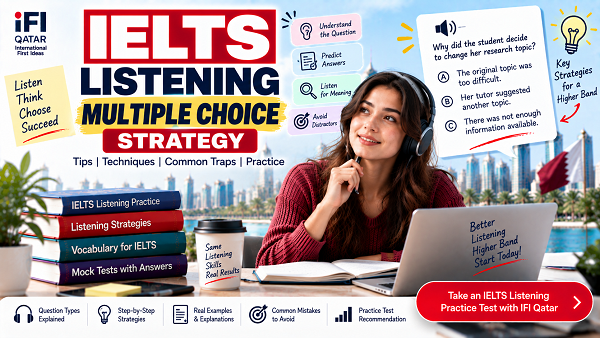
IELTS Listening multiple choice questions can be challenging because the recording often mentions several possible answers before revealing which one is correct. You may recognise words from the options, but that does not necessarily mean they are the answer.
The key is to listen for meaning, relationships, changes of opinion and specific details, rather than simply waiting to hear the exact words from an option.
In the IELTS Listening test, you hear the recordings once only. The test contains four parts and 40 questions, with one mark awarded for each correct answer. Multiple choice is one of the official IELTS Listening question types and may require you to choose one answer or, in some tasks, more than one answer.
This guide explains how IELTS Listening multiple choice questions work, the most common traps, how to predict answers before listening, and practical strategies you can use in your next IELTS Listening practice test.
What Are IELTS Listening Multiple Choice Questions?
IELTS Listening multiple choice questions require you to select the correct answer from a list of options based on information you hear in the recording.
A question may provide:
- Three possible answers
- A question followed by several options
- The beginning of a sentence with possible endings
- A longer list from which you must select more than one answer
For example:
Why did the student decide to change her research topic?
A. The original topic was too difficult.
B. Her tutor suggested another topic.
C. There was not enough information available.
You need to identify not only the information discussed but also the reason or relationship that answers the question.
What Skills Do Multiple Choice Questions Test?
Multiple choice questions can test your ability to understand:
- Specific details
- Main ideas
- Reasons and explanations
- Opinions
- Speaker attitudes
- Changes in decisions
- Relationships between ideas
- Information that is implied rather than directly repeated
This is why simply recognising vocabulary is not enough.
You need to understand what the speaker actually means.
Where Do Multiple Choice Questions Appear in IELTS Listening?
Multiple choice questions can appear in different parts of the IELTS Listening test.
The Listening test has four parts:
| Part | Typical context | Common speaker pattern |
|---|---|---|
| Part 1 | Everyday or social situation | Two speakers |
| Part 2 | Everyday or social situation | One main speaker |
| Part 3 | Education or training | Two or more speakers |
| Part 4 | Academic subject | One main speaker |
The recordings become progressively more challenging, and different English accents may be used, including British, Australian, New Zealand and North American accents.
Multiple choice questions are not restricted to one specific part of the test.
How IELTS Listening Multiple Choice Questions Work
The first step is to understand what you are actually being asked to do.
There are two important formats to recognise.
Multiple Choice With One Answer
You may see a question with three possible answers and need to select one.
For example:
What does the lecturer recommend students do first?
A. Read the course handbook
B. Contact their tutor
C. Attend an introductory session
Only one option is correct.
Multiple Choice With More Than One Answer
Some tasks provide a longer list and ask you to select more than one answer.
For example:
Which TWO facilities are included in the new sports centre?
A. Swimming pool
B. Tennis courts
C. Fitness studio
D. Café
E. Climbing wall
If the instruction says to choose TWO answers, selecting three is not a strategy for getting an extra mark.
Read the instruction carefully and identify exactly how many answers you need.
Official IELTS sample materials include both one-answer and multiple-answer Listening tasks.
The Biggest Challenge in IELTS Listening Multiple Choice
The biggest problem is often distractors.
A distractor is information that sounds relevant but does not represent the final correct answer.
For example:
“At first, I thought we should hold the meeting on Monday. Tuesday would also have been possible, but eventually we decided on Wednesday because most people were available.”
The options might be:
A. Monday
B. Tuesday
C. Wednesday
You may hear all three days.
But the correct answer is Wednesday because that is the final decision.
This is why IELTS Listening multiple choice questions test more than word recognition.
The Best IELTS Listening Multiple Choice Strategy
A reliable strategy has five stages:
1. Read the question.
2. Predict what information you need.
3. Compare the options.
4. Listen for meaning and changes.
5. Confirm the answer before moving on.
Let’s examine each step.
Step 1: Read the Question Before the Recording
Use the preparation time to understand what the question is asking.
Do not simply read every word quickly.
Identify the key information.
For example:
Why did the researchers choose the second location?
Focus on:
- Why → you need a reason
- researchers → who is involved
- choose → a decision
- second location → the specific subject
You can then anticipate the type of information you need to hear.
Identify Question Words
Pay particular attention to words such as:
- Why
- When
- Where
- Who
- Which
- What
- How
- What reason
- What problem
- What advantage
The question word often tells you what kind of answer to expect.
For example:
Why? → reason
Where? → place
When? → time/date
Who? → person/group
Which? → selection or distinction
Step 2: Compare the Options
Before listening, look at the differences between the options.
Suppose you see:
A. The course is too expensive.
B. The course is too difficult.
C. The course takes too much time.
The topic is probably a course problem.
The important task is to identify what distinguishes the options.
All three options may sound similar, but they represent three different reasons.
This helps you listen more strategically.
Underline the Key Differences
If possible, mentally highlight the important differences.
For example:
- expensive
- difficult
- time-consuming
You do not need to memorise every word.
Your goal is to know what information will separate the options.
Step 3: Predict the Meaning Before Listening
Prediction is one of the most useful IELTS Listening skills.
If the question asks:
Why did the company change its delivery system?
You can predict that the recording may discuss:
- delays
- customer complaints
- costs
- efficiency
- transportation problems
You are not trying to guess the exact answer.
You are preparing your brain for the type of information you need.
IELTS guidance for Listening preparation also emphasises using the time before the recording to anticipate the topic and the type of information required.
Step 4: Listen for Meaning, Not Just Words
This is one of the most important rules for multiple choice questions.
Do not automatically choose an answer because you hear a word from it.
For example, if the option says:
A. The museum was too expensive.
And you hear:
“We initially thought the museum was too expensive, but after comparing the prices, we realised it was actually quite reasonable.”
The word expensive appears in the recording.
But A is not the correct answer.
The speaker changed the meaning.
You need to understand the entire statement.
Step 5: Watch for Changes in Opinion
Speakers often change their minds.
Common signals include:
- But…
- However…
- Actually…
- In fact…
- Although…
- At first…
- Initially…
- We originally thought…
- I used to think…
- On second thought…
- But then…
- Eventually…
- In the end…
These expressions can signal that the information is changing.
For example:
“At first, we planned to travel by train. However, because of the timetable, we decided to take the bus instead.”
The correct answer is likely related to the final decision, not the initial plan.
How to Recognise Distractors in IELTS Listening
Distractors are one of the main reasons candidates lose marks in multiple choice questions.
Here are some common patterns.
The First Answer Is Not Always Correct
A speaker may introduce one option before rejecting it.
“We considered using the old library, but it was too small.”
The library was mentioned, but it was not the final choice.
Several Options May Be Mentioned
You may hear vocabulary connected to all three options.
This is intentional.
Your job is to identify which option actually answers the question.
A Speaker May Correct Themselves
For example:
“The meeting is on Thursday… sorry, I mean Friday.”
If the question asks for the final date, you need to follow the correction.
The Recording May Use Paraphrases
The correct option may not be repeated word-for-word.
For example:
Option:
The hotel was difficult to reach.
Recording:
“Getting there took much longer than we expected.”
The meaning is similar even though the wording is different.
How to Identify Paraphrases in Multiple Choice Questions
IELTS Listening does not require you to hear the exact words from an option.
You should develop the ability to recognise equivalent meanings.
For example:
| Option | Possible recording language |
|---|---|
| expensive | cost more than expected |
| difficult | challenging |
| cancelled | called off |
| improve | make better |
| delayed | held up |
| convenient | easy to access |
| crowded | full of people |
| problem | issue |
| benefit | advantage |
| reduce | decrease |
The important skill is understanding relationships between words and meanings.
Do not spend all your preparation time memorising synonyms. Practise hearing them in real contexts.
A Step-by-Step Example of an IELTS Listening Multiple Choice Question
Consider this example:
Why did Sarah choose to study online?
A. It was cheaper.
B. It fitted her schedule.
C. The course was shorter.
Imagine the recording says:
“Initially, I looked at the price because I wanted something affordable. However, the difference wasn’t particularly significant. The main reason I chose the online course was that I could study in the evenings after work. The programme actually takes longer than the classroom version.”
Let’s analyse it.
Option A: Cheaper
The speaker mentions price, but says the difference was not significant.
Not the answer.
Option B: It Fitted Her Schedule
The speaker says she could study in the evenings after work.
Correct.
Option C: The Course Was Shorter
The speaker explicitly says the programme takes longer.
Not the answer.
The correct answer is therefore:
B
This example demonstrates why you must listen for meaning and contrast, rather than selecting the first option mentioned.
Common IELTS Listening Multiple Choice Traps
Knowing the common traps can make your practice much more effective.
Trap 1: Choosing the First Option You Hear
The recording may mention an option early and then reject it.
Solution: Keep listening until you have enough information to confirm the answer.
Trap 2: Matching Exact Words
Hearing the same word as an option does not guarantee that it is correct.
Solution: Focus on meaning and context.
Trap 3: Ignoring Negative Language
Words such as:
- not
- never
- hardly
- rarely
- didn’t
- wasn’t
- no longer
can completely change the meaning.
Solution: Listen carefully for negatives.
Trap 4: Missing Corrections
Speakers may correct themselves.
Solution: Pay attention to phrases such as “actually”, “sorry”, “I mean” and “rather”.
Trap 5: Losing Your Place
If you spend too long thinking about one question, you may miss the next answer.
Solution: Make your best decision and move on.
Trap 6: Reading the Options Too Slowly
If you spend all your preparation time reading every word, you may not be ready when the recording begins.
Solution: Identify the key differences between options quickly.
Trap 7: Assuming the Answer Must Be a Specific Word
The correct answer may depend on the overall meaning of a sentence or conversation.
Solution: Listen to the complete idea.
How to Manage Your Attention During Multiple Choice Questions
IELTS Listening requires concentration because you hear the recording only once.
One useful technique is to keep moving your attention between:
Question → Options → Recording → Next Question
Do not become emotionally attached to one question.
If you miss an answer, make your best choice and continue.
The next question may be easier.
Use the Questions as a Roadmap
The questions can help you understand where you are in the recording.
If you are working through Questions 21–25, for example, you can anticipate that the information for the next question should appear relatively soon.
Official IELTS states that Listening questions follow the order of the information in the recording.
This makes question order an important navigation tool.
IELTS Listening Multiple Choice for Part 3
Part 3 can be particularly challenging because it often involves an educational or training context with multiple speakers.
You may need to distinguish:
- one student’s opinion
- another student’s opinion
- a tutor’s response
- an agreed decision
- a change in opinion
For example:
“I think the survey would be easier to conduct online.”
“I’m not sure. We might get more responses in person.”
“That’s a good point. Let’s use both methods.”
If the question asks:
What method do the students decide to use?
You need to identify the final decision, not simply the first opinion you hear.
Listen for Speaker Roles
Before the recording, identify who is likely to:
- suggest an idea
- disagree
- ask a question
- correct information
- make the final decision
This can make a multi-speaker conversation easier to follow.
IELTS Listening Multiple Choice for Part 4
Part 4 is typically an academic monologue.
You may hear a lecturer discussing:
- science
- education
- history
- technology
- the environment
- research
- social issues
The language can be denser, so prediction becomes particularly important.
Before listening, identify:
- the topic
- the key nouns
- the differences between options
- the type of information required
Do not try to understand every word.
Focus on the information that answers the question.
How to Improve Your IELTS Listening Multiple Choice Score
Improving this question type requires more than completing random practice tests.
You should analyse your mistakes.
Keep an IELTS Listening Error Log
After every practice test, record:
| Question | My answer | Correct answer | Why I was wrong |
|---|---|---|---|
| 12 | A | C | Chose first option mentioned |
| 18 | B | A | Missed paraphrase |
| 24 | C | B | Missed speaker correction |
After several tests, patterns will appear.
You may discover that your main problem is:
- distractors
- vocabulary
- paraphrasing
- concentration
- prediction
- following multiple speakers
- changing answers too quickly
Once you identify the pattern, you can practise that specific skill.
Use IELTS Listening Practice Tests Correctly
Practice tests are most useful when you treat them as diagnostic tools.
Do not simply check your score and move on.
Use this process:
Step 1: Complete the test under realistic conditions.
Step 2: Check your answers.
Step 3: Identify every incorrect answer.
Step 4: Listen again to the relevant section.
Step 5: Read the transcript if available.
Step 6: Identify why you selected the wrong option.
Step 7: Repeat the question and explain why the correct option is correct.
This turns one practice test into a detailed learning exercise.
IELTS itself recommends practice tests as a way to become familiar with the format and identify skills that need improvement.
A 7-Day IELTS Listening Multiple Choice Practice Plan
You can build your multiple choice skills with a focused one-week routine.
| Day | Focus |
|---|---|
| Day 1 | Understand question types and distractors |
| Day 2 | Practise prediction |
| Day 3 | Practise paraphrases |
| Day 4 | Focus on corrections and changes of opinion |
| Day 5 | Practise Part 3 conversations |
| Day 6 | Complete a timed Listening practice test |
| Day 7 | Review mistakes and repeat difficult questions |
The objective is not simply to complete more questions.
It is to understand why you get questions wrong.
A 30-Minute Daily IELTS Listening Routine
If you have limited study time, try this routine:
10 Minutes: Multiple Choice Practice
Complete a small set of questions.
Focus on accuracy rather than speed.
10 Minutes: Transcript Analysis
Review your mistakes and find the exact part of the recording that contained the answer.
5 Minutes: Vocabulary
Record useful expressions and paraphrases from the recording.
5 Minutes: Shadowing
Repeat selected sentences aloud to improve your ability to recognise natural spoken English.
This routine can be more useful than completing a full test every day without analysing your errors.
How Many Listening Answers Do You Need for a Higher Band?
IELTS Listening contains 40 questions, with one mark for each correct answer. The raw score is converted to an IELTS band score.
Official IELTS provides approximate score conversions, although the exact number of marks required for a particular band can vary slightly between test versions.
For example, IELTS currently gives these approximate reference points:
| Listening raw score | Approximate band |
|---|---|
| 16/40 | Band 5 |
| 23/40 | Band 6 |
| 30/40 | Band 7 |
| 35/40 | Band 8 |
These figures are approximate rather than a fixed guarantee for every test version.
This is why you should track your raw scores over several practice tests rather than judging your ability from a single test.
Should You Guess an IELTS Listening Multiple Choice Answer?
Yes, if you do not know the answer, you should make your best guess rather than leave it unanswered.
There is no penalty for an incorrect answer in IELTS Listening.
If you have missed a question, avoid spending too much time thinking about it because doing so can cause you to miss the next question.
Choose the most likely option and continue listening.
The Most Important IELTS Listening Multiple Choice Tips
Before your next practice test, remember these rules:
- Read the question carefully.
- Identify what information you need.
- Compare the options before listening.
- Predict the general meaning.
- Listen for paraphrases.
- Do not choose an option simply because you hear its exact word.
- Watch for corrections and changes of opinion.
- Listen for negative language.
- Follow the order of the questions.
- If you miss one answer, move on.
- Analyse your mistakes after the test.
- Practise under realistic conditions.
IELTS Listening Multiple Choice Checklist
Use this checklist during your preparation:
Before Listening
- Read the question.
- Identify the question type.
- Compare the options.
- Underline or notice the key differences.
- Predict the type of information you need.
While Listening
- Follow the question order.
- Listen for meaning.
- Watch for paraphrases.
- Notice changes and corrections.
- Listen for negative expressions.
- Do not panic if you miss one answer.
After Listening
- Check your answers.
- Review incorrect questions.
- Find the evidence in the recording.
- Identify the distractor.
- Record new vocabulary.
- Repeat difficult questions.
Frequently Asked Questions About IELTS Listening Multiple Choice
What is IELTS Listening multiple choice?
IELTS Listening multiple choice questions require you to select the correct answer from a list of options based on information in the recording. They can test understanding of specific details or the main points of a recording.
How many multiple choice questions are in IELTS Listening?
There is no fixed number of multiple choice questions in every IELTS Listening test. IELTS states that the number of questions for this question type is variable. The complete Listening test contains 40 questions.
Can there be more than one correct answer?
Yes. Some multiple choice tasks require you to select more than one answer. Always check the instructions to see exactly how many answers you need to choose.
Do IELTS Listening multiple choice questions follow order?
IELTS states that the Listening questions are presented in the same order as the information in the recording. This can help you navigate the recording and avoid losing your place.
Why are IELTS Listening multiple choice questions difficult?
They can be difficult because the recording may mention several options, use paraphrases, change a speaker’s opinion, or include information that sounds relevant but does not answer the question.
How can I avoid distractors in IELTS Listening?
Compare the options before listening and focus on differences between them. During the recording, listen for changes, corrections, contrast words and the overall meaning rather than selecting the first option you hear.
Is it better to listen for keywords?
Keywords can help you locate relevant information, but you should not rely on exact word matching. The recording may use paraphrases or synonyms, and an option may be mentioned only as a distractor.
Can I guess if I miss an IELTS Listening answer?
Yes. There is no penalty for incorrect answers, so making your best guess is preferable to leaving an answer unanswered.
How can I improve my IELTS Listening score quickly?
Start by identifying the specific reason for your mistakes. Practise prediction, paraphrase recognition, distractor identification and concentration, then use timed practice tests to measure your progress.
Are IELTS Listening questions the same for Academic and General Training?
The Listening test format is used in both IELTS Academic and IELTS General Training. Both have four parts and 40 questions, and recordings are heard once only.
Final Thoughts on IELTS Listening Multiple Choice
IELTS Listening multiple choice questions are not simply vocabulary tests.
To answer them successfully, you need to understand the recording, distinguish between similar ideas, recognise paraphrases, follow changes in opinion and avoid distractors.
The most effective approach is to prepare before the audio starts, listen actively while it is playing, and analyse your mistakes afterwards.
If you repeatedly lose marks on multiple choice questions, do not simply complete more tests. Find out why you are choosing the wrong answers.
A structured IELTS Listening practice test at IFI Qatar can help you become more familiar with the test format, identify your weak areas and measure your progress under realistic conditions.
Ready to test your IELTS Listening skills?
Take an IELTS Listening Practice Test with IFI Qatar and use your results to identify the skills you need to improve before test day.