

Currently Empty: ر.ق 0,00


IELTS
Common IELTS Grammar Mistakes and How to Avoid Them
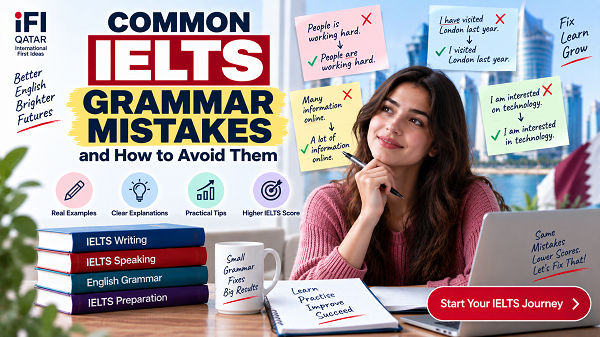
Why Grammar Matters in IELTS
Grammar plays an important role in IELTS because candidates need to communicate ideas accurately and effectively. Grammar is particularly important in IELTS Speaking and IELTS Writing, where grammatical range and accuracy form part of the assessment.
However, improving your IELTS grammar does not mean trying to use complicated sentences in every answer. A simple sentence that is accurate and clear is usually more useful than a complex sentence containing several errors.
For example:
Incorrect:
People is becoming more dependent on technology.
Correct:
People are becoming more dependent on technology.
The second sentence is simple, but it is grammatically accurate.
The key is to develop a combination of accuracy, variety and control.
What Are the Most Common IELTS Grammar Mistakes?
IELTS students often make similar grammar errors, especially when they are writing under time pressure or speaking spontaneously.
The most common IELTS grammar mistakes include:
- Subject-verb agreement errors
- Incorrect use of articles
- Tense mistakes
- Preposition errors
- Countable and uncountable noun errors
- Incorrect sentence structures
- Comparative and superlative mistakes
- Incorrect use of quantifiers
- Gerund and infinitive errors
- Adjective and adverb confusion
- Incorrect modal verb structures
- Conditional sentence errors
- Passive voice mistakes
- Double negatives
- Overusing complex grammar
Understanding these mistakes is the first step toward correcting them.
15 Common IELTS Grammar Mistakes Students Make
1. Subject-Verb Agreement Errors
Subject-verb agreement is one of the most common IELTS grammar problems.
The verb must agree with the subject in number.
Incorrect:
People is spending more time online.
Correct:
People are spending more time online.
Another example:
Incorrect:
The main reason are the high costs.
Correct:
The main reason is the high cost.
Common Subject-Verb Agreement Examples
| Incorrect | Correct |
|---|---|
| Students needs more practice. | Students need more practice. |
| Technology have changed society. | Technology has changed society. |
| The number of students are increasing. | The number of students is increasing. |
| These problems affects young people. | These problems affect young people. |
IELTS Grammar Tip for Subject-Verb Agreement
Pay special attention to structures such as:
- The number of…
- A number of…
- Each of…
- Every…
- One of…
For example:
The number of students is increasing.
But:
A number of students are studying abroad.
2. Incorrect Use of A, An and The
Articles are another major source of IELTS grammar errors.
English commonly uses:
- a
- an
- the
- no article
Students often forget an article before a singular countable noun.
Incorrect:
I bought new laptop.
Correct:
I bought a new laptop.
They may also use an article when talking about something in general.
Incorrect:
The technology has changed our lives.
Better:
Technology has changed our lives.
The correct choice depends on whether you are referring to something specific or discussing a general concept.
How to Avoid IELTS Article Mistakes
When you write a singular countable noun, ask yourself:
Does this noun need a, an, the or another determiner?
Developing this habit can help you identify article errors during your IELTS Writing review.
3. Confusing Countable and Uncountable Nouns
Countable and uncountable nouns frequently cause problems for IELTS candidates.
Common uncountable nouns include:
- information
- advice
- research
- knowledge
- education
- equipment
- accommodation
- traffic
- homework
- progress
Incorrect:
I received many useful advices.
Correct:
I received a lot of useful advice.
Another example:
Incorrect:
The university provides modern equipments.
Correct:
The university provides modern equipment.
Common IELTS Uncountable Noun Mistakes
| Incorrect | Correct |
|---|---|
| many informations | a lot of information |
| several advices | several pieces of advice |
| many researches | several research studies |
| modern equipments | modern equipment |
| many homeworks | a lot of homework |
Learning common uncountable nouns as complete vocabulary items can help prevent these errors.
4. Using the Wrong Verb Tense
Verb tense mistakes are common in both IELTS Speaking and IELTS Writing.
The correct tense depends on when an action happens and whether it is completed, continuing or connected to the present.
Incorrect:
Last year, I move to Doha and start studying English.
Correct:
Last year, I moved to Doha and started studying English.
Another common mistake involves the Present Perfect and Past Simple.
Incorrect:
I have visited London last year.
Correct:
I visited London last year.
The expression last year refers to a completed period in the past, so the Past Simple is normally used.
Present Perfect vs Past Simple in IELTS
Compare:
I visited London in 2024.
I have visited London several times.
The first sentence refers to a specific completed time. The second describes experience without specifying a completed past time.
IELTS Tense Tip
Before writing or speaking, identify the time reference:
- Is it happening now?
- Did it happen in the past?
- Has it continued until now?
- Is it a future possibility?
- Is it a general fact?
This makes choosing the correct tense easier.
5. Using the Wrong Preposition
Prepositions are small words, but incorrect preposition use can make your English sound unnatural.
Common IELTS preposition mistakes include:
- since / for
- in / on / at
- to / for
- about / on
- of / from
For example:
Incorrect:
I have lived in Doha since five years.
Correct:
I have lived in Doha for five years.
Use:
- for + period of time
- since + starting point
For example:
I have studied English for three years.
I have studied English since 2023.
Other common combinations include:
interested in
dependent on
responsible for
similar to
concerned about
How to Improve IELTS Preposition Accuracy
Do not always learn prepositions individually.
Instead, learn common word combinations as complete phrases.
For example:
interested in
depend on
responsible for
focus on
This approach can make accurate language use more automatic.
6. Making Sentence Structure Errors
Another common IELTS grammar mistake is creating incomplete, confusing or incorrectly connected sentences.
Incorrect:
Many people use social media, it has become an important part of modern life.
This creates a sentence structure problem because two independent clauses have been joined incorrectly.
Correct:
Many people use social media, and it has become an important part of modern life.
You could also write:
Many people use social media because it has become an important part of modern life.
Or:
Many people use social media. It has become an important part of modern life.
How to Build Better IELTS Sentences
A basic sentence structure is:
Subject + Verb + Object
For example:
Technology has transformed communication.
You can then add detail:
Technology has significantly transformed the way people communicate.
Or connect ideas:
Technology has significantly transformed communication because people can now exchange information instantly.
The goal is not to make every sentence extremely long. The goal is to communicate ideas clearly and accurately.
7. Misusing Comparative and Superlative Forms
Comparisons are particularly useful in IELTS Writing Task 1 and can also appear in Speaking and Writing Task 2.
A common error is using more with an adjective that already has a comparative form.
Incorrect:
This method is more easier.
Correct:
This method is easier.
Another example:
Incorrect:
This is the most cheapest option.
Correct:
This is the cheapest option.
Useful Comparison Structures for IELTS
Comparative:
Online learning is more flexible than traditional classroom learning.
Short adjective:
Public transport is cheaper than private transport.
Superlative:
This is the most effective solution.
Equal comparison:
Online education can be as effective as traditional education.
8. Confusing Much, Many, Few and Little
Quantifiers are another common source of IELTS grammar mistakes.
Use:
- many with countable plural nouns
- much with uncountable nouns
- few with countable plural nouns
- little with uncountable nouns
Examples:
Many students study English.
Much research has been conducted on this issue.
Few people understand the problem.
There is little evidence to support this argument.
Common Quantifier Errors in IELTS
Incorrect:
There are much problems with this system.
Correct:
There are many problems with this system.
Incorrect:
There is many information available online.
Correct:
There is a lot of information available online.
Using the correct quantifier makes your writing more precise.
9. Confusing Gerunds and Infinitives
Some English verbs are followed by -ing, while others are followed by to + verb.
Incorrect:
I enjoy to study English.
Correct:
I enjoy studying English.
Another example:
Incorrect:
I decided studying abroad.
Correct:
I decided to study abroad.
Common Verb Patterns for IELTS
Verb + -ing
- enjoy doing
- avoid doing
- consider doing
- suggest doing
- practise doing
Verb + to + infinitive
- want to do
- decide to do
- hope to do
- plan to do
- need to do
Learning these patterns can help you avoid repeated grammar errors.
10. Confusing Adjectives and Adverbs
Students sometimes use adjectives when an adverb is required.
Incorrect:
People communicate more effective online.
Correct:
People communicate more effectively online.
Compare:
Technology is effective.
Technology works effectively.
Another example:
Incorrect:
She speaks English fluent.
Correct:
She speaks English fluently.
Pay attention to the grammatical role of each word rather than simply adding -ly.
11. Using Modal Verbs Incorrectly
Modal verbs are useful for expressing possibility, ability, advice, obligation and prediction.
Common modal verbs include:
- can
- could
- may
- might
- should
- must
- would
A common grammar error is adding to after a modal verb.
Incorrect:
People should to exercise more.
Correct:
People should exercise more.
Incorrect:
Governments must to take action.
Correct:
Governments must take action.
Correct IELTS Modal Verb Structure
The basic structure is:
Modal + base verb
Examples:
Governments should invest in public transport.
Technology may change the way people work.
Individuals could reduce their use of plastic.
12. Making Conditional Sentence Errors
Conditional sentences can help IELTS candidates discuss possibilities, consequences and hypothetical situations.
First Conditional
Used for realistic future possibilities:
If governments invest in public transport, traffic congestion may decrease.
Second Conditional
Used for hypothetical or unlikely situations:
If I had more free time, I would learn another language.
A common mistake is mixing the structures incorrectly.
Incorrect:
If I will have enough money, I would study abroad.
Correct:
If I have enough money, I will study abroad.
For a hypothetical situation:
If I had enough money, I would study abroad.
IELTS Conditional Sentence Tip
Do not force conditional sentences into every answer.
Use them when they naturally help you explain:
- possibilities
- consequences
- hypothetical situations
- solutions
- predictions
13. Making Passive Voice Errors
Passive structures are especially useful in IELTS Academic Writing when describing processes and reporting information.
Compare:
Active:
Researchers conducted the study in 2025.
Passive:
The study was conducted in 2025.
A common passive voice mistake is using the wrong form of the past participle.
Incorrect:
The research was conduct in 2025.
Correct:
The research was conducted in 2025.
Basic Passive Voice Structure
Subject + be + past participle
Examples:
The data was collected from 500 participants.
The results were published last year.
The process is divided into three stages.
14. Using Double Negatives
A double negative can create incorrect or confusing sentences.
Incorrect:
I don’t know nothing about the topic.
Correct:
I don’t know anything about the topic.
You can also say:
I know nothing about the topic.
Another example:
Incorrect:
There isn’t no evidence.
Correct:
There isn’t any evidence.
Using one clear negative structure makes your meaning easier to understand.
15. Overusing Complex Grammar
Trying to sound advanced can actually create more IELTS grammar errors.
For example:
Unnecessarily complicated:
Although technology which has become extremely important in modern society and people who are using it every day, it has many benefits which can improve people’s lives.
A clearer version would be:
Although technology has some disadvantages, it has become an essential part of modern life. It allows people to communicate more easily and access information quickly.
The second version is clearer and easier to understand.
Should You Use Complex Grammar in IELTS?
Yes, but only when you can control it accurately.
Good IELTS writing and speaking should include a mixture of:
- Simple sentences
- Compound sentences
- Complex sentences
- Accurate grammatical structures
- Clear connections between ideas
Complex grammar is useful only when you can use it correctly.
IELTS Grammar Mistakes in Writing and Speaking
Grammar errors can appear differently in IELTS Writing and Speaking.
| IELTS Writing Grammar Mistakes | IELTS Speaking Grammar Mistakes |
|---|---|
| Incorrect verb tenses | Incorrect verb forms |
| Article errors | Subject-verb agreement |
| Run-on sentences | Tense inconsistency |
| Incorrect complex sentences | Preposition errors |
| Countable/uncountable noun errors | Missing articles |
| Incorrect passive structures | Incorrect word forms |
| Punctuation-related sentence problems | Overly complicated sentences |
IELTS Writing gives you time to plan and review your language, while Speaking requires you to produce language in real time.
For this reason, IELTS preparation should include both grammar exercises and practical communication practice.
How to Avoid Common IELTS Grammar Mistakes
Keep an IELTS Grammar Error Log
Create a personal grammar error log.
| My Mistake | Correction | Grammar Rule | New Example |
|---|---|---|---|
| People is | People are | Subject-verb agreement | People are using smartphones more often. |
| Many information | A lot of information | Uncountable noun | There is a lot of information online. |
| Discuss about | Discuss | Verb pattern | We discussed the problem. |
Review this list regularly.
Your own recurring mistakes are often more useful to study than random grammar exercises.
Review Your IELTS Writing
Take an IELTS Writing Task 1 or Task 2 response and check specifically for:
- Subject-verb agreement
- Articles
- Verb tenses
- Prepositions
- Plural forms
- Countable and uncountable nouns
- Sentence structure
- Verb patterns
- Conditionals
- Passive voice
Instead of trying to correct everything at once, identify the errors you make repeatedly.
Record Your IELTS Speaking Practice
Recording your Speaking practice can help you identify grammar problems that are difficult to notice while speaking.
Listen for:
- Repeated tense mistakes
- Missing articles
- Incorrect verb forms
- Preposition errors
- Incomplete sentences
- Repeated sentence structures
Then answer the same question again using the corrected grammar.
A useful practice cycle is:
Speak → Identify → Correct → Repeat
Practise Grammar Through IELTS Topics
Do not study grammar completely separately from IELTS.
Combine grammar practice with common IELTS topics.
Technology
Technology has changed the way people communicate.
Education
If universities offered more online courses, students could study more flexibly.
Environment
Governments should invest more in renewable energy.
Work
Many employees have become more dependent on digital technology.
This approach helps you improve grammar while developing IELTS vocabulary and ideas.
IELTS Grammar Checklist for Writing
Before submitting your IELTS essay, check the following areas.
Subject-Verb Agreement
Ask:
Does every subject have the correct verb?
Verb Tenses
Check:
- Is the tense appropriate for the time reference?
- Have I changed tense unnecessarily?
- Have I used Past Simple and Present Perfect correctly?
Articles
Check:
- a
- an
- the
- zero article
Plural Forms
Check whether countable nouns need a plural form.
Countable and Uncountable Nouns
Pay attention to words such as:
- information
- advice
- research
- equipment
- accommodation
- homework
Prepositions
Check common combinations such as:
- interested in
- dependent on
- responsible for
- similar to
- focused on
Sentence Structure
Ask:
- Are my sentences complete?
- Have I created any run-on sentences?
- Are my ideas clearly connected?
Complex Grammar
Ask:
Is this complex sentence accurate and clear?
If not, simplify it.
How to Improve Grammar for IELTS Speaking
Improving IELTS Speaking grammar requires more than completing grammar exercises.
A practical routine is:
Step 1: Choose an IELTS Speaking Topic
For example:
Technology
Step 2: Choose Three Grammar Structures
For example:
- Present Perfect
- Comparatives
- Conditionals
Step 3: Answer an IELTS Speaking Question
For example:
How has technology changed the way people work?
Step 4: Record Your Answer
Speak naturally and try to develop your ideas rather than focusing on every individual grammar rule.
Step 5: Identify Your Grammar Errors
Listen to your recording and write down your repeated mistakes.
Step 6: Answer the Question Again
Use the corrected structures in your second attempt.
This process gradually makes accurate grammar more automatic.
What Grammar Topics Should IELTS Students Study?
A focused IELTS grammar study plan should include:
- Subject-verb agreement
- Verb tenses
- Articles
- Countable and uncountable nouns
- Prepositions
- Modal verbs
- Conditionals
- Passive voice
- Comparatives and superlatives
- Relative clauses
- Gerunds and infinitives
- Sentence structure
- Conjunctions and linking structures
- Adjective and adverb forms
- Complex sentence structures
You do not need to master every grammar rule at once.
Start with the errors that repeatedly appear in your own IELTS Speaking and Writing.
Can Better Grammar Improve Your IELTS Score?
Grammar is an important part of IELTS performance, but it is not the only factor that matters.
In IELTS Speaking, candidates are assessed across four areas:
- Fluency and Coherence
- Lexical Resource
- Grammatical Range and Accuracy
- Pronunciation
IELTS Writing also uses multiple assessment criteria, so improving grammar alone does not guarantee a particular band score.
A strong IELTS preparation strategy should therefore combine grammar with:
- Vocabulary development
- Speaking fluency
- Pronunciation
- Reading practice
- Listening practice
- Writing structure
- Idea development
- IELTS exam strategies
The objective is not simply to memorise grammar rules. It is to use English accurately and effectively under exam conditions.
Frequently Asked Questions About IELTS Grammar Mistakes
What are the most common IELTS grammar mistakes?
The most common IELTS grammar mistakes include subject-verb agreement errors, incorrect articles, tense mistakes, preposition errors, countable and uncountable noun errors, sentence structure problems, incorrect verb patterns and conditional errors.
How can I improve my grammar for IELTS?
Identify your recurring mistakes, keep a grammar error log, practise grammar through IELTS topics, review your Writing tasks and record your Speaking practice. Focus on accuracy before trying to use increasingly complex structures.
Is grammar important in IELTS Speaking?
Yes. Grammatical range and accuracy is one of the assessment areas in IELTS Speaking. However, Speaking is also assessed through fluency and coherence, lexical resource and pronunciation.
Is grammar important in IELTS Writing?
Yes. Grammatical range and accuracy is one of the criteria used to assess IELTS Writing. Candidates need to demonstrate accurate and appropriate use of grammatical structures.
Should I use complicated grammar to get a high IELTS band?
No. Using complicated grammar incorrectly can reduce clarity and increase errors. It is better to demonstrate a suitable range of grammatical structures while maintaining accuracy and control.
What grammar topics should I study for IELTS?
Important areas include verb tenses, subject-verb agreement, articles, countable and uncountable nouns, prepositions, conditionals, modal verbs, passive voice, comparatives, relative clauses, gerunds and infinitives, and sentence structure.
How can I stop making the same grammar mistakes in IELTS?
Create a personal grammar error log. Record each mistake, its correction, the relevant grammar rule and a new example sentence. Then deliberately practise the corrected structure in IELTS Speaking and Writing tasks.
How can an IELTS course help me improve my grammar?
A structured IELTS course can combine grammar instruction with IELTS-specific Speaking and Writing practice. Regular feedback can also help identify recurring errors and show you how to correct them in the context of real exam tasks.
Final Thoughts on IELTS Grammar Mistakes
Making grammar mistakes is a normal part of learning English, but repeated errors can become a problem when they affect the accuracy and clarity of your IELTS answers.
The most effective approach is not to memorise hundreds of isolated grammar rules. Instead, identify the mistakes you make most frequently and practise correcting them in realistic IELTS tasks.
Start with the fundamentals:
- Subject-verb agreement
- Verb tenses
- Articles
- Prepositions
- Countable and uncountable nouns
- Sentence structure
- Conditionals
- Verb patterns
- Passive voice
Then gradually develop your ability to use more advanced structures accurately.
If you want structured IELTS preparation, expert guidance and regular practice across grammar, Speaking, Writing, Reading and Listening, an IELTS preparation course at IFI Qatar can help you build a more focused study plan.
Ready to improve your IELTS performance? Explore IFI Qatar’s IELTS courses and start preparing with a structured approach.