

Currently Empty: ر.ق 0,00


IELTS
IELTS Writing Task 2 Structure: Complete Guide for Band 7+
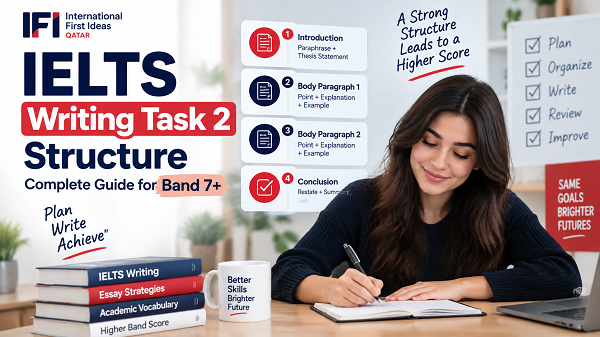
Knowing the IELTS Writing Task 2 structure is one of the most important steps toward achieving a high Writing score.
Many candidates know English well but still lose marks because their essays are poorly organized. Their ideas may be relevant, but the argument is difficult to follow, paragraphs are not logically developed, or the introduction and conclusion do not clearly answer the question.
The good news is that you do not need to memorize a complicated essay.
For most IELTS Writing Task 2 questions, a clear four-paragraph structure can provide an effective framework:
- Introduction
- Body Paragraph 1
- Body Paragraph 2
- Conclusion
The structure itself will not guarantee Band 7. Your score also depends on Task Response, Coherence and Cohesion, Lexical Resource, and Grammatical Range and Accuracy. However, a strong structure makes it much easier to demonstrate these skills.
This guide explains exactly how to structure your IELTS Task 2 essay, develop your ideas, and avoid common mistakes.
What Is IELTS Writing Task 2?
IELTS Writing Task 2 requires you to write an essay in response to a question or point of view.
You should write at least 250 words, and you are advised to spend approximately 40 minutes on this task.
Task 2 carries more weight than Writing Task 1 when your overall IELTS Writing score is calculated, so it deserves a significant part of your preparation.
Questions can ask you to:
- Agree or disagree with an opinion
- Discuss two different views
- Discuss a problem and its solutions
- Discuss advantages and disadvantages
- Answer two questions related to a topic
The first step is therefore not writing. It is understanding exactly what the question requires you to do.
The Best IELTS Writing Task 2 Structure for Band 7+
A practical structure for many Task 2 essays is:
| Paragraph | Main Purpose | What to Include |
|---|---|---|
| Introduction | Introduce the topic and answer the question | Paraphrase + thesis statement |
| Body Paragraph 1 | Develop the first main idea | Topic sentence + explanation + example |
| Body Paragraph 2 | Develop the second main idea | Topic sentence + explanation + example |
| Conclusion | Summarize your position | Restatement + final summary |
This structure is simple, logical, and easy for the examiner to follow.
However, structure should support your ideas rather than replace them. Do not force every essay into exactly the same template if the question requires a different approach.
Step 1: Analyze the Question Before Writing
Before you start your essay, spend a few minutes analyzing the question.
Look for three things:
1. The Topic
What is the general subject?
For example:
Some people believe that university education should be free for everyone.
The topic is university education and its cost.
2. The Task
What exactly does the question ask you to do?
Common instructions include:
- To what extent do you agree or disagree?
- Discuss both views and give your own opinion.
- What are the advantages and disadvantages?
- What problems does this cause, and what solutions can you suggest?
- Why is this the case? Is this a positive or negative development?
3. Your Position
If the question asks for your opinion, decide what you actually believe before writing.
A clear position makes the rest of the essay much easier to organize.
Step 2: Write a Strong IELTS Writing Task 2 Introduction
Your introduction should be concise and directly relevant to the question.
A useful structure is:
Sentence 1: Paraphrase the question
Sentence 2: Give your thesis or position
You generally do not need a long background paragraph.
Example Question
Some people believe that governments should provide free university education for all students. To what extent do you agree or disagree?
Weak Introduction
“Education is very important in today’s world. There are many universities around the world, and education has changed a lot. Some people think university education should be free.”
This introduction is repetitive and does not clearly establish the writer’s position.
Better Introduction
“Although university education can be expensive, some argue that governments should make it available to students without tuition fees. I largely agree with this view because free higher education can improve access to academic opportunities and provide long-term benefits for society.”
This version:
- Introduces the topic
- Paraphrases the question
- Gives a clear position
- Previews the main reasoning
How to Write an IELTS Writing Task 2 Thesis Statement
Your thesis statement tells the examiner what position your essay will take.
For an opinion essay, make your position clear.
Example:
“I strongly agree with this view because it can improve educational equality and create a more skilled workforce.”
Avoid vague statements such as:
“This essay will discuss this issue.”
That sentence does not tell the examiner what you think.
If the question asks for your opinion, your opinion should be clear throughout the essay, not just implied in the conclusion.
Step 3: Build Effective Body Paragraphs
The body paragraphs are where you develop your arguments.
A strong body paragraph can follow this pattern:
PEEL Structure
P — Point
Introduce the main idea.
E — Explanation
Explain why the idea is important.
E — Example
Give a relevant example.
L — Link
Connect the idea back to the question when appropriate.
For example:
Body Paragraph
“One major advantage of free university education is that it can increase access to higher education. Students from low-income families may be unable to afford tuition fees even when they have strong academic potential. Removing this financial barrier would allow more talented students to continue their education and develop professional skills. For example, government-funded university places could enable capable students from disadvantaged backgrounds to study subjects such as medicine, engineering, or education.”
Notice how the paragraph develops one central idea rather than presenting several unrelated points.
How Many Ideas Should You Put in Each Body Paragraph?
One common IELTS mistake is trying to include too many ideas.
For a typical four-paragraph essay, it is usually better to develop one strong central idea per body paragraph than to list several ideas without explaining them.
Compare:
Weak Development
“Free education helps poor students, improves society, creates jobs, reduces inequality, develops the economy, and helps governments.”
This is a list rather than an argument.
Strong Development
“Free university education can reduce inequality because students from lower-income families are less likely to be excluded from higher education due to financial limitations.”
Then explain the idea and provide an example.
Depth is generally more valuable than a long list of undeveloped points.
Step 4: Write the Second Body Paragraph
Your second body paragraph should introduce another important idea that supports your position or addresses another part of the question.
For example:
“Another important benefit is that a highly educated population can contribute to economic development. When more people have access to university-level education, countries can develop a larger pool of qualified professionals in areas such as healthcare, technology, and engineering. This can increase productivity and help businesses respond to changing economic demands.”
Again, the paragraph has:
- A clear topic sentence
- Explanation
- Development
- Relevant examples
Step 5: Write a Clear IELTS Writing Task 2 Conclusion
The conclusion should not introduce a completely new argument.
A simple structure is:
Restate your position + summarize the main ideas
Example:
“In conclusion, I believe that governments should provide greater access to affordable or free university education. This would reduce financial barriers for disadvantaged students while also helping countries develop a more highly skilled workforce.”
Keep your conclusion focused.
You do not need to repeat every sentence from the body paragraphs.
Complete IELTS Writing Task 2 Structure Example
Let’s put everything together.
Introduction
- Paraphrase the topic
- Give your position
Body Paragraph 1
- Main argument
- Explanation
- Example
Body Paragraph 2
- Second argument
- Explanation
- Example
Conclusion
- Restate your position
- Summarize the main arguments
This gives you a clear four-paragraph framework:
Introduction → Main Idea 1 → Main Idea 2 → Conclusion
IELTS Writing Task 2 Structure for Different Question Types
The basic four-paragraph structure can be adapted to different question types.
1. Opinion Essay
Typical question:
To what extent do you agree or disagree?
Recommended structure:
Introduction
- Paraphrase
- Clear opinion
Body 1
- Reason supporting your position
- Explanation
- Example
Body 2
- Second reason
- Explanation
- Example
Conclusion
- Restate your position
2. Discuss Both Views Essay
Typical question:
Some people believe X, while others believe Y. Discuss both views and give your own opinion.
Recommended structure:
Introduction
- Introduce both views
- Give your opinion
Body 1
- Explain View A
- Supporting explanation/example
Body 2
- Explain View B
- Supporting explanation/example
- Your position if appropriate
Conclusion
- Summarize both perspectives
- Clearly state your position
3. Advantages and Disadvantages Essay
Typical question:
What are the advantages and disadvantages of working from home?
Recommended structure:
Introduction
- Paraphrase the topic
- State what the essay will examine
Body 1
- Main advantages
- Explanation
- Examples
Body 2
- Main disadvantages
- Explanation
- Examples
Conclusion
- Summarize the overall balance
If the question asks whether the advantages outweigh the disadvantages, your position on that specific issue should be clear.
4. Problem and Solution Essay
Typical question:
What problems are caused by traffic congestion, and what solutions can be introduced?
Recommended structure:
Introduction
- Introduce the problem
- Mention the main areas you will discuss
Body 1
- Main problems
- Explanation
- Examples
Body 2
- Practical solutions
- Explanation
- Examples
Conclusion
- Summarize the problems and solutions
5. Two-Part Question Essay
Some IELTS questions contain two direct questions.
For example:
Why do people increasingly work from home? Is this a positive or negative development?
A suitable structure is:
Introduction
- Paraphrase
- Briefly answer both questions
Body 1
- Answer Question 1
Body 2
- Answer Question 2
Conclusion
- Summarize your answers
The most important point is to make sure both questions are fully answered.
IELTS Writing Task 2 Paragraph Length
There is no official rule saying every paragraph must contain a specific number of words.
Instead, focus on developing your ideas adequately.
A practical essay might look like:
- Introduction: 40–60 words
- Body Paragraph 1: 80–100 words
- Body Paragraph 2: 80–100 words
- Conclusion: 30–50 words
This is only a guideline. Your priority should be answering the question thoroughly while maintaining clear organization.
How to Improve Coherence and Cohesion
Coherence means that your ideas are logically organized and easy to understand.
Cohesion refers to how effectively your sentences and ideas are connected.
Use linking expressions naturally.
To Add Ideas
- Furthermore
- In addition
- Another important point is that
To Give Examples
- For example
- For instance
- A clear example of this is
To Explain Results
- Therefore
- As a result
- Consequently
To Contrast
- However
- Nevertheless
- In contrast
- On the other hand
Do not use linking words in every sentence. Excessive connectors can make your writing sound mechanical.
IELTS Writing Task 2 Vocabulary for Band 7+
A Band 7 essay does not require extremely complicated vocabulary.
Instead, focus on:
- Precise word choice
- Natural collocations
- Topic-specific vocabulary
- Appropriate academic language
- Avoiding unnecessary repetition
For example, instead of repeatedly writing:
“This is good for society.”
You might write:
“This can have significant benefits for society.”
Or:
“This can contribute to long-term social development.”
The goal is accuracy and flexibility, not using the most difficult word you know.
Grammar for a Band 7+ IELTS Essay
Your grammar should demonstrate variety while remaining accurate.
Try using a combination of:
- Simple sentences
- Compound sentences
- Complex sentences
- Relative clauses
- Conditional structures
- Passive constructions
Example:
“Although online education provides greater flexibility, it may not be suitable for students who require regular face-to-face interaction.”
This demonstrates a complex sentence while remaining natural and easy to understand.
Avoid adding complex grammar simply to impress the examiner. Incorrect complex grammar can hurt your score.
Common IELTS Writing Task 2 Structure Mistakes
Mistake 1: Writing Without a Clear Position
If the question asks for your opinion, the examiner should understand your position.
Mistake 2: Using a Memorized Template
Memorized phrases can make your essay sound unnatural and may not properly address the question.
Learn a flexible structure instead of memorizing an entire essay.
Mistake 3: Writing One Very Large Paragraph
Separate your main ideas into logically organized paragraphs.
Mistake 4: Including Too Many Ideas
A few well-developed ideas are usually more effective than many undeveloped ones.
Mistake 5: Adding Irrelevant Examples
Every example should support the argument you are making.
Mistake 6: Writing a Conclusion With a New Idea
Your conclusion should summarize the argument rather than introduce a completely new point.
Mistake 7: Ignoring the Exact Question
A beautifully written essay can still receive a disappointing score if it does not answer the task accurately.
IELTS Writing Task 2 Band 7 Checklist
Before submitting your essay, ask yourself:
Task Response
- Did I answer every part of the question?
- Is my position clear?
- Did I develop my main ideas?
- Are my examples relevant?
Coherence and Cohesion
- Are my paragraphs logically organized?
- Does each paragraph have one clear focus?
- Are my ideas connected naturally?
Vocabulary
- Did I use precise vocabulary?
- Did I avoid unnecessary repetition?
- Are my word choices natural?
Grammar
- Did I use a range of sentence structures?
- Are my sentences grammatically accurate?
- Did I check articles, verb forms, plurals, and subject-verb agreement?
Final Check
- Is the essay at least 250 words?
- Did I leave enough time to proofread?
A Simple IELTS Writing Task 2 Plan You Can Use
If you have approximately 40 minutes, try this approach:
First 5 Minutes — Plan
- Identify the question type
- Decide your position
- Choose two main ideas
- Think of supporting examples
Next 30 Minutes — Write
Follow your planned structure:
Introduction → Body 1 → Body 2 → Conclusion
Final 5 Minutes — Check
Look for:
- Grammar errors
- Spelling mistakes
- Repeated vocabulary
- Missing articles
- Subject-verb agreement
- Unclear sentences
- Whether you answered the question
This approach can prevent you from spending too much time writing the introduction and rushing the conclusion.
Can You Get Band 7 With a Simple Essay Structure?
Yes. A simple structure can support a Band 7+ performance, but structure alone does not produce a Band 7.
The examiner assesses your overall performance across the four IELTS Writing criteria.
To achieve a high score, you need to combine:
Clear structure + relevant ideas + strong development + appropriate vocabulary + grammatical accuracy
That is why practicing complete essays and receiving detailed feedback is often more effective than simply memorizing templates.
IELTS Writing Task 2 FAQ
What is the best IELTS Writing Task 2 structure?
A clear four-paragraph structure works well for many candidates: an introduction, two developed body paragraphs, and a conclusion. However, the structure should be adapted to the specific question.
How many paragraphs should IELTS Writing Task 2 have?
There is no official required number of paragraphs. A four-paragraph essay is a practical structure for many questions, but what matters most is logical organization and adequate development of ideas.
How long should IELTS Writing Task 2 be?
You must write at least 250 words. There is no need to write an extremely long essay; focus on answering the question clearly and developing your ideas sufficiently.
Should I memorize an IELTS Writing Task 2 template?
It is better to learn a flexible structure and useful language rather than memorize a complete template. Your response needs to address the specific question naturally.
How do I write a Band 7 IELTS essay?
Focus on fully addressing the task, developing relevant ideas, organizing information logically, using a sufficient range of vocabulary, and producing a range of grammatical structures with reasonable accuracy.
How can I improve my IELTS Writing Task 2 score?
Practice regularly, analyze your errors, study high-quality model responses, and get professional feedback on your writing. Identifying recurring weaknesses is one of the most effective ways to improve.
Improve Your IELTS Writing With IFI Qatar
Understanding the IELTS Writing Task 2 structure is an important first step. The next step is learning how to develop ideas, meet the IELTS assessment criteria, use vocabulary naturally, and avoid the mistakes that keep candidates stuck at lower bands.
At IFI Qatar, our IELTS preparation programs can help you build these skills through structured lessons, writing practice, expert feedback, and targeted exam strategies.
If your target is Band 7 or higher, don’t rely on templates alone. Build a writing strategy that you can confidently apply to different IELTS questions.
Ready to improve your IELTS Writing score?