

Currently Empty: ر.ق 0,00


IELTS
How to Progress from B2 to C1 English: Skills and Study Milestones
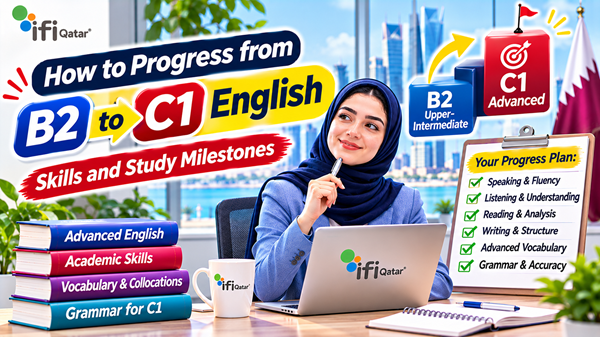
Reaching B2 in English is a significant achievement. At this level, you can usually communicate independently, understand the main ideas of complex texts and participate in conversations about a wide range of familiar subjects. You may also be able to use English in professional, academic and social situations without relying heavily on translation.
However, moving from B2 to C1 can feel surprisingly difficult.
At the upper-intermediate level, you already know a considerable amount of vocabulary and grammar. The challenge is no longer simply learning basic structures or memorising new words. Instead, you need to develop greater precision, flexibility, fluency and control over the language.
Progressing from B2 to C1 English means learning to communicate effectively in more demanding situations, understand subtle differences in meaning, organise complex ideas and choose language that suits different contexts.
This guide explains the key differences between B2 and C1, the skills you need to develop, practical study methods and measurable milestones that can help you work towards advanced English proficiency.
1. What Does It Mean to Progress from B2 to C1 English?
B2 and C1 are two levels in the Common European Framework of Reference for Languages (CEFR), an international framework used to describe language proficiency.
Both levels represent independent language use, but C1 requires a higher degree of flexibility, accuracy and control.
What Can You Do at B2 Level?
At B2, you can generally:
- Understand the main ideas of complex texts on concrete and abstract topics.
- Participate in conversations with a reasonable degree of fluency.
- Communicate with native English speakers without excessive difficulty.
- Explain opinions and support arguments.
- Write clear and detailed texts on different subjects.
- Understand many professional and academic discussions.
However, you may still experience difficulties when dealing with unfamiliar subjects, subtle meanings, complex arguments or fast and highly nuanced communication.
What Can You Do at C1 Level?
At C1, you can generally:
- Understand a wide range of demanding, longer texts.
- Recognise implicit meaning and subtle distinctions.
- Express ideas fluently without searching excessively for words.
- Use English flexibly in social, academic and professional situations.
- Produce clear, well-structured and detailed writing.
- Organise complex arguments using appropriate language.
- Adjust your vocabulary, tone and style to different contexts.
The difference is not simply the number of words you know. It is how effectively you can understand and use the language in demanding situations.
B2 vs C1 English: Key Differences
| Skill Area | B2 English | C1 English |
|---|---|---|
| Speaking | Communicates clearly on familiar and many unfamiliar topics | Expresses complex ideas fluently and flexibly |
| Listening | Understands extended speech on familiar and many general topics | Understands demanding speech and recognises implied meaning |
| Reading | Understands complex factual and literary texts | Understands long, demanding texts and subtle distinctions |
| Writing | Produces clear, detailed and organised texts | Produces well-structured texts with precise language and appropriate style |
| Vocabulary | Uses a broad vocabulary for general and many specialised topics | Uses a wide vocabulary accurately, flexibly and appropriately |
| Grammar | Uses a range of structures with generally good control | Demonstrates greater accuracy and flexibility with complex structures |
| Communication | Can explain and defend opinions | Can develop nuanced arguments and adapt communication to context |
The transition involves improving the quality of your language use rather than simply increasing the amount of English you know.
2. Why Is Moving from B2 to C1 So Challenging?
Many learners feel that their English stops improving once they reach an upper-intermediate level.
They can understand most everyday conversations, watch many English-language programmes and communicate at work. As a result, they may not notice obvious weaknesses in their language skills.
However, advanced proficiency requires more than being understood.
You Need Greater Accuracy
At B2, occasional grammar mistakes may not prevent you from communicating successfully.
At C1, you need better control over sentence structure, verb forms, complex clauses and grammatical choices.
For example:
B2-style expression:
“Although the project was difficult, we finished it on time.”
A more developed C1-style expression:
“Despite the considerable challenges involved, we managed to complete the project within the agreed timeframe.”
Both sentences are correct. The second demonstrates greater flexibility in sentence construction and vocabulary.
You Need More Precise Vocabulary
At B2, you may know several words that communicate a similar idea.
At C1, you should become more confident choosing the most appropriate word for the situation.
Consider these verbs:
- Get
- Obtain
- Acquire
- Secure
- Receive
They are related, but they are not always interchangeable.
For example:
- Obtain permission.
- Acquire a skill.
- Secure an agreement.
- Receive feedback.
Advanced vocabulary is not about choosing the most complicated word. It is about selecting the most accurate and natural expression.
You Need to Understand More Than the Literal Meaning
Advanced English communication often involves implied meaning, tone, attitude and context.
For example, consider the statement:
“That is certainly an interesting approach.”
Depending on the speaker’s tone and the surrounding discussion, this could express genuine interest, polite disagreement or mild criticism.
At C1, you need to become better at recognising these distinctions.
You Need Greater Flexibility
B2 learners can often communicate effectively in familiar situations but may rely on expressions they use repeatedly.
C1 requires greater flexibility when:
- Explaining unfamiliar ideas.
- Discussing abstract topics.
- Responding to unexpected questions.
- Presenting complex arguments.
- Adapting language to different audiences.
This flexibility develops through extensive exposure and active practice.
3. The Five Main Skills You Need to Develop from B2 to C1
To make progress towards C1, avoid focusing exclusively on grammar or vocabulary.
Advanced proficiency involves several connected skills that should develop together.
3.1 Advanced Speaking and Communication
At C1, speaking is not simply about talking quickly.
You need to communicate ideas clearly, organise arguments, express different perspectives and respond naturally to other speakers.
Focus on developing these abilities:
- Explain complex ideas without excessive hesitation.
- Discuss abstract and unfamiliar subjects.
- Support opinions with relevant examples.
- Compare different perspectives.
- Clarify and reformulate ideas.
- Participate in extended discussions.
- Use appropriate expressions for formal and informal situations.
Practical exercise:
Choose a topic such as remote working, artificial intelligence or international education.
Speak for three to five minutes and structure your response around:
- Your main position.
- Two supporting arguments.
- An example.
- An alternative perspective.
- A concluding statement.
Record yourself and review your fluency, vocabulary, organisation and grammar.
3.2 Advanced Listening Comprehension
At B2, you may understand most conversations when the topic is familiar and the speakers communicate relatively clearly.
C1 listening requires greater confidence with:
- Fast natural speech.
- Different English accents.
- Extended discussions.
- Academic lectures.
- Professional presentations.
- Implied meaning.
- Attitudes and opinions.
- Less predictable vocabulary.
Practical exercise:
Listen to a 10-minute interview or discussion.
During the first listening, identify the main argument.
During the second listening, focus on:
- Supporting examples.
- The speaker’s attitude.
- Important details.
- Changes in the speaker’s position.
- Expressions that indicate contrast or disagreement.
Finally, summarise the discussion in your own words.
3.3 Advanced Reading Skills
C1 reading involves more than understanding individual words and sentences.
You need to understand how ideas are connected, recognise the writer’s purpose and interpret complex arguments.
Practise reading:
- Opinion articles.
- Academic publications.
- Long-form journalism.
- Professional reports.
- Analytical essays.
- Editorials and reviews.
Pay attention to:
- Main arguments.
- Supporting evidence.
- Implied meaning.
- Tone and attitude.
- Logical relationships.
- Vocabulary in context.
Practical exercise:
Read an article of approximately 800–1,200 words.
After reading, write:
- A one-sentence summary.
- The author’s main argument.
- Three supporting points.
- Two expressions you found particularly useful.
- One question or criticism about the argument.
This exercise develops comprehension and critical reading at the same time.
3.4 Advanced Writing Skills
One of the most important differences between B2 and C1 is the ability to communicate complex ideas clearly and accurately in writing.
At C1, you should be able to produce well-organised texts with appropriate tone, vocabulary and structure.
Practise writing:
- Formal reports.
- Analytical essays.
- Professional emails.
- Academic summaries.
- Opinion articles.
- Arguments and counterarguments.
- Evaluations and recommendations.
Focus on:
- Paragraph development.
- Logical progression.
- Cohesion and coherence.
- Accurate vocabulary.
- Sentence variety.
- Appropriate register.
- Grammar accuracy.
Practical exercise:
Write a 250–300-word response to a question such as:
“To what extent has technology improved the quality of education?”
Include an introduction, developed arguments, relevant examples and a conclusion.
After writing, review whether each paragraph contributes clearly to your overall position.
3.5 Advanced Grammar and Sentence Control
At B2, you may already understand many complex grammar structures.
However, progressing to C1 requires more consistent and flexible use of them.
Prioritise:
- Complex conditional structures.
- Inversion for emphasis.
- Advanced relative clauses.
- Participle clauses.
- Modal verbs for speculation and deduction.
- Advanced passive structures.
- Cleft sentences.
- Hedging and cautious language.
- Complex linking structures.
For example:
Basic expression:
“I think this policy could cause problems.”
More nuanced expression:
“This policy may have unintended consequences, particularly if its long-term implications are not carefully considered.”
The second example demonstrates a more cautious and precise way of expressing an opinion.
Do not study advanced grammar only as isolated rules. Practise using each structure in meaningful speaking and writing activities.
4. Advanced Vocabulary: What Should You Learn at C1 Level?
Vocabulary development is essential when moving from B2 to C1.
However, learning long lists of unfamiliar words is not necessarily the most effective approach.
You need to develop a broader vocabulary and understand how words behave in different contexts.
Learn Collocations Instead of Isolated Words
A collocation is a combination of words that commonly occur together.
For example:
| Verb | Common Collocation |
|---|---|
| Raise | Raise an issue |
| Reach | Reach a conclusion |
| Draw | Draw attention |
| Meet | Meet expectations |
| Pose | Pose a challenge |
| Gain | Gain insight |
| Take | Take responsibility |
| Make | Make an assumption |
Learning collocations helps you produce more natural English.
Develop Vocabulary by Topic
Choose topics that frequently appear in academic, professional and everyday discussions.
Useful areas include:
- Education.
- Technology.
- Globalisation.
- Environment.
- Economics.
- Healthcare.
- Psychology.
- Employment.
- Science.
- Social change.
For each topic, collect useful nouns, verbs, adjectives and common expressions.
For example, when studying environmental issues, you might learn:
- Carbon emissions.
- Renewable energy.
- Environmental degradation.
- Sustainable development.
- Conservation efforts.
- Resource consumption.
Learn Synonyms and Their Differences
Do not assume that words with similar dictionary definitions can always replace one another.
For example:
- Significant: important or meaningful.
- Substantial: considerable in amount or degree.
- Notable: worthy of attention.
- Remarkable: unusual or impressive.
Understanding these distinctions helps you communicate more precisely.
Keep a Vocabulary Notebook
For each new expression, record:
- The word or phrase.
- Its meaning.
- A natural example sentence.
- Common collocations.
- Any differences from similar expressions.
Review the vocabulary regularly and use new expressions in your own speaking and writing.
5. A Practical B2 to C1 English Study Plan
A successful study plan should develop all four language skills while addressing your individual weaknesses.
The following eight-week framework provides a practical structure for organising your learning.
It is a suggested study programme, not a guaranteed timeline for reaching C1. Your starting point, available study time and learning history will influence how quickly you progress.
Weeks 1–2: Identify Weaknesses and Strengthen Your Foundation
Main objective: Understand your current abilities and identify the skills that need the most attention.
Focus on:
- Reviewing complex grammar structures.
- Identifying recurring speaking mistakes.
- Reading longer English articles.
- Listening to natural conversations.
- Reviewing vocabulary gaps.
- Writing organised paragraphs.
Suggested milestones:
- Complete an assessment of your current English level.
- Identify three recurring grammar problems.
- Record a three-minute speaking response.
- Write a structured 250-word text.
- Complete a listening and reading exercise.
Weeks 3–4: Develop Fluency and Vocabulary Precision
Main objective: Become more flexible when expressing ideas.
Focus on:
- Topic-based vocabulary.
- Collocations.
- Extended speaking practice.
- Natural English expressions.
- Listening to different accents.
- Writing longer and more developed paragraphs.
Suggested milestones:
- Explain an abstract topic for five minutes.
- Use new collocations naturally in sentences.
- Summarise an English discussion.
- Write an argument with supporting examples.
- Reduce repeated use of basic vocabulary.
Weeks 5–6: Improve Advanced Communication Skills
Main objective: Handle more demanding academic and professional communication.
Focus on:
- Critical reading.
- Complex listening materials.
- Formal and informal language.
- Nuanced arguments.
- Advanced sentence structures.
- Writing reports and analytical responses.
Suggested milestones:
- Identify implied meaning in a discussion.
- Present and defend a position.
- Write a coherent analytical text.
- Recognise differences in tone and register.
- Use a wider range of grammatical structures accurately.
Weeks 7–8: Apply Your Skills in Realistic Situations
Main objective: Use your English more independently across different contexts.
Focus on:
- Extended discussions.
- Professional presentations.
- Academic reading.
- Complex writing tasks.
- Timed language activities.
- Reviewing previous mistakes.
Suggested milestones:
- Participate in an extended discussion.
- Deliver a structured presentation.
- Understand the main arguments in a demanding article.
- Produce a well-organised written response.
- Demonstrate improved accuracy and flexibility across all four skills.
At the end of the eight weeks, review your performance and identify what still needs improvement before considering yourself ready for C1.
6. How to Organise Your Weekly B2 to C1 Study Routine
Consistency is important, but your schedule should also provide enough variety to develop different skills.
Here is an example of a weekly routine for learners who can dedicate approximately 45–60 minutes a day to English.
| Day | Main Focus | Suggested Activities |
|---|---|---|
| Monday | Speaking | Discuss an abstract topic and record your response |
| Tuesday | Listening | Listen to a lecture or interview and summarise it |
| Wednesday | Reading | Analyse an article and identify its main arguments |
| Thursday | Writing | Write an analytical essay or professional report |
| Friday | Grammar | Practise advanced structures in context |
| Saturday | Vocabulary | Review collocations and topic-based expressions |
| Sunday | Review | Evaluate progress and revisit recurring mistakes |
You can adapt the schedule to your availability.
If you have less time, use shorter sessions and rotate the skills throughout the week.
The most important thing is to practise actively rather than spending all your study time watching videos or reading explanations.
7. How to Know Whether You Are Ready for C1
Reaching C1 is not simply a matter of completing an advanced grammar book or learning a certain number of words.
You need to demonstrate that you can use English effectively across different situations.
The CEFR describes C1 proficiency in terms of what learners can understand and communicate. You can use similar performance indicators to evaluate your development.
C1 Speaking Milestones
You should be increasingly able to:
- Speak fluently without excessive hesitation.
- Develop complex arguments.
- Explain abstract concepts.
- Reformulate ideas when necessary.
- Adjust your language to different situations.
- Express subtle differences in meaning.
C1 Listening Milestones
You should be increasingly able to:
- Understand extended speech.
- Follow complex discussions.
- Recognise attitudes and implied meaning.
- Understand demanding presentations.
- Follow unfamiliar topics with less difficulty.
C1 Reading Milestones
You should be increasingly able to:
- Understand long and demanding texts.
- Recognise implied meaning.
- Follow complex arguments.
- Identify the writer’s purpose and attitude.
- Understand vocabulary through context.
C1 Writing Milestones
You should be increasingly able to:
- Organise complex information clearly.
- Develop arguments with supporting evidence.
- Use appropriate tone and register.
- Connect ideas effectively.
- Demonstrate strong grammatical control.
- Choose vocabulary precisely.
B2 to C1 Self-Assessment Checklist
Use this checklist to identify areas where you feel confident and areas that need further development.
-
I can explain complex topics without relying heavily on prepared sentences.
-
I can follow extended discussions on unfamiliar subjects.
-
I can recognise implied meaning and the speaker’s attitude.
-
I can read demanding articles and identify their main arguments.
-
I can write structured analytical texts.
-
I can use a broad range of vocabulary accurately.
-
I can adapt my tone to professional, academic and informal situations.
-
I can use complex grammatical structures with good control.
-
I can identify and correct many of my recurring mistakes.
This checklist is a learning tool, not an official CEFR assessment. A formal level assessment should consider performance across multiple skills.
8. Common Mistakes That Prevent Learners from Reaching C1
Some B2 learners spend months studying without making noticeable progress because their learning activities do not address the skills required at an advanced level.
Avoid these common mistakes.
Mistake 1: Memorising Advanced Words Without Using Them
Learning sophisticated vocabulary can be useful, but memorising definitions does not guarantee that you can use words naturally.
Instead, learn expressions in context and practise using them in your own sentences.
Mistake 2: Focusing Only on Grammar
Advanced grammar is important, but C1 requires much more than grammatical knowledge.
You also need strong listening, reading, writing and speaking skills.
Mistake 3: Avoiding Difficult Materials
If you only read simple articles and listen to familiar topics, you may not develop the ability to understand more demanding English.
Gradually introduce challenging materials that require greater concentration.
Mistake 4: Practising Speaking Without Reviewing Mistakes
Speaking regularly is important, but repeating the same errors without identifying them can limit progress.
Record yourself, review your language and seek feedback when possible.
Mistake 5: Using the Same Expressions Repeatedly
Relying on a small group of familiar expressions can make your communication repetitive.
Expand your vocabulary and practise expressing the same idea in different ways.
Mistake 6: Expecting to Reach C1 in a Fixed Number of Weeks
The B2-to-C1 transition is different for every learner.
Your progress depends on your current abilities, learning consistency, language exposure and opportunities to receive feedback.
Use milestones to monitor development rather than expecting a guaranteed result within a particular period.
9. Should You Study Independently or Join an Advanced English Course?
Self-study can help B2 learners develop vocabulary, improve reading comprehension and maintain regular exposure to English.
However, progressing towards C1 often requires more than independent practice.
You may need someone to identify weaknesses that you do not notice yourself, particularly in speaking, writing, pronunciation and grammatical accuracy.
When Self-Study May Be Enough
Independent learning may work well if you:
- Have a clear understanding of your weaknesses.
- Can select appropriate advanced materials.
- Follow a consistent study routine.
- Have opportunities to practise speaking.
- Can review and evaluate your writing.
- Know how to measure your progress.
When an Advanced English Course Can Help
A structured course may be more suitable if you:
- Need guidance on your learning priorities.
- Struggle with complex grammar.
- Want to improve academic or professional communication.
- Need feedback on speaking and writing.
- Find it difficult to maintain consistent study habits.
- Want to develop your skills through a planned learning pathway.
The Benefits of Combining Classes with Independent Practice
For many learners, combining structured instruction and self-study is a practical approach.
A course can provide:
- Organised lessons.
- Instructor guidance.
- Opportunities for interaction.
- Feedback on language performance.
- Clear learning objectives.
Independent practice can reinforce those lessons through reading, listening, vocabulary revision and writing exercises.
The two approaches can complement each other and help you use your study time more effectively.
10. How IFI Qatar Can Support Your Progress Towards Advanced English
Moving from B2 to C1 requires a more focused approach to language learning.
At this stage, you may already understand everyday English and communicate independently. Your next step is to improve the precision, flexibility and depth of your communication.
IFI Qatar offers English language learning programmes across levels A1 to C1, with face-to-face and online learning options.
For learners progressing beyond the intermediate stage, an appropriate upper-intermediate or advanced learning pathway can help address language weaknesses and develop the skills needed for more demanding communication.
Before choosing a programme, consider:
- Your current English proficiency.
- The skills you need to improve.
- Your academic or professional objectives.
- Your preferred learning format.
- Your available study time.
A suitable learning programme should reflect these factors rather than simply placing every learner into the same learning pathway.
Ready to take your English beyond B2?
Contact IFI Qatar to enquire about available English courses and discuss a learning option that matches your current level and your goal of developing advanced English skills.
Frequently Asked Questions About Progressing from B2 to C1 English
How long does it take to go from B2 to C1 English?
There is no fixed timeline for progressing from B2 to C1. It depends on your starting abilities, study frequency, quality of practice, exposure to English and opportunities for feedback. Regular assessment can help you understand how quickly your skills are developing.
Is B2 English considered fluent?
B2 is generally considered an upper-intermediate level. Learners at this level can communicate independently and handle many complex situations. However, they may still experience difficulties with nuanced meaning, unfamiliar subjects and demanding communication.
What is the main difference between B2 and C1 English?
The main difference is the degree of fluency, flexibility, accuracy and precision. B2 learners can communicate effectively in many situations, while C1 learners can handle more demanding language tasks and express complex ideas with greater control.
What should I study first to move from B2 to C1?
Start by assessing your current skills and identifying your main weaknesses. Many learners benefit from focusing on advanced vocabulary, collocations, complex listening, analytical reading, structured writing and more flexible speaking.
Is advanced vocabulary necessary for C1?
A broad vocabulary is important, but C1 proficiency is not simply about using difficult words. You need to understand word meanings, collocations, register and context, and choose expressions accurately.
Can I reach C1 English through self-study?
Yes, self-study can support progress towards C1 if you use appropriate materials, practise consistently and evaluate your performance. However, feedback from a qualified instructor can be valuable when improving speaking, writing and recurring language errors.
Do I need to improve all four English skills to reach C1?
C1 is an overall proficiency level that involves listening, reading, speaking and writing. You may have different strengths across these skills, but developing them together provides a more balanced language ability.
Is C1 English enough for university study?
C1 proficiency can be suitable for many demanding academic environments because it involves understanding complex texts, following extended discussions and producing structured writing. However, university admission requirements vary, so applicants should always check the specific institution’s English language requirements.
What is the best way to improve English speaking from B2 to C1?
Practise extended discussions, explain abstract topics, defend opinions and record your speaking. Review vocabulary, grammar, fluency and pronunciation, and seek feedback to identify areas for improvement.
Should I take an English course after reaching B2?
An English course may be useful if you need structured learning, instructor feedback or more opportunities to practise advanced communication. The most suitable programme depends on your current skills and learning objectives.