

Currently Empty: ر.ق 0,00


IELTS
British vs American English: Vocabulary and Everyday Usage Differences
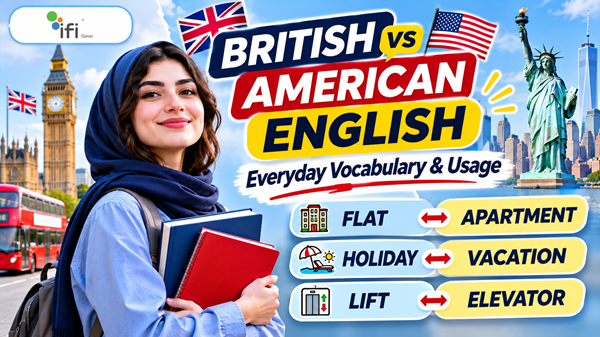
Have you ever watched an American TV series and heard someone say apartment, only to read a British article referring to a flat? Or wondered why Americans say vacation while British people often talk about going on holiday?
These are everyday examples of how English changes depending on where it is spoken.
British English and American English share the same language, grammar foundations and much of their vocabulary. However, they have developed different words, expressions and communication habits over time. Understanding these differences can make conversations easier, improve your listening skills and help you communicate more naturally with people from different English-speaking backgrounds.
In this guide, we explore the most important British vs American English differences, with practical vocabulary examples, everyday expressions and sample sentences you can use in real-life situations.
What Is the Difference Between British and American English?
British English and American English are two major varieties of the English language. British English developed in the United Kingdom, while American English developed in the United States and evolved through its own cultural, historical and linguistic influences.
Although speakers of both varieties generally understand each other, they sometimes use different words to describe the same objects, activities and situations.
For example:
| British English | American English | Meaning |
|---|---|---|
| Flat | Apartment | A place to live |
| Holiday | Vacation | Time away from work or study |
| Lift | Elevator | A machine that carries people between floors |
| Rubbish | Trash | Waste material |
| Petrol | Gas / Gasoline | Fuel for a car |
| Trainers | Sneakers | Sports or casual shoes |
| Queue | Line | A group of people waiting |
| Mobile phone | Cell phone | A portable telephone |
These differences are especially noticeable in everyday conversations, travel, shopping, entertainment and professional communication.
It is important to remember that neither variety is inherently better or more correct. Both are widely used and accepted forms of English.
1. British vs American English: Everyday Vocabulary
Some of the most noticeable differences involve ordinary words that people use every day.
Learning these vocabulary pairs will help you understand conversations, films, books and online content from both countries.
Home and Accommodation
British and American speakers often use different words for rooms, buildings and household objects.
| British English | American English |
|---|---|
| Flat | Apartment |
| Lift | Elevator |
| Ground floor | First floor |
| First floor | Second floor |
| Garden | Yard |
| Tap | Faucet |
| Bin | Trash can |
| Wardrobe | Closet |
| Cooker | Stove |
| Postcode | ZIP code |
Examples:
British English:
- I live in a small flat near the city centre.
- The lift is out of order.
- Please put the rubbish in the bin.
American English:
- I live in a small apartment near downtown.
- The elevator is out of order.
- Please put the trash in the trash can.
One particularly important difference is the use of floor numbers.
In British English, the ground floor is the level at street level. The first floor is the level above it.
In American English, the first floor usually refers to the street-level floor. Therefore, the British first floor is generally equivalent to the American second floor.
Food and Drinks
Food vocabulary is another area where British and American English differ considerably.
| British English | American English |
|---|---|
| Crisps | Chips |
| Chips | French fries |
| Biscuit | Cookie |
| Sweets | Candy |
| Aubergine | Eggplant |
| Courgette | Zucchini |
| Coriander | Cilantro |
| Rocket | Arugula |
| Courgette | Zucchini |
| Fizzy drink | Soda |
| Takeaway | Takeout |
| Bill | Check |
Examples:
British English:
- Would you like some biscuits with your tea?
- I ordered fish and chips.
- Let’s get a takeaway tonight.
American English:
- Would you like some cookies with your tea?
- I ordered a burger and French fries.
- Let’s get takeout tonight.
Be particularly careful with the word chips.
In British English, chips are usually thick-cut pieces of fried potato. In American English, chips generally refers to thin, crispy potato snacks, which British speakers call crisps.
This difference can easily cause confusion when ordering food.
Clothes and Fashion
British and American English also have different names for common clothing items.
| British English | American English |
|---|---|
| Trousers | Pants |
| Jumper | Sweater |
| Trainers | Sneakers |
| Waistcoat | Vest |
| Nappy | Diaper |
| Plimsolls | Sneakers / Canvas shoes |
| Dressing gown | Bathrobe |
| Braces | Suspenders |
| Wellies | Rain boots |
Examples:
British English:
- I need to buy a new pair of trousers.
- She is wearing a blue jumper.
- Don’t forget your trainers for the gym.
American English:
- I need to buy a new pair of pants.
- She is wearing a blue sweater.
- Don’t forget your sneakers for the gym.
A useful point to remember is that pants has different meanings in the two varieties. In American English, it generally means trousers. In British English, it usually refers to underwear.
Transport and Travel
If you travel between the UK and the United States, you will notice several vocabulary differences related to transport.
| British English | American English |
|---|---|
| Petrol | Gas / Gasoline |
| Petrol station | Gas station |
| Motorway | Freeway / Highway |
| Car park | Parking lot |
| Boot | Trunk |
| Bonnet | Hood |
| Lorry | Truck |
| Railway | Railroad |
| Return ticket | Round-trip ticket |
| Single ticket | One-way ticket |
| Pavement | Sidewalk |
| Zebra crossing | Crosswalk |
Examples:
British English:
- I need to stop at a petrol station.
- The car park is behind the supermarket.
- We bought return tickets to Manchester.
American English:
- I need to stop at a gas station.
- The parking lot is behind the supermarket.
- We bought round-trip tickets to Boston.
These words are especially useful when asking for directions, renting a car or using public transport.
2. British vs American English Expressions in Everyday Conversations
The differences between the two varieties are not limited to individual nouns. People also use different expressions when talking about daily activities.
Here are some common examples.
| British English | American English |
|---|---|
| Have a good holiday! | Have a good vacation! |
| Are you free at the weekend? | Are you free on the weekend? |
| I’ll ring you later. | I’ll call you later. |
| I’ve got to go. | I have to go. |
| Fancy a cup of tea? | Would you like a cup of tea? |
| That’s brilliant! | That’s awesome! |
| Cheers! | Thanks! |
| I’m knackered. | I’m exhausted. |
| Let’s pop round. | Let’s stop by. |
| It’s gone pear-shaped. | It didn’t go as planned. |
Some expressions are informal or associated with particular regions and age groups. They should not be treated as universal phrases used by every British or American speaker.
Examples in Context
Situation 1: Talking about a holiday
British English:
“Are you going on holiday this summer?”
American English:
“Are you going on vacation this summer?”
Situation 2: Making a phone call
British English:
“I’ll ring you when I get home.”
American English:
“I’ll call you when I get home.”
Situation 3: Talking about being tired
British English:
“I’m absolutely knackered after work.”
American English:
“I’m completely exhausted after work.”
Understanding these expressions helps you recognise natural communication rather than relying only on textbook vocabulary.
3. Words That Have Different Meanings in British and American English
Some English words are particularly confusing because they exist in both varieties but can have different meanings.
These differences are important because choosing the wrong interpretation may lead to misunderstandings.
Pants
In American English, pants usually means trousers.
In British English, pants usually means underwear.
Examples:
- American: I bought a new pair of pants for work.
- British: I bought a new pair of trousers for work.
Biscuit
In British English, a biscuit is generally a small, firm, sweet baked item.
In American English, a biscuit is usually a soft, savoury bread-like item, often served with breakfast or gravy.
Examples:
- British: Would you like a biscuit with your tea?
- American: We had biscuits and gravy for breakfast.
Chips
In British English, chips are thick pieces of fried potato.
In American English, chips usually refers to thin, crispy snacks.
Examples:
- British: I’d like fish and chips, please.
- American: I’d like a sandwich with potato chips.
Public School
In British English, a public school traditionally refers to a type of independent fee-paying school.
In American English, a public school is generally a school funded by the government and available to the public without tuition fees.
Examples:
- British: He attended a well-known public school.
- American: My children go to the local public school.
Quite
The word quite can have different strengths depending on the variety and context.
In British English, it can sometimes mean fairly or moderately, although it can also mean completely when used with certain adjectives.
In American English, it often means very or completely, depending on the sentence.
For example:
- British: The film was quite good. (Often understood as fairly good.)
- American: The film was quite good. (Can be understood as very good.)
Context and tone matter, so do not assume that every speaker uses the word in exactly the same way.
4. British vs American English in Shopping and Restaurants
Shopping and ordering food are everyday situations where vocabulary differences become particularly useful.
Knowing the local expressions can help you understand staff, ask questions and feel more comfortable.
At a Restaurant
| British English | American English |
|---|---|
| Could I have the bill, please? | Could I have the check, please? |
| I’d like a takeaway. | I’d like takeout. |
| Main course | Entrée |
| Starter | Appetizer |
| Pudding | Dessert |
| Fizzy drink | Soda |
One important difference is the word entrée.
In British English, an entrée can refer to a dish served before the main course in some dining contexts, although usage varies.
In American English, an entrée usually means the main dish.
Example conversation:
British English:
Customer: “Could I see the menu, please?”
Waiter: “Of course. Would you like a starter?”
Customer: “No, thank you. I’ll just have the main course.”
American English:
Customer: “Could I see the menu, please?”
Server: “Of course. Would you like an appetizer?”
Customer: “No, thank you. I’ll just have the entrée.”
While Shopping
| British English | American English |
|---|---|
| Shop | Store |
| Shopping centre | Shopping mall |
| Cashpoint / Cash machine | ATM |
| Till | Cash register |
| Trainers | Sneakers |
| Jumper | Sweater |
| Shop assistant | Sales associate |
Example sentences:
British English:
- The shop closes at 8 p.m.
- Where is the nearest cashpoint?
- I need to pay at the till.
American English:
- The store closes at 8 p.m.
- Where is the nearest ATM?
- I need to pay at the cash register.
5. British vs American English in Work and Education
Professional and academic communication also includes vocabulary differences.
If you study abroad, work for an international company or communicate with colleagues in the UK and US, understanding these terms can be very helpful.
| British English | American English |
|---|---|
| CV | Résumé |
| Holiday | Vacation |
| University | College / University |
| Timetable | Schedule |
| Mark | Grade |
| Headteacher | Principal |
| Revision | Studying / Reviewing |
| Term | Semester / Term |
| Staff room | Teachers’ lounge |
| Maths | Math |
Some of these words do not have perfectly identical meanings in every context.
For example, CV and résumé are both documents describing a person’s qualifications and work experience, but their typical length, format and use can differ between countries.
Similarly, college does not always mean exactly the same thing in the UK and the US. In the United States, it often refers to an institution of higher education, while in the UK it can refer to different types of educational institutions.
Examples in Academic and Professional Situations
British English:
- I need to revise for my English exam.
- The timetable has changed.
- I received a good mark in mathematics.
American English:
- I need to study for my English exam.
- The schedule has changed.
- I received a good grade in math.
Learning these differences can help you understand university instructions, workplace emails and educational materials from different countries.
6. Differences in British and American Grammar and Usage
Although vocabulary is the main focus of this guide, British and American English also have some differences in grammar and everyday usage.
These differences are generally small, but they are worth recognising.
Present Perfect vs Simple Past
British English often uses the present perfect to describe a recent event with relevance to the present.
American English may use the simple past in similar situations more frequently.
British English:
- I’ve just finished my homework.
- Have you eaten yet?
American English:
- I just finished my homework.
- Did you eat yet?
Both forms are used and understood in both varieties. The examples show common tendencies rather than strict rules.
Have Got vs Have
British English commonly uses have got to talk about possession.
American English often uses have.
British English:
- I’ve got a new phone.
- Have you got a car?
American English:
- I have a new phone.
- Do you have a car?
Both varieties understand both structures.
Shall vs Will
British English sometimes uses shall in suggestions or offers, especially with I and we.
American English generally uses will or other expressions more frequently in everyday conversation.
Examples:
- British: Shall we go for a walk?
- American: Should we go for a walk?
These are common tendencies, not rules that every speaker follows.
7. How to Understand Both British and American English
You do not need to choose one variety and ignore the other. In fact, understanding both can make you a more flexible English speaker.
Here are some practical ways to become familiar with both.
1. Watch British and American TV Shows
Watching different types of English-language programmes exposes you to everyday expressions, pronunciation and vocabulary.
Try watching:
- British dramas and comedies.
- American sitcoms.
- Interviews with British speakers.
- American news programmes.
- Documentaries from both countries.
Use English subtitles when necessary and write down unfamiliar expressions.
2. Read British and American Publications
Reading materials from both countries can help you recognise differences in vocabulary and sentence structure.
For example, compare how British and American publications describe:
- Education.
- Transport.
- Food.
- Employment.
- Travel.
- Technology.
Pay attention to words that appear frequently in everyday writing.
3. Create a British vs American Vocabulary Notebook
Keep a personal list of words that have different forms or meanings.
Organise them into categories such as:
- Home and accommodation.
- Food and restaurants.
- Transport and travel.
- Shopping.
- Work and education.
- Everyday expressions.
Review the list regularly and practise writing sentences with the new words.
4. Practise Listening to Different Accents
Vocabulary and pronunciation work together.
Listen to British and American speakers and notice how they pronounce common words.
You can practise with interviews, podcasts, news programmes and educational videos.
Try to understand the message without translating every word.
5. Use New Vocabulary in Real Conversations
The most effective way to remember new expressions is to use them.
For example, describe your home using British vocabulary and then repeat the description using American vocabulary.
British English:
“I live in a flat near the city centre. There is a small garden behind the building.”
American English:
“I live in an apartment near downtown. There is a small yard behind the building.”
This type of practice helps you become more comfortable switching between varieties.
8. Which Should You Learn: British or American English?
The best variety to focus on depends on your goals, audience and learning environment.
There is no universal answer because both varieties are widely used around the world.
Choose British English If:
- You plan to study or work in the United Kingdom.
- Your educational institution follows British English conventions.
- You regularly communicate with British organisations.
- Your learning materials are primarily based on British English.
Choose American English If:
- You plan to study or work in the United States.
- Your workplace communicates mainly with American clients.
- You regularly use American educational resources.
- You prefer American films, media and learning materials.
Should You Learn Both?
Yes. Even if you use one variety more frequently, understanding the other is a valuable skill.
For example, you might use British English in a university assignment while watching American films and communicating with American colleagues.
The ability to understand both varieties helps you communicate with a wider range of English speakers.
9. British vs American English: Practical Vocabulary Exercises
Test your understanding with these short exercises.
Exercise 1: Match the Words
Match each British English word with its American English equivalent.
- Flat
- Lift
- Rubbish
- Petrol
- Trainers
- Queue
- Holiday
- Car park
Options:
A. Vacation
B. Gas
C. Apartment
D. Parking lot
E. Sneakers
F. Trash
G. Elevator
H. Line
Answers:
- C – Apartment
- G – Elevator
- F – Trash
- B – Gas
- E – Sneakers
- H – Line
- A – Vacation
- D – Parking lot
Exercise 2: Choose the Correct Word
Complete each sentence using the appropriate British or American expression.
- I live in a small ______ near London. (flat / elevator)
- We need to stop at a ______ before driving further. (petrol station / sidewalk)
- Could you bring me the ______, please? (bill / pavement)
- She bought a new pair of ______ for running. (trainers / trousers)
- The ______ is on the second floor. (lift / petrol)
Answers:
- Flat
- Petrol station
- Bill
- Trainers
- Lift
Exercise 3: Rewrite the Sentences
Rewrite these British English sentences using American English vocabulary.
- I left my trainers in the flat.
- We are going on holiday next week.
- The car is in the car park.
- Please put the rubbish in the bin.
- I need to buy some biscuits.
Possible Answers:
- I left my sneakers in the apartment.
- We are going on vacation next week.
- The car is in the parking lot.
- Please put the trash in the trash can.
- I need to buy some cookies.
Exercise 4: Identify the Meaning
Choose the correct interpretation of each word in the specified variety.
1. In American English, what does “pants” usually mean?
A. Underwear
B. Trousers
C. Shoes
2. In British English, what does “chips” usually mean?
A. Thick-cut fried potatoes
B. Thin potato snacks
C. Biscuits
3. In American English, what does “first floor” usually refer to?
A. The level above the ground floor
B. The street-level floor
C. The basement
Answers: 1-B, 2-A, 3-B.
Frequently Asked Questions About British vs American English Differences
What is the main difference between British and American English?
The main differences involve vocabulary, spelling, pronunciation and some grammar conventions. Both varieties share the same basic language structure but use different words and expressions in certain situations.
Is British English more difficult than American English?
Neither variety is inherently more difficult. The level of difficulty depends on your familiarity with its vocabulary, pronunciation and expressions. Regular exposure and practice make both easier to understand.
Can British and American English speakers understand each other?
Yes. British and American English speakers generally understand each other without difficulty. Some unfamiliar expressions or words may require clarification, but communication is usually straightforward.
Is it okay to mix British and American English?
Mixing the two varieties is common in everyday communication. However, in formal writing, academic assignments and professional documents, it is better to follow one consistent style when a specific standard is expected.
What is the difference between a holiday and a vacation?
In British English, holiday commonly refers to time away from work or study. American English usually uses vacation for this meaning. The word holiday is also used in American English for special days and celebrations.
Do British and American English use different words for food?
Yes. Common examples include crisps and chips, aubergine and eggplant, courgette and zucchini, and sweets and candy.
Which English is used in IELTS: British or American?
IELTS accepts both British and American English. Candidates should use correct vocabulary and spelling and maintain consistency in their writing. Understanding both varieties can also help with listening and reading.
Should beginners learn British or American English first?
Beginners can start with either variety. The best choice depends on their goals, learning materials and preferred learning environment. They can gradually become familiar with the other variety as their skills develop.
Does British English have different grammar from American English?
Some grammar and usage differences exist, such as tendencies in present perfect usage and expressions like have got. However, most grammatical structures are shared between the two varieties.
How can I improve my understanding of British and American English?
Read materials from both countries, watch different English-language programmes, listen to native speakers, learn vocabulary in context and practise using new expressions in everyday conversations.
Improve Your Everyday English with IFI Qatar
Understanding British and American English differences is more than learning two lists of vocabulary. It is about becoming comfortable with the different ways people communicate in real-life situations.
Whether you are travelling, studying, working internationally or simply trying to improve your everyday conversations, recognising different expressions can help you communicate more naturally.
At IFI Qatar, English language learning opportunities cover levels from A1 to C1. Developing your vocabulary alongside listening, speaking, reading and writing can help you build practical communication skills for everyday and professional situations.
Ready to communicate more confidently in English?
Explore English courses at IFI Qatar and take the next step towards improving your everyday English skills.