

Currently Empty: ر.ق 0,00


IELTS
How to Improve English Reading Comprehension from Beginner to Advanced
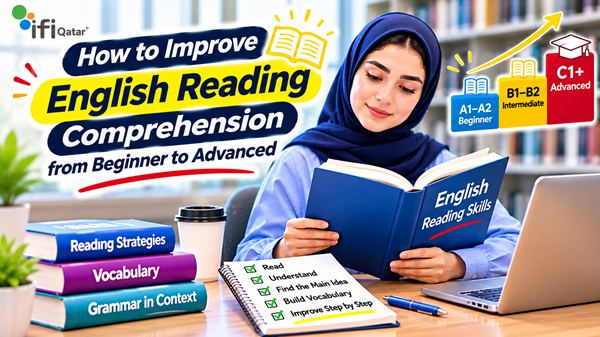
Reading is one of the most important skills you need to develop when learning English. It helps you understand information, expand your vocabulary, recognise grammar patterns and become more confident using the language.
However, knowing the meaning of individual English words does not automatically mean you can understand a complete text.
You might recognise most of the vocabulary in a paragraph but still struggle to understand its main message. You may also find it difficult to follow long sentences, identify important details or understand the relationship between different ideas.
This is where English reading comprehension becomes essential.
Reading comprehension is the ability to understand, interpret and use information presented in written language. It involves more than recognising words. You need to understand how sentences connect, identify the writer’s purpose and distinguish important information from supporting details.
Whether you are a beginner learning basic English or an advanced learner working with complex texts, there are practical ways to improve your reading comprehension.
In this guide, you will discover effective strategies for every English level, common mistakes to avoid, useful exercises and a practical study plan to help you become a more confident reader.
What Is English Reading Comprehension?
English reading comprehension is the ability to understand the meaning of written English and interpret the information presented in a text.
It involves several connected skills, including:
- Recognising vocabulary and expressions.
- Understanding sentence structures.
- Identifying the main idea.
- Finding supporting details.
- Understanding relationships between ideas.
- Making logical conclusions.
- Recognising the writer’s purpose and tone.
For example, consider this sentence:
“Although the weather was unfavourable, the organisers decided to continue with the outdoor event.”
You might understand the words individually but still need to recognise the relationship between them.
The word “although” introduces contrast. This tells you that the weather was not suitable, but the organisers continued with the event.
Understanding this relationship is part of reading comprehension.
Reading Comprehension vs Reading Fluency
These two concepts are related, but they are not identical.
| Skill | Meaning | Example |
|---|---|---|
| Reading Fluency | Reading smoothly, accurately and at an appropriate pace | Reading a paragraph without frequent interruptions |
| Reading Comprehension | Understanding and interpreting what you read | Explaining the main message of the paragraph |
| Vocabulary Knowledge | Understanding the meaning and use of words | Recognising the meaning of “although” |
| Critical Reading | Evaluating information and arguments | Identifying whether a statement is supported by evidence |
Reading faster does not necessarily mean understanding more.
The goal is to develop both fluency and comprehension so that you can read English naturally and accurately.
Why Is English Reading Comprehension Important?
Strong reading comprehension supports almost every area of English learning.
It helps you understand information, communicate more effectively and become more independent when using English.
1. Expand Your English Vocabulary
Reading exposes you to words and expressions in meaningful contexts.
Instead of memorising isolated vocabulary, you see how words are used in sentences and paragraphs.
For example, the word “improve” may appear in different contexts:
- Improve your English skills.
- Improve working conditions.
- Improve customer satisfaction.
- Improve the quality of education.
Recognising these patterns helps you understand both the meaning and usage of vocabulary.
2. Understand English Grammar More Naturally
Regular reading introduces you to grammatical structures in real sentences.
You become more familiar with:
- Different verb tenses.
- Conditional sentences.
- Relative clauses.
- Passive voice.
- Linking expressions.
- Complex sentence structures.
For example:
“Students who practise regularly tend to develop stronger language skills.”
Reading sentences like this helps you recognise how relative clauses and verb structures work in context.
3. Improve Your Writing Skills
Reading and writing are closely connected.
When you read well-written English texts, you become more familiar with paragraph organisation, sentence variety, transitions and vocabulary choices.
This knowledge can help you write more clearly and organise your ideas more effectively.
4. Develop Critical Thinking
At higher levels, reading comprehension involves evaluating information rather than simply understanding it.
You may need to:
- Compare different viewpoints.
- Identify assumptions.
- Recognise bias.
- Evaluate supporting evidence.
- Understand implied meanings.
- Draw conclusions from available information.
These skills are useful in education, professional communication and everyday life.
5. Become More Independent in English
Strong reading comprehension allows you to learn from English materials without depending constantly on translation.
You can read instructions, websites, articles, emails and educational resources more confidently.
This creates more opportunities to practise English outside the classroom.
How to Improve English Reading Comprehension at Different Levels
The best reading strategy depends on your current English proficiency.
A beginner does not need the same reading materials or techniques as an advanced learner.
The following sections explain how to develop reading comprehension step by step.
How to Improve Reading Comprehension at Beginner Level (A1–A2)
At beginner level, your priority should be understanding basic vocabulary, simple sentences and short texts.
You do not need to start with complicated articles or long stories.
Instead, choose materials that match your current language ability.
1. Start with Short and Simple Texts
Choose reading materials that contain familiar vocabulary and straightforward sentence structures.
Good options include:
- Short descriptions.
- Simple stories.
- Everyday conversations.
- Personal messages.
- Basic instructions.
- Short educational texts.
For example:
“Sarah lives in Doha. She works in a hospital. Every morning, she takes the bus to work. She enjoys reading books in her free time.”
After reading this paragraph, you should be able to answer simple questions:
- Where does Sarah live?
- Where does she work?
- How does she travel to work?
- What does she enjoy doing?
These exercises help you connect information across sentences.
2. Learn Vocabulary in Context
Beginners often try to memorise long vocabulary lists.
However, learning words in sentences can make them easier to understand and remember.
For example, instead of learning only the word “hungry”, study it in a sentence:
“I’m hungry because I haven’t eaten anything today.”
You can record vocabulary using a simple table:
| Word | Meaning | Example |
|---|---|---|
| Hungry | Wanting food | I’m hungry after work. |
| Journey | An act of travelling | The journey takes two hours. |
| Comfortable | Providing physical ease | This chair is comfortable. |
| Difficult | Not easy | This exercise is difficult. |
| Usually | In most situations | I usually wake up early. |
Focus on useful everyday vocabulary before moving towards specialised expressions.
3. Practise Reading One Sentence at a Time
If you find paragraphs difficult, begin with individual sentences.
Read a sentence and identify:
- Who or what is the subject?
- What action is happening?
- When does it happen?
- Where does it happen?
- What additional information is provided?
For example:
“My brother studies English at a language centre every evening.”
You can identify:
- Subject: My brother.
- Action: Studies.
- Object: English.
- Location: At a language centre.
- Time: Every evening.
This exercise helps beginners understand basic sentence organisation.
4. Read Aloud to Connect Words with Meaning
Reading aloud can help you notice sentence structure and become more familiar with English pronunciation.
Choose a short paragraph and read it slowly.
Focus on:
- Correct pronunciation.
- Word recognition.
- Natural pauses.
- Sentence meaning.
However, remember that reading aloud is a supporting exercise. You should also practise silent reading to develop independent comprehension.
5. Use Pictures to Understand New Texts
Visual information can make beginner-level reading easier.
For example, if you are reading about food, travel or daily routines, use pictures to connect unfamiliar vocabulary with familiar objects and activities.
This is particularly useful when learning basic nouns, verbs and adjectives.
How to Improve Reading Comprehension at Intermediate Level (B1–B2)
At intermediate level, you should gradually move beyond simple sentences and begin working with longer texts.
Your focus should shift towards understanding paragraph structure, recognising relationships between ideas and interpreting unfamiliar vocabulary.
1. Read Longer Articles and Stories
Start reading materials that contain several paragraphs.
Suitable examples include:
- News articles.
- Short opinion pieces.
- Blog posts.
- Informational articles.
- Short stories.
- Travel and lifestyle content.
Choose subjects that interest you.
If you enjoy technology, for example, reading articles about digital developments may make regular practice more enjoyable.
2. Identify the Main Idea of Each Paragraph
A paragraph usually develops one central idea supported by additional information.
After reading each paragraph, ask:
“What is the writer mainly trying to explain?”
Consider this example:
“Many people prefer working remotely because it offers greater flexibility. Employees can organise their schedules more independently and avoid spending time travelling to the office. However, remote work may also create challenges related to communication and teamwork.”
The main idea is that remote work offers flexibility but also presents certain challenges.
The other sentences provide supporting details.
Try writing a one-sentence summary for every paragraph you read.
3. Learn to Use Context Clues
At intermediate level, you should become more comfortable guessing unfamiliar words from the surrounding information.
For example:
“The company’s new policy was controversial, as employees expressed strong disagreement with the proposed changes.”
Even if you do not know “controversial”, the reference to strong disagreement suggests that the policy caused debate or disagreement.
Use context clues before checking a dictionary.
This develops your ability to understand texts without stopping at every unfamiliar expression.
4. Practise Skimming and Scanning
These two reading techniques are especially useful for intermediate learners.
Skimming means reading quickly to understand the general topic.
Scanning means looking for specific information.
For example, when reading a news article:
- Skim the headline and opening paragraph to understand the story.
- Scan the article to find a particular date, name or statistic.
Using these techniques helps you manage longer texts more efficiently.
5. Understand Linking Words and Expressions
Linking words explain how ideas relate to each other.
They can introduce contrast, reasons, results, examples or additional information.
| Linking Expression | Function | Example |
|---|---|---|
| However | Contrast | The task was difficult. However, she completed it. |
| Therefore | Result | It was raining; therefore, the event was cancelled. |
| Furthermore | Additional information | The course is affordable. Furthermore, it offers flexible schedules. |
| Although | Contrast | Although he was tired, he continued studying. |
| For example | Illustration | Some activities, for example reading, can improve vocabulary. |
| Consequently | Result | The company reduced costs. Consequently, profits increased. |
| In addition | Additional information | The hotel offers breakfast. In addition, guests can use the gym. |
Recognising these expressions helps you follow the logical development of a text.
6. Summarise What You Read
Summarising is an effective way to check whether you understand a text.
After reading an article, write a short summary using your own words.
Try to include:
- The main topic.
- The most important information.
- One or two supporting details.
- The overall conclusion.
Avoid copying complete sentences from the original text.
Your summary should demonstrate your understanding, not reproduce the article.
How to Improve Reading Comprehension at Advanced Level (C1 and Above)
Advanced learners should move beyond understanding explicit information.
At this stage, the goal is to interpret complex texts, recognise subtle differences in meaning and evaluate the quality of arguments.
1. Read More Challenging Materials
Choose texts with advanced vocabulary, complex arguments and varied sentence structures.
Examples include:
- Academic articles.
- Research reports.
- Editorials.
- Professional publications.
- Long-form journalism.
- Analytical essays.
- Literature.
Reading different genres helps you adapt to different writing styles and levels of complexity.
2. Identify the Writer’s Purpose and Tone
Advanced reading involves understanding not only what the writer says but also why and how they communicate it.
Ask yourself:
- Is the writer informing, persuading or criticising?
- Is the tone formal, neutral, critical or humorous?
- Does the writer support a particular position?
- Is the language objective or emotionally persuasive?
For example, compare these sentences:
“Government spending increased by 12% last year.”
“Government spending rose by an alarming 12% last year.”
Both sentences communicate an increase, but the second introduces a more negative evaluation through the word “alarming”.
Recognising these differences is an important advanced reading skill.
3. Understand Implied Meaning
Sometimes, writers communicate ideas indirectly.
You need to use information from the text to understand what is suggested rather than explicitly stated.
Consider this sentence:
“Despite the company’s impressive sales figures, several investors remain cautious.”
The sentence does not directly explain why investors are cautious.
However, it suggests that strong sales figures alone have not removed their concerns.
This type of interpretation requires attention to context and relationships between ideas.
4. Evaluate Arguments and Evidence
Advanced readers should examine how writers support their claims.
Look for:
- Research findings.
- Statistics.
- Expert opinions.
- Examples.
- Comparisons.
- Logical explanations.
- Possible limitations.
Ask whether the evidence actually supports the conclusion.
For example, if an article claims that a particular teaching method is effective, consider whether the writer provides sufficient research or examples to support that statement.
5. Compare Different Sources
Reading several articles about the same topic can help you understand different perspectives.
For example, if you are studying remote work, compare:
- A business article discussing productivity.
- An employee-focused article discussing work-life balance.
- A research report examining workplace performance.
Notice where the sources agree, where they disagree and how their arguments differ.
This develops critical reading and helps you understand complex issues more deeply.
6. Develop Your Understanding of Nuanced Vocabulary
Advanced texts often contain words with similar dictionary meanings but different implications.
Consider:
| Word | Meaning or Nuance |
|---|---|
| Suggest | Indicate a possibility or idea |
| Demonstrate | Show something through evidence |
| Imply | Communicate something indirectly |
| Assert | State something confidently |
| Acknowledge | Recognise or accept a fact |
| Challenge | Question or dispute an idea |
| Substantial | Considerable or significant in amount or degree |
| Marginal | Small or limited in effect or importance |
Understanding these differences helps you interpret more sophisticated writing accurately.
The Most Effective Reading Techniques for Better Comprehension
Regardless of your English level, several reading techniques can help you understand texts more effectively.
1. Skimming
Skimming is used when you want to understand the general meaning of a text quickly.
Focus on:
- Titles.
- Headings.
- Opening paragraphs.
- Topic sentences.
- Conclusions.
It is useful when deciding whether an article is relevant to your interests or research.
2. Scanning
Scanning helps you locate specific information.
For example, you can use it to find:
- Dates.
- Names.
- Numbers.
- Locations.
- Definitions.
- Specific examples.
Instead of reading everything carefully, move through the text looking for the information you need.
3. Intensive Reading
Intensive reading involves examining a short text or passage carefully.
You may focus on:
- Vocabulary.
- Grammar.
- Sentence structure.
- Meaning.
- Supporting details.
- Relationships between ideas.
This technique is useful when studying difficult passages or learning new language structures.
4. Extensive Reading
Extensive reading involves reading larger amounts of material for general understanding and enjoyment.
You can choose:
- Short stories.
- Novels.
- News articles.
- Blog posts.
- Magazine articles.
- Online educational content.
The objective is to develop reading habits and become more comfortable with written English.
Which Reading Technique Should You Use?
| Your Goal | Recommended Technique |
|---|---|
| Understand the general topic | Skimming |
| Find a specific detail | Scanning |
| Understand difficult sentences | Intensive Reading |
| Develop reading fluency | Extensive Reading |
| Analyse an author’s argument | Critical Reading |
| Review information for an assignment | Intensive Reading and Note-Taking |
Combining these techniques allows you to adapt your reading approach to different situations.
Common Mistakes That Reduce English Reading Comprehension
Some habits can make reading more difficult, even when you have a reasonable level of English.
Understanding these mistakes is an important step towards improvement.
| Common Mistake | Why It Is a Problem | Better Approach |
|---|---|---|
| Translating every sentence | Interrupts reading and slows comprehension | Try to understand the general meaning first |
| Looking up every unfamiliar word | Makes reading less continuous | Use context clues before checking a dictionary |
| Reading without a clear purpose | Makes it harder to identify important information | Decide what you want to understand |
| Choosing texts that are too difficult | Can reduce motivation and confidence | Match materials to your current level |
| Ignoring paragraph structure | Makes it difficult to follow the main argument | Identify the main idea of each paragraph |
| Focusing only on speed | Can reduce understanding | Balance reading speed with accuracy |
| Memorising vocabulary without examples | Makes it harder to recognise words in real texts | Learn vocabulary in context |
| Never reviewing what you read | Makes information harder to retain | Summarise important ideas after reading |
One of the most important principles is to choose reading materials that challenge you without making the learning process unnecessarily frustrating.
A Practical 30-Day Plan to Improve English Reading Comprehension
Consistent practice is more effective than occasional long study sessions.
The following plan gradually develops reading skills from basic comprehension to more advanced interpretation.
| Period | Daily Practice | Main Objective |
|---|---|---|
| Days 1–5 | Read short texts and identify basic information | Build reading confidence |
| Days 6–10 | Learn vocabulary in context and practise sentence comprehension | Improve vocabulary recognition |
| Days 11–15 | Read longer paragraphs and identify main ideas | Develop paragraph comprehension |
| Days 16–20 | Practise skimming, scanning and summarising | Improve reading efficiency |
| Days 21–25 | Read different article types and identify the writer’s purpose | Develop interpretation skills |
| Days 26–30 | Read challenging texts and evaluate arguments | Strengthen advanced comprehension |
Suggested Daily Reading Routine
You can follow this simple 25-minute routine:
| Time | Activity |
|---|---|
| 5 minutes | Review previously learned vocabulary |
| 10 minutes | Read a text appropriate to your level |
| 5 minutes | Identify the main idea and supporting details |
| 3 minutes | Record useful new vocabulary |
| 2 minutes | Write a short summary |
If you are a beginner, use shorter texts and spend more time understanding basic sentences.
If you are an advanced learner, choose more challenging materials and spend additional time analysing arguments and implied meanings.
Practical Exercises to Test Your English Reading Comprehension
The following exercises can help you practise different reading skills.
Exercise 1: Identify the Main Idea
Read the paragraph:
“Many people are choosing to use public transport instead of private cars. Public transport can reduce traffic congestion and may lower the environmental impact of daily travel. It can also be a more affordable option for people who commute regularly.”
What is the main idea?
A. Private cars are always expensive.
B. Public transport offers several benefits for daily travel.
C. Traffic congestion only happens in large cities.
D. People should stop travelling to work.
Correct answer: B.
The paragraph explains several advantages of using public transport.
Exercise 2: Find Supporting Details
According to the paragraph, what are three possible benefits of public transport?
Answer:
- It can reduce traffic congestion.
- It may lower the environmental impact of travel.
- It can be more affordable for regular commuters.
Exercise 3: Understand Vocabulary Through Context
Read the sentence:
“The new policy was introduced to encourage employees to adopt healthier habits.”
What does “adopt” mean in this sentence?
A. Reject something.
B. Start using or following something.
C. Forget something.
D. Explain something.
Correct answer: B.
The context suggests that employees are being encouraged to start following healthier habits.
Exercise 4: Understand Contrast
Read the sentence:
“Although the training programme was demanding, most participants completed it successfully.”
What does the sentence suggest?
A. Nobody completed the programme.
B. The programme was easy.
C. The programme was challenging, but most participants succeeded.
D. Participants refused to attend.
Correct answer: C.
The word “although” introduces a contrast between the difficulty of the programme and the successful outcome.
Exercise 5: Make an Inference
Read the sentence:
“James checked the weather forecast, packed an umbrella and put on his waterproof jacket before leaving home.”
What can you reasonably infer?
A. James expected rain or bad weather.
B. James was going swimming.
C. James forgot his jacket.
D. James was staying at home.
Correct answer: A.
The actions suggest that James expected wet weather, although the sentence does not explicitly say that it was raining.
How to Choose the Right Reading Materials for Your English Level
Choosing appropriate reading materials is essential for making consistent progress.
A text that is too easy may not provide enough challenge, while a text that is far beyond your current ability can make reading frustrating.
Use the following suggestions as a starting point.
| English Level | Recommended Materials | Reading Focus |
|---|---|---|
| A1 | Short descriptions, simple messages and basic stories | Recognising words and understanding simple sentences |
| A2 | Everyday articles, short stories and simple instructions | Understanding paragraphs and basic details |
| B1 | News articles, blogs and general interest texts | Identifying main ideas and supporting details |
| B2 | Longer articles, opinion pieces and detailed reports | Understanding arguments and complex information |
| C1 | Academic articles, professional publications and editorials | Interpreting tone, implications and advanced arguments |
| C2 | Complex literature, specialist publications and sophisticated essays | Understanding subtle meaning, style and nuanced language |
How to Know Whether a Text Is Right for You
After reading a short section, ask yourself:
- Can I understand the general topic?
- Can I identify the main idea?
- Can I understand most of the important information?
- Are unfamiliar words preventing me from following the text?
If you understand very little, choose something simpler.
If you understand the text easily but encounter a few unfamiliar expressions, it may be an appropriate level for further learning.
How General English Courses Can Help Improve Reading Comprehension
Improving English reading comprehension requires more than reading regularly.
You also need to develop the language skills that support understanding, including vocabulary, grammar, sentence structure and general language awareness.
A structured General English course can help you build these foundations progressively.
1. Develop Vocabulary at the Right Level
Learning vocabulary systematically helps you recognise more words when reading.
A well-organised learning programme can introduce vocabulary appropriate to your current proficiency and gradually increase its complexity.
2. Strengthen Your Grammar Knowledge
Grammar helps you understand how words and ideas connect.
When you recognise verb tenses, clauses, linking expressions and sentence patterns, complex texts become easier to interpret.
3. Improve Your Understanding of Written English
Regular practice with different types of written materials helps you become familiar with various sentence structures, topics and writing styles.
4. Build a Strong Foundation for Advanced Learning
A solid foundation in General English can prepare you for more specialised language development, including Academic English, professional communication and advanced reading.
5. Progress According to Your Current Level
Starting with materials appropriate to your proficiency helps you develop confidence before moving towards more demanding texts.
At IFI Qatar, English language learning opportunities cover levels from A1 to C1, supporting learners at different stages of their language development.
Frequently Asked Questions About English Reading Comprehension
How can I improve my English reading comprehension quickly?
Start by reading short texts every day. Focus on understanding the main idea, learning vocabulary in context and identifying supporting details. Practise summarising what you read instead of translating every sentence.
What is the best way to improve English reading skills for beginners?
Beginners should start with simple stories, short descriptions and everyday conversations. Learn basic vocabulary in context, practise understanding individual sentences and gradually move towards longer paragraphs.
How can I understand English texts without translating every word?
Use context clues, identify familiar words and focus on the overall message. Try to understand each sentence in relation to the surrounding information rather than translating individual words separately.
Does reading every day improve English comprehension?
Yes. Regular reading exposes you to vocabulary, grammar and different sentence structures. It also helps you become more familiar with written English and develop more effective reading habits.
How long does it take to improve English reading comprehension?
The time required depends on your current proficiency, reading habits and learning consistency. Regular practice can help you make progress, but developing strong comprehension across different text types takes time.
What should I read to improve my English?
Choose materials that match your current level and interests. Beginners can use simple stories and descriptions, while intermediate learners can read news articles and blogs. Advanced learners can explore academic articles, editorials and professional publications.
Is reading more important than learning grammar?
Both are important and support each other. Reading provides examples of grammar in context, while grammar knowledge helps you understand how sentences are constructed and how ideas connect.
What is the difference between reading fluency and reading comprehension?
Reading fluency refers to reading smoothly and accurately at an appropriate pace. Reading comprehension refers to understanding and interpreting the information in a text. Strong reading skills require both.
How can I remember what I read in English?
Write a short summary, record important vocabulary and review the main ideas after reading. Explaining the text in your own words can also help you remember the information.
Can a General English course improve reading comprehension?
Yes. General English courses can help develop the vocabulary, grammar and language knowledge needed to understand written English. Regular reading practice alongside structured learning can further strengthen comprehension.
Improve Your English with IFI Qatar
Becoming a confident English reader takes time, regular practice and a strong understanding of the language.
Whether you are learning basic vocabulary, working towards an intermediate level or preparing to understand more advanced texts, improving your reading comprehension can make a meaningful difference to your overall English ability.
At IFI Qatar, learners can develop their English through structured language learning opportunities covering levels from A1 to C1.
By strengthening your vocabulary, grammar and general communication skills, you can build a better foundation for understanding written English and using the language in everyday situations.
Ready to take the next step in your English learning journey?
Explore General English courses at IFI Qatar and start developing the skills you need to read, understand and communicate in English with greater confidence.