

Currently Empty: ر.ق 0,00


IELTS
IELTS Reading Matching Sentence Endings: Rules and Practice
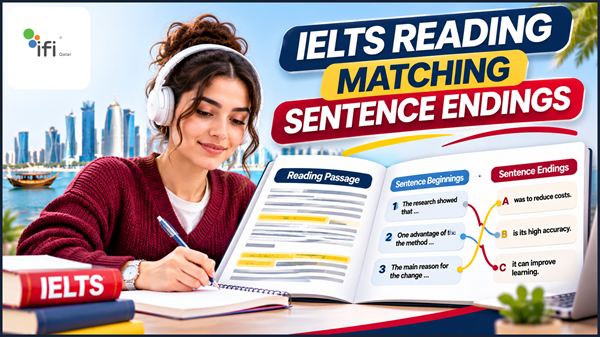
IELTS Reading matching sentence endings questions require more than finding familiar words in a passage. You are given several incomplete sentences and a list of possible endings. Your task is to identify which ending best completes each sentence according to the information in the reading text.
Although the format may look simple, this question type can be challenging because several options may appear grammatically correct or contain words related to the passage. The difficulty is choosing the ending that matches the writer’s actual meaning, not just one that sounds logical.
To answer these questions accurately, you need to understand sentence structure, recognise paraphrasing, locate relevant information and distinguish between similar options.
In this guide, you will learn the rules of IELTS matching sentence endings, discover a practical step-by-step strategy, explore common mistakes and complete an original practice exercise with answers and explanations.
What Are IELTS Matching Sentence Endings Questions?
IELTS matching sentence endings is a Reading question type in which you receive a list of incomplete sentences and a separate list of possible endings.
You must match each sentence beginning with the correct ending based on the information in the reading passage.
For example:
Sentence beginning:
Researchers discovered that regular physical activity…
Possible endings:
A. can improve several aspects of mental well-being.
B. is becoming less popular among young adults.
C. requires expensive equipment and professional supervision.
The correct answer depends on what the passage says about physical activity. Even if more than one ending sounds reasonable in general, only one should accurately complete the sentence according to the text.
What Does This Question Type Test?
Matching sentence endings mainly assesses your ability to understand the meaning of information presented in a reading passage.
It tests several related skills:
- Understanding the main ideas within a sentence.
- Identifying relevant information in a passage.
- Recognising synonyms and paraphrased expressions.
- Understanding relationships between ideas.
- Interpreting cause-and-effect relationships.
- Recognising grammatical connections between sentence parts.
- Distinguishing relevant information from misleading options.
You should focus on both meaning and grammar. A sentence may be grammatically correct but still be the wrong answer if it does not reflect the passage.
Are Matching Sentence Endings Included in IELTS Academic and General Training?
Yes. Matching sentence endings is a recognised question type in IELTS Reading preparation for both Academic and General Training candidates.
The reading texts differ between the two test versions, but the central task is the same: select the ending that accurately completes each sentence according to the information in the passage.
Rules of IELTS Matching Sentence Endings
Before learning how to answer these questions, it is important to understand their basic rules.
1. You Are Given More Endings Than Sentence Beginnings
One important feature is that the list of possible endings contains more options than the number of incomplete sentences.
For example, you might receive five sentence beginnings and seven possible endings.
This means some options will remain unused.
Do not assume that every ending must be selected.
2. Each Sentence Must Be Completed According to the Passage
Your answer must be supported by the reading text.
An ending may be factually correct in real life or logically reasonable, but that does not make it the correct IELTS answer.
Always use the information in the passage rather than your personal knowledge or assumptions.
3. Sentence Beginnings Follow the Order of Information in the Passage
The incomplete sentences are presented in the same order as the relevant information appears in the reading passage.
This is an important advantage because it helps you locate answers more efficiently.
For example, if you find the information supporting Question 1 near the beginning of the relevant section, the information for Question 2 should appear later in the passage.
However, do not assume that the answers will always be in consecutive sentences or paragraphs.
4. Grammar Must Match the Sentence Structure
The selected ending must create a grammatically correct sentence.
For example:
Beginning: The main advantage of the new system is…
Possible ending: that it reduces the amount of time required.
The sentence is grammatically complete and natural.
However, grammar alone is not enough. You must also confirm that the passage supports the statement.
5. Some Options Are Designed to Distract You
Incorrect endings may include words or ideas that appear in the passage but do not complete the sentence correctly.
These options are designed to test whether you understand the meaning of the information rather than simply recognise familiar vocabulary.
This is why careful reading is essential.
How to Answer IELTS Matching Sentence Endings Step by Step
A clear strategy can make this question type easier to manage, especially when you are working under the 60-minute IELTS Reading time limit.
Follow these steps to improve your accuracy.
Step 1: Read the Sentence Beginnings First
Start by reading all the incomplete sentences before examining the passage in detail.
Your goal is to understand what each sentence is discussing.
For example:
- The research team decided to change its approach because…
- The new technology became popular among businesses after…
- One unexpected result of the experiment was…
These beginnings indicate that you should look for:
- A reason for changing an approach.
- An event that occurred before a technology became popular.
- An unexpected finding from an experiment.
Understanding these relationships helps you search for the right information.
Step 2: Underline the Keywords
Identify words that can help you locate relevant information in the passage.
Useful keywords may include:
- Names of researchers.
- Dates and numbers.
- Technical terms.
- Specific events.
- Important nouns.
- Distinctive concepts.
For example:
“The research team decided to change its approach because…”
Possible keywords include:
- Research team.
- Change its approach.
- Because.
However, remember that the passage may use different words to express the same idea.
The word “because” could be paraphrased as “due to”, “as a result of” or “following the discovery that”.
Step 3: Read the Possible Sentence Endings
Now examine the list of endings.
Try to understand the meaning of each option rather than memorising individual words.
You can also eliminate options that are clearly incompatible with the sentence beginning.
For example:
Beginning: The main purpose of the programme was…
Ending A: to provide additional training for new employees.
Ending B: because the company had reduced its annual budget.
Ending C: while the results were being analysed.
Ending A is grammatically and logically compatible with the beginning. However, you must still check whether it matches the passage.
Step 4: Predict the Type of Information You Need
Before scanning the passage, think about the relationship required to complete each sentence.
For example:
| Sentence Beginning | Information to Look For |
|---|---|
| The main reason for the decision was… | A cause or explanation |
| The researchers discovered that… | A finding or result |
| The project became successful after… | An event or change |
| The biggest disadvantage was… | A limitation or problem |
| The study was conducted to… | A purpose or objective |
This makes it easier to identify the relevant part of the passage.
Step 5: Scan the Passage for Relevant Information
Use your keywords to locate the section that discusses the topic.
You do not need to read every sentence in detail from the beginning.
Instead, scan for names, dates, distinctive terms and related ideas.
For example, if a sentence beginning refers to a research project, look for the paragraph discussing that project.
Once you find a likely match, read the surrounding sentences carefully.
Do not choose an answer based on one familiar word.
Step 6: Look for Synonyms and Paraphrasing
The IELTS Reading test frequently presents information using different vocabulary from the questions.
For example:
| Sentence Beginning | Possible Wording in the Passage |
|---|---|
| The research was carried out… | The study was conducted… |
| The method became popular… | The approach gained widespread acceptance… |
| The results were unexpected… | The findings were surprising… |
| The main reason was… | The primary explanation was… |
| The number increased… | The figure rose… |
| The process became faster… | The procedure was completed in less time… |
If you only search for exact keyword matches, you may miss the correct information.
Focus on meaning rather than identical wording.
Step 7: Match the Ending and Check the Grammar
After locating the relevant information, compare the possible endings.
Ask yourself:
- Does this ending accurately represent the passage?
- Does it complete the sentence grammatically?
- Does it express the same relationship as the original information?
- Does it introduce an idea that the passage does not support?
- Is another ending more accurate?
The correct option should satisfy both meaning and grammar.
Step 8: Eliminate Used Options and Review Your Answers
After selecting an ending, mark it as used so that you can focus on the remaining choices.
Then review the completed sentences.
Check whether each sentence:
- Makes grammatical sense.
- Reflects the information in the passage.
- Uses the correct relationship between ideas.
- Avoids unsupported assumptions.
Do not change an answer simply because another option contains more familiar vocabulary. Change it only when you find stronger evidence.
How to Recognise Distractors in IELTS Matching Sentence Endings
Distractors are incorrect options designed to look attractive.
Understanding how they work can help you avoid losing marks.
1. Options That Repeat Words from the Passage
An incorrect ending may contain exactly the same keywords as the relevant paragraph.
For example, the passage might discuss a new technology and its development costs.
An option mentioning development costs may look correct, but the sentence beginning may actually ask about the technology’s main benefit.
The presence of familiar vocabulary does not guarantee a correct match.
How to avoid this mistake: Read the complete sentence and check whether the relationship between the two ideas is accurate.
2. Options That Are Grammatically Correct but Factually Wrong
Some endings fit the sentence structure perfectly but contradict the passage.
For example:
Beginning: The researchers concluded that…
Ending A: the method was suitable for all age groups.
Ending B: the method was effective only for younger participants.
Both endings may be grammatically correct.
Only the passage can tell you which statement is supported.
How to avoid this mistake: Separate grammar checking from evidence checking. Both are necessary.
3. Options That Describe Related but Different Information
A passage may discuss several aspects of the same topic.
For example, a paragraph about renewable energy might mention:
- Installation costs.
- Environmental benefits.
- Maintenance requirements.
- Government incentives.
An ending about installation costs may appear relevant, but the sentence beginning might specifically ask about the environmental advantages.
How to avoid this mistake: Identify exactly what the sentence beginning asks you to complete.
4. Options That Reverse Cause and Effect
IELTS questions may test whether you understand the relationship between two events.
For example:
- The company introduced a new system because productivity had fallen.
- Productivity improved after the company introduced a new system.
These statements describe different relationships.
Confusing a cause with a result can lead to an incorrect answer.
How to avoid this mistake: Pay attention to expressions such as because, therefore, as a result, following and due to.
5. Options That Include Unsupported Details
An ending may contain a statement that sounds reasonable but adds information that is not mentioned in the passage.
For example, the text may say that a new programme improved employee performance.
An option might claim that it improved performance by reducing working hours.
Unless the passage supports that specific explanation, the option should not be selected.
How to avoid this mistake: Do not add information based on your assumptions or general knowledge.
Useful Grammar Skills for Matching Sentence Endings
Grammar is an important part of this question type because you need to connect two parts of a sentence accurately.
However, grammar should support your understanding of the passage rather than replace it.
Subject and Verb Agreement
Check that the subject and verb agree.
For example:
- The results indicate…
- The result indicates…
A mismatch between singular and plural forms may help you eliminate an option.
Verb Patterns
Some verbs require particular structures.
For example:
- Decide to do something.
- Succeed in doing something.
- Prevent someone from doing something.
- Allow someone to do something.
Understanding these patterns can help you recognise grammatically incompatible endings.
Connectors and Logical Relationships
Pay attention to words that express relationships between ideas.
| Relationship | Useful Expressions |
|---|---|
| Cause | Because, due to, since |
| Result | Therefore, consequently, as a result |
| Contrast | However, whereas, although |
| Purpose | In order to, so that, with the aim of |
| Addition | Furthermore, moreover, in addition |
| Time | Before, after, once, during |
Recognising these relationships helps you understand how the sentence should be completed.
Relative Clauses
Some endings begin with relative pronouns such as who, which or that.
For example:
“The organisation introduced a system which…”
The correct ending must connect naturally with the relative clause.
Practise recognising these structures so you can eliminate options that do not fit grammatically.
Common Mistakes in IELTS Matching Sentence Endings
Even candidates with a good level of English can lose marks because of avoidable mistakes.
1. Choosing an Answer Before Reading the Passage
Predicting an ending can be useful, but selecting it without checking the text is risky.
Better approach: Use grammar and context to narrow down your choices, then confirm the answer using evidence from the passage.
2. Looking Only for Exact Keywords
The passage may use synonyms or completely different expressions.
Better approach: Develop your paraphrasing skills and focus on the meaning of the sentence.
3. Ignoring the Order of Information
Some candidates search randomly through the entire passage for every answer.
Better approach: Use the fact that the sentence beginnings follow the order of the relevant information in the passage. This can help you move through the text more efficiently.
4. Choosing an Option Because It Sounds Logical
An option may make perfect sense in everyday life but still be incorrect according to the passage.
Better approach: Make every decision based on textual evidence.
5. Ignoring Grammatical Structure
An ending may contain relevant information but fail to complete the sentence correctly.
Better approach: Read the completed sentence from beginning to end and check the grammatical connection.
6. Spending Too Much Time on One Question
Trying to understand every word in a paragraph can waste valuable time.
Better approach: Locate the relevant section first, read it carefully and make a decision based on the available evidence. If you are uncertain, move on and return later.
7. Forgetting to Check Unused Options
Candidates sometimes assume that every ending must be used.
Better approach: Remember that there are more possible endings than sentence beginnings. Leave the unnecessary options unused.
IELTS Matching Sentence Endings Practice Exercise
Now that you understand the rules and strategies, try the following original practice exercise.
Read the passage carefully and complete the five sentences by choosing the correct endings from A–G.
There are two extra options that you do not need to use.
Reading Passage: The Changing Role of Urban Gardens
Urban gardens have become increasingly common in cities around the world. These spaces can take different forms, including community allotments, rooftop gardens and small areas of vegetation developed between residential buildings.
One reason for their growing popularity is the limited availability of green space in densely populated neighbourhoods. In some cities, residents have transformed unused land into shared gardens where they can grow vegetables and spend time outdoors. Local authorities have also supported certain projects by making vacant public land available to community groups.
Beyond food production, urban gardens can provide environmental benefits. Plants help create shade and can reduce the temperature of surrounding areas during hot weather. Some gardens also attract insects and birds, creating small habitats within heavily developed urban environments. However, the extent of these benefits depends on the size, location and management of each garden.
Urban gardening can also strengthen relationships between residents. Community projects often bring together people from different age groups and cultural backgrounds. Participants may share gardening knowledge, exchange produce and organise local activities. Researchers studying several community projects found that regular participation was associated with stronger social connections among residents.
Despite these advantages, maintaining an urban garden is not always easy. Some projects experience difficulties because volunteers have limited time, while others struggle to secure a reliable supply of water. Access to suitable land can also be a challenge, particularly in areas where property values are high.
To improve the long-term success of these projects, some organisations have introduced training sessions for volunteers. These programmes cover practical topics such as soil preparation, water management and seasonal planting. Rather than simply providing equipment, organisers aim to help participants develop the skills needed to manage the gardens independently.
Questions 1–5
Complete the sentences by choosing the correct ending, A–G.
1. Urban gardens have become more popular partly because…
2. Local authorities have supported some gardening projects by…
3. The environmental benefits of urban gardens depend on…
4. Participation in community gardening projects has been associated with…
5. Training programmes have been introduced to help volunteers…
Possible Sentence Endings
A. developing stronger relationships with other residents.
B. providing community groups with access to unused public land.
C. the location, size and management of the gardens.
D. reducing the cost of purchasing vegetables in every neighbourhood.
E. the shortage of green spaces in densely populated areas.
F. managing gardening projects more independently.
G. replacing the need for professional landscape designers.
Answers and Explanations
Question 1: E — the shortage of green spaces in densely populated areas.
The first paragraph explains that urban gardens are becoming popular partly because green space is limited in densely populated neighbourhoods.
The phrase “limited availability of green space” is paraphrased as “the shortage of green spaces”.
Question 2: B — providing community groups with access to unused public land.
The passage states that local authorities have made vacant public land available to community groups.
The phrase “making vacant public land available” expresses the same idea as providing access to unused public land.
Question 3: C — the location, size and management of the gardens.
The second paragraph explains that environmental benefits depend on the size, location and management of each garden.
The wording in the correct ending closely follows this information.
Question 4: A — developing stronger relationships with other residents.
The third paragraph states that researchers found regular participation was associated with stronger social connections among residents.
“Stronger social connections” is paraphrased as “developing stronger relationships”.
Question 5: F — managing gardening projects more independently.
The final paragraph explains that training programmes help participants develop the skills needed to manage gardens independently.
The correct ending summarises this purpose.
Why Are the Other Options Incorrect?
D — reducing the cost of purchasing vegetables in every neighbourhood.
The passage mentions growing vegetables, but it does not claim that urban gardens reduce food costs in every neighbourhood.
G — replacing the need for professional landscape designers.
The passage discusses training volunteers, but it does not mention replacing professional designers.
These options may sound related to urban gardening, but they are not supported by the text.
How to Improve Your IELTS Matching Sentence Endings Score
Understanding the question format is only the first step. Consistent practice is necessary to improve your speed, accuracy and confidence.
1. Practise Paraphrasing Every Day
Choose a short paragraph and identify expressions that communicate similar meanings.
For example:
- Increased rapidly = rose significantly.
- A major problem = a serious difficulty.
- A lack of resources = insufficient supplies.
- Became widely accepted = gained general recognition.
This will help you recognise the relationship between question wording and passage wording.
2. Improve Your Scanning Skills
Practise locating names, dates, technical terms and distinctive expressions in reading passages.
Start with shorter texts and gradually move towards longer IELTS-style passages.
Remember that scanning helps you locate information, while careful reading helps you confirm its meaning.
3. Study Sentence Structure
Review common grammatical patterns, including:
- Subject–verb agreement.
- Verb patterns.
- Relative clauses.
- Conditional structures.
- Cause-and-effect connectors.
- Conjunctions.
These structures can help you eliminate grammatically incompatible options.
4. Review Every Incorrect Answer
Do not simply check the answer key and move on.
For each mistake, identify the reason:
- Did you miss a synonym?
- Did you misunderstand the passage?
- Did you choose an option based on familiar keywords?
- Did you confuse cause and effect?
- Did you overlook the grammatical structure?
- Did you select an answer without enough textual evidence?
Understanding why an answer is incorrect is one of the most useful ways to improve.
5. Practise Under Realistic Time Conditions
Once you understand the strategy, complete matching sentence endings exercises under timed conditions.
This helps you develop the ability to:
- Analyse sentence beginnings quickly.
- Recognise relevant keywords.
- Locate information efficiently.
- Compare possible endings.
- Avoid spending too long on difficult questions.
Do not focus only on speed. Accuracy should come first, followed by gradually improving your response time.
How IELTS Reading Mock Tests Can Help You Prepare
Practising individual question types is useful, but it does not fully prepare you for the demands of the complete IELTS Reading test.
In the actual examination, you need to manage different question formats, understand unfamiliar topics and maintain concentration throughout the test.
A structured IELTS Reading mock test can help you evaluate your performance under realistic conditions.
It can show you:
- How accurately you answer matching sentence endings questions.
- Whether you recognise paraphrased information.
- How effectively you manage reading time.
- Which question types cause the most difficulty.
- Whether you lose marks because of misunderstanding or poor time management.
- How your performance changes across different passages.
After completing a mock test, review your incorrect answers carefully.
For example, if you frequently choose sentence endings because they contain familiar words rather than matching the passage meaning, your next preparation session should focus on paraphrasing and contextual understanding.
A mock test is most valuable when you use its results to guide your next stage of preparation rather than simply recording an estimated band score.
Frequently Asked Questions About IELTS Matching Sentence Endings
What are matching sentence endings in IELTS Reading?
Matching sentence endings is an IELTS Reading question type in which candidates complete incomplete sentences by selecting the correct endings from a list. Answers must match the information in the reading passage.
How do you answer IELTS matching sentence endings questions?
Read the sentence beginnings, identify keywords, examine the possible endings, scan the passage for relevant information and confirm each answer using meaning and grammar. Always check that your chosen ending is supported by the text.
Are there more sentence endings than questions in IELTS Reading?
Yes. Matching sentence endings questions provide more possible endings than incomplete sentences. Some options will remain unused.
Do matching sentence endings questions follow the order of the passage?
Yes. The sentence beginnings are presented in the same order as the relevant information in the reading passage. This can help you locate answers more efficiently.
Can I choose an answer based only on grammar?
No. Grammar can help eliminate unsuitable options, but the correct ending must also reflect the information in the passage. A grammatically correct sentence may still be factually incorrect.
Do I need to read the whole passage before answering matching sentence endings?
Not necessarily. You can begin by reading the sentence beginnings and identifying keywords. Then scan the passage for relevant information and read the surrounding section carefully to confirm your choices.
What is the biggest challenge in matching sentence endings questions?
One of the biggest challenges is recognising paraphrasing and distinguishing between options that contain similar information. Candidates often select an answer because it repeats familiar words without checking whether it expresses the correct meaning.
Are matching sentence endings included in IELTS General Training?
Yes. Matching sentence endings is a recognised IELTS Reading question type. However, Academic and General Training Reading use different types of texts.
How many matching sentence endings questions are in IELTS Reading?
There is no fixed number. The number of questions varies between test versions and practice materials.
How can I improve my accuracy in matching sentence endings?
Practise identifying keywords, recognising synonyms, understanding sentence structure and locating supporting evidence in the passage. Reviewing incorrect answers and completing timed Reading mock tests can also help.
Should I eliminate used sentence endings?
Yes. Marking selected options as used can make it easier to focus on the remaining possibilities and avoid accidentally choosing the same ending again.
Can a sentence ending be logically correct but still be wrong?
Yes. An option may sound reasonable in general but still be incorrect if the passage does not support it. Always base your answer on the text rather than personal knowledge or assumptions.
Improve Your IELTS Reading Skills with IFI Qatar
IELTS matching sentence endings questions test your ability to understand relationships between ideas, recognise paraphrasing and select information accurately.
The most effective approach is to combine careful reading with a structured strategy. Start by analysing the sentence beginnings, identify useful keywords, locate the relevant information and confirm each answer using both meaning and grammar.
However, practising one question type is not enough to prepare for the complete IELTS Reading examination. You also need to manage different question formats and complete all three passages within the available time.
At IFI Qatar, candidates can enquire about IELTS Reading mock tests to practise under realistic conditions, review their performance and identify areas that need further improvement.
Want to know how well you perform in IELTS Reading? Contact IFI Qatar to enquire about available Reading mock tests and take a more structured approach to your preparation.
Build your reading accuracy, improve your timing and approach your IELTS examination with greater confidence.