

Currently Empty: ر.ق 0,00


IELTS
How to Know When You Are Ready to Book Your IELTS Exam
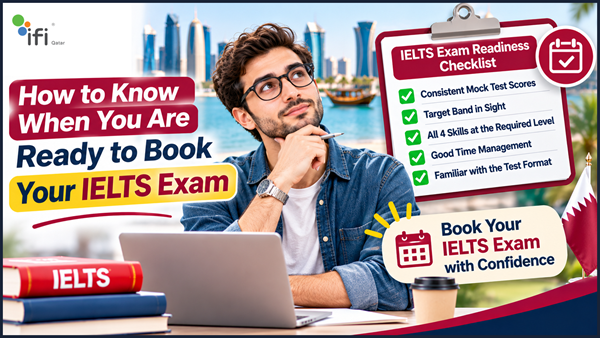
Preparing for IELTS takes time, practice and consistent effort. But how do you know when your preparation is actually complete? Should you book your test as soon as you achieve your target score in a mock test, or should you wait until your performance becomes more consistent?
Booking too early can mean paying for an exam before you are sufficiently prepared. Waiting too long, on the other hand, can delay your university application, immigration process or professional plans.
The best time to book IELTS is when you have a realistic understanding of your current English level, can complete the test under timed conditions and are consistently performing close to the score you need.
However, readiness is about more than one practice result. You should also consider your performance in all four skills, your ability to manage exam time, your understanding of the test format and the specific requirements of your application.
This guide explains how to know whether you are ready to take the IELTS test, which signs to look for, how to use mock test results and what to check before confirming your exam booking.
What Does It Mean to Be Ready to Take the IELTS Test?
Being ready to take IELTS means having a sufficiently developed level of English and the practical skills needed to demonstrate that ability under official test conditions.
It does not mean that you must answer every question correctly or achieve a perfect result in every practice test.
Instead, readiness means that you can:
- Understand the IELTS test format and instructions.
- Complete each section within the allocated time.
- Perform consistently across Listening, Reading, Writing and Speaking.
- Work towards the overall and individual band scores required for your application.
- Recognise your weaknesses and manage them effectively.
- Complete a realistic mock test without major time-management problems.
- Understand what to expect on test day.
Your readiness should be measured against your own target score, not someone else’s preparation timeline.
For example, a candidate who needs an overall 6.0 may be ready earlier than someone aiming for 7.5 or higher. Their preparation requirements and the level of accuracy expected from their English skills will be different.
The most important question is not whether you feel ready in general, but whether your current performance is realistically aligned with the IELTS score you need.
10 Signs You Are Ready to Book Your IELTS Exam
There is no single indicator that guarantees success in IELTS. However, the following signs can help you make a more informed booking decision.
1. You Know Exactly What IELTS Score You Need
Before booking IELTS, you should understand the score requirements of your intended university, employer, professional organisation or immigration route.
Find out:
- The minimum overall IELTS band score.
- Whether individual component scores are required.
- Whether IELTS Academic or General Training is needed.
- Whether a specific test format is accepted.
- Whether there are additional validity or submission conditions.
For example, an institution might require an overall score of 6.5 with no individual component below 6.0.
A candidate who achieves an overall 7.0 but receives 5.5 in Writing may still fail to meet this requirement.
This is why your target should include both the overall score and any minimum skill requirements.
2. Your Mock Test Results Are Consistent
One of the strongest signs of exam readiness is consistent performance across several realistic practice tests.
A single high score may not accurately represent your current ability. You might have received familiar questions, benefited from favourable conditions or performed particularly well in one section.
Instead, complete multiple mock tests and compare the results.
For example:
| Mock Test | Listening | Reading | Writing | Speaking |
|---|---|---|---|---|
| Test 1 | 6.5 | 6.0 | 5.5 | 6.0 |
| Test 2 | 7.0 | 6.5 | 6.0 | 6.0 |
| Test 3 | 7.0 | 6.5 | 6.0 | 6.5 |
This candidate is showing a relatively stable performance, with some improvement across the practice sessions.
However, the results still need to be compared with the required target. If the institution requires 6.5 in every skill, the candidate is not yet meeting all the conditions.
The purpose of tracking mock results is to identify patterns rather than celebrate one unusually high score.
3. You Can Complete the Test Within the Time Limit
Knowing the answers is not enough if you cannot complete the test within the available time.
IELTS requires candidates to demonstrate their language skills under timed conditions.
For example:
- Reading requires you to manage several texts and questions within the allocated time.
- Writing requires you to complete two tasks while maintaining accuracy and organisation.
- Listening requires you to follow recordings and respond to questions as the test progresses.
- Speaking requires you to communicate naturally and develop your answers during the interview.
If you regularly leave questions unanswered because you run out of time, you may need more practice before booking.
Try completing full-length mock tests under realistic timing conditions.
If you can manage the sections without rushing excessively or leaving large portions incomplete, this is a positive sign.
4. You Understand the IELTS Test Format
Exam familiarity can reduce unnecessary stress and help you focus on demonstrating your English ability.
You should know:
- How many sections are included.
- What types of questions may appear.
- How the test is structured.
- How the answers must be recorded or submitted.
- How much time is available.
- What instructions you must follow.
For example, IELTS Reading includes different question types, such as matching headings, multiple choice, True/False/Not Given and sentence completion.
Similarly, IELTS Writing Academic includes Task 1 and Task 2, while General Training Writing Task 1 requires a letter.
If you still feel confused about the test structure, spend more time reviewing official practice materials before booking.
5. Your Writing Performance Is at the Required Level
Writing is often one of the most challenging sections for candidates because it requires more than correct grammar and vocabulary.
Your responses need to meet the official assessment criteria.
For IELTS Writing, these include:
- Task Achievement for Task 1.
- Task Response for Task 2.
- Coherence and Cohesion.
- Lexical Resource.
- Grammatical Range and Accuracy.
Task 2 carries more weight than Task 1 in the overall Writing score.
You should be able to:
- Understand the question and address its requirements.
- Organise your ideas logically.
- Develop and support your arguments.
- Use vocabulary accurately and appropriately.
- Construct a range of grammatical structures.
- Complete both tasks within the available time.
If you can write complete responses consistently and receive feedback showing that your performance is close to your target, you may be approaching exam readiness.
If your Writing score is based only on self-assessment, consider getting your work evaluated against the IELTS criteria.
6. Your Speaking Performance Is Stable
Feeling nervous before an IELTS Speaking test is normal. You do not need to speak perfectly or without hesitation to achieve a good score.
However, you should be able to communicate your ideas clearly and develop your answers without depending heavily on memorised scripts.
The official IELTS Speaking assessment uses four criteria:
- Fluency and Coherence.
- Lexical Resource.
- Grammatical Range and Accuracy.
- Pronunciation.
Before booking, practise speaking about familiar and unfamiliar topics.
You should be comfortable:
- Answering Part 1 questions naturally.
- Speaking for the required time in Part 2.
- Developing and explaining ideas in Part 3.
- Using vocabulary appropriate to the topic.
- Recovering when you make a mistake.
- Maintaining understandable pronunciation.
Recording your practice sessions can help you identify hesitation, repetition, unclear pronunciation and grammatical weaknesses.
7. You Know Your Weaknesses and Have Addressed the Main Ones
Being ready does not mean having no weaknesses.
Even strong IELTS candidates make mistakes. What matters is whether your weaknesses are understood and whether they are likely to prevent you from achieving your target score.
For example:
| IELTS Skill | Possible Weakness | What to Check Before Booking |
|---|---|---|
| Listening | Missing answers due to distractors | Can you identify paraphrasing and follow the recording? |
| Reading | Running out of time | Can you complete all passages within the time limit? |
| Writing | Weak task development | Can you address every part of the question clearly? |
| Speaking | Frequent hesitation | Can you develop relevant answers naturally? |
If one skill remains significantly below your target, it may be worth addressing it before booking.
You do not need to eliminate every small mistake, but you should understand the weaknesses that could affect your result.
8. You Can Perform Well Without Depending on Memorised Answers
Memorised responses may appear useful during preparation, but relying on them can create problems when the actual questions are different from what you expected.
IELTS assesses your ability to use English appropriately in different situations.
For example, in Speaking, memorised answers may sound unnatural or fail to address the examiner’s actual question.
In Writing, memorised essays may not respond accurately to the task.
A candidate approaching exam readiness should be able to:
- Understand unfamiliar questions.
- Organise ideas independently.
- Use vocabulary naturally.
- Adapt answers to different topics.
- Explain opinions without relying on prepared scripts.
Your preparation should build flexible language skills rather than encourage you to memorise complete responses.
9. You Have Completed at Least One Realistic Full Mock Test
Practising individual IELTS sections is useful, but it does not always show whether you can manage the complete examination.
A full mock test helps you understand how your performance changes when you have to complete several sections in one sitting.
It can reveal:
- Concentration problems.
- Time-management weaknesses.
- Fatigue during longer sections.
- Difficulty switching between tasks.
- Unexpected weaknesses in individual skills.
A full mock test should follow the relevant test format and timing as closely as possible.
After completing it, review the result carefully rather than focusing only on the overall estimated band.
10. You Have a Clear Booking and Application Timeline
Your preparation should be connected to a realistic deadline.
For example, you may need IELTS for:
- A university admission deadline.
- A scholarship application.
- An immigration process.
- Professional registration.
- An employment opportunity.
Before booking, check how much time you need to receive your result and complete any remaining application steps.
Also allow enough time for a possible retake if your result does not meet the required score.
If your mock results are already aligned with your target and your application deadline is approaching, delaying the booking indefinitely may not be helpful.
How Many Mock Tests Should You Take Before Booking IELTS?
There is no official number of mock tests that guarantees exam readiness.
Some candidates may become familiar with the test format quickly, while others need more practice to achieve consistent performance.
The quality of your practice is more important than simply completing a large number of tests.
A useful approach is to:
- Complete an initial mock test to identify your current level.
- Review your results and identify weaknesses.
- Follow a focused preparation plan.
- Complete another realistic mock test.
- Compare your performance with the previous result.
- Repeat the process until your results are sufficiently consistent with your target.
For example, a candidate preparing for an overall 6.5 may initially achieve 5.5 in Reading and 6.0 in Listening. After targeted preparation, their results may improve to 6.5 and 7.0.
This improvement is encouraging, but Writing and Speaking must also be assessed before making a final decision.
Do not book simply because you have completed five, ten or fifteen practice tests. Book when your performance indicates that you are reasonably prepared for the required standard.
What Is a Good Mock Test Score Before Booking IELTS?
A good mock test score depends on the result you need for your application.
There is no universal mock test band that means every candidate is ready to take IELTS.
Consider these illustrative examples:
| Required Overall IELTS Score | Example Mock Test Performance | Readiness Consideration |
|---|---|---|
| 6.0 | Overall results around 6.0–6.5 | Check whether every required component meets its minimum |
| 6.5 | Overall results around 6.5–7.0 | Review individual skills and consistency |
| 7.0 | Overall results around 7.0–7.5 | Check whether performance is stable across all four skills |
| 7.5 | Overall results around 7.5–8.0 | Pay close attention to weaker components and assessment accuracy |
These ranges are illustrative preparation examples, not official IELTS booking thresholds or guarantees.
A mock test is also an estimate, not an official result.
Listening and Reading practice tests can provide a useful indication of performance through correct answers. Writing and Speaking require more careful evaluation because they are assessed using specific performance criteria.
If your application requires a minimum score in every skill, do not rely only on your overall mock test result.
How to Assess Your Readiness in Each IELTS Skill
A useful readiness assessment should examine Listening, Reading, Writing and Speaking separately.
IELTS Listening Readiness
You may be approaching readiness if you can:
- Follow conversations and monologues without losing track.
- Recognise paraphrased information.
- Identify distractors.
- Understand different accents.
- Follow instructions and word limits.
- Complete the required answers accurately.
Pay particular attention to recurring mistakes.
If you repeatedly lose marks because of spelling, singular and plural forms or missed information, work on these issues before booking.
IELTS Reading Readiness
You should be able to:
- Identify the main ideas in passages.
- Locate specific information efficiently.
- Understand paraphrasing.
- Distinguish between True, False and Not Given.
- Handle matching and multiple-choice questions.
- Manage the time available for all passages.
If you understand the texts but regularly fail to finish the test, focus on reading strategies and time management.
IELTS Writing Readiness
Your Writing preparation should demonstrate that you can:
- Understand the requirements of each task.
- Produce a relevant and well-organised response.
- Develop ideas with sufficient explanation.
- Use appropriate vocabulary.
- Control grammar and sentence structure.
- Complete both tasks within the time limit.
For Writing, an assessment by someone familiar with the IELTS band descriptors can be particularly useful.
IELTS Speaking Readiness
You should be able to:
- Answer questions directly.
- Extend your responses with relevant details.
- Speak about familiar and unfamiliar topics.
- Maintain a natural flow.
- Use a suitable range of vocabulary.
- Pronounce words clearly enough to communicate your meaning.
You do not need to eliminate every hesitation. Focus on communicating clearly and developing your answers appropriately.
When Should You Delay Booking Your IELTS Exam?
Sometimes the most sensible decision is to continue preparing rather than book immediately.
Consider delaying your exam if:
Your Mock Test Results Are Highly Inconsistent
If your results change significantly between practice sessions, you may not yet have a reliable understanding of your current level.
For example, achieving 7.0 in one Reading test and 5.5 in another may indicate inconsistent performance, differences in test difficulty or problems with your preparation approach.
Review the reasons before making a booking decision.
One or More Skills Are Below Your Required Minimum
If your university requires at least 6.0 in every component and your Writing performance remains around 5.0, you should consider whether more focused preparation is necessary.
A strong Listening or Reading result does not automatically compensate for a component that fails to meet a separate minimum.
You Have Not Practised Under Timed Conditions
Completing exercises without time limits can help you learn, but it does not show how you will perform in the actual examination.
If you regularly need extra time to complete Reading passages or Writing tasks, practise under realistic conditions before booking.
You Do Not Understand the Test Format
If you are still unfamiliar with question types, instructions or test procedures, you may lose marks because of avoidable mistakes.
Review the official test format and complete practice questions before deciding.
You Have Not Received Reliable Writing and Speaking Feedback
Self-assessment can be useful, but it may not identify all the weaknesses affecting your performance.
If you are unsure whether your Writing or Speaking meets your target band, seek a structured assessment before committing to the exam.
When Is the Best Time to Book IELTS?
The best time to book IELTS is when your preparation, target score and application timeline are aligned.
You should ideally have:
- A clear understanding of your required IELTS score.
- Consistent practice results close to your target.
- Evidence that all four skills are sufficiently developed.
- Experience completing full mock tests under timed conditions.
- A realistic understanding of your remaining weaknesses.
- Enough time to receive and use your official result.
You should also check the availability of test dates at your preferred location.
If you need IELTS for a university or immigration deadline, work backwards from that date.
Allow time for result processing, document submission and a possible retake if needed.
Do not leave booking until the final moment, particularly when your application has a fixed deadline.
IELTS Exam Readiness Checklist
Use this checklist to review your preparation before booking.
| Readiness Check | Yes / No |
|---|---|
| I know the exact IELTS score required for my application. | |
| I know whether I need Academic or General Training. | |
| I understand the overall and individual band requirements. | |
| I have completed realistic mock tests. | |
| My mock results are reasonably consistent. | |
| I can complete Listening within the required time. | |
| I can complete Reading within the required time. | |
| I can write both tasks within the available time. | |
| My Writing has been reviewed against IELTS criteria. | |
| I can speak naturally and develop my answers. | |
| I understand my main weaknesses. | |
| I know the test date and result timeline I need. | |
| I have checked the registration and identification requirements. |
If you answer “No” to several important questions, you may benefit from additional preparation or a mock test assessment.
If you can answer “Yes” to most of them, you may be approaching the right time to book.
This checklist is a practical self-assessment tool, not an official IELTS eligibility test.
Why an IELTS Mock Test Assessment Can Help Before Booking
A mock test is useful because it gives you an opportunity to experience the test format and evaluate your current performance before taking the official examination.
However, the value of a mock test depends on how accurately it reflects the real test and how effectively your results are reviewed.
A structured assessment can help you understand:
- Your estimated performance in each skill.
- Whether your results are close to your target.
- Which question types cause the most difficulty.
- Whether you manage time effectively.
- Which weaknesses require further preparation.
- Whether booking now is a reasonable decision.
For Writing and Speaking, feedback is particularly important because the quality of your response must be evaluated against the IELTS assessment criteria.
For Writing, the official criteria include Task Achievement or Task Response, Coherence and Cohesion, Lexical Resource, and Grammatical Range and Accuracy.
For Speaking, examiners assess Fluency and Coherence, Lexical Resource, Grammatical Range and Accuracy, and Pronunciation.
A structured assessment helps turn practice results into a practical preparation plan.
What to Check Before Confirming Your IELTS Booking in Qatar
If you are planning to take IELTS in Qatar, there are a few additional details to confirm before completing your registration.
Choose the Correct IELTS Test Type
Make sure you select the test required for your application.
Check whether you need:
- IELTS Academic.
- IELTS General Training.
- IELTS for UKVI.
- Another specifically approved test.
Do not choose a test type based only on general advice from friends or online discussions.
Check Available Test Dates
Choose a date that gives you enough time to prepare and receive your result before your application deadline.
Check the current availability through the relevant official booking channel or test centre.
Confirm the Current Test Delivery Format
IELTS announced in March 2026 that it would move away from paper-based testing from mid-2026, with exact implementation timelines varying by market. Test delivery arrangements can therefore differ by location and booking period.
Before booking in Qatar, check the current format available at your chosen test centre.
Prepare the Correct Identification Document
Your identification details must match the requirements of your test registration.
IELTS advises candidates to bring the same identification document used when booking. If you bring the wrong document or forget it, you may not be allowed to take the test.
Check the current instructions from your test centre before the examination.
Review Registration and Payment Conditions
Before confirming your booking, review:
- Available test dates.
- Registration deadlines.
- Payment requirements.
- Cancellation and transfer conditions.
- Identification requirements.
- Result delivery arrangements.
These details can vary by provider and location, so always confirm the latest information before making payment.
Frequently Asked Questions About IELTS Exam Readiness
How do I know if I am ready to take the IELTS test?
You are likely approaching readiness when your mock test results are reasonably consistent, your performance is close to the required score, you can complete the test under timed conditions and you understand your weaknesses in all four skills.
How many mock tests should I take before booking IELTS?
There is no official number. Instead of focusing on how many mock tests you complete, pay attention to the consistency and quality of your results. Several realistic practice tests can help you identify whether your performance is stable.
Should I book IELTS as soon as I achieve my target band in a mock test?
Not necessarily. One mock test may not accurately represent your ability. Compare results from multiple practice sessions and check whether your individual skill scores meet the requirements of your intended application.
What is a good mock test score before the real IELTS exam?
A good score depends on your target. If you need an overall 6.5, practice results around that level may indicate progress, but you must also consider individual component requirements and the reliability of the mock test assessment.
Can I be ready for IELTS if one skill is weaker than the others?
Yes, but it depends on your required score. If your application has minimum requirements for individual components, a weaker skill below that threshold may prevent you from meeting the conditions even if your overall score is sufficient.
Is one full IELTS mock test enough to determine readiness?
One full mock test can provide a useful starting point, but it is not always enough to establish consistent performance. Comparing multiple tests and reviewing mistakes gives you a more reliable picture.
How long should I prepare for IELTS before booking?
There is no fixed preparation period. It depends on your current English level, target band, familiarity with the test and available study time. Some candidates need only a short period of focused preparation, while others require several months.
Can a mock test guarantee my official IELTS score?
No. A mock test provides an estimate of your current performance, not a guaranteed official result. The actual examination may contain different questions and testing conditions.
Should I take IELTS if I still feel nervous?
Feeling nervous does not necessarily mean you are unprepared. Many candidates experience exam anxiety. If your performance is consistent and you understand the test format, some nervousness should not automatically prevent you from booking.
When should I book IELTS if I need it for university admission?
Work backwards from your application deadline. Allow enough time for the test, result processing and document submission. If possible, also leave room for another attempt if your first result does not meet the university’s requirements.
Is IELTS Academic or General Training better for me?
Neither is universally better. IELTS Academic is commonly used for higher education and certain professional purposes, while General Training is used for other work, migration and training purposes. Your intended institution or authority determines which test is acceptable.
Where can I take an IELTS mock test in Qatar before booking the official exam?
Candidates in Qatar can enquire about IELTS preparation and mock test services at IFI Qatar. A structured mock test can help you review your current performance, identify weaknesses and make a more informed decision about booking.
Ready to Book Your IELTS Exam? Make Your Next Step Count
Booking IELTS at the right time can make your preparation more focused and help you plan around important application deadlines.
Before confirming your test date, make sure you understand your target score, have practised under realistic conditions and can perform consistently across Listening, Reading, Writing and Speaking.
If you are close to your target but unsure whether your preparation is sufficient, a structured mock test or skill assessment can help you make a more informed decision.
At IFI Qatar, candidates can enquire about IELTS mock tests and assessment services to understand their current performance and identify any remaining preparation needs.
Already achieving your target in practice tests? Contact IFI Qatar to discuss your IELTS test booking and take the next step towards your exam.
Prepare with a clear goal, choose the right test date and approach your IELTS examination with confidence.