

Currently Empty: ر.ق 0,00


IELTS
How to Read English News Articles and Understand the Main Ideas
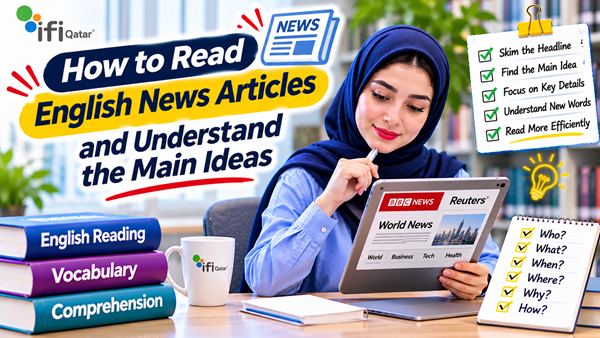
Reading English news articles is a practical way to improve your language skills while learning about current events, society, technology, business and the world around you.
However, reading the news in a second language can be challenging. You may understand individual words but struggle to follow the complete story. Some articles contain unfamiliar expressions, long sentences, formal vocabulary and details that make it difficult to identify the main message.
The good news is that you do not need to understand every word to understand a news article.
By learning how to recognise the main idea, identify important details and use context to understand unfamiliar vocabulary, you can become a more confident and efficient reader.
This guide explains how to read English news articles step by step. You will learn practical reading strategies, discover useful news vocabulary, practise identifying main ideas and explore ways to improve your English through regular news reading.
Why Should You Read English News Articles to Improve Your English?
English news articles provide authentic language examples that help you understand how English is used to communicate real information.
Unlike many textbook exercises, news articles introduce you to language used in journalism, public communication and everyday discussions.
Here are some important benefits.
1. Improve Your Reading Comprehension
News articles help you practise understanding information presented in different sentence structures and writing styles.
As you read regularly, you become better at identifying:
- Main ideas.
- Supporting details.
- Important facts.
- Causes and effects.
- Different opinions.
- Conclusions and implications.
These skills are useful not only for reading the news but also for understanding emails, reports, articles and other English texts.
2. Expand Your Everyday English Vocabulary
News articles introduce words and expressions related to subjects such as:
- Politics and government.
- Business and economics.
- Health and education.
- Science and technology.
- Environment and climate.
- International relations.
- Culture and society.
For example, when reading an article about the economy, you may encounter words such as inflation, investment, revenue and economic growth.
Learning these words in context helps you understand their meanings and how they are used in real communication.
3. Understand Different Writing Styles
News articles are not all written in the same way.
A business report may contain financial terminology, while a lifestyle article may use more conversational language.
Reading different types of news helps you become familiar with various vocabulary choices, sentence structures and communication styles.
4. Develop Critical Reading Skills
Understanding a news article involves more than recognising its words.
You should also consider:
- What information is being presented?
- Who is providing the information?
- What evidence supports the claims?
- Which details are facts and which are opinions?
- What is the author’s main message?
These questions encourage you to read actively rather than simply move your eyes across the text.
5. Build Confidence in Understanding English Without Translation
When you read regularly, you gradually become more comfortable understanding information directly in English.
You learn to recognise familiar expressions, understand vocabulary through context and follow the logical structure of paragraphs.
This can reduce your dependence on translating every sentence into your native language.
How to Read English News Articles: 8 Effective Strategies
Reading news articles efficiently requires a different approach from reading a novel or studying a grammar textbook.
You should focus on understanding the important information first and examine smaller details when necessary.
The following strategies can help you develop this habit.
1. Read the Headline Before the Full Article
The headline usually communicates the main topic or most important development in a news story.
Before reading the complete article, examine the headline and ask yourself:
- What is the news about?
- Who or what is involved?
- What might have happened?
- Is the headline describing a problem, announcement or development?
For example:
Headline:
“New Technology Helps Schools Improve Online Learning”
Before reading the article, you can identify several important points:
- Topic: Education and technology.
- Main subject: Schools.
- Development: New technology.
- Possible result: Improved online learning.
You do not need to know every word in the headline to predict the general subject.
Practical tip: Try to explain the headline in one simple English sentence before moving to the article.
2. Use Skimming to Understand the General Meaning
Skimming means reading quickly to understand the overall topic and structure of a text.
Instead of examining every sentence, focus on the parts that communicate the most important information.
When skimming a news article, pay attention to:
- The headline.
- The first paragraph.
- Subheadings.
- The first sentence of each major paragraph.
- The final paragraph.
The opening paragraph of a news report often provides the central information, while the following paragraphs explain the background and supporting details.
For example, imagine an article about a new public transport project.
By skimming, you may discover that:
- A new transport system has been announced.
- The project aims to improve city travel.
- Construction is expected to take place in several stages.
- Officials have explained its expected benefits.
You can understand the general story without reading every sentence carefully.
3. Use Scanning to Find Specific Information
Scanning means searching for particular details without reading the complete article.
This technique is useful when you want to find information such as:
- Dates.
- Names.
- Locations.
- Prices.
- Statistics.
- Organisations.
- Specific events.
For example, if an article discusses a business announcement and you want to know when it happened, scan the text for dates and time expressions.
You do not need to read every paragraph again.
Remember the difference:
| Reading Technique | Purpose | Example |
|---|---|---|
| Skimming | Understand the general topic | Find out what the news story is about |
| Scanning | Locate specific information | Find the date, location or amount mentioned |
| Intensive Reading | Understand details carefully | Examine an important paragraph or explanation |
| Extensive Reading | Read regularly for general understanding | Read different English news articles for practice |
Knowing when to use each technique makes your reading more efficient.
4. Identify the 5 Ws and 1 H
A useful method for understanding news articles is to identify the five Ws and one H:
- Who?
- What?
- When?
- Where?
- Why?
- How?
These questions help you organise the most important information in a news story.
Consider this hypothetical news report:
“City officials announced a new recycling programme on Monday. The programme will begin in September and will encourage households to separate plastic, paper and glass waste. According to the announcement, the initiative aims to reduce landfill waste and improve environmental awareness.”
You can identify the information as follows:
| Question | Answer |
|---|---|
| Who? | City officials |
| What? | A new recycling programme |
| When? | Announced on Monday; starts in September |
| Where? | In the city |
| Why? | To reduce landfill waste and improve environmental awareness |
| How? | By encouraging households to separate recyclable materials |
This method is especially useful for learners who struggle to understand the structure of news stories.
5. Find the Main Idea of Each Paragraph
A news article usually contains several paragraphs, each presenting a particular part of the story.
Some paragraphs explain the main event, while others provide background information, statistics, expert opinions or additional details.
To identify the main idea, ask yourself:
“What is the most important message in this paragraph?”
Consider this example:
“Several local businesses have started using renewable energy to reduce their operating costs. Solar panels have become increasingly popular because they allow companies to generate electricity on their own premises. Business owners also believe that renewable energy can support their long-term environmental goals.”
The main idea is:
Local businesses are increasingly adopting renewable energy for financial and environmental reasons.
The remaining sentences explain the reasons behind this development.
Try to summarise each paragraph in one sentence. This exercise can significantly improve your reading comprehension.
6. Do Not Stop at Every Unfamiliar Word
One of the most common mistakes English learners make is stopping whenever they encounter an unfamiliar word.
This interrupts reading and makes it difficult to understand the overall message.
Instead, try to guess the meaning from the surrounding information.
For example:
“The company announced a substantial increase in its annual revenue following strong international sales.”
Even if you do not know the word substantial, the sentence suggests that the company’s revenue increased significantly.
Use the following process:
- Read the complete sentence.
- Examine the words before and after the unfamiliar expression.
- Identify the general topic.
- Guess the possible meaning.
- Check a dictionary if the word is important.
You should look up unfamiliar words when they are essential to understanding the story, appear repeatedly or are useful for your vocabulary development.
7. Separate Facts from Opinions
News articles may contain factual information, expert comments, official statements and personal opinions.
Learning to distinguish these elements is an important part of reading comprehension.
Example of a fact:
“The new library opened on 12 March.”
This statement provides a specific event and date that can potentially be verified.
Example of an opinion:
“The new library is the most impressive public building in the city.”
This statement expresses an evaluation rather than an objective fact.
Pay attention to expressions that introduce opinions or reported claims:
- According to…
- Experts believe…
- Critics argue…
- Supporters claim…
- Officials stated…
- Researchers suggest…
These expressions help you understand who is presenting an idea and whether the article is reporting a fact, an interpretation or a claim.
8. Summarise the Article in Your Own Words
After reading an article, close it and explain the main story using your own English.
You can use this simple structure:
- The article is about…
- The main development is…
- The report explains that…
- One important detail is…
- The overall message is…
For example:
“The article is about a new recycling programme introduced by city officials. The programme encourages households to separate recyclable materials. Its main purpose is to reduce waste and improve environmental awareness.”
You do not need to reproduce the original article.
The purpose is to demonstrate that you understood its central message.
How to Understand the Main Idea of an English News Article
Identifying the main idea is one of the most important reading skills.
The main idea explains what the text is primarily about. Supporting details provide additional information, evidence and examples.
Main Idea vs Supporting Details
Consider this hypothetical paragraph:
“Online shopping has become increasingly popular in recent years. Many consumers prefer buying products online because it saves time and provides access to a wider range of choices. Digital payment systems and home delivery services have also made online shopping more convenient.”
Main idea:
Online shopping has become increasingly popular because of its convenience.
Supporting details:
- Consumers can save time.
- Online stores offer more product choices.
- Digital payment systems make transactions easier.
- Home delivery services improve convenience.
The main idea communicates the central message, while the supporting details explain why it is important.
Where Can You Find the Main Idea?
The main idea may appear in different parts of a news article.
| Location | What to Look For |
|---|---|
| Headline | The central news topic |
| First paragraph | The most important development |
| First sentence of a paragraph | The paragraph’s central point |
| Repeated information | Ideas emphasised throughout the article |
| Final paragraph | Summary or broader implications |
Do not assume that the first sentence always contains the complete main idea. Some articles develop their central argument across several paragraphs.
Three Questions to Check Your Understanding
After reading a news article, answer these questions:
- What is the article mainly about?
- What is the most important information the writer wants readers to understand?
- Which details support or explain that information?
If you can answer these questions clearly, you have probably understood the article’s central message.
Common News Vocabulary Every English Learner Should Know
News articles frequently use vocabulary that appears across different topics.
Learning these expressions can help you understand a wider range of stories.
General News Vocabulary
| Word or Expression | Meaning |
|---|---|
| Announcement | A public statement about something |
| Development | A new event or change |
| Report | An account of information or events |
| Issue | A subject or problem being discussed |
| Impact | An effect or influence |
| Decision | A choice made after consideration |
| Statement | Something formally said or written |
| Response | A reaction to an event or situation |
| Concern | A feeling of worry about something |
| Investigation | A detailed examination of an issue |
Business and Economy Vocabulary
| Word or Expression | Meaning |
|---|---|
| Revenue | Money earned by a business |
| Investment | Money or resources put into something for future benefit |
| Inflation | A general increase in prices |
| Profit | Money remaining after costs are deducted |
| Market | An environment where products or services are bought and sold |
| Consumer | A person who buys or uses products |
| Employment | The condition of having paid work |
| Economic growth | An increase in economic activity or output |
Politics and Society Vocabulary
| Word or Expression | Meaning |
|---|---|
| Government | The group or system responsible for governing a country |
| Policy | An official plan or course of action |
| Election | A process in which people vote to choose representatives |
| Public | Relating to people in general |
| Community | A group of people living in or connected to an area |
| Regulation | An official rule |
| Authority | An organisation or person with official power |
| Agreement | A shared decision or arrangement |
Science and Technology Vocabulary
| Word or Expression | Meaning |
|---|---|
| Innovation | A new idea, method or product |
| Research | The systematic study of a subject |
| Technology | The use of scientific knowledge for practical purposes |
| Data | Facts or information used for analysis |
| Discovery | Something newly found or learned |
| Artificial intelligence | Technology that performs tasks associated with human intelligence |
| Digital | Related to computer-based technology |
| Application | A practical use of something or a software programme |
Learn Vocabulary Through Context
Memorising definitions is useful, but understanding how words appear in real sentences is even more important.
For example:
“Rising inflation has affected household spending.”
The word inflation appears in a sentence about prices and household expenses.
You can record the word together with its example sentence rather than learning it in isolation.
This helps you remember both the meaning and its typical usage.
How to Read Different Types of English News Articles
Different news categories use different vocabulary and writing styles.
If you want to improve your general English reading skills, practise with a variety of article types.
1. Breaking News
Breaking news reports describe recent or developing events.
They often use:
- Short, direct sentences.
- Specific dates and locations.
- Reported statements.
- Time-related expressions.
When reading breaking news, focus on what happened, who was involved and what information has been confirmed.
Be aware that early reports can change as more information becomes available.
2. Business News
Business articles discuss companies, markets, employment, investment and economic developments.
You may encounter financial terminology and numerical information.
Focus on understanding:
- Which company or market is involved.
- What has changed.
- How the development affects customers or businesses.
- What the financial figures represent.
3. Technology News
Technology articles often introduce new products, research findings and digital developments.
Look for the problem being addressed, the technology being discussed and its possible applications.
Technical terms may require additional research, especially when the subject is unfamiliar.
4. Health and Science News
Health and science reports frequently explain research, medical developments and scientific findings.
Pay attention to the difference between:
- Established evidence.
- Preliminary findings.
- Research limitations.
- Expert interpretations.
- Future possibilities.
For example, a report saying that a study “suggests a possible benefit” should not be understood as proof that the benefit is guaranteed.
5. Lifestyle and Culture News
Lifestyle and culture articles often use more descriptive and conversational expressions.
They can be useful for learning everyday vocabulary, understanding opinions and recognising language used to describe experiences, habits and social trends.
Reading different categories helps you develop a broader vocabulary and become more comfortable with different English writing styles.
A Simple 7-Day Plan to Practise Reading English News
You do not need to spend hours reading the news every day.
A consistent 15–20-minute routine can help you develop better reading habits.
Use this seven-day plan to get started.
| Day | Activity | Skill to Practise |
|---|---|---|
| Day 1 | Read three headlines and predict their topics | Understanding headlines |
| Day 2 | Read one short article using skimming | Identifying general meaning |
| Day 3 | Find five specific details in an article | Scanning |
| Day 4 | Identify the main idea of each paragraph | Reading comprehension |
| Day 5 | Learn 10 useful words from a news article | Vocabulary development |
| Day 6 | Separate facts from opinions in an article | Critical reading |
| Day 7 | Write a short summary of an article in your own words | Understanding and summarising |
How to Make Your Daily Practice More Effective
Follow these recommendations:
- Choose articles that match your English level.
- Start with familiar subjects.
- Avoid looking up every unfamiliar word.
- Keep a vocabulary notebook.
- Summarise articles in simple English.
- Gradually read more challenging texts.
- Review previously learned vocabulary.
The objective is to build a sustainable reading habit rather than complete as many articles as possible.
Practical Exercise: Understand the Main Idea of a News Article
The following practice passage is designed to help you apply the reading strategies discussed in this guide.
Practice News Article
New Community Library Opens to Support Local Education
“A new community library has opened in the city to provide residents with greater access to educational resources. The facility includes reading areas, digital learning equipment and spaces for educational workshops.
Local officials explained that the project aims to encourage reading among young people and support lifelong learning. The library will also organise activities for students, families and other community members.
Residents will be able to access books, educational materials and selected digital resources. The initiative is expected to create additional opportunities for people who want to develop their knowledge and skills.”
Exercise 1: Identify the Main Idea
What is the passage mainly about?
A. The history of public libraries.
B. The opening of a new community library and its educational purpose.
C. The development of digital learning equipment.
D. The importance of reading among university students.
Correct answer: B.
The passage focuses on a new library and explains how it aims to support education and community learning.
Exercise 2: Find the Supporting Details
Which facilities are available in the new library?
Possible answers:
- Reading areas.
- Digital learning equipment.
- Spaces for educational workshops.
Exercise 3: Answer the 5 Ws and 1 H
- Who is involved? Local officials and community residents.
- What happened? A new community library opened.
- Where? In the city.
- Why? To improve access to educational resources and encourage learning.
- How? Through books, digital resources and educational activities.
- When? The passage does not provide a specific opening date.
Notice that not every question can be answered from the passage. Good reading comprehension also means recognising when information is missing.
Exercise 4: Write a Short Summary
Try summarising the article in two sentences.
Example answer:
“A new community library has opened to provide residents with access to books, digital resources and educational activities. The project aims to encourage reading and create more opportunities for lifelong learning.”
This exercise helps you practise identifying important information and expressing it clearly in English.
Common Mistakes to Avoid When Reading English News
Even learners with a good vocabulary can struggle with news articles if they use ineffective reading habits.
| Mistake | Why It Is a Problem | Better Approach |
|---|---|---|
| Translating every sentence | Slows down reading and interrupts comprehension | Understand the general meaning first |
| Looking up every unfamiliar word | Makes reading unnecessarily time-consuming | Use context before checking a dictionary |
| Reading without a purpose | Makes it difficult to identify relevant information | Decide what you want to learn before reading |
| Ignoring headlines | Misses an important clue about the article | Predict the topic from the headline |
| Focusing only on vocabulary | Can distract from the overall message | Identify the main idea and supporting details |
| Reading only one type of news | Limits exposure to different vocabulary | Explore several news categories |
| Copying entire paragraphs as notes | Does not encourage independent understanding | Write short summaries in your own words |
| Assuming every reported claim is a fact | Can lead to misunderstanding | Identify the source and nature of each claim |
Frequently Asked Questions About Reading English News Articles
How can I read English news articles more easily?
Start with short articles on familiar topics. Read the headline, skim the opening paragraph and identify the main idea. Use context to understand unfamiliar words instead of translating every sentence.
What is the best way to understand the main idea of a news article?
Focus on the headline, opening paragraph and key information repeated throughout the article. Ask yourself what happened, who was involved and why the story matters. Then explain the main message in one or two sentences.
Should I look up every unfamiliar word when reading English news?
No. Try to understand unfamiliar words through context first. Use a dictionary when a word is essential to understanding the article, appears frequently or is particularly useful for your vocabulary development.
What is the difference between skimming and scanning in news reading?
Skimming helps you understand the general topic and structure of an article. Scanning helps you find specific details, such as names, dates, statistics and locations.
Is reading English news good for improving vocabulary?
Yes. News articles introduce vocabulary from different areas of everyday life, business, technology, health and society. Learning words in context can help you understand their meanings and usage more effectively.
How long should I read English news every day?
For most learners, 15–20 minutes of focused daily reading is a practical starting point. You can gradually increase your reading time as your comprehension and confidence improve.
Should beginners read English news articles?
Yes, but beginners should start with short and relatively simple articles. They can also use graded news materials designed for English learners before moving to more complex reports.
How can I remember what I read in an English news article?
Write down the main idea, record a few important details and summarise the article in your own words. Reviewing your notes and vocabulary later can also improve retention.
Can reading English news improve my speaking skills?
Yes, indirectly. News reading introduces useful vocabulary, expressions and information that you can use when discussing different subjects. Combining reading with speaking practice helps you use this language more actively.
What should I do if I understand the words but not the complete article?
Focus on sentence relationships and paragraph structure. Look for connecting words, identify the main subject and action in each sentence, and summarise each paragraph separately. Understanding how ideas connect is just as important as knowing individual words.
Improve Your English Reading Skills with IFI Qatar
Reading English news articles is a valuable way to develop your vocabulary, improve comprehension and become more familiar with real-world English.
However, becoming a confident reader also requires a strong foundation in grammar, vocabulary and general language comprehension.
At IFI Qatar, learners can develop their English through structured General English learning opportunities, with language levels ranging from A1 to C1.
Improving your general English skills can help you:
- Understand written English more confidently.
- Recognise common vocabulary and expressions.
- Follow longer sentences and paragraphs.
- Improve reading comprehension.
- Communicate more effectively in everyday situations.
- Develop the language foundation needed for further academic or professional learning.
Whether you are starting to learn English or working towards a higher level, consistent practice and appropriate instruction can help you make progress.
Ready to improve your English?
Explore General English courses at IFI Qatar and take the next step towards understanding, reading and communicating in English with greater confidence.