

Currently Empty: ر.ق 0,00


IELTS
How to Read Academic Articles in English More Efficiently
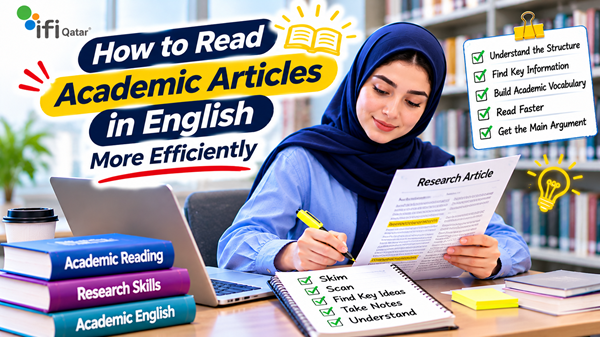
Reading academic articles in English can be challenging, especially when you are studying at university, preparing for an international degree or working with research papers. Academic texts often contain unfamiliar vocabulary, complex sentence structures and detailed explanations that require more concentration than everyday English.
Many students try to understand every sentence before moving to the next paragraph. Although this approach may seem logical, it can make reading unnecessarily slow and exhausting. You might spend several minutes analysing one difficult sentence and still struggle to identify the article’s main argument.
The solution is not simply to read faster. It is to develop a more effective reading strategy.
Learning how to read academic articles in English involves understanding the structure of academic texts, identifying important information, recognising key arguments and using reading techniques that match your purpose.
In this guide, you will discover practical strategies to improve your academic reading speed, understand complex texts more confidently and develop the English skills needed for university-level study.
Why Is Reading Academic Articles in English Difficult?
Academic articles are different from everyday English materials. They are written to communicate research, explain theories, analyse evidence and present arguments.
As a result, they often require a more focused approach to reading.
Understanding the most common difficulties can help you identify which skills you need to improve.
1. Unfamiliar Academic Vocabulary
Academic articles frequently contain formal expressions, technical terminology and words that are less common in everyday conversations.
For example, you might encounter expressions such as:
- Significant findings
- Theoretical framework
- Empirical evidence
- Research methodology
- Statistical analysis
- Correlation
- Implications
- Limitations
Looking up every unfamiliar word can interrupt your reading and make it difficult to follow the overall argument.
Instead, learn to recognise which words are essential for understanding the article and which ones can be understood through context.
2. Complex Sentence Structures
Academic writers often use long sentences containing several clauses, technical expressions and detailed explanations.
For example:
“Although previous studies have identified a relationship between student motivation and academic achievement, further research is required to determine how different learning environments influence this relationship.”
A student who reads this sentence word by word may find it difficult to understand.
A more effective approach is to identify its main structure:
- Previous studies found a relationship.
- The relationship involves motivation and academic achievement.
- More research is needed.
- The research should examine different learning environments.
Breaking complex sentences into smaller ideas makes them easier to understand.
3. Long and Detailed Articles
Research articles may contain several sections, including an abstract, introduction, literature review, methodology, results, discussion and conclusion.
Reading every section with the same level of attention is not always necessary.
For example, if you only need to understand the author’s main argument, the abstract, introduction and conclusion may provide a useful starting point.
4. Difficulty Identifying Important Information
Academic articles include different types of information:
- Main arguments
- Supporting evidence
- Research findings
- Examples
- Background information
- Limitations
- Recommendations
Not every sentence is equally important.
Efficient academic reading requires you to distinguish between the central message and supporting details.
5. Translating Every Sentence into Your Native Language
Some English learners translate each sentence before moving forward.
Although translation can sometimes help clarify difficult passages, relying on it continuously may slow down reading and make it harder to develop direct comprehension in English.
Try to understand the overall meaning of a paragraph before translating individual expressions.
How to Read Academic Articles in English: 10 Effective Strategies
You do not need to understand every word to read an academic article successfully. Instead, use a structured process that helps you find the most relevant information.
The following strategies can make academic reading more manageable and productive.
1. Start by Understanding Your Reading Purpose
Before opening an academic article, ask yourself why you are reading it.
Your purpose determines how carefully you need to examine different sections.
For example:
| Reading Purpose | What to Focus On |
|---|---|
| Understanding the main topic | Title, abstract and introduction |
| Finding a specific argument | Relevant headings and body paragraphs |
| Reviewing research findings | Results and discussion |
| Preparing an assignment | Main arguments, evidence and limitations |
| Comparing different studies | Research questions, methods and conclusions |
| Learning new vocabulary | Repeated academic expressions and technical terms |
If you are preparing a university assignment, identify the question you need to answer before reading.
This prevents you from spending time on information that is unrelated to your task.
2. Read the Title and Abstract First
The title and abstract provide an overview of the research.
The title identifies the subject, while the abstract usually summarises the research purpose, methodology, major findings and conclusions.
For example, consider this hypothetical research title:
The Impact of Online Learning on University Students’ Academic Performance
Before reading the complete article, you can already identify:
- Main topic: Online learning.
- Target group: University students.
- Main issue: Academic performance.
The abstract may then explain what the researchers investigated and what they discovered.
Practical tip: After reading the abstract, write a one-sentence explanation of what you expect the article to discuss. This gives you a clear direction before moving to the full text.
3. Use Skimming to Understand the Main Idea
Skimming means reading a text quickly to understand its general topic and structure.
You do not need to examine every sentence. Instead, focus on information that reveals the article’s overall message.
When skimming an academic article, look at:
- The title.
- The abstract.
- Section headings.
- The first paragraph.
- The first sentence of relevant paragraphs.
- The conclusion.
For example, if an article contains headings such as “Benefits of Online Learning”, “Student Engagement” and “Challenges of Digital Education”, you can quickly understand its main areas of discussion.
Skimming is particularly useful when you have several articles to review and need to decide which ones are relevant.
4. Use Scanning to Find Specific Information
Scanning is different from skimming.
While skimming helps you understand the general topic, scanning helps you locate specific information without reading every sentence.
You might scan an article to find:
- A particular statistic.
- A researcher’s name.
- A specific date.
- A definition.
- A key term.
- A research finding.
For example, if you want to find information about the number of participants in a study, look for numerical figures or expressions such as “participants”, “sample size” or “respondents”.
You do not need to read the entire article again to locate one detail.
5. Understand the Structure of Academic Articles
Recognising the structure of a research article makes it easier to understand where important information is located.
Many academic research papers follow a structure commonly known as IMRaD:
| Section | Main Purpose | What You Should Look For |
|---|---|---|
| Introduction | Explains the research topic and purpose | Research question and background |
| Methods | Describes how the research was conducted | Participants, procedures and data collection |
| Results | Presents the research findings | Main outcomes and statistical results |
| Discussion | Interprets the findings | Meaning, implications and limitations |
Some articles also include a literature review, theoretical framework, recommendations and conclusion.
Understanding these sections helps you read more strategically.
For example, if you want to know how researchers collected their data, focus on the Methods section rather than reading every section in detail.
6. Identify the Main Argument in Each Paragraph
A paragraph usually develops one central idea supported by explanations, examples or evidence.
Finding this central idea can make academic reading much easier.
A useful technique is to ask:
- What is this paragraph mainly about?
- What point is the author trying to communicate?
- Which sentences provide supporting evidence?
- How does this paragraph connect to the previous one?
Consider the following example:
“Regular physical activity has been associated with several health benefits. Research suggests that consistent exercise can support cardiovascular health, improve sleep quality and contribute to psychological well-being. These benefits may vary depending on an individual’s age, activity level and general health.”
The main idea is that regular physical activity is associated with several health benefits.
The remaining sentences provide supporting details and qualifications.
After reading each paragraph, try to explain its main message in one sentence.
7. Learn to Read Complex Sentences in Smaller Parts
Long academic sentences can become easier when you identify their main clause and supporting information.
Consider this example:
“Students who participate in collaborative learning activities, particularly those involving discussion and problem-solving, may develop stronger communication skills.”
Instead of reading the entire sentence as one unit, divide it into parts:
- Main subject: Students.
- Main action: May develop stronger communication skills.
- Additional information: Students participate in collaborative learning activities.
- Examples: Discussion and problem-solving.
The central message becomes much clearer.
You can also pay attention to connecting expressions:
| Expression | Function |
|---|---|
| Although | Introduces contrast |
| Because | Explains a reason |
| Therefore | Introduces a result |
| However | Presents an opposing idea |
| Furthermore | Adds information |
| Whereas | Compares two ideas |
| Despite | Introduces contrast |
| Consequently | Shows a consequence |
Recognising these expressions helps you understand the logical relationships between ideas.
8. Use Context to Understand Unfamiliar Vocabulary
You do not need to look up every unfamiliar word.
Sometimes, the surrounding sentence provides enough information to understand its meaning.
For example:
“The researchers observed a significant decline in attendance after the introduction of the new timetable.”
Even if you do not know the word “decline”, the phrase “in attendance after the introduction of the new timetable” may help you understand that attendance decreased.
When you encounter an unfamiliar word:
- Read the complete sentence.
- Examine the surrounding information.
- Identify the word’s grammatical function.
- Guess its possible meaning.
- Check a dictionary if the word is important to understanding the passage.
This approach helps you maintain reading flow while developing vocabulary skills.
9. Take Short and Organised Reading Notes
Taking notes can help you remember important information and prepare for assignments.
However, copying entire paragraphs into your notebook is not an efficient strategy.
Instead, record the most relevant information.
A simple academic reading note might include:
| Note Category | Information to Record |
|---|---|
| Article topic | Online learning and student performance |
| Main argument | Digital learning offers flexibility |
| Supporting evidence | Findings from the research |
| Limitations | Challenges related to student engagement |
| Conclusion | The importance of effective teaching methods |
| New vocabulary | Engagement, flexibility, accessibility |
You can also use abbreviations, short phrases and keywords.
The purpose of reading notes is to help you remember and organise ideas, not reproduce the entire article.
10. Review What You Have Read
After completing an article or section, spend a few minutes reviewing the information.
Ask yourself:
- What was the main purpose of the article?
- What were the author’s most important arguments?
- What evidence supported these arguments?
- What conclusions did the researchers reach?
- What questions remain unanswered?
Try to explain the article without looking at the original text.
If you can describe its main ideas clearly, you probably understood the most important information.
How to Read Different Sections of an Academic Article
Each section of an academic article has a different purpose. Knowing how to approach each one can save time and improve comprehension.
Reading the Abstract
The abstract is usually a short overview of the entire study.
Look for:
- Research topic.
- Research objective.
- Methodology.
- Main findings.
- Overall conclusion.
Do not assume that the abstract provides every detail. Use it to decide whether the article is relevant to your needs.
Reading the Introduction
The introduction explains the background and purpose of the research.
Focus on:
- The problem being investigated.
- Previous research.
- The research gap.
- The study’s objectives.
- Research questions or hypotheses.
A good understanding of the introduction helps you follow the rest of the article.
Reading the Literature Review
The literature review discusses existing research and theoretical perspectives related to the topic.
Look for:
- Important theories.
- Previous research findings.
- Similarities between studies.
- Differences in researchers’ opinions.
- Gaps in existing knowledge.
You do not necessarily need to remember every study mentioned. Focus on how the sources contribute to the author’s argument.
Reading the Methodology
The methodology explains how the research was conducted.
Depending on the study, you may find information about:
- Research design.
- Participants.
- Data collection.
- Research instruments.
- Data analysis.
Understanding the methodology helps you evaluate how the findings were produced.
Reading the Results
The Results section presents the findings.
Focus on:
- Main outcomes.
- Important statistics.
- Tables and figures.
- Patterns or relationships.
- Results connected to the research questions.
Do not assume that every statistical result is equally important.
Reading the Discussion and Conclusion
The Discussion section explains what the findings mean and how they relate to previous research.
The Conclusion usually summarises the most important points and may identify limitations or future research opportunities.
These sections are particularly useful when you need to understand the overall contribution of an article.
Academic Vocabulary That Helps You Read Research Papers
Academic vocabulary plays an important role in reading comprehension.
You do not need to memorise every technical word, but recognising frequently used academic expressions can make research articles easier to understand.
Here are some useful examples:
| Academic Word | Meaning in Context |
|---|---|
| Approach | A method or way of doing something |
| Assess | To evaluate or examine |
| Evidence | Information supporting a claim |
| Establish | To demonstrate or create something |
| Factor | An element that influences a situation |
| Indicate | To show or suggest |
| Interpret | To explain the meaning of information |
| Investigate | To examine a subject systematically |
| Outcome | A result or consequence |
| Relevant | Connected to a particular subject |
| Significant | Important or statistically meaningful, depending on context |
| Variable | A factor that can change or be measured |
| Implication | A possible effect or consequence |
| Limitation | A restriction or weakness |
| Hypothesis | A proposed explanation that can be tested |
Build a Personal Academic Vocabulary List
Instead of memorising long lists of unrelated words, organise vocabulary according to academic subjects or functions.
For example:
Research vocabulary:
- Methodology
- Sample
- Findings
- Evidence
- Data
Argument vocabulary:
- Claim
- Perspective
- Counterargument
- Interpretation
- Conclusion
Cause-and-effect vocabulary:
- Consequently
- Therefore
- Result in
- Contribute to
- Influence
Write an example sentence for each new word. Learning vocabulary in context makes it easier to recognise and use these expressions correctly.
Common Academic Reading Mistakes to Avoid
Some reading habits make academic articles more difficult than necessary.
Recognising these mistakes can help you develop a more efficient approach.
| Common Mistake | Why It Slows You Down | Better Approach |
|---|---|---|
| Reading every word with equal attention | Not all information is equally important | Adjust your reading speed to your purpose |
| Translating every sentence | Interrupts comprehension and reading flow | Use context to understand unfamiliar expressions |
| Looking up every new word | Creates unnecessary interruptions | Check only important or repeated vocabulary |
| Ignoring headings | Makes article structure harder to understand | Preview headings before reading |
| Skipping the abstract | Removes a useful overview | Read the abstract first |
| Highlighting entire paragraphs | Makes important information difficult to identify | Highlight only key ideas |
| Reading without a clear purpose | Encourages unnecessary reading | Identify your research question first |
| Failing to review | Makes information harder to remember | Summarise the main points after reading |
The goal is not to read every academic article as quickly as possible. It is to use your time effectively while maintaining an accurate understanding of the material.
A Practical 7-Day Plan to Improve Academic Reading Skills
If you want to become more confident when reading academic articles in English, consistent practice is essential.
The following seven-day plan can help you develop the most important reading skills.
| Day | Practice Activity | Main Skill |
|---|---|---|
| Day 1 | Read three academic article titles and abstracts | Identifying research topics |
| Day 2 | Practise skimming a short academic article | Understanding general meaning |
| Day 3 | Find specific facts, names and statistics in an article | Scanning |
| Day 4 | Identify the main idea of each paragraph | Reading comprehension |
| Day 5 | Collect and learn 10 academic vocabulary items | Vocabulary development |
| Day 6 | Read an article and create structured notes | Information organisation |
| Day 7 | Explain the article’s main argument without looking at the text | Retention and comprehension |
Daily Practice Recommendation
Spend approximately 20–30 minutes practising academic reading.
You can begin with shorter texts and gradually move towards longer research articles.
Choose subjects that interest you, such as education, technology, health, business or environmental studies.
As your comprehension improves, increase the complexity of the materials.
Practical Exercise: Test Your Academic Reading Skills
The following short passage can help you practise identifying main ideas and supporting information.
Practice Text
“Digital learning has become an increasingly important part of higher education. Online platforms allow students to access educational resources, attend virtual lectures and communicate with instructors from different locations. These opportunities can make education more flexible and accessible. However, successful online learning also requires effective time management, reliable internet access and sufficient student motivation. Without these factors, learners may find it difficult to maintain consistent academic progress.”
Exercise 1: Identify the Main Idea
What is the passage mainly about?
A. The history of university education.
B. The benefits and challenges of digital learning.
C. The importance of traditional classrooms.
D. The development of internet technology.
Correct answer: B. The passage discusses both the advantages and challenges of online education.
Exercise 2: Find the Supporting Details
Which three factors does the passage identify as important for successful online learning?
Answer:
- Effective time management.
- Reliable internet access.
- Sufficient student motivation.
Exercise 3: Explain the Conclusion
What might happen if students do not have the necessary conditions for successful online learning?
Example answer:
“They may struggle to maintain consistent academic progress.”
Exercise 4: Identify Academic Vocabulary
Find three academic expressions in the passage.
Possible answers include:
- Higher education.
- Educational resources.
- Academic progress.
This exercise develops several reading skills at the same time: identifying main ideas, locating supporting details and recognising academic vocabulary.
How Academic English Courses Can Improve Your Reading Skills
Reading academic articles efficiently requires more than knowing individual English words. You need to understand complex sentence structures, recognise relationships between ideas and interpret information accurately.
These abilities are part of Academic English.
Developing your Academic English skills can help you:
Improve Reading Comprehension: Understand complex academic texts and identify their central arguments.
Expand Academic Vocabulary: Recognise formal expressions and subject-related terminology.
Understand Grammar and Sentence Structures: Interpret longer sentences and follow complicated explanations.
Develop Critical Reading: Distinguish between evidence, opinions, assumptions and conclusions.
Improve Note-Taking: Organise important information without copying entire passages.
Strengthen Academic Communication: Use information from academic sources more confidently in discussions and assignments.
For students preparing for international university study, these skills can also support other academic activities, including essay writing, research preparation and seminar participation.
Frequently Asked Questions About Reading Academic Articles in English
How can I read academic articles in English faster?
Start by identifying your reading purpose. Read the title and abstract, skim the headings, and use scanning to locate specific information. Focus on important ideas rather than examining every sentence with equal attention.
Should I read an academic article from beginning to end?
Not always. Your reading approach should depend on your purpose. If you need a general understanding, begin with the abstract, introduction and conclusion. If you are reviewing research methodology or findings, focus more closely on the relevant sections.
How can I understand difficult academic vocabulary?
Use the surrounding sentences to understand unfamiliar words. Check a dictionary when a word is essential to the main argument or appears repeatedly. Keeping a personal academic vocabulary list can also improve your reading comprehension over time.
What is the difference between skimming and scanning?
Skimming means reading quickly to understand the general meaning and structure of a text. Scanning means searching for specific information, such as a statistic, name, definition or research finding.
Why are academic articles difficult to understand?
Academic articles often contain specialised vocabulary, complex grammar, long sentences and detailed explanations. Readers may also struggle to identify the main argument or distinguish important findings from supporting information.
How can I improve my academic reading comprehension?
Read academic texts regularly, practise identifying paragraph main ideas, learn common academic vocabulary and take organised notes. Reviewing what you have read can also help you retain important information.
Should I translate academic articles into my native language?
Translation can help when a passage is particularly difficult, but translating every sentence may slow down your reading. Try to understand the overall meaning in English first and use translation selectively when necessary.
How long should I spend reading an academic article?
There is no fixed reading time. It depends on the article’s length, complexity and your purpose. Skimming a paper for relevance may take only a few minutes, while analysing its methodology and findings requires more time.
What should I read first in a research paper?
Start with the title and abstract to understand the topic and research purpose. Then examine the introduction and conclusion. If the article is relevant to your task, read the sections that contain the information you need in greater detail.
Can an Academic English course help me understand research papers?
Yes. Academic English learning can help you develop reading comprehension, academic vocabulary, grammar awareness and the ability to interpret complex sentences. These skills can make university-level reading more manageable.
Develop Your Academic English Skills with IFI Qatar
Reading academic articles confidently is an important part of preparing for university study and working in an international academic environment.
When you understand how to identify main arguments, recognise important evidence and interpret complex English sentences, academic reading becomes more manageable and productive.
However, these abilities develop through consistent practice and a strong foundation in English.
At IFI Qatar, learners can strengthen their English language skills through structured learning opportunities designed to support communication and academic development.
Improving your Academic English can help you:
- Understand university-level reading materials.
- Develop a stronger academic vocabulary.
- Interpret complex grammar and sentence structures.
- Improve reading comprehension.
- Prepare for academic assignments and discussions.
- Become more confident using English in educational environments.
Ready to become a more confident English reader?
Explore English language learning opportunities at IFI Qatar and take the next step towards stronger academic communication skills.