

Currently Empty: ر.ق 0,00


IELTS
IELTS Reading Summary Completion: How to Choose the Correct Words
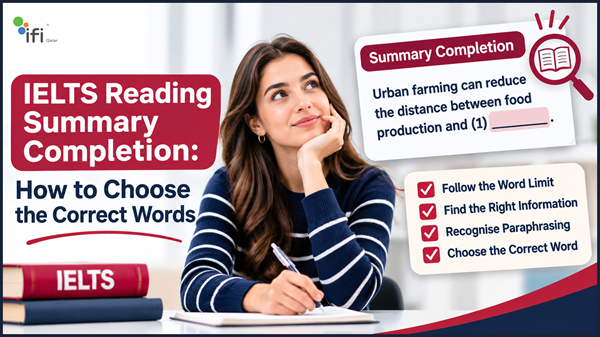
IELTS Reading Summary Completion questions can look straightforward at first. You are given a short summary with several missing words, and your task is to complete the gaps using information from a reading passage or a list of possible answers.
However, many candidates lose marks even when they understand the general meaning of the text. They may choose a word that looks relevant but does not fit grammatically, exceed the permitted word limit, overlook a paraphrased expression or select an answer that changes the meaning of the original information.
The challenge is not simply finding words in the passage. You need to understand the summary, identify the relevant information, recognise the relationship between ideas and choose words that fit both the meaning and grammar of each sentence.
In this guide, you will learn how IELTS Reading Summary Completion works, how to approach both versions of the task, how to identify the correct words and how to avoid common mistakes. You will also find practical examples and an original practice exercise with detailed answers.
What Is IELTS Reading Summary Completion?
IELTS Reading Summary Completion is a question type in which candidates complete an incomplete summary using information from a reading passage.
The summary represents the main ideas or important details from a particular section of the passage. Several words or phrases have been removed, leaving gaps that candidates must complete.
For example:
Passage:
The introduction of public libraries provided communities with greater access to educational materials. In addition to lending books, many libraries began offering free workshops and language classes. These services helped residents develop new skills and encouraged lifelong learning.
Summary:
Public libraries improved access to educational materials and began providing additional services, including free workshops and ______ classes. These activities supported skill development and encouraged ______ learning.
Possible answers:
- Language
- Lifelong
- Commercial
- Private
Correct answers:
- Language
- Lifelong
To answer correctly, you must understand the original passage and recognise which words complete the summary without changing its meaning.
What Skills Does Summary Completion Test?
This question type assesses several important Reading skills:
- Understanding the main ideas of a passage.
- Identifying specific details.
- Recognising synonyms and paraphrasing.
- Understanding relationships between sentences.
- Predicting the grammatical form of missing words.
- Locating relevant information efficiently.
- Following word-limit instructions accurately.
It is therefore important to develop both vocabulary knowledge and reading comprehension rather than relying only on keyword matching.
What Are the Two Types of IELTS Reading Summary Completion?
There are two main variations of Summary Completion questions. Understanding the difference is essential because each requires a slightly different approach.
1. Summary Completion Using Words From the Passage
In this version, you must find the correct words directly in the reading passage.
You are not given a list of possible answers. Instead, you need to locate the relevant information and copy the required word or words accurately.
Example:
Passage:
Many coastal communities depend on fishing as an important source of income. However, overfishing has reduced fish populations in several regions. To address this problem, governments have introduced stricter regulations and established protected marine areas.
Summary:
Many coastal communities rely on fishing for their ______. However, overfishing has reduced fish populations, encouraging governments to introduce stricter regulations and protected marine areas.
Instruction: NO MORE THAN TWO WORDS
Correct answer: income
The answer appears directly in the passage.
You should not replace it with a synonym such as earnings because the task requires words taken from the text.
2. Summary Completion Using a List of Words
In this version, you receive a list of possible words or phrases and must select the correct option for each gap.
The list may contain more options than you need, meaning some words will remain unused.
The options may include:
- Words taken directly from the passage.
- Synonyms of expressions used in the passage.
- Words with related meanings that require careful interpretation.
Example:
Passage:
The development of electric vehicles has increased demand for efficient battery technology. Researchers are investigating new materials that could improve energy storage and extend driving distances.
Summary:
Researchers are exploring new materials to improve battery ______ and increase the distance electric vehicles can travel.
Options:
A. efficiency
B. pollution
C. advertising
D. maintenance
Correct answer: A — efficiency
The correct option completes the summary logically and reflects the information in the passage.
Key Differences Between the Two Versions
| Feature | Words From the Passage | Word List |
|---|---|---|
| Answer source | Original reading passage | Provided list |
| Need to copy exact wording | Yes | Not necessarily |
| Options provided | No | Yes |
| Main challenge | Locating and selecting exact words | Comparing meanings and eliminating distractors |
| Important skills | Scanning, paraphrasing and grammar | Vocabulary, context and grammar |
Before answering, always identify which version you are dealing with. The correct strategy depends partly on the instructions.
How to Answer IELTS Reading Summary Completion Step by Step
A structured approach can make these questions easier and reduce unnecessary mistakes.
Step 1: Read the Instructions Carefully
Before reading the summary, check the word limit.
Common instructions include:
- NO MORE THAN ONE WORD
- NO MORE THAN TWO WORDS
- NO MORE THAN THREE WORDS
- NO MORE THAN TWO WORDS AND/OR A NUMBER
These instructions are not optional. If your answer exceeds the permitted number of words, you will lose the mark even if the meaning is correct.
For example:
If the instruction says NO MORE THAN TWO WORDS, the following answers are acceptable:
- Research
- Climate change
- Energy consumption
However, a three-word answer such as the global climate change exceeds the limit.
Remember that the word limit is a maximum, not a target. You do not have to use the full number of permitted words.
Step 2: Read the Complete Summary Before Filling the Gaps
Do not immediately search for the first missing word.
Read the entire summary to understand:
- What subject it discusses.
- Which ideas are connected.
- Whether it describes a process, explanation, comparison or result.
- Which section of the original passage may contain the information.
Understanding the overall meaning can help you identify the relevant part of the passage more quickly.
Step 3: Predict the Type of Word Needed
One of the most useful techniques is predicting the grammatical category of the missing word.
Look at the words immediately before and after each gap.
For example:
The researchers collected ______ from several different locations.
The sentence structure suggests that the gap probably requires a noun.
Other common patterns include:
| Sentence Structure | Likely Missing Word |
|---|---|
| A significant ______ occurred | Noun |
| The results were extremely ______ | Adjective |
| Researchers ______ the samples | Verb |
| The population increased ______ | Adverb |
| A method of ______ energy | Noun or gerund |
This prediction does not identify the exact answer, but it helps you eliminate words that cannot fit grammatically.
Step 4: Identify Keywords in the Summary
Underline important words and expressions around each gap.
These may include:
- Names and dates.
- Technical terms.
- Subjects and objects.
- Words indicating cause and effect.
- Comparative expressions.
- Words describing changes or results.
For example:
Summary: The new system reduced the amount of ______ required for processing.
Useful keywords include:
- New system.
- Reduced.
- Amount.
- Required for processing.
You can use these ideas to locate the relevant section of the passage.
Do not expect every keyword to appear exactly as written. IELTS frequently uses paraphrasing.
Step 5: Locate the Relevant Paragraph
Use scanning to find the part of the passage that discusses the same subject.
You do not need to read every sentence in detail before locating the relevant information.
Look for:
- Repeated concepts.
- Synonyms of summary keywords.
- Names, dates or technical terms.
- References to the same event or process.
Once you identify the relevant paragraph, read it more carefully.
An important point: Summary Completion answers do not necessarily follow the order in which the information appears in the passage. The answers usually come from one section, but you should not assume that every gap corresponds to the next sentence in the original text.
Step 6: Recognise Paraphrasing
The summary may express the original information using different vocabulary or sentence structures.
For example:
| Passage | Summary |
|---|---|
| Increased considerably | Rose significantly |
| A decline in population | A reduction in numbers |
| Was responsible for | Played a major role in |
| Provided access to | Made available |
| Had a negative impact | Adversely affected |
| Remained unchanged | Stayed stable |
| Led to an improvement | Resulted in better performance |
| Was introduced | Was implemented |
The key is to understand the meaning rather than search only for identical words.
Step 7: Check the Meaning and Grammar
After finding a possible answer, insert it into the summary and read the complete sentence.
Ask yourself:
- Does the sentence make sense?
- Is the grammatical structure correct?
- Does the word express the intended meaning?
- Does it accurately reflect the passage?
- Does it follow the word limit?
An answer may be relevant to the passage but still be incorrect if it does not fit the gap.
Step 8: Check Spelling and Word Count
When the task requires you to copy words from the passage, reproduce their spelling accurately.
Also check whether you have exceeded the word limit.
Pay particular attention to:
- Singular and plural forms.
- Spelling differences.
- Hyphenated words.
- Unnecessary articles.
- Extra descriptive words.
According to the official IELTS guidance, hyphenated words such as check-in count as one word. Candidates should also follow the exact wording and word-limit instructions given in the task.
How to Find the Correct Words More Quickly
Time management is important because the IELTS Reading test contains 40 questions and lasts 60 minutes.
You should develop a method that helps you locate answers without repeatedly reading the entire passage.
Use Skimming to Understand the Main Idea
Skimming means reading quickly to understand the general subject and organisation of a text.
For Summary Completion, this helps you identify which paragraph or section is likely to contain the information.
You do not need to understand every unfamiliar word during the first reading.
Focus on:
- The topic of each paragraph.
- The main idea.
- Important examples.
- Changes in the discussion.
- Relationships between different ideas.
Use Scanning to Locate Specific Information
Scanning means searching for particular information without reading every sentence.
For example, if the summary mentions a research project conducted in 2018, look for the date or related references in the passage.
If the summary describes a process involving water treatment, search for relevant terminology and related concepts.
Once you find the likely section, slow down and read carefully.
Use Grammar to Eliminate Incorrect Answers
Grammar can help you reduce the number of possible answers.
Consider this example:
The new technology was designed to improve the ______ of the production process.
Possible answers:
- Efficient
- Efficiency
- Efficiently
- Inefficient
The sentence requires a noun after the article the and before of.
Therefore, efficiency is the grammatically appropriate choice.
This method is especially useful when you are choosing from a word list.
Focus on Meaning, Not Just Individual Words
Sometimes the summary uses a completely different sentence structure from the passage.
For example:
Passage: The lack of sufficient rainfall caused agricultural production to fall.
Summary: Poor weather conditions resulted in a reduction in ______ output.
The word agricultural is the correct choice, even though the sentence structure is different.
Recognising these relationships is an essential part of IELTS Reading preparation.
Common IELTS Reading Summary Completion Mistakes
Many candidates understand the passage but still make avoidable mistakes when completing the summary.
Here are some of the most common problems.
1. Ignoring the Word Limit
This is one of the easiest mistakes to prevent.
If the instruction allows no more than two words, a three-word answer is incorrect even if it accurately represents the passage.
Solution: Read the instructions before answering and count your words before moving to the next question.
2. Choosing a Synonym Instead of the Exact Word
When the task requires words from the passage, you should copy the original wording rather than replace it with a synonym.
For example:
Passage: The company experienced substantial growth.
If the answer requires a word from the passage, writing significant instead of substantial may be incorrect.
Solution: Check whether the instructions require you to use words from the passage or choose from a list.
3. Matching Keywords Without Understanding the Context
A familiar keyword may appear several times in the passage.
However, only one occurrence may contain the information required by the summary.
Solution: Read the complete sentence and understand how the information relates to the summary.
4. Choosing the Wrong Grammatical Form
Candidates sometimes identify the correct general idea but select a word with the wrong grammatical form.
For example:
- Success instead of successful.
- Improve instead of improvement.
- Significant instead of significantly.
Solution: Predict the required part of speech before searching for the answer.
5. Overlooking Paraphrased Expressions
The passage may use different words to express the same meaning.
For example, a sharp fall may be paraphrased as a considerable decline.
Solution: Develop your vocabulary by learning words in context and practising synonym recognition.
6. Assuming the Answers Follow Passage Order
Unlike some IELTS Reading question types, Summary Completion answers do not necessarily appear in the same order as the gaps.
Solution: Understand the full summary and search for the relevant information rather than automatically moving through the passage from beginning to end.
7. Copying Too Much Information
Sometimes candidates write an entire phrase when only one word is required.
This can lead to a word-limit violation.
Solution: Identify the precise information needed and use the shortest answer that fully satisfies the question.
8. Making Spelling Mistakes
Even if you identify the correct word, incorrect spelling can cost you the mark.
Solution: Check the spelling carefully, especially when copying unfamiliar technical vocabulary.
IELTS Reading Summary Completion Practice Exercise
The best way to improve your performance is to practise applying these strategies to original passages.
The following exercise is designed to test your ability to locate information, identify paraphrased expressions and select grammatically correct answers.
Practice Passage: The Rise of Urban Farming
Urban farming has become increasingly popular in cities around the world. As urban populations grow, access to fresh food has become an important concern for many communities. Urban farming offers a practical way to produce vegetables and herbs within residential areas, sometimes using rooftops, balconies and unused buildings.
One major advantage of this approach is the opportunity to shorten the distance between food production and consumption. Traditional agricultural products often travel considerable distances before reaching consumers. By growing food closer to where people live, urban farms may reduce transportation requirements and help communities access locally produced ingredients.
However, urban farming also faces several challenges. Limited space can restrict the amount of food that can be produced, while the availability of suitable soil and water may vary significantly between locations. Some projects therefore use hydroponic systems, which allow plants to grow without traditional soil. Instead, their roots receive nutrients through water-based solutions.
Technology has also contributed to the development of urban agriculture. Automated irrigation systems can regulate water delivery, while sensors help farmers monitor environmental conditions. These tools can improve resource management, although their installation and maintenance may require considerable investment.
Despite these limitations, urban farming continues to attract interest from local governments, businesses and residents. Many experts believe it can complement conventional agriculture by providing fresh produce on a local scale. However, it is unlikely to replace large agricultural systems entirely.
Questions 1–5
Complete the summary below.
Choose NO MORE THAN TWO WORDS from the passage for each answer.
Urban farming allows communities to grow food within residential areas, including rooftops and unused buildings. One important benefit is that it can reduce the distance between food production and (1) ______.
Some urban farms use hydroponic systems when traditional (2) ______ is unsuitable or unavailable. These systems provide plant roots with nutrients through water-based solutions.
Modern technology also supports urban agriculture. Automated irrigation systems control the delivery of (3) ______, while sensors monitor environmental conditions.
However, installing and maintaining these technologies may require significant (4) ______.
Although urban farming can support local food production, experts generally consider it a (5) ______ to conventional agriculture rather than a complete replacement.
Answer Key
- Consumption
- Soil
- Water
- Investment
- Complement
Detailed Answer Explanations
Question 1: Consumption
The passage states that urban farming can shorten the distance between food production and consumption.
The summary uses the same concept, so consumption is the correct answer.
Question 2: Soil
The passage explains that hydroponic systems allow plants to grow without traditional soil.
The summary asks what may be unsuitable or unavailable, making soil the correct choice.
Question 3: Water
The passage states that automated irrigation systems regulate water delivery.
The summary paraphrases this idea as controlling the delivery of something.
The correct answer is water.
Question 4: Investment
The passage explains that installing and maintaining technology may require considerable investment.
The summary uses the expression significant, which has a similar meaning to considerable.
Therefore, investment is correct.
Question 5: Complement
The final paragraph explains that urban farming can complement conventional agriculture rather than replace it entirely.
The summary expresses the same relationship using different wording.
The correct answer is complement.
What Do These Questions Test?
This exercise demonstrates five important skills:
| Question | Main Skill Tested |
|---|---|
| 1 | Understanding contextual meaning |
| 2 | Locating specific information |
| 3 | Recognising paraphrasing |
| 4 | Identifying related vocabulary |
| 5 | Understanding relationships between ideas |
If you found Questions 4 and 5 more difficult, spend additional time practising paraphrasing and understanding how ideas are expressed differently across sentences.
How to Improve Your IELTS Reading Summary Completion Score
Learning the strategy is important, but consistent practice is what helps you apply it accurately under examination conditions.
The following methods can help you improve.
1. Build a Personal Paraphrasing Vocabulary List
Create a list of commonly used academic expressions and their alternatives.
For example:
| Word or Expression | Possible Alternatives |
|---|---|
| Increase | Rise, grow, expand |
| Decrease | Decline, reduce, fall |
| Important | Significant, essential, crucial |
| Cause | Lead to, result in, contribute to |
| Benefit | Advantage, positive effect |
| Problem | Issue, difficulty, challenge |
| Show | Demonstrate, indicate, reveal |
| Change | Alter, modify, transform |
| Improve | Enhance, strengthen, develop |
| Reduce | Lower, minimise, decrease |
Practise using these expressions in complete sentences. This will help you recognise paraphrased information more naturally.
2. Practise Predicting Missing Words
Take a short academic paragraph and remove several words.
Before looking back at the original text, predict what type of word belongs in each gap.
Ask yourself:
- Do I need a noun?
- Is an adjective required?
- Does the sentence need a verb?
- Is the missing information a specific detail or a general concept?
Then compare your prediction with the original text.
This exercise helps develop grammatical awareness.
3. Review Every Incorrect Answer
Do not simply check the answer key and move on.
For each incorrect answer, identify the reason:
- Did you misunderstand the summary?
- Did you miss a paraphrased expression?
- Did you choose an incorrect grammatical form?
- Did you exceed the word limit?
- Did you select information from the wrong paragraph?
- Did you copy the wrong word?
Keeping an error log can help you identify repeated weaknesses.
4. Practise Different Completion Formats
Summary Completion is closely related to other IELTS Reading completion tasks.
Practise:
- Summary Completion.
- Note Completion.
- Sentence Completion.
- Table Completion.
- Flow-chart Completion.
These formats share several skills, including locating specific information, understanding context and following word limits.
5. Complete Timed IELTS Reading Practice Tests
Individual exercises are useful for learning specific techniques, but you also need to practise managing your time across a complete Reading test.
A full practice test can help you assess:
- How quickly you locate relevant information.
- How accurately you recognise paraphrasing.
- How often you exceed word limits.
- Which question types cause the most difficulty.
- Whether you can maintain concentration throughout the test.
Reviewing your results is just as important as completing the questions.
Why IELTS Reading Practice Tests Matter
You may understand how Summary Completion works but still struggle to apply the technique when you are working against the clock.
This is why regular IELTS Reading practice tests are valuable.
They allow you to practise different question types, evaluate your current level and identify areas that require further attention.
A structured Reading mock test can help you:
- Assess your Reading performance.
- Practise Summary Completion under timed conditions.
- Improve scanning and skimming skills.
- Recognise paraphrased information.
- Identify recurring grammar and vocabulary mistakes.
- Develop better time-management strategies.
- Monitor your progress over multiple attempts.
For example, you may discover that you can identify the correct information but frequently lose marks because of spelling mistakes or word-limit errors.
This insight gives you a specific area to work on instead of repeating general Reading exercises without a clear objective.
At IFI Qatar, candidates preparing for IELTS can explore Reading mock test options to assess their performance and practise working through different question types under realistic examination conditions.
Regular practice, combined with careful feedback and error analysis, can help you approach the official IELTS Reading test with greater confidence.
IELTS Reading Summary Completion: Final Checklist
Before submitting your answers, use this checklist:
-
Have I read the instructions carefully?
-
Do I understand the word limit?
-
Have I read the complete summary?
-
Have I predicted the grammatical type of each missing word?
-
Have I identified the relevant section of the passage?
-
Have I recognised possible paraphrases?
-
Does each answer match the meaning of the original text?
-
Does each answer fit grammatically?
-
Have I copied the correct word when required?
-
Have I checked spelling and word count?
Following this checklist can help you avoid common mistakes and improve your accuracy.
Frequently Asked Questions About IELTS Reading Summary Completion
What is IELTS Reading Summary Completion?
IELTS Reading Summary Completion is a question type in which candidates complete a summary of part of a reading passage by filling in missing words or selecting answers from a provided list.
How many words can I write in IELTS Summary Completion?
The permitted number of words depends on the instructions for each task. You may see instructions such as NO MORE THAN ONE WORD, NO MORE THAN TWO WORDS or NO MORE THAN TWO WORDS AND/OR A NUMBER. Always follow the exact limit provided.
Do I have to use words directly from the passage?
It depends on the task. In one version, you must copy the required words directly from the reading passage. In another version, you select answers from a provided list, which may contain words or synonyms.
Do IELTS Summary Completion answers follow passage order?
Not necessarily. Unlike some other Reading question types, Summary Completion answers may not appear in the same order as the gaps. They usually come from one relevant section of the passage, so you should locate and understand that section carefully.
How can I find answers faster in Summary Completion?
Read the summary first, identify keywords and predict the grammatical type of each missing word. Then scan the passage to locate the relevant section and read it carefully to confirm the answer.
Should I use synonyms in IELTS Summary Completion?
If you must select words directly from the passage, use the original wording rather than replacing it with synonyms. If you are selecting from a word list, choose the option that best matches the meaning and grammar of the summary.
What is the difference between Summary Completion and Sentence Completion?
Summary Completion requires you to complete a summary of a section of the passage, while Sentence Completion involves filling gaps in individual sentences based on information in the text. Both question types test your ability to locate and understand specific information.
Is Summary Completion the same in IELTS Academic and General Training?
Both Academic and General Training Reading tests include summary and other completion question formats. However, the reading texts and overall content differ between the two test types.
Why do I lose marks in IELTS Summary Completion?
Common reasons include exceeding the word limit, selecting a word with the wrong grammatical form, misunderstanding paraphrasing, copying incorrect information and making spelling mistakes.
How can I improve my IELTS Summary Completion skills?
Practise identifying paraphrases, predicting missing word types, scanning for relevant information and checking grammar and word limits. Completing timed Reading practice tests can also help you identify recurring mistakes.
Are IELTS Reading mock tests useful for Summary Completion?
Yes. Reading mock tests allow you to practise Summary Completion alongside other question types under timed conditions. They also help you evaluate your overall performance and identify areas that need improvement.
Improve Your IELTS Reading Skills With IFI Qatar
IELTS Reading Summary Completion requires more than a good vocabulary. You need to understand the passage, recognise paraphrased ideas, predict missing word types and follow the instructions accurately.
The most effective way to develop these skills is through consistent practice and detailed review of your mistakes.
If you are preparing for IELTS in Qatar, regular Reading practice can help you become more confident with completion questions and improve your overall test performance.
At IFI Qatar, you can explore IELTS Reading mock tests to evaluate your current level, practise different question formats and identify areas that need more attention.
Ready to assess your IELTS Reading performance? Explore IELTS Reading mock test options at IFI Qatar and take a more structured approach to achieving your target band score.