

Currently Empty: ر.ق 0,00


IELTS
How to Write a CV in English: Structure, Language and Professional Presentation
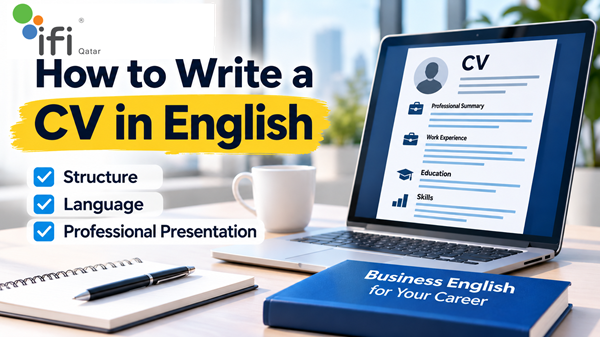
Writing a CV in English is an important step when applying for jobs in international companies, multinational organisations or English-speaking workplaces. However, a strong CV involves more than translating your previous experience into English. You need to present your qualifications clearly, choose professional vocabulary, describe your achievements effectively and organise your information in a way that makes it easy for recruiters to understand your value.
A well-written CV helps employers quickly identify your professional background, relevant skills and suitability for a position. Whether you are applying for your first job, looking for a promotion or planning to work abroad, learning how to write a CV in English can improve the quality of your job applications.
In this guide, you will learn how to structure an English CV, write each section professionally, avoid common language mistakes and present your experience with confidence.
1. What Is a CV and Why Does It Matter?
A CV, short for curriculum vitae, is a professional document that summarises your education, work experience, skills and qualifications. Employers use it to evaluate whether your background matches the requirements of a job.
In many countries, the terms CV and resume are used differently. In the UK and several other international markets, CV is the common term for a job application document. In the United States, a resume is generally shorter, while a CV may refer to a more detailed academic or professional record.
For most standard job applications, an effective English CV should be:
- Clear and easy to read.
- Relevant to the position.
- Written in professional English.
- Consistent in formatting and presentation.
- Focused on measurable achievements rather than general claims.
- Free from spelling and grammatical errors.
Your CV is often one of the first opportunities to make a professional impression. Its content and presentation should demonstrate attention to detail and effective communication skills.
2. What Is the Correct Structure of an English CV?
A professional CV usually follows a clear structure. Although the exact sections depend on your experience and the position you are applying for, most CVs include the following elements.
2.1 Contact Information
Start your CV with your essential contact details. Make sure employers can identify you and contact you easily.
Include:
- Full name.
- Professional email address.
- Phone number, including the international country code when relevant.
- City and country.
- LinkedIn profile, if it is professional and up to date.
- Portfolio or professional website, if relevant to your industry.
Example:
Sarah Ahmed
Doha, Qatar
Phone: +974 XXX XXXXX
Email: sarah.ahmed@email.com
LinkedIn: linkedin.com/in/sarahahmed
Avoid using informal email addresses, unnecessary personal information or outdated contact details. Information such as marital status, religion and national identification numbers is generally unnecessary unless an employer specifically requests it for a legitimate reason.
2.2 Professional Summary
A professional summary is a short introduction that highlights your experience, key strengths and career focus. It usually appears immediately below your contact information.
Aim for approximately three to four concise sentences. Avoid vague statements and focus on information that is relevant to the position.
Weak example:
I am a hardworking and motivated person. I am looking for a good job where I can improve my skills and gain experience.
Stronger example:
Marketing professional with four years of experience in digital campaigns, content development and social media management. Skilled in analysing campaign performance, coordinating marketing projects and creating customer-focused content. Seeking to contribute communication and analytical skills to a growing international organisation.
The stronger version communicates professional experience, relevant abilities and career direction more effectively.
2.3 Work Experience
Your work experience section should demonstrate what you have done professionally and how your contribution has benefited previous employers.
List your positions in reverse chronological order, starting with your most recent role.
For each position, include:
- Job title.
- Company name.
- Location.
- Employment dates.
- Three to five relevant responsibilities or achievements.
Example:
Marketing Executive
ABC Solutions, Doha, Qatar
January 2022 – Present
- Developed and implemented digital marketing campaigns across multiple platforms.
- Analysed campaign performance and prepared monthly reports.
- Coordinated content production with internal teams.
- Improved social media engagement through targeted content strategies.
Whenever possible, use measurable results to demonstrate your impact.
For example:
General statement:
Responsible for managing social media accounts.
Achievement-focused statement:
Managed three social media accounts and increased audience engagement by 35% over six months.
Only include figures that you can support with accurate information.
2.4 Education and Qualifications
List your educational background in reverse chronological order, beginning with your most recent qualification.
Include:
- Degree or qualification.
- Institution name.
- Location.
- Graduation year or study period.
- Relevant academic achievements, if useful.
Example:
Bachelor of Business Administration
University of Doha, Qatar
2020 – 2024
If you are a recent graduate, you can include relevant coursework, academic projects, internships or achievements. If you have extensive professional experience, keep this section concise and prioritise your employment history.
2.5 Skills
Your skills section should highlight abilities that are relevant to the job description.
It is useful to organise skills into categories.
Technical Skills
- Microsoft Excel
- Data Analysis
- Project Management Software
- Digital Marketing Tools
Professional Skills
- Communication
- Problem-Solving
- Team Collaboration
- Time Management
- Leadership
Language Skills
- Arabic: Native
- English: Professional Working Proficiency
- French: Basic
Be accurate when describing your language level. Avoid claiming fluency unless you can communicate confidently in professional situations.
2.6 Certifications and Professional Training
Include certificates, professional courses and training programmes that support your suitability for the position.
Example:
- Project Management Professional (PMP) – 2025
- Advanced Microsoft Excel – 2024
- Digital Marketing Certificate – 2023
For each qualification, provide the certificate name, issuing organisation and completion year where appropriate.
2.7 Additional Sections
Depending on your background and the role, you may also include:
- Professional Projects
- Volunteer Experience
- Publications
- Awards and Achievements
- Professional Memberships
- Languages
- Technical Portfolio
Only add sections that strengthen your application. A CV should be relevant rather than unnecessarily long.
3. How to Write Professional English in Your CV
The language you use can significantly influence how employers perceive your experience. A professional CV should communicate information directly, accurately and confidently.
3.1 Use Strong Action Verbs
Action verbs make your responsibilities and achievements more specific. Instead of repeatedly using phrases such as “was responsible for”, begin bullet points with clear verbs.
| Instead of | Use |
|---|---|
| Was responsible for managing | Managed |
| Helped with projects | Supported or coordinated |
| Worked on reports | Prepared or analysed |
| Did customer service tasks | Assisted customers or resolved enquiries |
| Made a new process | Developed or introduced |
| Took care of a team | Supervised or led |
| Made improvements | Improved or optimised |
Useful action verbs for different professional situations include:
Management: Led, supervised, coordinated, delegated, directed.
Communication: Presented, negotiated, explained, advised, collaborated.
Administration: Organised, scheduled, maintained, processed, documented.
Marketing: Developed, launched, promoted, analysed, optimised.
Customer Service: Assisted, resolved, supported, responded, advised.
Choose verbs that accurately describe your contribution. Do not use a stronger verb simply because it sounds more impressive.
3.2 Use Professional and Concise Language
Recruiters often review many applications, so unnecessary wording can make your CV less effective.
Compare these examples:
Less professional:
I was working with different departments and I was helping them to complete their daily tasks.
More professional:
Collaborated with multiple departments to support daily operations and improve workflow efficiency.
The second version is more concise and communicates the same information in a professional tone.
3.3 Write Bullet Points Instead of Long Paragraphs
Long paragraphs can make a CV difficult to scan. Use bullet points to organise your responsibilities and achievements.
Less effective:
I worked as a sales assistant where I was responsible for communicating with customers, answering their questions, helping them choose products and preparing daily sales reports.
More effective:
- Assisted customers with product selection and enquiries.
- Explained product features and pricing.
- Prepared daily sales reports.
- Supported the team in achieving monthly sales targets.
Each bullet point should communicate one clear responsibility or achievement.
3.4 Use Consistent Verb Tenses
Verb tense should reflect whether a role is current or previous.
For a current position, use the present tense for ongoing responsibilities:
- Manage customer enquiries.
- Prepare weekly performance reports.
- Coordinate meetings with clients.
For previous positions, use the past tense:
- Managed customer enquiries.
- Prepared weekly performance reports.
- Coordinated meetings with clients.
Achievement statements normally describe completed results in the past tense, even when the job is current:
- Increased customer retention by 15%.
- Introduced a new reporting process.
- Reduced administrative processing time.
Consistency makes your CV easier to read and more professional.
4. How to Describe Work Experience and Achievements in English
One of the most challenging parts of CV writing is explaining your previous work experience effectively. Many applicants describe only their daily responsibilities instead of showing what they achieved.
A useful approach is to combine an action verb, the task or project, and the result.
4.1 Use the Action + Task + Result Formula
A simple structure is:
Action verb + what you did + measurable or practical result.
For example:
- Coordinated a customer support team and reduced response times by 20%.
- Developed a new filing system that improved document accessibility.
- Trained five new employees to support the department’s onboarding process.
Not every achievement needs a percentage or financial figure. You can also explain the practical outcome of your work.
Example:
Created a customer feedback process to identify recurring service issues and support improvements in customer satisfaction.
4.2 Examples for Different Professions
The following examples show how to describe professional experience across several industries.
Administration
- Organised meetings, maintained records and coordinated office activities.
- Prepared business documents and managed confidential correspondence.
- Improved filing procedures to support faster document retrieval.
Sales
- Built relationships with new clients and maintained existing accounts.
- Monitored sales performance and prepared monthly reports.
- Supported the achievement of quarterly revenue targets.
Customer Service
- Responded to customer enquiries through email and telephone.
- Resolved complaints professionally and escalated complex cases.
- Maintained accurate customer records in the company database.
Marketing
- Created content for digital marketing campaigns.
- Monitored engagement and analysed campaign performance.
- Collaborated with designers and marketing teams to deliver promotional materials.
Education
- Prepared lesson plans based on students’ learning objectives.
- Assessed student progress and provided constructive feedback.
- Developed classroom activities to encourage participation.
Adapt these examples to your actual experience. A CV should reflect what you have genuinely done, not simply repeat impressive-sounding statements.
5. English CV Formatting and Professional Presentation
A well-written CV can lose its impact if the layout is confusing or difficult to read. Professional presentation helps employers locate important information quickly.
5.1 Choose a Clear and Professional Layout
Use a simple layout with clearly separated sections. Avoid excessive decoration, complicated tables and unnecessary graphics.
A practical CV format includes:
- One or two pages for many early- and mid-career applicants, depending on experience and industry.
- A readable font such as Arial, Calibri or Aptos.
- Consistent font sizes and heading styles.
- Clear spacing between sections.
- Bullet points for responsibilities and achievements.
- Consistent date formatting.
Senior professionals, academics and applicants in specialised fields may need a longer document to represent their experience appropriately.
5.2 Use Consistent Formatting
Consistency demonstrates attention to detail.
For example, if you write employment dates as:
January 2022 – March 2024
Use the same format throughout the document rather than switching between different date styles.
Also check that:
- All job titles follow the same formatting.
- Company names are presented consistently.
- Bullet points use similar punctuation.
- Headings follow a logical order.
- Margins and spacing are balanced.
5.3 Save Your CV in the Appropriate File Format
PDF is often a suitable format for sending a finished CV because it generally preserves the layout across devices.
However, some employers or application systems specifically request a Word document or another format. Always follow the employer’s instructions.
Use a professional file name, such as:
Sarah_Ahmed_CV.pdf
Avoid vague file names such as:
- CV_final_new.pdf
- MyCV123.pdf
- Document1.pdf
5.4 Consider Applicant Tracking Systems (ATS)
Some employers use Applicant Tracking Systems (ATS) to organise and screen applications.
To make your CV easier for these systems to process:
- Use standard section headings such as Work Experience, Education and Skills.
- Include relevant terminology from the job description when it accurately reflects your experience.
- Avoid placing essential information inside images.
- Prefer a straightforward layout.
- Check that the text can be selected and copied from the final PDF.
An ATS-friendly CV is not about repeating every keyword in the job advertisement. It is about presenting relevant information in a clear, readable format.
6. Common English CV Writing Mistakes to Avoid
Even applicants with good English skills can make mistakes when preparing a professional CV. Reviewing these common problems can help you improve both language accuracy and presentation.
6.1 Translating Sentences Directly from Your Native Language
Direct translation can produce unnatural or grammatically incorrect English.
For example:
Unnatural:
I have good ability in communication with customers.
Natural:
I have strong customer communication skills.
Focus on natural professional English rather than translating every sentence word for word.
6.2 Using Informal Language
Avoid conversational expressions and slang.
Instead of:
- Got experience in sales.
- Did many different jobs.
- Good at talking to people.
Use:
- Experienced in sales operations.
- Performed a range of administrative duties.
- Demonstrated strong interpersonal communication skills.
6.3 Making Unsupported Claims
Statements such as “the best employee”, “excellent in everything” or “perfect communication skills” do not provide meaningful evidence.
Use specific examples to demonstrate your strengths.
For instance:
Weak: Excellent leadership skills.
Stronger: Supervised a team of six employees and coordinated weekly performance reviews.
6.4 Including Irrelevant Information
Your CV should focus on information that supports your application.
Avoid including unrelated personal details, outdated experience or lengthy descriptions of responsibilities that do not connect to the position.
6.5 Ignoring Grammar and Spelling
Errors in grammar, spelling and punctuation can reduce the professional impact of your CV.
Pay particular attention to:
- Subject–verb agreement.
- Verb tense.
- Articles such as a, an and the.
- Prepositions.
- Singular and plural forms.
- Capitalisation.
- Consistent punctuation.
Use a spelling and grammar checker, but always review the final document yourself.
7. English CV Vocabulary: Useful Words and Phrases
Learning professional vocabulary can help you describe your experience more naturally and confidently.
Here are useful expressions for different CV sections.
| Professional purpose | Useful English expressions |
|---|---|
| Introducing experience | Experienced in, specialised in, skilled in |
| Describing responsibilities | Responsible for, managed, coordinated |
| Showing achievements | Achieved, delivered, improved, increased |
| Describing teamwork | Collaborated with, worked alongside, supported |
| Explaining problem-solving | Resolved, identified, implemented |
| Describing organisation | Organised, scheduled, maintained |
| Showing leadership | Led, supervised, trained, mentored |
| Describing communication | Presented, negotiated, advised |
You can also use the following professional phrases in your CV:
- Proven ability to manage multiple priorities.
- Strong background in customer relationship management.
- Experienced in coordinating cross-functional teams.
- Skilled in preparing reports and analysing data.
- Able to work effectively under pressure.
- Demonstrated commitment to continuous professional development.
- Experienced in supporting business operations.
- Strong written and verbal communication skills.
Remember that these phrases should support real evidence in your CV. Avoid using them as a substitute for specific examples.
8. Sample English CV Template
The following template provides a simple structure you can adapt to your own professional background.
FULL NAME
City, Country
Phone: +[Country Code] [Phone Number]
Email: [Professional Email Address]
LinkedIn: [LinkedIn Profile]
PROFESSIONAL SUMMARY
[Write three to four sentences describing your professional background, relevant experience, key strengths and career objective.]
WORK EXPERIENCE
[Job Title]
[Company Name], [Location]
[Month Year] – [Month Year or Present]
- [Describe a relevant responsibility using a strong action verb.]
- [Highlight a professional achievement or contribution.]
- [Include a measurable result where accurate and available.]
[Previous Job Title]
[Company Name], [Location]
[Month Year] – [Month Year]
- [Describe an important responsibility.]
- [Explain a project or contribution.]
- [Highlight a relevant achievement.]
EDUCATION
[Degree or Qualification]
[Institution Name], [Location]
[Graduation Year]
SKILLS
- [Professional Skill]
- [Technical Skill]
- [Communication Skill]
- [Industry-Specific Skill]
CERTIFICATIONS
- [Certificate Name] – [Issuing Organisation], [Year]
- [Certificate Name] – [Issuing Organisation], [Year]
LANGUAGES
- [Language]: [Proficiency Level]
- [Language]: [Proficiency Level]
You do not need to include every section if it is not relevant to your experience. Customise the template according to the job requirements and your professional background.
9. How to Improve Your English for CV Writing
Writing a professional CV requires more than general English knowledge. You need to understand formal vocabulary, sentence structure, grammar and the communication style used in professional environments.
If you want to improve your CV writing skills, focus on the following areas.
9.1 Learn Business English Vocabulary
Study vocabulary related to your industry and professional responsibilities. For example, someone working in finance may need terms related to budgeting, reporting and financial analysis, while a marketing professional may need vocabulary related to campaigns, customer engagement and brand development.
9.2 Practise Writing Professional Sentences
Take simple descriptions of your previous responsibilities and rewrite them using professional language.
For example:
Basic: I helped customers.
Improved: Assisted customers with enquiries and provided information about available products and services.
This exercise helps you develop more natural and precise professional writing.
9.3 Strengthen Your Grammar
Focus on grammar areas that frequently appear in CVs:
- Past and present tenses.
- Active and passive voice.
- Sentence structure.
- Articles and prepositions.
- Verb forms.
- Subject–verb agreement.
Accurate grammar makes your professional experience easier to understand.
9.4 Develop Your Overall Workplace Communication Skills
CV writing is only one part of professional communication. You may also need to write business emails, participate in meetings, present ideas, communicate with clients and attend interviews in English.
Developing these skills together can help you feel more confident in international work environments.
10. How Career-Focused English Courses Can Help You
If you are planning to apply for international positions or work in an English-speaking environment, improving your professional English can make a meaningful difference.
Career-focused English learning can help you:
- Write clearer professional documents.
- Use appropriate workplace vocabulary.
- Explain your experience and qualifications.
- Communicate confidently with employers and colleagues.
- Improve your business writing and speaking skills.
- Prepare for professional conversations and interviews.
At IFI Qatar, learners can strengthen their English through structured language programmes designed to develop practical communication skills. Improving your English step by step can help you present your professional background more effectively and communicate with greater confidence.
Whether you are preparing for your first international job application or looking to advance your career, investing in your English skills is a practical step towards your professional goals.
11. Frequently Asked Questions About Writing a CV in English
How do I write a CV in English for the first time?
Start with your contact information, professional summary, education, skills and any relevant work experience. If you have limited employment history, include internships, academic projects, volunteering and relevant training. Use clear professional language and organise your information in reverse chronological order.
What is the correct format for an English CV?
A standard English CV usually includes contact information, a professional summary, work experience, education, skills and relevant certifications. Additional sections can be included when they support your application.
How long should an English CV be?
For many early- and mid-career applicants, one or two pages are sufficient. However, the appropriate length depends on your experience, industry and the employer’s requirements. Academic and senior professional CVs may be longer.
Should I use British or American English in my CV?
Either can be appropriate, depending on the employer and destination country. The most important point is consistency. Avoid mixing spelling conventions, such as “organise” and “organize”, throughout the same document.
Should I include a photo in my English CV?
It depends on the country, industry and employer. In some markets, photographs are common, while in others they are discouraged or unnecessary. Check the employer’s instructions and local hiring practices before including one.
How can I describe work experience if I have no professional experience?
Focus on transferable skills and relevant activities. You can include internships, volunteer work, university projects, freelance assignments and practical training. Explain what you contributed and what skills you developed.
What English level do I need to write a professional CV?
There is no single required English level for every CV. However, a good command of grammar, professional vocabulary and clear sentence structure is important. The level of English needed also depends on the position and the employer’s expectations.
Is a CV the same as a resume?
The terms are used differently across countries. In many markets, a CV is the standard document for job applications. In the United States, a resume is usually a concise employment-focused document, while a CV is often more detailed and used for academic or research positions.
Should I use first person in my English CV?
Most professional CVs avoid repeated first-person pronouns such as “I” and “my”. Instead of writing “I managed a team”, use “Managed a team of six employees”. This creates a concise and professional style.
Can I use the same CV for every job application?
It is better to tailor your CV to each position. Review the job description, identify the most relevant requirements and highlight the experience and skills that genuinely match them. Keep your employment history accurate while adjusting the emphasis and wording.
Conclusion: Present Your Professional Experience with Confidence
Learning how to write a CV in English is an essential skill for anyone pursuing career opportunities in international workplaces. A successful CV combines a clear structure, accurate grammar, relevant professional vocabulary and achievement-focused descriptions.
Start by organising your experience into logical sections. Use strong action verbs, write concise bullet points and focus on the skills and achievements that matter to your target position. Finally, review the document carefully to ensure that the language and presentation are professional and consistent.
Remember that your CV represents not only your qualifications but also your ability to communicate professionally. Strengthening your Business English skills can help you create better job applications and communicate more confidently throughout your career.
Ready to improve your professional English? Explore career-focused English learning opportunities at IFI Qatar and take the next step towards stronger workplace communication.