

Currently Empty: ر.ق 0,00


IELTS
Word Families in English: How Nouns, Verbs, Adjectives and Adverbs Connect
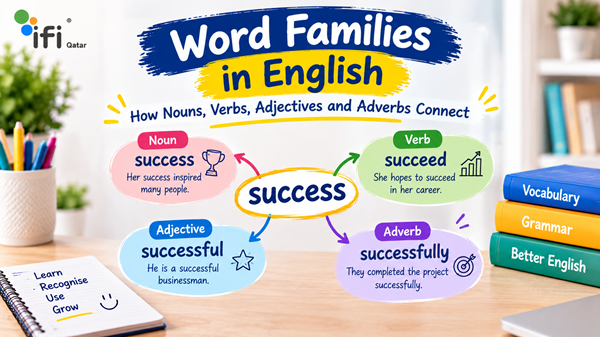
Have you ever learned an English word but struggled to use it in different sentences? You may know the verb educate, for example, but what about education, educational and educationally? These words look similar because they belong to the same word family.
Learning English word families is an effective way to expand your vocabulary without memorising every word as a completely separate item. By understanding how nouns, verbs, adjectives and adverbs are connected, you can recognise more words, choose the correct form and communicate more accurately.
For example, consider the following words:
- Success – noun
- Succeed – verb
- Successful – adjective
- Successfully – adverb
Although these words have different grammatical functions, they share a common meaning.
In this guide, you will learn what English word families are, how words change their forms, which suffixes are commonly used, and how to apply word families in everyday English. You will also find practical examples and exercises to test your understanding.
What Are Word Families in English?
A word family is a group of words that share the same root or base and have related meanings. These words may belong to different parts of speech, such as nouns, verbs, adjectives and adverbs.
For example, the word family of beauty includes:
| Word | Part of Speech | Example |
|---|---|---|
| Beauty | Noun | The beauty of the city attracts visitors. |
| Beautify | Verb | They want to beautify the garden. |
| Beautiful | Adjective | It is a beautiful place. |
| Beautifully | Adverb | The room was beautifully decorated. |
The words are connected by meaning, but each one performs a different grammatical function.
Another example is the care word family:
- Care – noun or verb
- Careful – adjective
- Carefully – adverb
- Careless – adjective
- Carelessness – noun
Understanding these connections helps you learn several useful words from one familiar base word.
Why Are Word Families Important?
Learning word families can make vocabulary development more organised and effective.
The main benefits include:
- Expanding your vocabulary: You can learn several related words from one base word.
- Improving grammar: You become more familiar with the different forms needed in a sentence.
- Developing reading skills: Recognising familiar roots can help you understand unfamiliar words.
- Improving writing: You can select more precise words and avoid repeating the same form.
- Building speaking confidence: Knowing different word forms makes it easier to express ideas naturally.
For English learners, word families are particularly useful because they connect vocabulary learning with grammar.
The Four Main Parts of Speech in English Word Families
To understand word families, you first need to recognise the four main parts of speech: nouns, verbs, adjectives and adverbs.
Each category has a different role in a sentence.
1. Nouns: Words That Name People, Places, Things and Ideas
A noun identifies a person, place, object, activity or concept.
Examples include:
- Education
- Happiness
- Decision
- Development
- Communication
- Beauty
- Success
Nouns can be used as subjects, objects or complements in sentences.
Examples:
- Education creates new opportunities.
- Her decision surprised everyone.
- The company encourages professional development.
- Good communication is important in every workplace.
Many nouns are formed from verbs or adjectives by adding suffixes such as -tion, -ment, -ness and -ity.
Examples:
| Base Word | Noun Form |
|---|---|
| Educate | Education |
| Develop | Development |
| Happy | Happiness |
| Active | Activity |
| Decide | Decision |
| Improve | Improvement |
2. Verbs: Words That Describe Actions and States
Verbs express actions, events, processes or states.
Examples include:
- Educate
- Develop
- Decide
- Improve
- Communicate
- Succeed
- Create
A verb is essential to most English sentences because it tells the reader what the subject does or what happens.
Examples:
- Teachers educate students.
- The company wants to develop new products.
- We need to decide what to do.
- Regular practice can improve your English.
- Students should communicate clearly.
Some verbs are formed from nouns or adjectives by adding suffixes such as -ize, -ify and -en.
Examples:
| Base Word | Verb Form |
|---|---|
| Modern | Modernize |
| Simple | Simplify |
| Strength | Strengthen |
| Beauty | Beautify |
| Identity | Identify |
3. Adjectives: Words That Describe Nouns
Adjectives provide information about nouns. They describe qualities, characteristics, conditions and states.
Examples include:
- Beautiful
- Successful
- Educational
- Creative
- Careful
- Active
- Responsible
Adjectives usually appear before nouns or after linking verbs such as be, seem, look and feel.
Examples:
- She is a successful student.
- This is an educational programme.
- He gave a creative answer.
- The instructions are clear.
- You should be careful when using unfamiliar words.
Many adjectives are formed by adding suffixes such as -ful, -less, -able, -ive and -ous.
Examples:
| Base Word | Adjective Form |
|---|---|
| Care | Careful |
| Success | Successful |
| Danger | Dangerous |
| Create | Creative |
| Comfort | Comfortable |
| Hope | Hopeful |
4. Adverbs: Words That Describe Verbs, Adjectives and Other Adverbs
Adverbs provide additional information about how, when, where or to what extent something happens.
Many adverbs are formed by adding -ly to adjectives.
Examples:
- Careful → Carefully
- Successful → Successfully
- Quick → Quickly
- Slow → Slowly
- Beautiful → Beautifully
Consider these sentences:
- She is a careful driver.
- She drives carefully.
In the first sentence, careful describes the noun driver. In the second, carefully describes the verb drives.
Other examples:
- He completed the project successfully.
- The teacher explained the lesson clearly.
- She answered the question confidently.
- They worked efficiently.
Not all adverbs end in -ly. Words such as often, always, here, there, very and well are also adverbs.
English Word Families: Examples and Common Patterns
The best way to understand word families is to study complete groups of related words.
The following examples show how one base word can develop into several grammatical forms.
Common Word Families: Noun, Verb, Adjective and Adverb
| Noun | Verb | Adjective | Adverb |
|---|---|---|---|
| Success | Succeed | Successful | Successfully |
| Beauty | Beautify | Beautiful | Beautifully |
| Care | Care | Careful / Careless | Carefully / Carelessly |
| Creation | Create | Creative | Creatively |
| Education | Educate | Educational | Educationally |
| Communication | Communicate | Communicative | Communicatively |
| Decision | Decide | Decisive | Decisively |
| Difference | Differ | Different | Differently |
| Strength | Strengthen | Strong | Strongly |
| Improvement | Improve | Improved / Improving | — |
| Explanation | Explain | Explainable | — |
| Activity | Activate | Active | Actively |
Important: Not every word family has a commonly used form in all four categories. Some forms are uncommon, unnatural or have specialised meanings. The table illustrates useful relationships rather than suggesting that every possible form should be used in everyday English.
Word Family Examples in Complete Sentences
Studying words in context helps you understand how their grammatical roles differ.
1. Success
- Noun: Her success encouraged other students.
- Verb: She hopes to succeed in her career.
- Adjective: He is a successful business owner.
- Adverb: The team completed the project successfully.
2. Education
- Noun: Education plays an important role in personal development.
- Verb: Schools educate students in different subjects.
- Adjective: The centre offers educational programmes.
- Adverb: The topic was discussed educationally in a specialist context, although this adverb is uncommon in everyday English.
3. Creation
- Noun: The creation of the new website took several weeks.
- Verb: The designer will create a new layout.
- Adjective: She has a creative approach to problem-solving.
- Adverb: He solved the problem creatively.
4. Difference
- Noun: There is a significant difference between the two options.
- Verb: The two products differ in quality.
- Adjective: They have different opinions.
- Adverb: The new system works differently.
5. Care
- Noun: Children need attention and care.
- Verb: You should care about the quality of your work.
- Adjective: She is a careful learner.
- Adverb: He checked the document carefully.
These examples show why learning words as connected groups is more useful than memorising isolated vocabulary.
How Are Word Families Formed?
English word families are often formed by adding prefixes and suffixes to a root or base word. A prefix appears at the beginning of a word, while a suffix appears at the end.
Suffixes are particularly important because many of them help change a word from one part of speech to another.
Common Suffixes That Form Nouns
| Suffix | Function | Examples |
|---|---|---|
| -tion | Forms nouns from verbs | Education, communication |
| -sion | Forms nouns from verbs | Decision, discussion |
| -ment | Forms nouns related to actions or results | Development, improvement |
| -ness | Forms nouns from adjectives | Happiness, kindness |
| -ity | Forms abstract nouns | Activity, creativity |
| -er | Often identifies a person who performs an action | Teacher, writer |
| -ance | Forms nouns | Importance, performance |
| -ence | Forms nouns | Difference, confidence |
Examples:
- Develop → Development
- Happy → Happiness
- Important → Importance
- Confident → Confidence
- Perform → Performance
Common Suffixes That Form Verbs
| Suffix | Function | Examples |
|---|---|---|
| -ize | Forms verbs meaning to make or become | Modernize, organize |
| -ify | Forms verbs meaning to make or cause | Simplify, beautify |
| -en | Often means to make or become | Strengthen, widen |
| -ate | Forms verbs | Activate, communicate |
Examples:
- Modern → Modernize
- Simple → Simplify
- Strong → Strengthen
- Active → Activate
Common Suffixes That Form Adjectives
| Suffix | Common Meaning or Function | Examples |
|---|---|---|
| -ful | Having a quality or being full of something | Helpful, successful |
| -less | Without something | Careless, hopeless |
| -able | Capable of being or doing something | Readable, understandable |
| -ible | Capable of being or done | Visible, accessible |
| -ous | Having a particular quality | Dangerous, famous |
| -ive | Having a particular nature or tendency | Creative, active |
| -al | Related to something | Personal, educational |
| -ic | Related to or characteristic of something | Economic, historic |
Examples:
- Care → Careful
- Hope → Hopeless
- Understand → Understandable
- Danger → Dangerous
- Create → Creative
- Education → Educational
Common Suffixes That Form Adverbs
The suffix -ly is one of the most common ways to form adverbs from adjectives.
| Adjective | Adverb |
|---|---|
| Careful | Carefully |
| Successful | Successfully |
| Quick | Quickly |
| Slow | Slowly |
| Easy | Easily |
| Happy | Happily |
| Complete | Completely |
| Natural | Naturally |
Examples:
- She speaks clearly.
- He works efficiently.
- They completed the task successfully.
- I can easily understand the instructions.
Remember that spelling may change when -ly is added. For example, happy becomes happily, not happyly.
How to Identify the Correct Word Form in a Sentence
One of the biggest challenges for English learners is knowing which form of a word belongs in a sentence.
The meaning may be familiar, but choosing between a noun, verb, adjective or adverb requires an understanding of sentence structure.
1. Identify the Role of the Missing Word
Look at the words around the gap to understand what type of word is required.
For example:
“Her ______ was impressive.”
The sentence needs a noun because the missing word is the subject.
Possible answer: “Her performance was impressive.”
Now consider:
“She performed ______.”
The sentence needs an adverb because the missing word describes how she performed.
Possible answer: “She performed successfully.”
2. Look at the Words Before and After the Gap
Certain grammatical patterns can help you identify the correct form.
| Sentence Pattern | Likely Word Form | Example |
|---|---|---|
| A / an / the + ______ | Noun or adjective + noun | A successful student |
| Subject + ______ | Often a verb | Students communicate. |
| Be / seem / look / feel + ______ | Often an adjective | She looks confident. |
| Verb + ______ | Often an adverb | He speaks clearly. |
| Very + ______ | Often an adjective or adverb | Very careful / very carefully |
These are useful clues, not absolute rules. The correct choice always depends on the complete sentence.
3. Check the Meaning of the Sentence
Grammar alone is not enough. The selected word must also make sense.
Compare:
- The instructions were clear.
- The teacher explained the instructions clearly.
Both sentences are grammatically correct, but the first describes the instructions, while the second describes the teacher’s action.
4. Check the Spelling
Some word forms require spelling changes.
Examples:
- Happy → Happiness
- Happy → Happily
- Easy → Easily
- Decide → Decision
- Strong → Strength
Do not assume that every word follows exactly the same spelling pattern. When you are unsure, check a reliable dictionary.
Common Mistakes When Learning English Word Families
Understanding word families can improve your vocabulary, but learners sometimes confuse related forms.
Here are some frequent mistakes and their corrections.
| Incorrect Sentence | Correct Sentence | Explanation |
|---|---|---|
| She is a success person. | She is a successful person. | Use an adjective before a noun to describe it. |
| He speaks English fluent. | He speaks English fluently. | Use an adverb to describe how someone speaks. |
| Their decide was final. | Their decision was final. | Use the noun form after a possessive determiner. |
| The explanation was clearly. | The explanation was clear. | Use an adjective after linking verb was. |
| We need to improvement our skills. | We need to improve our skills. | Use a verb after to in this infinitive structure. |
| She completed the task careful. | She completed the task carefully. | Use an adverb to describe the action. |
| Education is very importance. | Education is very important. | Use an adjective after very in this sentence. |
| He is a create person. | He is a creative person. | Use the adjective form to describe a person. |
Confusing Nouns and Adjectives
A noun names something, while an adjective describes it.
Incorrect: “She has a beauty voice.”
Correct: “She has a beautiful voice.”
Beauty is a noun, while beautiful is an adjective.
Confusing Adjectives and Adverbs
Adjectives describe nouns, while adverbs often describe verbs.
Incorrect: “He drives careful.”
Correct: “He drives carefully.”
Choosing the Wrong Verb Form
Some sentences require a verb rather than a noun.
Incorrect: “We need to development our skills.”
Correct: “We need to develop our skills.”
The verb develop is required after to in this infinitive construction.
Using a Word Form That Does Not Exist or Is Unnatural
Not every combination of a root and suffix creates a standard English word. Even if a form seems logical, it may not be used by fluent speakers.
For example, unpossible is not the standard form; English uses impossible.
Always learn word forms in context and check unfamiliar combinations.
How to Learn English Word Families More Effectively
Learning word families becomes easier when you organise vocabulary and practise using related words in real sentences.
The following methods can help you build a stronger vocabulary.
1. Create a Word Family Notebook
Choose a base word and record its common forms.
For example:
| Part of Speech | Word |
|---|---|
| Noun | Success |
| Verb | Succeed |
| Adjective | Successful |
| Adverb | Successfully |
Add one example sentence for each form.
Review your notebook regularly and include new words as you encounter them.
2. Learn Words by Topic
Organising word families around familiar subjects can make vocabulary easier to remember.
For example, when studying education, you might learn:
- Educate
- Education
- Educational
- Educator
For communication:
- Communicate
- Communication
- Communicative
- Communicator
For development:
- Develop
- Development
- Developed
- Developing
This method is especially useful when preparing for conversations, academic tasks or professional situations.
3. Practise Changing the Form of a Word
Take a sentence and rewrite it using another form of the same word family.
For example:
- Original: “She is a successful student.”
- New sentence: “She achieved success as a student.”
- Another version: “She completed the course successfully.”
This exercise helps you understand how different forms work in context.
4. Read English Texts and Identify Word Families
When reading articles, short stories or educational materials, look for related words.
Ask yourself:
- What is the base word?
- Is this form a noun, verb, adjective or adverb?
- Does the suffix change the grammatical role?
- How does the word contribute to the meaning of the sentence?
Recording useful examples can help you recognise patterns over time.
5. Use New Words in Your Own Sentences
Do not stop after learning a definition. Write or say a sentence using each new form.
For example, with the word family create:
- Create: I want to create a new project.
- Creation: The creation of the website took a month.
- Creative: She has a creative approach.
- Creatively: He solved the problem creatively.
Using words actively makes it easier to remember them.
6. Review Your Mistakes
If you use the wrong form, record the sentence and correct it.
For example:
- Incorrect: “She answered the question confident.”
- Correct: “She answered the question confidently.”
- Reason: The adverb confidently describes the verb answered.
Reviewing these corrections helps you identify repeated grammar and vocabulary problems.
Practice Exercises: English Word Families
Test your understanding with the following exercises. Try to complete each question before checking the answer key.
Exercise 1: Identify the Part of Speech
Identify whether the bold word is a noun, verb, adjective or adverb.
- Her confidence improved over time.
- He answered the question correctly.
- They want to modernize the building.
- She is a creative student.
- The company announced an important development.
- He speaks English fluently.
- We need to strengthen our skills.
- It was a successful event.
- Their decision surprised everyone.
- She explained the rules clearly.
Exercise 2: Choose the Correct Word Form
Choose the correct word to complete each sentence.
- She is a very ______ student. (success / successful / successfully)
- He completed the assignment ______. (careful / carefully / carefulness)
- Their ______ was important. (decide / decision / decisive)
- We need to ______ our communication skills. (improvement / improve / improved)
- The teacher gave a ______ explanation. (clearly / clear / clarity)
- They discussed the ______ of the project. (develop / development / developed)
- She answered the question ______. (confident / confidence / confidently)
- The programme provides ______ support. (education / educational / educate)
- Regular practice can ______ your vocabulary. (strength / strengthen / strong)
- His ______ helped the team. (creative / creatively / creativity)
Exercise 3: Complete the Word Families
Complete the missing forms where a common and natural form exists.
| Noun | Verb | Adjective | Adverb |
|---|---|---|---|
| Success | ______ | Successful | Successfully |
| Beauty | Beautify | ______ | Beautifully |
| ______ | Create | Creative | Creatively |
| Decision | Decide | Decisive | ______ |
| Difference | Differ | Different | ______ |
| Care | Care | Careful | Carefully |
| Development | Develop | ______ | — |
| Strength | Strengthen | Strong | Strongly |
Exercise 4: Correct the Mistakes
Rewrite each sentence using the correct word form.
- She is a success businesswoman.
- He speaks English fluent.
- We need to development a better plan.
- Her explain was very clear.
- The students worked careful.
- This is an importance decision.
- He answered the question confident.
- Their create was impressive.
Answers and Explanations
Exercise 1
- Noun — Confidence names a quality.
- Adverb — Correctly describes how he answered.
- Verb — Modernize describes an action.
- Adjective — Creative describes the student.
- Noun — Development names a process or result.
- Adverb — Fluently describes how he speaks.
- Verb — Strengthen describes an action.
- Adjective — Successful describes the event.
- Noun — Decision names a choice.
- Adverb — Clearly describes how she explained the rules.
Exercise 2
- Successful — An adjective is needed to describe the student.
- Carefully — An adverb describes how he completed the assignment.
- Decision — A noun is needed as the subject.
- Improve — The verb is required after need to.
- Clear — An adjective describes the explanation.
- Development — A noun is required after the.
- Confidently — An adverb describes how she answered.
- Educational — An adjective describes the support.
- Strengthen — A verb is required after can.
- Creativity — A noun is needed as the subject.
Exercise 3
| Noun | Verb | Adjective | Adverb |
|---|---|---|---|
| Success | Succeed | Successful | Successfully |
| Beauty | Beautify | Beautiful | Beautifully |
| Creation | Create | Creative | Creatively |
| Decision | Decide | Decisive | Decisively |
| Difference | Differ | Different | Differently |
| Care | Care | Careful | Carefully |
| Development | Develop | Developed / Developing | — |
| Strength | Strengthen | Strong | Strongly |
Exercise 4
- She is a successful businesswoman.
- He speaks English fluently.
- We need to develop a better plan.
- Her explanation was very clear.
- The students worked carefully.
- This is an important decision.
- He answered the question confidently.
- Their creation was impressive.
Frequently Asked Questions About English Word Families
What are English word families?
English word families are groups of related words that share a common root or base. They may include nouns, verbs, adjectives and adverbs. For example, success, succeed, successful and successfully belong to the same word family.
Why should I learn word families in English?
Learning word families helps you expand your vocabulary, understand unfamiliar words, recognise grammatical patterns and use the correct form of a word in speaking and writing.
How can I identify a word family?
Start by identifying the base or root word. Then look for related forms created through prefixes and suffixes. For example, care, careful, carefully, careless and carelessness belong to the same word family.
What is the difference between a noun, verb, adjective and adverb?
A noun names a person, place, thing or idea. A verb describes an action or state. An adjective describes a noun, while an adverb provides information about a verb, adjective or another adverb.
Can one English word have several forms?
Yes. Many English words have several related forms. For example, create is a verb, creation is a noun, creative is an adjective and creatively is an adverb.
Do all word families have nouns, verbs, adjectives and adverbs?
No. Some word families have common forms in all four categories, while others have only two or three commonly used forms. Some possible combinations may be uncommon or unnatural.
How can word families improve my English writing?
Word families help you choose the correct grammatical form and express ideas more precisely. They also allow you to vary your vocabulary and avoid repeating the same word unnecessarily.
What is the best way to memorise English word families?
Learn words in groups, organise them by topic, write example sentences and practise changing one form into another. Regular reading and speaking practice can help you remember how each form is used.
Build Your English Vocabulary With IFI Qatar
Understanding English word families can help you move beyond memorising individual words. When you recognise the relationship between nouns, verbs, adjectives and adverbs, you can build a broader vocabulary and use English more accurately in everyday communication.
At IFI Qatar, you can explore English courses designed to help you improve your vocabulary, grammar and overall communication skills. Whether you are learning the basics or developing your intermediate English, structured lessons and regular practice can help you understand new words and use them with greater confidence.
A well-organised vocabulary learning plan can also help you identify gaps in your knowledge, practise word forms in context and develop stronger reading, speaking and writing skills.
Ready to expand your English vocabulary? Contact IFI Qatar to explore available English courses and find a suitable learning option for your current level and goals.