

Currently Empty: ر.ق 0,00


IELTS
Countable and Uncountable Nouns: Rules, Examples and Common Expressions
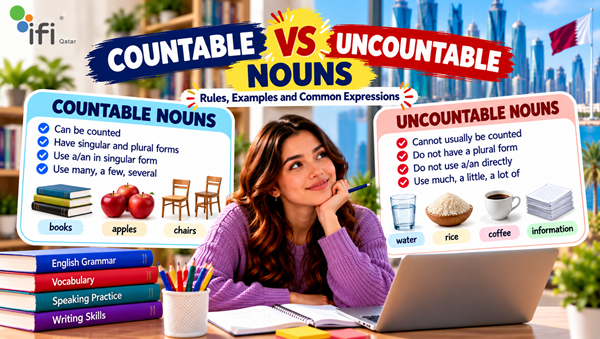
Have you ever wondered whether to say many books or much books? Or why English speakers say a piece of advice instead of an advice?
These questions are related to one important area of English grammar: countable and uncountable nouns.
Understanding the difference helps you make fewer grammar mistakes, ask questions more naturally, and communicate more confidently in everyday situations. Whether you are ordering food, shopping, talking about your work, or describing your daily routine, you will use countable and uncountable nouns regularly.
In this guide, you will learn how to identify each type of noun, understand the rules for articles and quantity words, avoid common mistakes, and practise with exercises and answers.
What Are Countable and Uncountable Nouns?
English nouns can be divided into different categories. One important distinction is whether a noun can be counted as individual items or is usually treated as a whole, substance, or general concept.
Countable nouns refer to things that can be counted individually.
Uncountable nouns refer to things that are not normally counted as separate units in their usual meaning.
Compare these examples:
- Countable: one apple, two apples, three apples.
- Uncountable: some water, some rice, some information.
You can say three apples because apples are individual items. However, you would normally say some water, not three waters, when referring to water as a substance.
The key is to understand how English treats each noun in context.
What Are Countable Nouns?
Countable nouns refer to people, places, objects, or ideas that can be counted as separate units. They have both singular and plural forms.
Examples of Countable Nouns
| Singular | Plural | Example Sentence |
|---|---|---|
| Book | Books | I have three books. |
| Student | Students | There are twenty students in the class. |
| Chair | Chairs | We need four chairs. |
| Apple | Apples | She bought five apples. |
| Car | Cars | There are two cars outside. |
| Question | Questions | I have a few questions. |
| Idea | Ideas | They shared several ideas. |
| Friend | Friends | He has many friends. |
| Ticket | Tickets | We bought two tickets. |
| Lesson | Lessons | She attends three lessons a week. |
These nouns can be counted individually, so you can use numbers directly before them.
For example:
- one student
- two students
- five students
- ten students
Rules for Countable Nouns
Countable nouns follow several important grammar rules.
1. Singular countable nouns usually need a determiner.
A singular countable noun generally cannot stand alone in an ordinary sentence when used with a common noun meaning.
Incorrect: I bought book.
Correct: I bought a book.
You can also use other determiners:
- I bought the book.
- I bought this book.
- I bought my book.
- I bought one book.
2. Use a or an with singular countable nouns.
Examples:
- She has a bicycle.
- I need a pen.
- He ate an orange.
- She is an engineer.
Use a before a consonant sound and an before a vowel sound. The sound matters more than the spelling.
For example, we say an hour because the h is silent, but a university because the word begins with a /j/ sound.
3. Use plural forms when counting more than one item.
Examples:
- one lesson
- two lessons
- three lessons
Most English nouns form their plural by adding -s or -es, although some have irregular plural forms.
Examples:
- child → children
- person → people
- man → men
- woman → women
- foot → feet
4. Use many, a few, and several with plural countable nouns.
Examples:
- How many students are there?
- I have a few questions.
- She bought several books.
- There aren’t many chairs in the room.
These expressions help you talk about quantities without specifying an exact number.
What Are Uncountable Nouns?
Uncountable nouns refer to substances, materials, abstract ideas, activities, or other things that English speakers do not normally count as individual units in a particular meaning.
They usually do not have a plural form when used in their uncountable sense.
Examples of Uncountable Nouns
| Category | Examples | Example Sentence |
|---|---|---|
| Liquids | Water, milk, coffee | I drink plenty of water. |
| Food and substances | Rice, sugar, flour | We need some rice. |
| Abstract concepts | Advice, information, knowledge | She gave me useful advice. |
| Materials | Wood, gold, plastic | The table is made of wood. |
| Weather and nature | Rain, sunshine, air | We had heavy rain yesterday. |
| Work and activities | Work, homework, research | I have a lot of homework. |
| Feelings and qualities | Happiness, patience, confidence | Learning requires patience. |
| General concepts | Money, equipment, furniture | The office needs new furniture. |
You would normally say:
- some information
- a little money
- much furniture
- a lot of homework
- enough equipment
You would not normally say informations, moneys, furnitures, or homeworks when using these nouns in their usual uncountable meanings.
Rules for Uncountable Nouns
1. Uncountable nouns usually take a singular verb.
Examples:
- The information is useful.
- My homework is difficult.
- The furniture looks modern.
- The equipment needs repair.
- The advice was helpful.
Even when an uncountable noun refers to a large quantity, it normally takes a singular verb.
Incorrect: The information are correct.
Correct: The information is correct.
2. Do not normally use a or an directly before an uncountable noun.
Incorrect: I need an advice.
Correct: I need some advice.
Incorrect: She gave me an information.
Correct: She gave me some information.
You can use a counting expression when you need to refer to one unit or one item of something that is usually uncountable.
For example:
- a piece of advice
- a piece of information
- a glass of water
- a cup of coffee
- a loaf of bread
3. Use much, a little, and a bit of with uncountable nouns.
Examples:
- How much water do you drink?
- I have a little time.
- We need a bit of information.
- There isn’t much sugar left.
- She has very little patience.
These expressions describe quantities without counting individual units.
4. Use some and any with uncountable nouns.
Examples:
- We need some milk.
- Is there any water in the bottle?
- I don’t have any information about the event.
- Would you like some coffee?
The choice between some and any depends on the sentence and its meaning, as explained later in this guide.
Countable vs Uncountable Nouns: Key Differences
The following table summarises the main differences between the two categories.
| Grammar Feature | Countable Nouns | Uncountable Nouns |
|---|---|---|
| Can be counted individually? | Yes | Not normally in their usual meaning |
| Singular form | Yes | Usually no separate countable singular form |
| Plural form | Usually yes | Usually no |
| Use a or an directly? | With singular nouns | Not normally |
| Use many? | Yes, with plural nouns | No, not in the usual construction |
| Use much? | Not normally | Yes |
| Use a few? | Yes | No, not in the usual construction |
| Use a little? | Not normally | Yes |
| Example | Three books | Some information |
Compare these sentences:
Countable: There are many books on the shelf.
Uncountable: There is much information in this report.
In everyday affirmative sentences, a lot of is often more natural than much.
For example:
- I have a lot of books.
- I have a lot of work.
The important point is that the quantity expression must match the way the noun is being used.
How to Use Much, Many, A Lot Of, A Few and A Little
Quantity words, also known as quantifiers, help you describe how much or how many of something exists.
Choosing the correct quantifier is one of the most common challenges for English learners.
Much vs Many
Use many with plural countable nouns and much with uncountable nouns.
Examples with many:
- How many people attended the meeting?
- I don’t have many friends in this city.
- There are too many mistakes in this document.
- How many lessons do you have this week?
Examples with much:
- How much money do you need?
- We don’t have much time.
- How much milk is left?
- There isn’t much traffic today.
A common mistake is using much before a plural countable noun.
Incorrect: How much books do you have?
Correct: How many books do you have?
Similarly, avoid using many before an uncountable noun in its usual meaning.
Incorrect: How many information do you need?
Correct: How much information do you need?
A Lot Of and Lots Of
Use a lot of or lots of with both plural countable nouns and uncountable nouns.
Examples:
- She has a lot of books.
- We have lots of students in our school.
- I have a lot of work today.
- There is lots of water in the tank.
These expressions are common in everyday conversation and are useful when you want to sound natural.
Compare:
- There are many people at the event.
- There are a lot of people at the event.
Both sentences are correct. In many everyday situations, a lot of sounds more conversational.
A Few vs A Little
Use a few with plural countable nouns and a little with uncountable nouns.
Examples with a few:
- I have a few questions.
- She bought a few apples.
- We need a few more chairs.
- There are a few students in the classroom.
Examples with a little:
- I need a little help.
- We have a little time before the meeting.
- Add a little sugar to the coffee.
- She speaks a little French.
The difference between few and a few, and between little and a little, is also important.
A few means some, although the number is small.
“I have a few friends here.”
This suggests that the speaker has some friends.
Few emphasises that the number is small and often implies that it is not enough.
“Few people understood the instructions.”
This suggests that not many people understood them.
Similarly:
- I have a little time. — I have some time.
- I have little time. — I have almost no time or not enough time.
Enough, Too Much and Too Many
Use enough to describe a sufficient quantity.
Examples:
- We have enough chairs for everyone.
- There is enough water for the journey.
- I don’t have enough time to finish the report.
- Do we have enough information to make a decision?
Use too many with plural countable nouns.
Examples:
- There are too many people in the room.
- You made too many mistakes.
- She bought too many clothes.
Use too much with uncountable nouns.
Examples:
- There is too much sugar in this tea.
- I have too much work today.
- He spends too much money on unnecessary things.
The word too suggests an excessive amount, often more than is desirable or manageable.
How to Use Some and Any
The words some and any can be used with both countable and uncountable nouns, but the sentence type and intended meaning influence which one is appropriate.
Using Some
Use some in many affirmative sentences.
Examples:
- I bought some apples.
- We need some water.
- She has some useful information.
- There are some students outside.
You can also use some in offers and requests when you expect, invite or encourage a positive response.
Examples:
- Would you like some coffee?
- Can I have some water, please?
- Would you like some biscuits?
These questions are common when offering food or drink or asking for something politely.
Using Any
Use any in many negative sentences and questions.
Examples:
- I don’t have any money.
- There isn’t any milk in the fridge.
- Do you have any questions?
- Is there any information about the course?
However, any can also appear in affirmative sentences when it means “it does not matter which” or “whichever”.
Examples:
- You can choose any book you like.
- Any student can apply if they meet the requirements.
- Call me any time.
Therefore, the rule is not simply that some is always affirmative and any is always negative. Context matters.
Common Uncountable Nouns English Learners Often Get Wrong
Some English nouns are particularly confusing because learners may try to use them as countable nouns based on how similar words work in their first language.
Here are several common examples.
Advice
Advice is normally uncountable.
Incorrect: She gave me an advice.
Correct: She gave me some advice.
Correct: She gave me a piece of advice.
Example:
“My teacher gave me a useful piece of advice about improving my speaking skills.”
Information
Information is normally uncountable.
Incorrect: I need more informations.
Correct: I need more information.
Correct: I need two pieces of information.
Example:
“Could you give me some information about the English course?”
Furniture
Furniture is normally uncountable.
Incorrect: We bought three furnitures.
Correct: We bought three pieces of furniture.
Example:
“The office needs some new furniture.”
Equipment
Equipment is normally uncountable.
Incorrect: The school bought new equipments.
Correct: The school bought new equipment.
Correct: The school bought three pieces of equipment.
Example:
“The classroom has all the equipment we need for the lesson.”
Homework
Homework is normally uncountable.
Incorrect: I have three homeworks to finish.
Correct: I have three homework assignments to finish.
Correct: I have a lot of homework today.
Example:
“She usually completes her homework before dinner.”
Luggage and Baggage
Luggage and baggage are normally uncountable when referring to travel bags and belongings.
Incorrect: I have two luggages.
Correct: I have two pieces of luggage.
More naturally, when the individual items are clear:
“I have two suitcases.”
Example:
“How much luggage are you taking on your trip?”
News
News is uncountable and takes a singular verb, even though it ends in -s.
Incorrect: The news are good.
Correct: The news is good.
Example:
“I have some good news for you.”
Research
Research is usually uncountable when referring to the activity or body of work.
Incorrect: She conducted several researches.
Correct: She conducted some research.
You can also say:
“She completed several research projects.”
Example:
“The university is conducting research into language learning.”
Traffic
Traffic is normally uncountable when referring to vehicles moving along roads.
Incorrect: There were many traffics on the road.
Correct: There was a lot of traffic on the road.
Example:
“There is usually heavy traffic during the morning rush hour.”
Nouns That Can Be Countable or Uncountable
Some nouns can be both countable and uncountable. Their meaning often changes depending on the context.
This is an important exception because a noun does not always belong permanently to only one category.
Coffee
Uncountable: Coffee as a drink or substance.
“I drink coffee every morning.”
Countable: A serving or cup of coffee.
“We ordered two coffees.”
In a café, two coffees commonly means two cups or servings of coffee.
Chicken
Uncountable: Chicken as food.
“We had chicken for dinner.”
Countable: An individual animal.
“There are six chickens on the farm.”
The context tells you whether the word refers to food or animals.
Paper
Uncountable: The material used for writing or printing.
“I need some paper.”
Countable: A document, newspaper, academic paper or examination paper.
“She published two research papers.”
Hair
Uncountable: Hair in general or the hair on someone’s head.
“Her hair is very long.”
Countable: Individual strands of hair.
“I found three grey hairs.”
Experience
Uncountable: Knowledge or skill gained over time.
“She has a lot of experience in teaching.”
Countable: An event or activity someone has experienced.
“Travelling abroad was an unforgettable experience.”
Room
Uncountable: Space available for an activity.
“There isn’t enough room for another desk.”
Countable: A separate space within a building.
“Our house has four rooms.”
Time
Uncountable: Time as a general concept or resource.
“I don’t have much time today.”
Countable: An occasion or instance.
“I have visited Qatar three times.”
Business
Uncountable: Commercial activity in general.
“She is interested in business.”
Countable: A company or commercial organisation.
“They own three businesses.”
The meaning of the noun determines which grammar rules apply. When learning new vocabulary, it is useful to study example sentences rather than memorising a word without context.
How to Count Uncountable Nouns
Although uncountable nouns cannot normally be counted directly, you can often count them by referring to a container, measurement or unit.
This is especially useful when talking about food, drinks, materials and information.
Common Expressions for Counting Uncountable Nouns
| Expression | Example |
|---|---|
| A piece of advice | She gave me a piece of advice. |
| A piece of information | I need one more piece of information. |
| A glass of water | Could I have a glass of water? |
| A cup of coffee | He ordered a cup of coffee. |
| A bottle of milk | We bought a bottle of milk. |
| A loaf of bread | I bought a loaf of bread. |
| A slice of bread | She ate a slice of bread. |
| A bowl of rice | He had a bowl of rice. |
| A bag of flour | We need a bag of flour. |
| A piece of furniture | They delivered a piece of furniture. |
| A piece of equipment | The laboratory needs a new piece of equipment. |
| A piece of news | I have an interesting piece of news. |
These expressions make it possible to talk about specific quantities.
For example:
Instead of saying “two breads”, you could say:
- two loaves of bread
- two slices of bread
- two pieces of bread
The correct expression depends on the form and quantity you mean.
Countable and Uncountable Nouns in Everyday Conversations
Knowing the rules is useful, but applying them in real situations is what makes your English more natural.
Here are some common examples from everyday communication.
At a Restaurant or Café
Customer: Could I have a cup of coffee and two sandwiches, please?
Server: Of course. Would you like some water as well?
Customer: Yes, please. And could I have a little milk with my coffee?
Notice the use of:
- a cup of coffee
- two sandwiches
- some water
- a little milk
The expressions match the nouns they describe.
At a Supermarket
Customer: How many apples do you have in this bag?
Shop Assistant: There are six apples.
Customer: Great. I also need some rice and a bottle of milk.
This conversation combines plural countable nouns with uncountable nouns and counting expressions.
In an English Class
Teacher: Do you have any questions about today’s lesson?
Student: Yes. I need some information about the homework.
Teacher: Of course. I can give you a few examples to help you understand the exercise.
In this conversation:
- questions and examples are plural countable nouns.
- information and homework are uncountable nouns.
Practising these short conversations can help you use the grammar in context.
Common Mistakes With Countable and Uncountable Nouns
Let’s review some frequent errors and their corrections.
| Incorrect Sentence | Correct Sentence | Explanation |
|---|---|---|
| I need an advice. | I need some advice. | Advice is normally uncountable. |
| She gave me many informations. | She gave me a lot of information. | Information is normally uncountable. |
| How much books do you have? | How many books do you have? | Use many with plural countable nouns. |
| There are too much people here. | There are too many people here. | Use too many with plural countable nouns. |
| I have a few money. | I have a little money. | Use a little with uncountable nouns. |
| The news are interesting. | The news is interesting. | News takes a singular verb. |
| We bought three furnitures. | We bought three pieces of furniture. | Furniture is normally uncountable. |
| There isn’t many milk. | There isn’t much milk. | Use much with uncountable nouns. |
| I have two homeworks today. | I have two homework assignments today. | Homework is normally uncountable. |
| She has many work to do. | She has a lot of work to do. | Work is normally uncountable in this meaning. |
A useful habit is to check the noun before choosing the article, quantifier or verb. Ask yourself whether you are counting individual items or referring to a substance, quantity or general concept.
Countable and Uncountable Nouns: Practice Exercises
Test your understanding with these exercises. Try to answer each question before checking the answer key.
Exercise 1: Identify the Noun Type
Write C for countable or U for uncountable in the usual meaning shown.
- Chair
- Information
- Rice
- Student
- Advice
- Apple
- Furniture
- Homework
- Ticket
- Money
Exercise 2: Choose the Correct Word
Choose the correct option to complete each sentence.
- How _____ students are in your class?
- A. much
- B. many
- I don’t have _____ time today.
- A. many
- B. much
- She bought _____ apples at the supermarket.
- A. a little
- B. a few
- We need _____ information before making a decision.
- A. some
- B. a
- There is too _____ sugar in my coffee.
- A. many
- B. much
- I have _____ questions about the lesson.
- A. a few
- B. a little
- How _____ money do you need?
- A. many
- B. much
- They bought three _____ of furniture.
- A. pieces
- B. furnitures
Exercise 3: Correct the Mistakes
Rewrite each sentence correctly.
- She gave me an advice.
- There are much people at the event.
- I need a few water.
- The information are useful.
- We bought two furnitures.
- How many money do you have?
- He has many homework to finish.
- I would like an information about the course.
Exercise 4: Complete the Conversation
Fill in the blanks with suitable words or expressions.
Customer: Could I have _____ coffee, please?
Server: Certainly. Would you like _____ sugar?
Customer: Just _____, please. And could I have two _____ of cake?
Server: Of course. Anything else?
Customer: Yes, I’d like a _____ of water, too.
Answers and Explanations
Exercise 1
- C — Chair
- U — Information
- U — Rice
- C — Student
- U — Advice
- C — Apple
- U — Furniture
- U — Homework
- C — Ticket
- U — Money
Exercise 2
- B — many. Students is a plural countable noun.
- B — much. Time is uncountable in this context.
- B — a few. Apples is a plural countable noun.
- A — some. Information is uncountable.
- B — much. Sugar is uncountable.
- A — a few. Questions is plural and countable.
- B — much. Money is uncountable.
- A — pieces. Furniture is normally uncountable, so use a counting expression.
Exercise 3
- She gave me some advice. / She gave me a piece of advice.
- There are many people at the event.
- I need a little water.
- The information is useful.
- We bought two pieces of furniture.
- How much money do you have?
- He has a lot of homework to finish.
- I would like some information about the course.
Exercise 4
One possible set of answers is:
Customer: Could I have a cup of coffee, please?
Server: Certainly. Would you like some sugar?
Customer: Just a little, please. And could I have two pieces of cake?
Server: Of course. Anything else?
Customer: Yes, I’d like a glass of water, too.
Other answers may also be correct if they fit the grammar and meaning of the conversation.
Frequently Asked Questions About Countable and Uncountable Nouns
What is the difference between countable and uncountable nouns?
Countable nouns refer to individual items that can be counted, such as books, students, and apples. Uncountable nouns refer to things that are not normally counted individually, such as water, information, and furniture.
Is money countable or uncountable in English?
Money is normally uncountable. You would say “I have some money” or “How much money do you need?” To count specific amounts, use a currency unit or a counting expression, such as “three coins” or “two banknotes”.
Is advice countable or uncountable?
Advice is normally uncountable. Say “some advice” or “a piece of advice”, not “an advice”. When referring to several separate recommendations, you can also say “three pieces of advice”.
Can a noun be both countable and uncountable?
Yes. Some nouns can be used in both ways, depending on their meaning. For example, chicken is uncountable when referring to meat but countable when referring to individual animals. Similarly, room can mean space in an uncountable sense or a separate room in a building in a countable sense.
Should I use much or many?
Use many with plural countable nouns, as in “How many books do you have?” Use much with uncountable nouns, as in “How much water do you need?”
What is the difference between a few and a little?
Use a few with plural countable nouns, such as “a few friends”. Use a little with uncountable nouns, such as “a little time”. Both expressions suggest a small but positive quantity.
Why do we say “some information” instead of “some informations”?
Information is normally uncountable in English and does not usually take a plural -s. To refer to separate items, say “some information” or “three pieces of information”.
Are countable and uncountable nouns important for speaking English?
Yes. They help you form accurate questions, describe quantities, order food, discuss everyday activities and communicate more clearly. Learning them also improves grammatical accuracy in writing and formal communication.
Improve Your English Grammar With IFI Qatar
Learning countable and uncountable nouns gives you a stronger foundation for everyday English. Once you understand the difference, it becomes easier to ask questions, describe quantities, talk about your experiences and avoid common grammar mistakes.
At IFI Qatar, you can explore English courses suited to different proficiency levels, including beginner and intermediate learners. With structured lessons and regular practice, you can work towards improving your grammar, vocabulary, speaking and overall communication skills.
Whether you are starting to learn English or building on what you already know, choosing a course that matches your level can help you develop your skills step by step.
Ready to take the next step in your English learning journey? Contact IFI Qatar to explore available courses and find an option that suits your current level and learning goals.