

Currently Empty: ر.ق 0,00


IELTS
IELTS Reading Matching Headings: Step-by-Step Solving Method
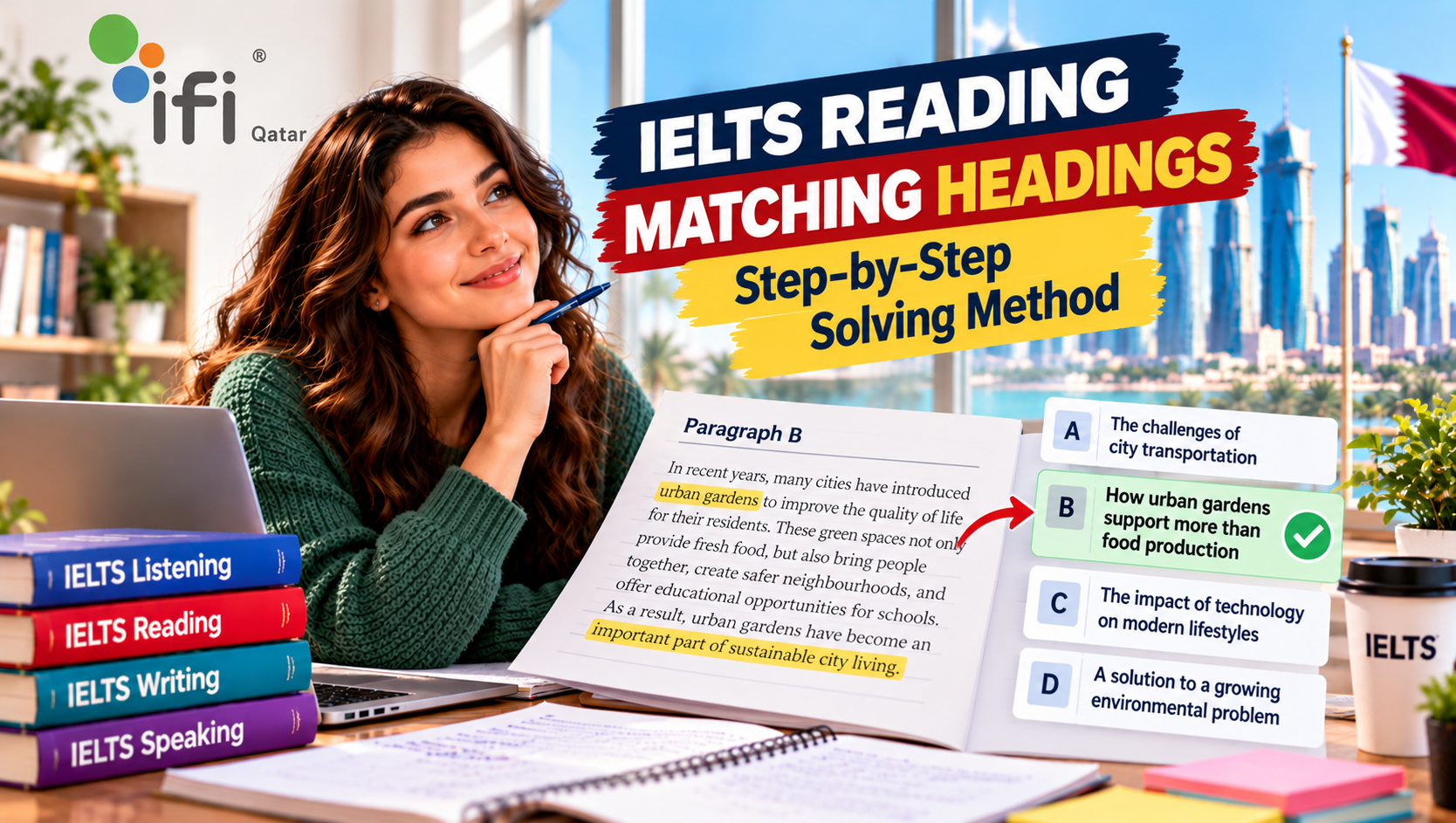
IELTS Reading matching headings questions can be challenging because they require you to understand the main idea of a paragraph rather than simply locate a word or phrase in the text. Several headings may appear relevant, and the passage may contain details that seem to match more than one option.
The key is to identify what each paragraph is mainly about and distinguish its central message from supporting examples, explanations, and minor details.
The most effective way to solve IELTS Reading matching headings questions is to understand the main idea of each paragraph first, then compare that idea with the available headings. Matching words alone is rarely enough because IELTS questions often use synonyms and paraphrases instead of repeating the exact wording from the passage.
In this guide, you will learn a step-by-step solving method, discover common mistakes to avoid, and practise with an original matching headings exercise and answer key.
What Are IELTS Reading Matching Headings Questions?
IELTS Reading matching headings questions ask you to match a list of headings with the paragraphs or sections of a reading passage.
Each heading summarises the main idea of a paragraph. Your task is to identify which heading best represents the overall message of each section.
For example, a paragraph might describe how urban trees reduce heat, improve air quality, and provide shade. A suitable heading would summarise the wider benefit of trees in cities rather than focus on one individual benefit.
What Do Matching Headings Questions Test?
This question type primarily tests your ability to:
- Identify the main idea of a paragraph.
- Understand the purpose of a section.
- Distinguish central ideas from supporting details.
- Recognise synonyms and paraphrased information.
- Compare several similar options.
- Read efficiently without translating every sentence.
These skills are important because the correct heading may express the paragraph’s meaning using different vocabulary from the original text.
How Are Matching Headings Questions Different from Matching Information?
Although the two question types may look similar, they require different approaches.
| Question type | What you need to identify |
|---|---|
| Matching Headings | The main idea of each paragraph or section |
| Matching Information | A specific detail, example, explanation, or piece of information within the passage |
For matching headings, you should focus on the overall message. For matching information, you need to locate the particular information described in the question.
Confusing these two tasks can lead you to choose headings based on isolated details rather than the paragraph’s central idea.
How to Solve IELTS Reading Matching Headings Step by Step
Follow this method whenever you encounter a matching headings task.
Step 1: Read the Instructions Carefully
Before reading the passage, check what the question asks you to do.
Look for information such as:
- How many paragraphs need headings.
- Whether all headings must be used.
- Whether some headings are extra.
- Whether the paragraphs are labelled with letters.
- Whether the instructions allow a heading to be used more than once.
In many matching headings tasks, there are more headings than paragraphs. This means some options will remain unused.
Do not assume that every heading must have an answer.
Step 2: Read All the Headings First
Read the heading list before analysing the paragraphs in detail.
Try to understand the main concept expressed by each heading. You can underline or mentally note the most important words.
For example:
- The growth of an unexpected industry
- Why an earlier method failed
- The influence of technology on human behaviour
- A solution to a widespread problem
You do not need to memorise every word. Instead, identify the main idea that each heading represents.
If two headings seem similar, note the difference between them. One may focus on a cause, while the other focuses on a result or solution.
Step 3: Read the First Paragraph for Its General Meaning
Start with the first paragraph that needs a heading.
Read it to understand what the paragraph is mainly about. Avoid stopping at every unfamiliar word unless it prevents you from understanding the overall message.
Ask yourself:
- What is the paragraph discussing?
- What point is the writer making?
- Why has this information been included?
- If I had to summarise the paragraph in one sentence, what would I say?
Your own summary is important. It prevents the heading options from influencing your interpretation too early.
Step 4: Identify the Main Idea, Not Just a Keyword
A paragraph may contain several examples, facts, or descriptions. One of these details may resemble a heading, but that does not automatically make it the correct answer.
Consider this example:
“Several schools have introduced outdoor lessons. Teachers report that students are often more engaged when learning takes place in gardens or parks. Outdoor activities can also encourage collaboration and help learners connect classroom topics with the natural environment.”
A heading such as “Learning Outside the Traditional Classroom” summarises the overall message.
A heading such as “The Benefits of School Gardens” might seem relevant, but it could be too narrow if the paragraph discusses outdoor learning more broadly.
The best heading represents the whole paragraph, not just one sentence.
Step 5: Pay Attention to the First and Last Sentences
The first sentence often introduces the paragraph’s main idea, while the final sentence may explain its significance or draw a conclusion.
However, this is not a fixed rule. Sometimes the central point appears in the middle, or the paragraph develops an argument gradually.
A useful approach is to read the opening and closing sentences carefully, then scan the remaining sentences to confirm the paragraph’s overall meaning.
Never choose a heading based only on the first sentence without checking the rest of the paragraph.
Step 6: Match Your Summary to the Headings
Once you understand the paragraph, compare your summary with the available options.
Look for a heading that captures the same central meaning, even if the vocabulary differs.
For example, the passage might describe how workers become more productive when they have greater control over their schedules. The heading may express this as “The Relationship Between Flexibility and Performance” rather than repeat the words used in the paragraph.
This is where recognising paraphrases becomes particularly important.
Step 7: Eliminate Headings That Are Too Narrow or Too Broad
If several headings seem possible, examine what each one actually covers.
A heading may be incorrect because it:
- Describes only one example.
- Focuses on a minor detail.
- Introduces a topic that the paragraph does not discuss.
- Reverses the relationship between a cause and its result.
- Summarises only part of the paragraph.
The correct heading should match the paragraph’s main message without adding an unsupported idea.
Step 8: Confirm Your Choice Before Moving On
After selecting a heading, reread your short summary and compare it with the chosen option.
Ask whether the heading would still make sense if you removed the paragraph’s specific examples and minor details.
If it captures the main message, your choice is likely to be appropriate.
If it matches only one sentence, reconsider whether another heading represents the paragraph more accurately.
Step 9: Use the Remaining Headings Carefully
If a heading is clearly correct for one paragraph, remove it from consideration where the instructions require each heading to be used only once.
For the remaining paragraphs, compare the unused options with their main ideas.
However, do not force a weak match simply because an option remains unused. Recheck the paragraph and the instructions if you cannot find a convincing answer.
Step 10: Review Your Answers
When you have matched all the paragraphs, check your choices again.
Make sure each heading reflects the overall meaning of the corresponding paragraph and that you have followed the task instructions.
If time is limited, prioritise answers where you were uncertain rather than rereading the entire passage from the beginning.
How to Identify the Main Idea of a Paragraph
Recognising the main idea is the most important skill in matching headings. The following techniques can help you develop it.
Look for the Paragraph’s Central Purpose
A paragraph may introduce a problem, explain a cause, describe a change, compare alternatives, present a solution, or challenge an existing belief.
Identifying its purpose can help you narrow down the headings.
For example, if a paragraph explains why a previously successful farming method became less effective, a heading about the reasons for declining effectiveness may be more suitable than one about the history of farming.
Separate the Main Idea from Supporting Details
Supporting details help explain or prove the main point. They may include:
- Statistics.
- Research findings.
- Examples.
- Historical events.
- Quotations.
- Specific people or locations.
These details can help you understand the paragraph, but they are not necessarily its main idea.
If a paragraph contains three examples that all illustrate the same broader point, choose a heading that summarises the shared idea rather than one that describes just one example.
Watch for Contrast and Change
Words such as “however”, “although”, “nevertheless”, and “in contrast” can signal an important shift in the argument.
A paragraph may begin by describing an established belief and then explain why new evidence challenges it.
In such cases, the main idea may be the change in understanding rather than the original belief.
Notice Cause-and-Effect Relationships
Some headings summarise why something happened or what resulted from a particular development.
Look for expressions such as “as a result”, “because of”, “therefore”, and “this led to”. These can help you identify whether the paragraph focuses on a cause, a consequence, or a relationship between the two.
Common IELTS Matching Headings Mistakes
Understanding what not to do is just as important as learning the correct method.
Choosing a Heading Because It Repeats a Word
A heading may contain a word that appears several times in a paragraph, but the overall meaning may not match.
IELTS often tests understanding through paraphrasing. A heading with different vocabulary may be correct, while an option containing familiar words may refer to the wrong idea.
Always compare meanings rather than count matching words.
Reading Too Quickly to Understand the Argument
Skimming is useful, but reading so quickly that you miss the paragraph’s purpose can lead to incorrect choices.
If two headings appear plausible, slow down and examine how the ideas are connected. The distinction may depend on whether the paragraph explains a cause, describes an outcome, or presents a limitation.
Focusing on One Interesting Example
A paragraph about transport might mention electric buses, cycling, and pedestrian areas. Choosing a heading about electric buses alone would overlook the wider argument if all three examples support a broader idea about sustainable urban transport.
The heading should cover the paragraph as a whole.
Spending Too Long on One Paragraph
One difficult paragraph can consume valuable time if you repeatedly compare every heading.
If you cannot decide, write a brief summary, eliminate clearly unsuitable options, and move on temporarily if necessary. Return to the question after solving easier paragraphs.
Assuming the First Sentence Always Contains the Answer
Topic sentences are helpful, but the main idea is not always stated immediately.
Some paragraphs begin with a historical example, a question, or a contrasting viewpoint before revealing the central argument.
Read enough of the paragraph to understand its complete message.
Ignoring the Meaning of the Entire Passage
The surrounding passage can provide context about the subject and the writer’s argument. Use that context when needed, but do not let the general topic replace the specific meaning of the paragraph.
Two paragraphs about the same subject can have very different main ideas.
IELTS Reading Matching Headings Practice Exercise
The following original exercise will help you apply the step-by-step method. Read each paragraph, identify its main idea, and select the most appropriate heading.
List of Headings
i. How urban gardens support more than food production
ii. The financial risks of introducing new technology
iii. Why traditional farming methods are disappearing
iv. A change in the way people learn new skills
v. The limitations of relying on digital communication
vi. The importance of designing cities for warmer climates
Paragraph A
Community gardens are often created to provide residents with access to fresh vegetables. However, their benefits can extend well beyond food production. Shared gardening activities bring neighbours together, provide opportunities for people to exchange practical knowledge, and create green spaces in densely populated areas. In some neighbourhoods, these gardens have also become places where schools organise environmental activities.
Paragraph B
In the past, people often developed practical skills through long periods of observation and direct guidance from experienced workers. Today, online tutorials and short digital courses allow learners to access information independently. Although hands-on experience remains important, the process of acquiring knowledge has become more flexible, with many people combining online learning and practical training.
Paragraph C
Installing advanced equipment can help a company improve efficiency, but the initial investment may create financial pressure. Businesses must consider purchase costs, staff training, maintenance, and the possibility that the equipment may become outdated. If the expected productivity gains do not materialise, the organisation may struggle to recover its investment.
Questions 1–3
Choose the correct heading for each paragraph.
Question 1: Paragraph A
Question 2: Paragraph B
Question 3: Paragraph C
Answer Key and Explanations
Question 1: i — How urban gardens support more than food production
The paragraph begins by mentioning fresh vegetables, but its central focus is the wider social, educational, and environmental benefits of community gardens. A heading focused only on food production would be too narrow.
Question 2: iv — A change in the way people learn new skills
The paragraph contrasts traditional learning through observation and guidance with modern digital learning. Its main idea is the change in how people acquire skills, not the advantages or disadvantages of technology alone.
Question 3: ii — The financial risks of introducing new technology
The paragraph discusses investment costs, training, maintenance, outdated equipment, and the risk of failing to recover expenses. These details all support the central idea of financial risk.
What Can You Learn from This Exercise?
Notice that the correct headings do not simply repeat the most obvious words from the paragraphs.
Paragraph A mentions vegetables, but the main idea is broader than food. Paragraph B discusses online courses, but its focus is the changing process of learning. Paragraph C describes several costs, but the shared idea is financial risk.
This is the central principle of matching headings: identify the idea that connects the paragraph’s details.
How to Improve Your IELTS Reading Matching Headings Score
Learning the method is the first step. Consistent practice will help you apply it more efficiently under exam conditions.
Practise Summarising Paragraphs in One Sentence
Choose a short article and write a one-sentence summary for each paragraph before looking at any headings.
This forces you to identify the central message independently. Once you can do this consistently, matching your summary to a heading becomes easier.
Build Your Paraphrasing Skills
Create a vocabulary list of common synonyms and related expressions.
For example:
- Increase — rise, grow, expand.
- Problem — issue, challenge, difficulty.
- Cause — reason, factor, explanation.
- Result — outcome, consequence, effect.
- Change — shift, transformation, development.
These words are not interchangeable in every context, so learn them through sentences rather than memorising isolated lists.
Review Every Incorrect Answer
After completing a practice exercise, identify why your choice was wrong.
Ask yourself whether you selected a heading because of one keyword, missed a contrast, misunderstood the paragraph, or chose an option that was too specific.
Understanding the reason for a mistake is more useful than simply memorising the correct answer.
Practise Under Timed Conditions
Untimed exercises help you develop the method, but you also need to practise using it efficiently.
Gradually introduce time limits and complete matching headings questions as part of full IELTS Reading practice tests.
This will help you manage the task alongside other question types and become more comfortable making decisions without repeatedly rereading the passage.
Use Reading Mock Tests to Track Progress
A Reading mock test allows you to practise multiple question types under timed conditions. It can help you identify whether matching headings is your main weakness or whether other skills, such as locating specific information or understanding complex sentences, also need attention.
After each test, record your score, review incorrect answers, and choose one or two areas to improve before the next attempt.
Frequently Asked Questions About IELTS Reading Matching Headings
What is the best strategy for IELTS Reading matching headings?
Read the headings first, identify the main idea of each paragraph, and then match your summary to the heading that best represents the whole paragraph. Focus on meaning rather than repeated keywords.
Should I read the whole passage before matching headings?
You do not always need to read the entire passage in detail before answering. Reading the headings first and then analysing the relevant paragraphs can be efficient. Use the wider passage for context when necessary.
How do I distinguish between two similar headings?
Compare the central ideas each heading expresses. Check whether one is too narrow, too broad, or focused on a different aspect of the paragraph. Look at the paragraph as a whole rather than relying on one sentence.
Are matching headings questions difficult in IELTS Reading?
They can be challenging because they require you to understand the overall meaning of a paragraph and distinguish it from supporting details. With practice in summarising paragraphs and recognising paraphrases, the task can become more manageable.
Can I use the same heading more than once?
Follow the instructions for the specific task. In many matching headings exercises, each heading can be used only once and some headings are not needed. Always check the wording rather than assume the rules are identical in every task.
Should I read every word of the paragraph?
Not necessarily. Read for general meaning first, then examine particular sentences when you need to confirm your interpretation. If an unfamiliar word does not affect the main idea, you may not need to stop and analyse it.
How can I improve my speed in matching headings questions?
Practise identifying the main idea quickly, summarising paragraphs in one sentence, and recognising paraphrased language. Timed practice can help you develop a balance between speed and accuracy.
Do IELTS Reading mock tests help with matching headings?
Yes. Reading mock tests let you practise matching headings under timed conditions and review your decisions alongside other question types. Analysing incorrect answers can help you identify recurring weaknesses and improve your approach.
Practise IELTS Reading with IFI Qatar
Improving your IELTS Reading score involves more than reading quickly. You need to understand how a passage is organised, identify the main ideas, and recognise how writers express the same meaning in different words.
Start by applying the step-by-step method to individual paragraphs. Then practise matching headings in timed exercises and full Reading mock tests. Review every incorrect answer to understand whether the problem was identifying the main idea, recognising paraphrases, or distinguishing a central message from a supporting detail.
Ready to put your Reading skills into practice? Explore the IELTS Reading practice and mock-test options available through IFI Qatar to assess your current performance, build confidence with different question types, and identify the areas that deserve more attention before your official exam.