

Currently Empty: ر.ق 0,00


IELTS
How to Find Your Current English Level Before Choosing a Course
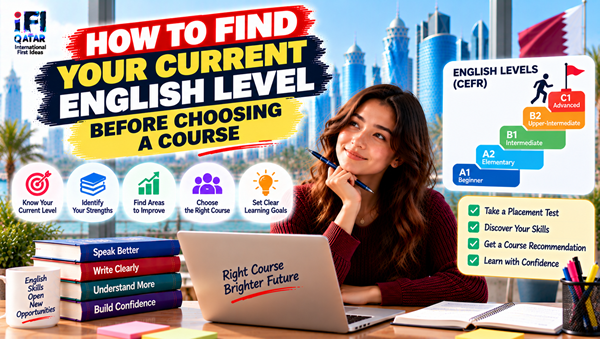
Choosing an English course is easier when you know what you can already do in English. You might understand conversations but struggle to speak confidently, read articles comfortably but make frequent grammar mistakes, or communicate well at work while finding formal writing difficult.
These differences matter because your English level is not determined by one skill alone. Choosing a course that is too easy can slow your progress, while joining a class that is too advanced may leave you struggling to keep up.
An English level test is a practical starting point. It helps identify your current abilities, highlight areas for improvement and guide you towards a course that matches your needs.
At IFI Qatar, learners can explore English language programmes across levels from A1 to C1. Before choosing your next course, discover how to assess your current level and why a structured placement assessment can help you make a more informed decision.
Why Should You Take an English Level Test Before Choosing a Course?
An English level test helps you understand your current proficiency instead of relying on assumptions about your ability.
You may have studied English for years, but the amount of time you have spent learning does not necessarily reflect your present skills. Your level depends on how effectively you can understand and use English in real situations.
Taking a placement assessment before enrolling can help you:
- Choose a course that matches your current ability.
- Identify strengths and weaknesses across different language skills.
- Avoid repeating material you already understand.
- Recognise areas that require additional practice.
- Set realistic learning goals.
- Make better use of your time and course investment.
For example, you might have strong reading comprehension but limited confidence in speaking. An assessment can help distinguish these needs and guide a more suitable learning plan.
The goal is not simply to receive a level label. It is to understand what you can do in English now and what you need to develop next.
What Are the Different English Language Levels?
English courses commonly use the Common European Framework of Reference for Languages (CEFR) to describe proficiency. The framework includes six main levels, from A1 for beginners to C2 for highly proficient users.
| CEFR level | General ability | What it means in practice |
|---|---|---|
| A1 – Beginner | Understands and uses basic expressions | Can introduce themselves and answer simple questions |
| A2 – Elementary | Communicates in familiar, routine situations | Can discuss everyday needs using simple language |
| B1 – Intermediate | Handles many familiar situations independently | Can describe experiences, explain plans and understand the main points of clear speech |
| B2 – Upper-intermediate | Communicates with greater fluency and independence | Can discuss a range of topics and understand more complex texts |
| C1 – Advanced | Uses English effectively in complex situations | Can communicate fluently and organise ideas clearly for academic or professional purposes |
| C2 – Proficient | Understands almost everything with ease | Can express subtle meanings and communicate with a high degree of precision |
These descriptions are general guidelines, not test results. A learner may perform differently across speaking, listening, reading and writing.
IFI Qatar offers English language learning options across levels from A1 to C1. A placement assessment can help you understand which level to explore before selecting a suitable programme.
How Can You Find Your Current English Level?
There are several ways to estimate your English proficiency. Each method provides different information, so it is useful to understand what it can and cannot tell you.
1. Take an English Level Test
An English level test is one of the most direct ways to begin assessing your proficiency. Depending on its design, it may evaluate grammar, vocabulary, reading comprehension, listening or other language skills.
A short online test can provide an initial indication of your level, but it may not give a complete picture of your communication abilities.
For example, multiple-choice questions can measure your understanding of grammar rules, but they cannot fully demonstrate how confidently you participate in a conversation or organise a written argument.
For a more useful assessment, choose an option that considers the skills relevant to your learning goals.
2. Assess Your Speaking Ability
Ask yourself how comfortably you can communicate in English without preparing every sentence in advance.
Consider these questions:
- Can you introduce yourself and describe your daily routine?
- Can you explain an experience in several connected sentences?
- Can you express an opinion and support it with reasons?
- Can you participate in a discussion about unfamiliar topics?
- Can you explain complex ideas clearly and respond naturally to follow-up questions?
If you can answer basic questions but struggle to develop longer responses, speaking practice may be an important priority.
If you can communicate comfortably but frequently search for words or make grammatical errors, your next step may involve improving fluency, accuracy and vocabulary.
A speaking assessment can help reveal these differences more clearly than a grammar quiz alone.
3. Check Your Listening Comprehension
Listening ability affects how well you follow conversations, understand instructions and respond appropriately.
Try listening to a short English conversation, interview or educational video without subtitles. Then summarise the main idea and identify important details.
Pay attention to whether you can:
- Understand the main message.
- Recognise specific information.
- Follow connected speech at a natural pace.
- Understand unfamiliar words from context.
- Distinguish the speaker’s main point from supporting details.
If you understand written English much better than spoken English, listening practice may need greater attention in your learning plan.
4. Evaluate Your Reading Skills
Reading provides useful information about your vocabulary, comprehension and ability to understand written ideas.
Choose an article appropriate to your interests and read it without translating every sentence. Then try to explain its main argument and identify the important details.
Ask yourself:
- Can I understand the main idea quickly?
- Can I identify supporting points?
- Can I understand unfamiliar words from context?
- Can I follow longer paragraphs and connected arguments?
- Can I distinguish facts, opinions and implications?
The purpose is not to understand every word. It is to determine how effectively you can understand the text as a whole.
5. Review Your Writing Ability
Writing reveals skills that may not be obvious during conversation. You might speak confidently but struggle to organise a formal email, explain an argument or use accurate grammar in longer sentences.
Write a short paragraph about a familiar topic. Then review whether you can:
- Organise ideas logically.
- Use appropriate vocabulary.
- Construct accurate sentences.
- Connect ideas naturally.
- Explain your meaning without excessive repetition.
- Check spelling, punctuation and grammar.
For a more useful assessment, ask a qualified teacher or language professional to review your writing. Self-correction can be helpful, but you may overlook errors that have become habitual.
Is an Online English Level Test Enough?
An online English level test can be a convenient first step, particularly when you want to estimate your proficiency before contacting a course provider.
However, not all tests measure the same skills or use the same scoring methods.
| Assessment method | Main benefit | Important limitation |
|---|---|---|
| Short online quiz | Quick indication of grammar and vocabulary knowledge | May not assess speaking or writing |
| Online proficiency test | Can provide a broader estimate, depending on its design | Accuracy and coverage vary by provider |
| Self-assessment checklist | Helps you reflect on everyday communication | Depends on your own judgement |
| Teacher-led placement assessment | Can explore communication skills and learning needs | The depth and format depend on the assessment |
| Formal proficiency examination | Provides results under a defined testing system | May be unnecessary when you only need to choose a general English course |
A short quiz is useful for orientation, but it should not automatically determine which course you join.
If your results are unclear, or your skills vary significantly, a more comprehensive placement assessment can help you make a better-informed decision.
What Should an English Placement Assessment Measure?
A useful placement assessment should consider your current abilities and the purpose for which you want to learn English.
Grammar and Vocabulary
Grammar and vocabulary help you construct sentences, express meaning accurately and understand other speakers.
An assessment may explore your understanding of sentence structure, verb forms, word choice and common grammatical patterns.
The aim is not to memorise rules for a test. It is to identify which language features you can use confidently and which need further practice.
Speaking and Communication
Speaking assessment can help reveal how effectively you express ideas, respond to questions and maintain a conversation.
Relevant factors may include fluency, vocabulary, grammatical accuracy, pronunciation and the ability to organise your thoughts.
Listening and Reading
These receptive skills show how well you understand spoken and written English.
Your results may indicate whether you need more practice understanding the main idea, locating details, following longer explanations or interpreting unfamiliar language.
Writing Skills
Writing assessment can show how effectively you organise information, connect ideas and use grammar and vocabulary in context.
Depending on your goals, writing may include everyday messages, emails, paragraphs or more formal texts.
Important: The exact skills covered depend on the placement assessment offered by the provider. Before booking, ask which components are included and how the results will be used to recommend a course.
How Do You Choose the Right English Course After Your Test?
Once you have an estimate of your level, the next step is to match it with your goals.
Choose a Course That Matches Your Current Ability
If you are new to English, you may need to develop basic vocabulary, sentence patterns and everyday communication.
If you can already communicate in familiar situations, you may benefit from more extensive speaking practice, improved grammatical accuracy and broader vocabulary.
At higher levels, you may want to focus on expressing complex ideas, understanding detailed texts, writing more precisely or communicating effectively in professional and academic settings.
Your assessment results should help you identify an appropriate starting point rather than push you towards the highest possible course level.
Consider Why You Want to Learn English
Your purpose affects which skills deserve the most attention.
| Your goal | Skills to prioritise |
|---|---|
| Everyday communication | Speaking, listening and practical vocabulary |
| Workplace communication | Meetings, professional vocabulary, speaking and writing |
| Academic study | Reading comprehension, structured writing, listening and discussion |
| IELTS preparation | The four IELTS skills and the requirements of your target test |
| Greater confidence | Regular speaking practice, listening and feedback |
A general English course and an IELTS preparation course serve different purposes. If your immediate goal is an IELTS score, make sure the programme addresses the exam format as well as the English skills you need to improve.
Ask What Happens After the Assessment
Before enrolling, find out how your results will guide the next step.
Useful questions include:
- Will I receive a recommended course level?
- Can I discuss my strengths and weaknesses?
- Does the recommendation consider my learning goals?
- Which skills will the course develop?
- How will I monitor my progress?
These questions help you evaluate whether the course is appropriate for your needs, rather than selecting a programme based on its name alone.
English Level Test in Qatar: Find the Right Starting Point with IFI Qatar
If you are looking for English classes in Doha, determining your current level is a practical first step before choosing a programme.
IFI Qatar provides English language learning options across levels from A1 to C1. Instead of guessing which level is right for you, contact the team to ask about placement assessment options and the most suitable course for your current ability and goals.
A clear starting point can help you focus on the right skills, set realistic expectations and choose a learning path that fits your needs.
How to Request a Placement Assessment
- Contact IFI Qatar: Explain that you want to identify your current English level before enrolling.
- Discuss your goals: Share whether you need English for everyday communication, work, academic study or IELTS preparation.
- Ask about the assessment: Confirm the available assessment format, the skills covered and whether an appointment is required.
- Review your course options: Use the assessment recommendation and your goals to decide which programme to consider.
Contact IFI Qatar to discuss your next step:
- Location: 16th Floor, Laffan Tower, West Bay, Doha, Qatar
- Phone: +974 4037 9708
- Email: info@ifi.qa
- Website: https://ifi.qa/
Ready to find your English level? Contact IFI Qatar and ask about placement assessment options before choosing your course.
Frequently Asked Questions About English Level Tests
How can I check my English level for free?
You can start with a free online English quiz or a self-assessment checklist. These tools can provide an initial estimate, but their coverage and accuracy vary. If you need a more reliable basis for choosing a course, ask the provider about its placement assessment.
What is the difference between an English level test and an English placement test?
An English level test estimates your current proficiency. An English placement test is generally used to help determine which class or course level is appropriate for you. The terms are sometimes used interchangeably, so check what the specific assessment measures.
How long does an English placement test take?
The duration depends on the provider and the skills being assessed. A short online quiz may take only a few minutes, while an assessment that includes speaking, writing, listening and reading may take longer. Ask the provider for the expected duration before booking.
Can I have different English levels in speaking and writing?
Yes. Language skills do not always develop at the same pace. You might understand conversations well but find it difficult to write accurately, or you may read confidently but struggle to speak spontaneously. A broader assessment can help identify these differences.
What is the highest English level?
Under the CEFR framework, C2 is the highest of the six proficiency levels. However, reaching C2 is not necessary for every learner or goal. The level you need depends on your personal, academic or professional requirements.
Should I take an English level test before joining an IELTS course?
It can be helpful, particularly if you are unsure whether you need to develop general English skills before focusing on IELTS techniques. An assessment can help identify language gaps and guide your preparation priorities. Your IELTS target score and current performance should also inform your study plan.
Does an English level test guarantee that I will be placed in the correct class?
No assessment can guarantee a perfect match in every case. The usefulness of the recommendation depends on the assessment’s coverage, the information you provide and the provider’s placement process. Ask how the results are interpreted and whether you can discuss your recommended level before enrolling.
Final Thoughts
Finding your current English level is about more than receiving a score. It is about understanding what you can already do, recognising where you need support and choosing a course that helps you move forward.
An online quiz can be a useful first step, but a suitable placement assessment may provide a clearer picture of your abilities and learning priorities.
If you are planning to study English in Doha, contact IFI Qatar to discuss placement assessment options and explore the available English language programmes. Start with a level that reflects your current skills, then build a learning plan around your goals.