

Currently Empty: ر.ق 0,00


IELTS
IELTS Speaking Questions 2026: Part 1, Part 2 and Part 3 Practice
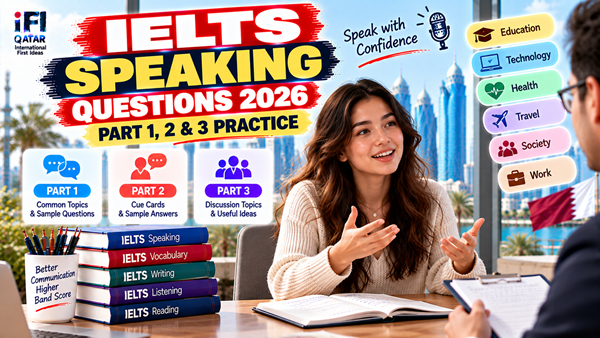
Preparing for the IELTS Speaking test becomes easier when you know how to practise different question types, organise your answers and express your ideas naturally. If your exam is approaching, working through a range of IELTS Speaking questions 2026 can help you become more confident and identify the areas that need improvement.
The IELTS Speaking test assesses your ability to communicate in English through an interview with an examiner. You will answer questions about familiar subjects, speak at length about a particular topic and discuss broader issues related to your ideas and experiences.
This guide provides practical IELTS Speaking questions for Parts 1, 2 and 3, along with sample answers, cue cards and preparation strategies. The questions are designed to help you practise common themes such as education, technology, work, travel, hobbies, health and the environment.
Important: These are practice questions, not an official list of confirmed IELTS questions for 2026. The exact questions you receive may differ. Use them to develop flexible speaking skills rather than memorising complete answers.
What Is the IELTS Speaking Test Format?
The IELTS Speaking test lasts approximately 11–14 minutes and consists of three parts. The format is the same for IELTS Academic and IELTS General Training.
| Part | Duration | What you need to do |
|---|---|---|
| Part 1: Introduction and interview | 4–5 minutes | Answer questions about familiar topics and personal experiences. |
| Part 2: Individual long turn | 3–4 minutes, including preparation | Prepare for one minute and speak for up to two minutes about a topic on a cue card. |
| Part 3: Discussion | 4–5 minutes | Discuss broader, more abstract questions connected to the Part 2 topic. |
Examiners assess four main criteria throughout the test:
- Fluency and Coherence: How smoothly you speak and organise your ideas.
- Lexical Resource: How accurately and flexibly you use vocabulary.
- Grammatical Range and Accuracy: The variety and accuracy of your grammatical structures.
- Pronunciation: How clearly and intelligibly you speak.
You do not need to use complicated vocabulary in every sentence to perform well. Your priority should be to communicate clearly, develop relevant ideas and use English accurately.
IELTS Speaking Part 1 Questions 2026
Part 1 focuses on familiar subjects, including your home, work, studies, interests and everyday activities. The examiner usually asks several short questions about a few topics.
The aim is to answer naturally and provide enough information to demonstrate your speaking ability without turning every response into a long speech.
Topic 1: Work or Studies
These questions help you practise discussing your education, career and future plans.
- Do you work or are you a student?
- Why did you choose your current job or field of study?
- What do you enjoy most about your work or studies?
- Is there anything you would like to change about your job or studies?
- What would you like to do in the future?
Sample question: What do you enjoy most about your studies?
Sample answer:
“What I enjoy most is learning things that I can apply in real life. I particularly like subjects that involve problem-solving because they encourage me to think independently. I also enjoy working with other students and exchanging ideas.”
Why this answer works: It answers the question directly, provides a reason and develops the response with relevant detail.
Topic 2: Hometown and Accommodation
Practise talking about where you live and the places that are familiar to you.
- Where is your hometown?
- What do you like most about living there?
- Has your hometown changed much in recent years?
- Do you prefer living in a house or an apartment?
- Is there anything you would like to improve about your neighbourhood?
Sample question: What do you like most about your hometown?
Sample answer:
“What I like most is the sense of community. People are generally familiar with their neighbours, and there are several places where families can spend time together. I also appreciate the local food and the fact that many important facilities are within easy reach.”
Topic 3: Technology
Technology is a useful practice theme because it connects to daily routines, communication, education and entertainment.
- What electronic device do you use most often?
- How has technology changed the way you communicate?
- Do you prefer reading on paper or on a screen?
- Is there a technological device you would like to own?
- Do you think you spend too much time using your phone?
Sample question: What electronic device do you use most often?
Sample answer:
“I use my smartphone more than any other device. It helps me communicate with friends, organise my schedule and access information quickly. However, I try to limit unnecessary screen time, especially when I need to concentrate on studying.”
Topic 4: Hobbies and Free Time
These questions help you practise describing your interests, habits and preferences.
- What do you usually do in your free time?
- Do you prefer spending your free time alone or with other people?
- Have your hobbies changed since you were a child?
- Is there a new activity you would like to try?
- How important is it to have a hobby?
Sample question: How do you usually spend your free time?
Sample answer:
“I usually spend my free time reading, going for walks or meeting friends. I find these activities relaxing because they help me take a break from my daily responsibilities. Recently, I’ve also been trying to spend less time on social media.”
Topic 5: Food and Cooking
Food-related questions give you an opportunity to describe preferences, routines and experiences.
- Do you enjoy cooking?
- What kind of food do you eat most often?
- Did you learn to cook when you were young?
- Do you prefer eating at home or in restaurants?
- Has your diet changed over the years?
Sample question: Do you enjoy cooking?
Sample answer:
“Yes, although I wouldn’t say I’m an expert. I enjoy preparing simple meals because I can choose the ingredients and adjust them to my taste. I also think cooking at home is a useful life skill.”
Topic 6: Travel and Holidays
Practise describing places, travel preferences and memorable experiences.
- Do you enjoy travelling?
- Do you prefer travelling alone or with other people?
- What kind of places would you like to visit?
- What do you usually do when you go on holiday?
- Do you prefer relaxing holidays or adventurous ones?
Sample question: What kind of places would you like to visit?
Sample answer:
“I’d love to visit places with a combination of natural scenery and cultural attractions. I enjoy exploring historic neighbourhoods and trying local food, but I also like spending time outdoors. That combination makes a trip more interesting for me.”
IELTS Speaking Part 2 Cue Cards 2026
In Part 2, the examiner gives you a task card with a topic and points to cover. You have one minute to prepare and can make notes before speaking for up to two minutes.
A useful answer usually includes an introduction, a clear sequence of details and a short conclusion. You do not need to address the bullet points as separate, disconnected answers; use them to organise one coherent talk.
The following cue cards are practice prompts covering useful IELTS themes.
Cue Card 1: Describe a Person Who Has Influenced You
You should say:
- Who this person is
- How you know this person
- What qualities this person has
- And explain how this person has influenced you
How to prepare your answer:
Choose someone you can describe comfortably, such as a teacher, family member, friend or colleague. Think of one specific experience that demonstrates the person’s influence.
Sample answer:
“One person who has influenced me considerably is a teacher I had at school. I first met her when I was preparing for an important examination, and she quickly became someone I respected.
What impressed me most was her patience. Whenever students struggled with a difficult concept, she explained it in different ways rather than simply repeating the same information. She also encouraged us to ask questions and learn from our mistakes.
I remember that I was quite nervous about making mistakes in front of other people. Her encouragement helped me become more confident and willing to participate in class.
Even today, I try to approach difficult tasks with the same patience she demonstrated. I think her influence was important because she taught me not only academic knowledge but also how to keep improving.”
Cue Card 2: Describe a Skill You Would Like to Learn
You should say:
- What the skill is
- Why you want to learn it
- How you would learn it
- And explain how this skill could benefit you
Ideas to consider: Learning a language, cooking, public speaking, photography or a digital skill.
Sample answer:
“A skill I’d really like to develop is public speaking. Although I can communicate comfortably in everyday situations, speaking in front of a large audience requires a different level of confidence and preparation.
I’d like to improve because public speaking could be useful in my professional life. It would help me explain ideas clearly, present projects and participate more confidently in meetings.
To develop this skill, I’d start by practising short presentations at home and recording myself. After that, I’d look for opportunities to speak in front of small groups and ask for feedback.
I think the most challenging part would be controlling my nerves, but regular practice would probably make that easier. Ultimately, I believe public speaking would help me become a more effective communicator.”
Cue Card 3: Describe a Memorable Trip
You should say:
- Where you went
- Who you went with
- What you did there
- And explain why the trip was memorable
Sample answer:
“One trip I remember particularly well was a short holiday I took with a few friends. We visited a coastal town that was very different from the busy city where we lived.
During the trip, we explored the local area, tried traditional dishes and spent time walking along the waterfront. We hadn’t planned every activity in advance, so we had the freedom to discover places that weren’t on our original itinerary.
What made the trip memorable was the relaxed atmosphere. I enjoyed having time to talk with my friends without worrying about work or other responsibilities.
It also reminded me that travelling doesn’t always have to involve expensive hotels or a complicated schedule. Sometimes, a simple trip with good company can be just as enjoyable.”
Cue Card 4: Describe a Piece of Technology You Find Useful
You should say:
- What the technology is
- When you started using it
- What you use it for
- And explain why you find it useful
Sample answer:
“One piece of technology I find particularly useful is my laptop. I use it for studying, communicating with other people and managing different tasks.
I started using a laptop regularly when I needed to access online learning resources. Since then, it has become an essential part of my daily routine.
One of its biggest advantages is that it allows me to work efficiently. I can research a topic, organise my notes and complete assignments without switching between several devices. It also gives me access to educational materials that would otherwise be difficult to find.
Of course, technology can sometimes be distracting, so I try to turn off unnecessary notifications when I need to focus. Overall, I find my laptop valuable because it helps me learn and work more effectively.”
Cue Card 5: Describe a Book or Article You Found Interesting
You should say:
- What it was about
- When you read it
- Why you chose it
- And explain what you learned from it
Sample answer:
“One book I found interesting was a book about developing better habits. I started reading it because I wanted to manage my time more effectively and become more consistent with my daily routines.
The book explained how small, repeated actions can gradually lead to meaningful changes. Rather than suggesting that people should transform their lives overnight, it focused on making realistic improvements and tracking progress.
What I found most useful was the idea of breaking a large goal into smaller tasks. I’ve tried applying that approach to studying by setting specific daily objectives instead of simply telling myself to study more.
I enjoyed the book because its advice was practical and easy to apply. It encouraged me to think about how my everyday decisions influence my long-term goals.”
Cue Card 6: Describe a Time You Solved a Problem
You should say:
- What the problem was
- When it happened
- What you did to solve it
- And explain how you felt afterwards
Sample answer:
“I remember a time when I had to complete an important project within a short deadline. At first, I felt overwhelmed because there were several tasks to finish and I wasn’t sure where to begin.
Instead of trying to do everything at once, I divided the project into smaller steps and decided which tasks were most urgent. I also asked a colleague for advice about one part that I found particularly difficult.
Gradually, the work became more manageable, and I was able to complete the project on time.
Afterwards, I felt relieved and more confident. The experience taught me that staying organised and asking for help when necessary can be more effective than trying to handle every problem alone.”
Cue Card 7: Describe a Place Where You Like to Relax
You should say:
- Where the place is
- How often you go there
- What you do there
- And explain why you find it relaxing
Sample answer:
“A place where I like to relax is a quiet park not far from where I live. I try to visit it whenever I have some free time, particularly at the weekend.
The park has walking paths, trees and several places where people can sit. I usually walk for a while and then find a quiet spot to read or listen to music.
I like this place because it offers a break from the noise and activity of the city. Spending time outdoors helps me clear my mind and return to my responsibilities feeling refreshed.
I don’t need to do anything particularly exciting there. Simply being in a peaceful environment is enough to help me relax.”
Cue Card 8: Describe a Goal You Would Like to Achieve
You should say:
- What the goal is
- Why it is important to you
- What you need to do to achieve it
- And explain how you would feel if you achieved it
Sample answer:
“One goal I’d like to achieve is improving my English enough to communicate confidently in academic and professional situations.
This goal matters to me because English can create opportunities for further education, international communication and career development.
To achieve it, I need to practise regularly rather than study only when I have an examination coming up. My plan would include reading, listening to English content, expanding my vocabulary and speaking with other people whenever possible.
I also want to become more comfortable making mistakes, because I think worrying too much about accuracy can sometimes prevent people from communicating.
If I achieve this goal, I’d feel proud because it would represent consistent effort over time. More importantly, I’d be able to use English as a practical skill rather than simply as a subject to study.”
IELTS Speaking Part 3 Questions 2026
Part 3 develops ideas related to the Part 2 topic. Questions are usually broader and may ask you to compare situations, explain social changes, discuss advantages and disadvantages or predict future developments.
Your answers should generally include a clear opinion, an explanation and a relevant example or consequence.
Education
- How has education changed in recent decades?
- Should schools place more emphasis on practical skills?
- What are the advantages and disadvantages of online learning?
- How important are teachers compared with digital learning resources?
- Should university education be available to everyone?
Sample question: What are the advantages and disadvantages of online learning?
Sample answer:
“One major advantage is flexibility. Students can access educational materials from different locations and often study at a time that suits their schedule. Online learning can also make certain courses available to people who live far from educational institutions.
However, it requires self-discipline, and some students may find it difficult to stay motivated without direct interaction with teachers and classmates. In addition, not everyone has reliable internet access or a suitable study environment.
I think online learning is most effective when it combines flexibility with appropriate support and opportunities for interaction.”
Technology
- How has technology changed the way people communicate?
- Do you think artificial intelligence will create more jobs or eliminate them?
- Should children have unrestricted access to digital devices?
- What problems can excessive dependence on technology create?
- How might technology change workplaces in the future?
Sample question: How has technology changed the way people communicate?
Sample answer:
“Technology has made communication much faster and more convenient. People can exchange messages, hold video meetings and maintain relationships across long distances without travelling.
However, digital communication can sometimes reduce opportunities for face-to-face interaction. Messages may also be misunderstood because people cannot always interpret tone or body language.
I believe technology has improved communication overall, but people still need to use it thoughtfully and maintain meaningful personal relationships.”
Health and Lifestyle
- Who should be responsible for improving public health: individuals or governments?
- Why do some people find it difficult to maintain a healthy lifestyle?
- How can cities encourage people to exercise more?
- Should schools teach children more about nutrition?
- How might modern lifestyles affect people’s well-being?
Sample question: Why do some people find it difficult to maintain a healthy lifestyle?
Sample answer:
“One reason is that people often have busy schedules and limited time for exercise or preparing balanced meals. In some cases, the cost or availability of healthier options can also be a barrier.
Work pressure and long commuting times may make it difficult to maintain consistent routines. I think employers, schools and local authorities can all contribute by making healthier choices more convenient, although individuals also need to take responsibility for their habits.”
Environment
- What environmental problems are most serious today?
- Should governments or individuals take greater responsibility for protecting the environment?
- How can cities encourage people to use public transport?
- Do you think people are more environmentally aware than they were in the past?
- What can schools do to encourage environmentally responsible behaviour?
Sample question: How can cities encourage people to use public transport?
Sample answer:
“Cities can encourage public transport by making it reliable, affordable and convenient. If buses and trains run frequently and connect residential areas with workplaces, more people may be willing to use them instead of driving.
Authorities can also improve pedestrian access and cycling facilities to make it easier to complete shorter journeys without a car. However, public transport needs to meet people’s practical needs; otherwise, they may continue to prefer private vehicles.”
Work and Careers
- What makes a job satisfying?
- Is salary more important than job satisfaction?
- How has technology changed working environments?
- Should people change careers during their working lives?
- What skills will be important for future employees?
Sample question: What makes a job satisfying?
Sample answer:
“I think job satisfaction depends on several factors, including a reasonable salary, supportive colleagues and opportunities to develop professionally. People are often more motivated when they understand the purpose of their work and feel that their contributions are valued.
Salary is certainly important because people need financial security, but it may not be enough to maintain long-term satisfaction if the working environment is stressful or there is no opportunity for growth.”
How to Give Better Answers to IELTS Speaking Questions
Practising questions is useful, but the way you answer them matters just as much. Instead of memorising complete responses, learn a flexible structure that helps you develop your ideas naturally.
Use a Simple Answer Structure for Part 1
For many Part 1 questions, try this three-step approach:
- Answer: Respond directly to the question.
- Explain: Give a reason or describe your preference.
- Expand: Add a relevant detail or short example.
For example:
Question: Do you enjoy reading?
Answer: “Yes, I do. I enjoy reading because it helps me relax and learn about subjects I might not encounter in everyday life. Recently, I’ve been reading more non-fiction because I find practical books particularly useful.”
This approach provides enough detail without forcing you to speak for too long.
Use Your One-Minute Preparation Time for Part 2
When you receive a cue card, do not try to write complete sentences. Instead, note down a few keywords that will help you remember your ideas.
For a cue card about a memorable trip, your notes might look like this:
- Where: coastal town
- When: last summer
- Who: two friends
- Activities: local food, walking, sightseeing
- Why memorable: relaxing, good company, new experiences
These notes provide a structure while allowing you to speak naturally.
Try to organise your response chronologically when describing an experience. For a person or object, you might organise it around background, important details and personal significance.
Develop Your Ideas in Part 3
Part 3 requires more explanation than Part 1. A useful approach is to state your opinion, explain why you hold it and support your reasoning with an example.
For instance:
Question: Should schools use more technology in classrooms?
Answer: “I think technology can be beneficial when it supports the learning objectives. For example, interactive tools can help students visualise difficult concepts and access additional resources. However, technology should not replace effective teaching, because students still need guidance and opportunities to discuss ideas.”
The response gives a position, explains the reasoning and acknowledges a limitation.
Common Mistakes to Avoid in the IELTS Speaking Test
Memorising Complete Answers
Memorised answers may not fit the exact question and can sound unnatural. Practise organising ideas and using flexible language instead of preparing scripts for every possible topic.
Giving Answers That Are Too Short
A one-word response rarely demonstrates your ability to develop ideas. Add a relevant reason, explanation or example when appropriate.
Using Complicated Vocabulary Incorrectly
Advanced vocabulary is useful only when it expresses the intended meaning accurately. Choose natural collocations and prioritise clarity over complexity.
Speaking Too Quickly
Speaking quickly does not automatically improve your score. Aim for a comfortable pace, clear pronunciation and logical organisation.
Ignoring Grammar and Pronunciation
Regularly review your recordings to identify repeated grammatical mistakes, unclear sounds and problems with word stress. Focus on errors that affect clarity or occur frequently.
Failing to Answer the Actual Question
Listen carefully to what the examiner asks. If the question asks you to compare two options, make the comparison explicit instead of describing only one option.
A 7-Day IELTS Speaking Practice Plan
If your exam is approaching, use this short plan to practise a range of question types.
| Day | Practice focus | Suggested activity |
|---|---|---|
| Day 1 | Part 1 | Practise work, studies, hometown and hobbies. Record your answers. |
| Day 2 | Part 1 | Practise technology, food, travel and daily routines. |
| Day 3 | Part 2 | Complete three cue cards with one-minute preparation and timed speaking. |
| Day 4 | Part 2 | Practise describing a person, a place and a memorable experience. |
| Day 5 | Part 3 | Answer broader questions about education, technology and health. |
| Day 6 | Full mock Speaking test | Complete all three parts without stopping to correct yourself. |
| Day 7 | Review and feedback | Listen to recordings, identify recurring errors and repeat selected answers. |
Keep a record of your progress. For each practice session, note one strength and two areas to improve. This helps you avoid trying to fix every aspect of your speaking at once.
How an IELTS Speaking Course Can Help You Prepare
Independent practice can help you become familiar with question types, improve fluency and expand your vocabulary. However, it can be difficult to judge your own performance accurately.
A structured IELTS Speaking course can provide opportunities to practise under realistic conditions, receive feedback and work on specific weaknesses.
Consider additional coaching if:
- You struggle to extend answers beyond one or two sentences.
- You frequently pause because you cannot organise your ideas.
- You repeat the same vocabulary or grammatical structures.
- You are unsure how your speaking compares with IELTS assessment criteria.
- You need to improve your performance before a specific test date.
Useful speaking practice should address the four official assessment criteria: fluency and coherence, lexical resource, grammatical range and accuracy, and pronunciation. A course should help you understand these criteria and apply them to your own answers rather than simply giving you scripts to memorise.
Improve Your IELTS Speaking with IFI Qatar
If you are preparing for IELTS in Qatar and want more structured practice, IFI Qatar can help you explore suitable IELTS preparation options.
A speaking-focused learning plan can help you practise different question types, build confidence and identify the areas that need the most attention before your exam.
Contact IFI Qatar to discuss IELTS preparation options and find out how speaking practice and feedback can support your target score.
Frequently Asked Questions About IELTS Speaking Questions 2026
What are the latest IELTS Speaking questions for 2026?
The practice questions in this guide cover common themes such as education, technology, health, work, travel and hobbies. They are not confirmed official questions. The exact questions in your test may differ, so use these topics to practise flexible responses rather than predict the exam.
Are IELTS Speaking questions the same for Academic and General Training?
Yes. The Speaking test format is the same for IELTS Academic and IELTS General Training. Both versions use the same three-part Speaking test and assessment criteria.
How long is the IELTS Speaking test?
The IELTS Speaking test lasts approximately 11–14 minutes. Part 1 takes around 4–5 minutes, Part 2 lasts 3–4 minutes including preparation time, and Part 3 takes around 4–5 minutes.
How long should I speak in IELTS Speaking Part 1?
Give a direct answer and develop it with a reason or relevant detail. You generally do not need to speak for two minutes on a Part 1 question. Focus on natural, relevant responses rather than trying to make every answer long.
How long should I speak in IELTS Speaking Part 2?
You have one minute to prepare and can speak for up to two minutes. Aim to develop a coherent response that addresses the cue card. Use the preparation time to note keywords and organise your ideas.
How can I improve my IELTS Speaking score?
Practise regularly, record your answers, review recurring mistakes and develop your ability to explain ideas clearly. Work on fluency, vocabulary, grammar and pronunciation. Feedback from a suitably qualified teacher can help you identify problems you may not notice yourself.
Should I memorise IELTS Speaking sample answers?
No. Sample answers can demonstrate useful vocabulary and answer structures, but memorising complete responses is not a reliable strategy. Your answers should respond directly to the question and reflect your own ideas and experiences.
What topics should I practise before IELTS Speaking?
Prepare for a range of familiar and broader topics, including work, studies, family, hometown, hobbies, technology, education, health, travel and the environment. Practise giving personal answers in Part 1, extended talks in Part 2 and reasoned opinions in Part 3.
Can an IELTS Speaking course help me achieve Band 7?
A course may help you identify weaknesses and practise the skills needed for your target band. However, no course can guarantee a particular result. Your outcome depends on your current proficiency, practice, feedback and performance on test day.
Final Thoughts: Practise Smart Before Your IELTS Exam
Preparing for IELTS Speaking is not simply about learning answers to a list of questions. It is about becoming comfortable discussing familiar subjects, organising longer responses and explaining your opinions clearly.
Use the IELTS Speaking questions 2026 in this guide to practise all three parts of the test. Record your responses, review your mistakes and focus on making steady improvements in fluency, vocabulary, grammar and pronunciation.
If you want structured practice and feedback before your exam, contact IFI Qatar to explore IELTS preparation options that suit your needs.
Start practising today, identify your speaking weaknesses and build a preparation routine that moves you closer to your target band score.