

Currently Empty: ر.ق 0,00


IELTS
IELTS Band Descriptors Explained for Students
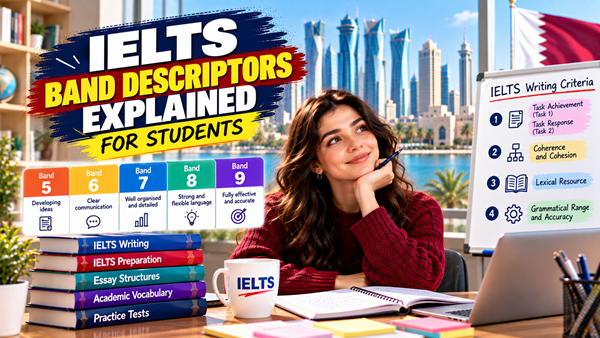
Understanding the IELTS band descriptors is one of the most useful steps you can take when preparing for the Writing test. You may know how to write an essay, use linking words and include advanced vocabulary, but do you know exactly what IELTS examiners assess when they award your score?
The official IELTS band descriptors explain the standards used to evaluate your performance. They show what examiners look for in your response, from answering the question fully to organising ideas, choosing vocabulary and using grammar accurately.
Once you understand these criteria, you can stop relying on vague goals such as “use better English” and start working on specific improvements that can make your writing more effective.
This guide explains the IELTS Writing assessment criteria, the differences between Bands 5, 6, 7 and 8, and how to use the descriptors to improve your preparation.
What Are IELTS Band Descriptors?
IELTS band descriptors are official assessment guidelines that describe the performance expected at different IELTS band levels. They help explain how examiners evaluate candidates’ English-language skills.
For IELTS Writing, examiners assess four criteria:
- Task Achievement or Task Response
- Coherence and Cohesion
- Lexical Resource
- Grammatical Range and Accuracy
Task Achievement is used for Writing Task 1, while Task Response is used for Writing Task 2. The other three criteria apply to both tasks.
Each criterion evaluates a different aspect of your writing. A response may contain accurate grammar but still receive a lower score if it does not answer the question properly. Similarly, a well-organised essay may lose marks if its ideas are not sufficiently developed or its vocabulary is inaccurate.
The descriptors therefore assess the overall quality of your response rather than simply counting grammar mistakes or advanced words.
The Four IELTS Writing Assessment Criteria Explained
1. Task Achievement and Task Response
These criteria evaluate how effectively you fulfil the requirements of the writing task.
For Academic Writing Task 1, Task Achievement focuses on how well you select, describe and summarise the key information in a visual prompt. For General Training Task 1, it considers how effectively you address the letter’s purpose and required bullet points.
For Writing Task 2, Task Response assesses how fully you answer the question, develop your main ideas and communicate a clear position where required.
What examiners look for:
- Whether you address every part of the task.
- Whether your ideas are relevant to the question.
- Whether your main points are explained and supported.
- Whether your response has an appropriate format.
- Whether you provide an overview when required for Academic Task 1.
- Whether your position is clear and consistent in Task 2.
Example:
Imagine the Task 2 question asks whether governments should spend more money on public transport than on roads.
A weak response might discuss traffic problems in general without clearly stating which investment should receive priority.
A stronger response would directly answer the question, explain the reasons behind the position and develop those reasons with relevant examples.
How to improve: Before writing, identify the instruction words in the question and list every part you need to address. After writing, check whether each paragraph contributes directly to answering the task.
2. Coherence and Cohesion
Coherence and Cohesion evaluates how logically you organise your response and how effectively you connect your ideas.
Coherence is about the overall structure and progression of ideas. Cohesion concerns the language and techniques used to connect sentences and paragraphs.
Examiners consider:
- Logical organisation of information and arguments.
- Clear progression from one idea to the next.
- Appropriate paragraphing.
- Logical sequencing within paragraphs.
- Effective referencing and substitution.
- Appropriate use of linking expressions.
For example, an essay about online education might organise its ideas into an introduction, a paragraph explaining the benefits, a paragraph discussing the disadvantages and a conclusion.
This structure helps readers understand the argument. However, paragraphing alone is not enough: each paragraph also needs a clear purpose and logically connected supporting ideas.
How to improve: Give each body paragraph one central focus. Introduce the main idea, explain it, and add a relevant example or supporting detail. Use linking expressions where they clarify relationships rather than inserting them into every sentence.
3. Lexical Resource
Lexical Resource assesses the range, accuracy and appropriateness of the vocabulary you use.
A high score does not require using the longest or most complicated words possible. It requires selecting words that communicate your meaning precisely and naturally.
Examiners consider:
- Range of vocabulary.
- Accuracy of word choice.
- Appropriate vocabulary for the topic and task.
- Use of collocations and less common expressions.
- Spelling and word formation.
- The frequency and impact of vocabulary errors.
Consider these two sentences:
Less precise: “Technology gives many good things to people.”
More precise: “Technology offers several practical benefits, including faster communication and easier access to information.”
The second sentence expresses the idea more specifically without relying on unnecessarily complicated vocabulary.
However, using an advanced word incorrectly can weaken a response. Accurate, natural language is more valuable than impressive vocabulary that does not fit the context.
How to improve: Learn vocabulary in topic-related phrases and collocations. Practise using new expressions in complete sentences, and check whether each word conveys the intended meaning.
4. Grammatical Range and Accuracy
Grammatical Range and Accuracy assesses the variety of sentence structures you use and how accurately you use them.
A response consisting entirely of short, simple sentences may communicate basic ideas, but it offers limited evidence of grammatical range. At the same time, long sentences with frequent errors can make your meaning difficult to follow.
Examiners consider:
- Variety of sentence structures.
- Use of simple and complex sentences.
- Accuracy of grammar.
- Control of clauses and sentence boundaries.
- Appropriate punctuation.
- The frequency and impact of errors.
Compare the following examples:
Limited range: “Many people work from home. They save time. They spend less money on transport.”
More varied: “Many people who work from home save time because they no longer need to commute, which can also reduce their transport expenses.”
The second example combines related ideas using a relative clause and a subordinate clause.
Complexity should still serve clarity. You do not need to make every sentence long or complicated.
How to improve: Practise a controlled range of structures, including relative clauses, conditionals, contrast clauses and cause-and-effect sentences. Review your writing for recurring errors rather than trying to use every grammar structure in a single essay.
IELTS Band Descriptors: What Do Bands 5, 6, 7 and 8 Mean?
The official descriptors describe performance at each band in detail. The following table provides a simplified interpretation of common differences in IELTS Writing performance. It is a study guide, not a replacement for the complete official assessment scales.
| Criterion | Band 5: Developing | Band 6: Competent | Band 7: Good | Band 8: Very Good |
|---|---|---|---|---|
| Task Achievement / Response | Some requirements may be inadequately covered; ideas may lack development | Main requirements are addressed, although development may be uneven | Requirements are generally covered with a clear position and relevant development | The task is appropriately addressed and ideas are well developed |
| Coherence and Cohesion | Organisation may be repetitive or lack clear progression | Overall progression is clear, but linking may be mechanical | Ideas are logically organised with clear progression | Information is well organised and cohesion is handled effectively |
| Lexical Resource | Limited range, repetition and noticeable errors | Adequate vocabulary, with some imprecision | Sufficient range for flexibility and precision, with some inaccuracies | Wide vocabulary used flexibly and precisely, with occasional errors |
| Grammatical Range and Accuracy | Limited and repetitive structures; frequent errors may affect meaning | Mix of simple and complex structures; errors rarely impede communication | Varied structures, generally good control and frequent error-free sentences | Wide range of structures used accurately, with most sentences error-free |
The table highlights an important point: moving from Band 6 to Band 7 is not simply about using more advanced vocabulary. You need to demonstrate stronger performance across the relevant criteria.
For example, a candidate may learn sophisticated linking phrases but remain at a similar level if the essay does not answer every part of the question or if the main ideas are insufficiently developed.
What Is the Difference Between IELTS Writing Band 6 and Band 7?
Many candidates aim for Band 7 because it is required by some universities, employers and professional organisations. However, the exact score requirement depends on the institution or purpose.
The difference between Band 6 and Band 7 is best understood by examining the quality of the response.
Task Achievement and Task Response
At Band 6, the response generally addresses the task, but some ideas may need more explanation or support.
At Band 7, the response more fully covers the requirements. Main ideas are relevant and developed, and the position is clear when the task requires one.
Improvement example:
Instead of writing, “Public transport is good because it helps people,” explain how it helps, who benefits and why the point supports your argument.
Coherence and Cohesion
At Band 6, the overall progression may be clear, although some connections between ideas can feel mechanical.
At Band 7, ideas are generally organised logically, with clearer progression throughout the response.
Improvement example: Build a paragraph around one central argument. Explain the argument before introducing a new point, and make the relationship between sentences clear.
Lexical Resource
At Band 6, vocabulary is generally adequate, although word choice may lack precision.
At Band 7, the vocabulary gives the writer more flexibility and precision, although some inappropriate choices or collocation errors may remain.
Improvement example: Instead of repeatedly using “important”, learn when expressions such as “essential”, “significant”, “a key factor” or “a major consideration” are appropriate.
Grammatical Range and Accuracy
At Band 6, candidates use a mixture of simple and complex structures, but their flexibility may be limited.
At Band 7, a wider variety of complex structures is used with greater control, and error-free sentences occur frequently.
Improvement example: Practise combining related ideas accurately using clauses beginning with “although”, “because”, “while” and “which”. Review whether the resulting sentences remain grammatically correct and easy to follow.
These are general distinctions, not a formula for receiving a specific score. Your response must be assessed as a whole against the official descriptors.
How IELTS Writing Task 1 Is Assessed
Writing Task 1 uses the same four broad assessment dimensions, but the first criterion is Task Achievement.
IELTS Academic Writing Task 1
For Academic Task 1, you describe, summarise or explain information presented in a visual format, such as a chart, graph, table, map or process diagram.
To perform well, you should:
- Identify and highlight the key features.
- Provide a clear overview of the main trends, differences or stages.
- Support your description with accurate details from the visual.
- Organise information into a logical sequence.
- Use appropriate vocabulary for describing data and processes.
- Maintain accurate grammar and punctuation.
One common mistake is describing every figure without identifying the main trends. A strong response helps the reader understand the most important information rather than presenting a list of unrelated details.
IELTS General Training Writing Task 1
For General Training Task 1, you write a letter in response to a situation.
Your response should address the required bullet points, make its purpose clear and use an appropriate tone.
For example, a letter to a friend may use a different level of formality from a letter requesting information from an organisation.
Failing to cover a required bullet point or using an unsuitable tone can weaken Task Achievement.
How IELTS Writing Task 2 Is Assessed
Writing Task 2 requires an essay responding to a point of view, argument or problem. It is assessed using Task Response, Coherence and Cohesion, Lexical Resource, and Grammatical Range and Accuracy.
Task Response: Answer the Entire Question
Read the prompt carefully and identify exactly what it asks you to do.
If the question asks you to discuss both views and give your own opinion, you need to cover both views and clearly communicate your position. Discussing only one side does not fully meet the requirements.
Coherence and Cohesion: Develop a Logical Argument
Organise your essay so that each paragraph contributes to the overall argument. Explain the relationship between your ideas instead of relying on linking words alone.
Lexical Resource: Use Precise and Appropriate Vocabulary
Select vocabulary that fits the topic and expresses your intended meaning accurately. Avoid memorised phrases that do not fit the question.
Grammatical Range and Accuracy: Balance Variety with Control
Use different sentence structures when they help express your ideas. Check agreement, articles, verb forms, punctuation and sentence boundaries.
Remember the Weighting of Task 2
The two Writing tasks are assessed independently using the relevant criteria. The four criteria are equally weighted within each task, but Writing Task 2 carries more weight than Task 1 when the overall Writing score is calculated.
This means that your preparation plan should give appropriate attention to Task 2 rather than treating the two tasks as equally weighted components.
How to Use IELTS Band Descriptors to Improve Your Writing
Reading the descriptors is only the first step. You need to use them to identify weaknesses and make measurable improvements.
Step 1: Understand Your Target Band
Find out what overall IELTS score and individual skill scores you need. Requirements vary by university, programme, employer and application route.
Then review the official Writing descriptors for the band you are targeting.
Step 2: Write Under Realistic Conditions
Complete a Writing Task 1 or Task 2 response within the official time limits. Avoid using dictionaries or rewriting sentences indefinitely if you want to evaluate your current exam performance.
Step 3: Evaluate Each Criterion Separately
Review the response using the four assessment criteria.
Ask yourself:
- Task Achievement / Response: Did I answer every part of the question?
- Coherence and Cohesion: Is my response logically organised?
- Lexical Resource: Is my vocabulary varied, accurate and appropriate?
- Grammatical Range and Accuracy: Have I used a range of structures with reasonable control?
This approach makes it easier to identify whether your main weakness is content, organisation, vocabulary or grammar.
Step 4: Ask for Specific Feedback
A general comment such as “improve your grammar” does not tell you what to do next.
Useful feedback identifies the problem, explains why it affects your response and suggests a practical correction. For example, a teacher might identify that your body paragraphs contain relevant ideas but lack supporting explanations.
Step 5: Rewrite and Compare
After reviewing the feedback, rewrite the response. Compare the original and revised versions to see whether your argument is clearer, your vocabulary more precise or your grammar more accurate.
Keep a record of recurring mistakes so that your next practice session targets the same weaknesses.
Common Misunderstandings About IELTS Band Descriptors
Using Advanced Vocabulary Guarantees a Higher Band
It does not. Vocabulary is only one of the four Writing criteria. Inaccurate or inappropriate word choice can weaken your response even when the words sound sophisticated.
More Linking Words Always Improve Coherence
Overusing linking expressions can make writing mechanical. Logical organisation and clear relationships between ideas are more important than inserting a connector into every sentence.
A Few Grammar Mistakes Automatically Mean a Low Score
The descriptors consider grammatical range, accuracy and the impact of errors. The type, frequency and seriousness of mistakes matter; not every error has the same effect.
One Strong Criterion Can Compensate Fully for Another Weak Criterion
The four criteria are assessed separately and carry equal weight within each task. Strong vocabulary cannot automatically make up for an essay that fails to answer the question.
Memorised Essays Are a Reliable Shortcut to Band 7
Memorised material may not address the actual task and can lead to irrelevant or unnatural responses. It is more useful to learn adaptable structures and practise developing relevant ideas.
Frequently Asked Questions About IELTS Band Descriptors
What are the four IELTS Writing assessment criteria?
The four criteria are Task Achievement for Writing Task 1, Task Response for Writing Task 2, Coherence and Cohesion, Lexical Resource, and Grammatical Range and Accuracy. Each task uses the relevant four criteria.
Where can I find the official IELTS band descriptors?
The official IELTS website provides public Writing band descriptors for Academic and General Training Task 1 and Task 2. Use the official documents when reviewing the full descriptions of performance at each band level.
What is the difference between Task Achievement and Task Response?
Task Achievement is used for Writing Task 1 and evaluates how well you fulfil the task requirements. Task Response is used for Writing Task 2 and evaluates how fully you address the question, develop your ideas and communicate your position where required.
Is IELTS Writing Task 2 more important than Task 1?
Yes. Task 2 carries more weight in the overall Writing score. However, you should still prepare for both tasks because each contributes to your final result.
How can I improve my IELTS Writing from Band 6 to Band 7?
Start by identifying which criterion limits your performance. Work on answering all parts of the task, developing relevant ideas, organising paragraphs logically, using vocabulary precisely and controlling a wider range of grammatical structures. Use feedback and repeated practice to evaluate progress.
Do I need advanced vocabulary to achieve Band 7 in IELTS Writing?
You need sufficient vocabulary to express ideas flexibly and precisely, but using rare or complicated words is not a requirement in itself. Appropriate word choice, natural collocations and accurate use of vocabulary are important.
Can I use IELTS band descriptors to mark my own essay?
Yes, you can use them for self-review and to identify areas for improvement. However, assigning yourself an accurate band score can be difficult because the descriptors require an overall judgement of the response. Feedback from an experienced IELTS teacher can help you interpret them more reliably.
Improve Your IELTS Writing with a Clearer Preparation Strategy
Understanding the IELTS band descriptors helps you prepare with a clearer purpose. Instead of simply writing more essays, you can identify which assessment criteria need attention and focus your practice on the skills that matter.
Start by reviewing the official descriptors, completing timed writing tasks and evaluating your performance against each criterion. Then use targeted feedback to improve your task response, organisation, vocabulary and grammar.
If you want structured guidance, IELTS preparation courses at IFI Qatar can be a useful next step. Focused practice and feedback can help you understand your writing weaknesses, develop more effective habits and work towards your target IELTS score.
Prepare with purpose. Understand the criteria. Improve one skill at a time.