

Currently Empty: ر.ق 0,00


IELTS
IELTS Vocabulary by Topic: Education, Technology and Health
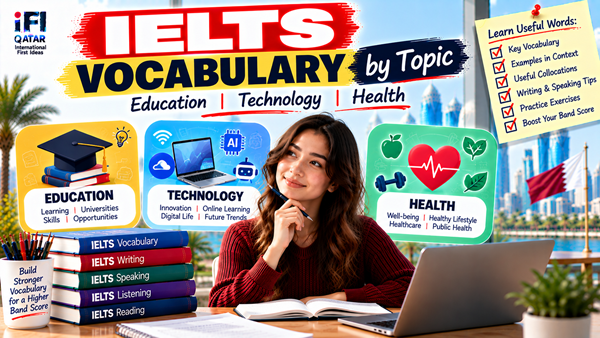
Building a strong vocabulary is an important part of IELTS preparation. Whether you are describing your education, discussing the impact of technology or expressing an opinion about public health, the words you choose can help you communicate your ideas more clearly and precisely.
However, learning long lists of unfamiliar words is not always the best approach. To use vocabulary effectively in the IELTS test, you need to understand word meanings, common collocations, grammatical patterns and the contexts in which expressions sound natural.
This guide explores three important IELTS vocabulary topics: Education, Technology and Health. You will learn useful words and phrases, see how they work in example sentences, and discover how to apply them in IELTS Writing and Speaking.
If you are preparing for IELTS Academic or IELTS General Training, use this guide as a starting point for building a topic-based vocabulary bank that you can review and expand throughout your preparation.
Why Is Topic-Based Vocabulary Important for IELTS?
IELTS questions often ask candidates to discuss familiar areas of modern life, including education, technological change, healthcare, the environment and society. Organising vocabulary by topic helps you prepare for these discussions without trying to predict the exact questions that will appear.
Topic-based vocabulary can help you:
- Express opinions with greater precision.
- Explain causes, effects, advantages and disadvantages.
- Develop ideas in IELTS Writing Task 2 essays.
- Give more detailed answers in IELTS Speaking Part 3.
- Recognise synonyms and paraphrases in Reading and Listening.
- Avoid repeating the same basic words throughout a response.
For example, instead of repeatedly using the word good when discussing education, you could use beneficial, effective, valuable or accessible, depending on the meaning you want to communicate.
The important point is that these words are not interchangeable in every sentence. Effective vocabulary use means choosing the word that expresses your intended meaning accurately.
IELTS Education Vocabulary: Words and Phrases for Academic Topics
Education is a useful topic to prepare for because it covers schools, universities, teaching methods, examinations, online learning and access to educational opportunities.
The following vocabulary can help you discuss the benefits and challenges of education in both Speaking and Writing.
Essential Education Vocabulary
| Word or phrase | Meaning | Example sentence |
|---|---|---|
| Curriculum | The subjects and content taught in an educational programme | Schools should develop a curriculum that balances academic knowledge and practical skills. |
| Higher education | Education at university or a similar institution | Higher education can improve access to professional opportunities. |
| Academic performance | How well a student performs in educational assessments | Regular feedback can help students improve their academic performance. |
| Critical thinking | The ability to analyse information and evaluate ideas | Critical thinking should be encouraged from an early age. |
| Vocational training | Education that develops skills for a particular job or profession | Vocational training can prepare young people for employment in skilled industries. |
| Lifelong learning | Learning that continues throughout a person’s life | Lifelong learning is increasingly important as workplaces change. |
| Educational attainment | The highest level of education a person has completed | Educational attainment can influence employment opportunities. |
| Literacy | The ability to read and write effectively | Improving literacy is essential for educational and social development. |
| Compulsory education | Education that people are legally required to receive | Compulsory education helps ensure that children receive a basic education. |
| Equal access | The opportunity to use or benefit from something without unfair barriers | Governments should promote equal access to quality education. |
| Student engagement | The degree to which students participate in learning | Interactive lessons can increase student engagement. |
| Assessment | The process of evaluating knowledge or ability | Continuous assessment may provide a broader picture of student progress than a single examination. |
Useful Education Collocations for IELTS
A collocation is a combination of words that commonly appear together. Learning collocations can make your English sound more natural than translating phrases directly from your first language.
| Collocation | Example sentence |
|---|---|
| Acquire knowledge | Students acquire knowledge through study, discussion and practical experience. |
| Develop practical skills | Schools should help learners develop practical skills alongside theoretical knowledge. |
| Meet educational needs | Teaching methods should be adapted to meet different educational needs. |
| Improve academic performance | Consistent revision can help students improve their academic performance. |
| Pursue higher education | Many students pursue higher education to expand their career options. |
| Bridge the skills gap | Closer cooperation between universities and employers may help bridge the skills gap. |
| Promote equal opportunities | Scholarships can help promote equal opportunities in education. |
| Encourage independent learning | Research projects can encourage independent learning and critical thinking. |
Education Vocabulary for IELTS Writing Task 2
Education essays often ask whether university education should be free, whether examinations are effective, or whether practical skills should receive more attention in schools.
Use topic vocabulary to make your argument more specific.
Example question: Some people believe that schools should focus on practical skills rather than academic subjects. To what extent do you agree or disagree?
Example paragraph:
Schools should provide students with a balanced curriculum that combines academic knowledge with practical skills. While traditional subjects help learners develop analytical abilities and a strong theoretical foundation, vocational training can prepare them for the demands of the workplace. By offering both forms of education, schools can improve students’ employability without neglecting their intellectual development.
Notice how expressions such as balanced curriculum, theoretical foundation, vocational training and employability communicate specific ideas. The paragraph does not need complicated vocabulary in every sentence to make its argument effective.
Education Vocabulary for IELTS Speaking
In Speaking Part 3, you may be asked about the purpose of education, the role of teachers or differences between traditional and modern learning.
Useful expressions include:
- A well-rounded education: Education that develops a broad range of knowledge and abilities.
- Hands-on experience: Practical experience gained by doing something.
- A learning environment: The conditions in which learning takes place.
- Student-centred learning: An approach that places learners’ needs and participation at the centre of teaching.
- Transferable skills: Skills that can be used in different jobs or situations.
Example answer:
“I think a well-rounded education should combine theoretical knowledge with hands-on experience. Students need subject knowledge, but they also need transferable skills, such as communication and problem-solving, to succeed in the workplace.”
IELTS Technology Vocabulary: Words for Innovation and Digital Life
Technology is another useful topic because it relates to communication, education, employment, entertainment, privacy and changes in everyday life.
When discussing technology in IELTS, focus on explaining how a development affects people rather than simply naming devices or applications.
Essential Technology Vocabulary
| Word or phrase | Meaning | Example sentence |
|---|---|---|
| Technological advancement | Progress in technology | Technological advancements have transformed how people communicate. |
| Artificial intelligence | Technology that performs tasks associated with human intelligence | Artificial intelligence is changing how some businesses process information. |
| Automation | The use of technology to perform tasks with limited human intervention | Automation may reduce the need for workers to perform certain repetitive tasks. |
| Digital literacy | The ability to use and evaluate digital information and tools effectively | Digital literacy is an increasingly important skill for students. |
| Cybersecurity | The protection of systems, networks and information from digital threats | Strong cybersecurity measures are necessary to protect sensitive information. |
| Data privacy | The protection and appropriate handling of personal information | Data privacy has become a major concern for internet users. |
| Remote working | Working away from a traditional workplace, often using digital tools | Remote working can give employees greater flexibility. |
| Digital divide | The gap between people who can access and use digital technology and those who cannot | The digital divide may limit educational opportunities in underserved communities. |
| Online learning | Learning through internet-based platforms and resources | Online learning allows students to access educational materials from different locations. |
| Innovation | The introduction of new ideas, methods or products | Innovation can help organisations improve their services. |
| Screen time | The amount of time spent using screens | Excessive screen time may interfere with sleep or physical activity for some people. |
| Information overload | A situation in which people receive more information than they can effectively process | Constant notifications can contribute to information overload. |
Useful Technology Collocations for IELTS
| Collocation | Example sentence |
|---|---|
| Keep pace with technological change | Workers may need ongoing training to keep pace with technological change. |
| Rely on digital platforms | Many businesses rely on digital platforms to communicate with customers. |
| Protect personal data | Organisations should take appropriate steps to protect personal data. |
| Improve digital access | Public investment can improve digital access in remote communities. |
| Raise privacy concerns | The collection of personal information can raise privacy concerns. |
| Streamline repetitive tasks | Automation can streamline repetitive tasks and reduce administrative work. |
| Bridge the digital divide | Affordable internet access can help bridge the digital divide. |
| Transform the workplace | New technologies continue to transform the workplace. |
Technology Vocabulary for IELTS Writing Task 2
Technology essays often examine whether digital tools improve education, whether automation creates unemployment or whether people have become too dependent on their devices.
Example question: Some people believe that technology has made people’s lives easier, while others think it has created new problems. Discuss both views and give your opinion.
Example paragraph:
Technological advancements have made many everyday tasks more convenient. For example, digital platforms allow people to access services, communicate with colleagues and study remotely without travelling long distances. Nevertheless, greater reliance on technology can raise concerns about data privacy and increase the digital divide between people who have reliable internet access and those who do not. The overall impact therefore depends on how technology is designed, distributed and used.
This paragraph uses topic-specific vocabulary to explain both benefits and drawbacks. Each expression contributes to the argument rather than appearing simply to demonstrate advanced English.
Technology Vocabulary for IELTS Speaking
Technology-related Speaking questions may ask how smartphones have changed communication, whether children should use digital devices at school or how artificial intelligence might affect future employment.
Useful expressions include:
- User-friendly: Easy to understand and operate.
- Cutting-edge technology: The most advanced technology available in a particular field.
- Digital communication: Communication through electronic or online tools.
- A double-edged sword: Something that has both benefits and disadvantages.
- Become increasingly dependent on: To rely more and more on something.
- Enhance productivity: To improve the amount or quality of work completed.
Example answer:
“I think technology is a double-edged sword. On the one hand, user-friendly applications make it easier to access information and communicate with others. On the other hand, becoming increasingly dependent on digital devices can reduce face-to-face interaction and create concerns about privacy.”
IELTS Health Vocabulary: Words for Well-Being and Public Health
Health is a broad topic that includes physical activity, diet, mental well-being, healthcare services and government responsibility.
In IELTS essays, health questions frequently involve explaining causes, discussing preventive measures or evaluating the responsibilities of individuals and governments.
Essential Health Vocabulary
| Word or phrase | Meaning | Example sentence |
|---|---|---|
| Public health | The health of a population and efforts to protect and improve it | Public health campaigns can raise awareness of preventable diseases. |
| Preventive healthcare | Measures designed to prevent illness or identify health problems early | Preventive healthcare can help identify certain conditions before they become more serious. |
| Balanced diet | A diet containing an appropriate variety of nutrients | A balanced diet is an important part of maintaining good health. |
| Sedentary lifestyle | A way of living involving little physical activity | A sedentary lifestyle can increase the risk of certain health problems. |
| Mental well-being | A person’s psychological and emotional state | Adequate rest and social support can contribute to mental well-being. |
| Healthcare services | Services that help prevent, diagnose or treat health conditions | Accessible healthcare services are essential for communities. |
| Life expectancy | The average number of years a person is expected to live under specified conditions | Improvements in healthcare have contributed to higher life expectancy in many populations. |
| Health awareness | Knowledge and understanding of health issues | Health awareness programmes can encourage people to adopt healthier habits. |
| Chronic disease | A long-term health condition | Managing a chronic disease may require ongoing medical care. |
| Access to treatment | The ability to obtain appropriate medical care | Financial barriers can limit access to treatment. |
| Physical activity | Bodily movement that uses energy | Regular physical activity can support physical and mental well-being. |
| Health inequality | Differences in health outcomes or access to care between groups | Health inequality may be influenced by income, location and access to services. |
Useful Health Collocations for IELTS
| Collocation | Example sentence |
|---|---|
| Lead a healthy lifestyle | People can support their health by following a balanced diet and staying active. |
| Raise public awareness | Schools can raise public awareness of healthy eating and physical activity. |
| Prevent the spread of disease | Public health measures can help prevent the spread of infectious diseases. |
| Improve access to healthcare | Investment in local services can improve access to healthcare. |
| Address health inequalities | Governments can develop policies to address health inequalities. |
| Place a strain on healthcare systems | A growing demand for treatment can place a strain on healthcare systems. |
| Promote mental well-being | Employers can promote mental well-being by encouraging a healthy work-life balance. |
| Adopt healthier habits | Education may encourage people to adopt healthier habits. |
Health Vocabulary for IELTS Writing Task 2
Health essays may ask whether governments should be responsible for citizens’ health, whether unhealthy food should be taxed or how public health can be improved.
Example question: Some people believe that governments should be responsible for improving public health, while others think individuals should take responsibility for their own well-being. Discuss both views and give your opinion.
Example paragraph:
Individuals play an important role in maintaining their health by adopting healthier habits, including regular physical activity and a balanced diet. However, governments also have a responsibility to create conditions that support public well-being. Investment in preventive healthcare, public health education and accessible medical services can help reduce health inequalities. In my view, personal responsibility and effective public policy should work together rather than be treated as competing approaches.
The vocabulary helps distinguish between individual choices and wider public responsibilities, making the argument clearer and easier to follow.
Health Vocabulary for IELTS Speaking
For Speaking Part 3, you may be asked why some people exercise regularly, how modern lifestyles affect health or whether governments should provide free healthcare.
Useful expressions include:
- Work-life balance: The relationship between time spent working and time available for personal life.
- Mental health awareness: Understanding and recognition of mental health issues.
- A sedentary routine: A routine involving little physical movement.
- A preventive approach: An approach focused on preventing problems before they occur.
- Affordable healthcare: Medical services that people can reasonably afford.
- A growing concern: An issue that is becoming increasingly important or worrying.
Example answer:
“I think maintaining a healthy work-life balance is important because excessive work pressure can affect people’s mental well-being. Employers can help by providing reasonable workloads, while individuals can benefit from regular physical activity and sufficient rest.”
How to Use IELTS Topic Vocabulary Without Sounding Unnatural
Learning vocabulary is only the first step. You also need to use words accurately and appropriately in your answers.
Learn Words in Context
Do not memorise a word without an example. Learn how it behaves in a sentence and which words commonly appear around it.
For example:
- Word: access
- Collocation: access to healthcare
- Example: “Everyone should have access to essential healthcare services.”
This approach helps you remember the expression as a usable unit of language.
Practise Paraphrasing
IELTS rewards your ability to communicate ideas clearly, not your ability to repeat memorised phrases.
For example:
- Technology is changing the workplace.
- Technological advancements are transforming working environments.
- Automation is changing how certain tasks are performed.
These sentences express related ideas but are not identical in meaning. Choose a paraphrase that accurately reflects the point you want to make.
Use Vocabulary That Matches Your Meaning
Advanced vocabulary is not automatically better vocabulary. An unusual word used incorrectly can weaken an otherwise strong response.
For example, significant means important or considerable, while efficient describes achieving a result without unnecessary waste of time or resources. They cannot replace each other in every context.
Prioritise accuracy, clarity and natural word combinations.
Review Vocabulary Through Active Recall
Instead of repeatedly reading the same vocabulary list, cover the definitions and test yourself.
For each word or collocation, try to:
- Recall its meaning.
- Produce a natural example sentence.
- Use it in a short Speaking answer or paragraph.
- Review it again after a few days.
You can use flashcards, a vocabulary notebook or a digital study tool to track your progress.
A 7-Day Plan to Learn IELTS Vocabulary by Topic
If you want to start applying the vocabulary in this guide, use the following one-week routine.
| Day | Focus | Practice activity |
|---|---|---|
| Day 1 | Education vocabulary | Learn 10–12 useful words and write five sentences. |
| Day 2 | Education collocations | Write one paragraph about the purpose of education. |
| Day 3 | Technology vocabulary | Learn key terms and practise paraphrasing five sentences. |
| Day 4 | Technology Speaking | Record a two-minute response about the effects of technology. |
| Day 5 | Health vocabulary | Learn useful terms and create example sentences. |
| Day 6 | Health Writing | Plan and write a Task 2 paragraph about public health. |
| Day 7 | Revision and recall | Test yourself on all three topics and review difficult expressions. |
The number of words is a flexible target, not a requirement. It is better to learn fewer expressions well than to memorise a large list and forget how to use most of it.
Practice Exercise: Test Your IELTS Topic Vocabulary
Complete the sentences using the most suitable word or phrase from the list.
Word bank: digital divide · critical thinking · preventive healthcare · lifelong learning · data privacy · balanced diet
- Schools should encourage __________ so that students can evaluate information rather than simply memorise facts.
- Affordable internet access can help reduce the __________ between connected and underserved communities.
- Organisations need clear policies to protect __________ when collecting personal information.
- Regular check-ups and early screening are examples of __________.
- As industries change, __________ can help workers develop new skills throughout their careers.
- A __________ provides a variety of nutrients that support overall health.
Answers
- Critical thinking
- Digital divide
- Data privacy
- Preventive healthcare
- Lifelong learning
- Balanced diet
After checking your answers, write one original sentence for each expression. This extra step helps you move from recognising vocabulary to using it independently.
Frequently Asked Questions About IELTS Vocabulary Topics
What are the most important IELTS vocabulary topics?
Useful topics to prepare include education, technology, health, the environment, work, society, crime, transport and media. The exact topics in your test may vary, so focus on developing flexible vocabulary that helps you explain ideas rather than memorising predicted answers.
How can I improve my IELTS vocabulary quickly?
Learn words in context, study common collocations, write your own example sentences and practise using new expressions in Speaking and Writing. Review vocabulary regularly through active recall and focus on words relevant to your current language level and target score.
How many vocabulary words should I learn every day for IELTS?
There is no universal daily target. A manageable set of five to fifteen new words or collocations can be a useful starting point, depending on your level and available time. Make sure you can understand, recall and use the expressions accurately before adding too many more.
Is topic vocabulary important for IELTS Writing Task 2?
Yes. Topic vocabulary can help you explain ideas precisely, discuss causes and effects, compare viewpoints and support arguments. However, it must be relevant and accurate. Repeating advanced words unnecessarily will not improve the quality of an essay.
Should I use advanced vocabulary in IELTS Speaking?
Use vocabulary that expresses your ideas naturally and precisely. You can demonstrate a broad vocabulary range through appropriate word choices, collocations and paraphrasing. Do not force complicated expressions into answers where simpler language would be clearer.
Can I memorise vocabulary lists for IELTS?
Vocabulary lists can help you organise your learning, but memorising definitions alone is not enough. Learn example sentences, grammatical patterns and collocations, then practise using the expressions in new contexts.
How can an IELTS vocabulary course help me?
A structured course can help you organise vocabulary by topic, practise collocations, identify common word-choice errors and apply new expressions to IELTS Writing and Speaking. The most useful course should combine vocabulary learning with opportunities to practise and receive relevant feedback.
Build Your IELTS Vocabulary with IFI Qatar
A strong IELTS vocabulary is not about using the longest or most complicated words. It is about choosing accurate expressions, understanding how words work together and using them confidently in context.
Start with the Education, Technology and Health vocabulary in this guide. Practise the example sentences, write short paragraphs and record your Speaking answers. As you improve, expand your vocabulary to other common IELTS themes and revisit older expressions regularly.
If you want a more structured way to develop your vocabulary for IELTS, explore the IELTS preparation options available at IFI Qatar. A vocabulary-focused learning plan can help you identify gaps, practise useful collocations and apply new language to your exam responses.
Ready to improve your IELTS vocabulary? Contact IFI Qatar to discuss suitable preparation options and take the next step towards your target score.