

Currently Empty: ر.ق 0,00


IELTS
IELTS Collocations for Writing and Speaking: 100+ Useful Examples
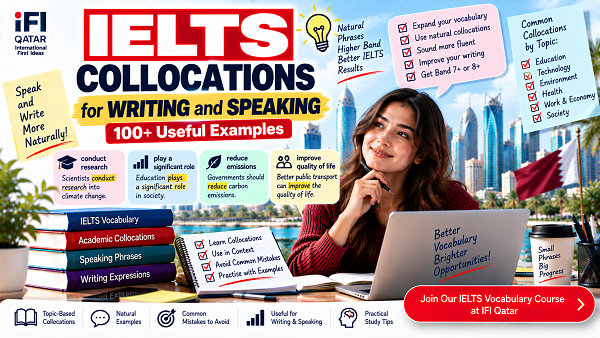
Learning individual vocabulary words is not enough to build a strong IELTS vocabulary. To communicate naturally and accurately, you also need to know which words commonly go together.
These word combinations are called collocations.
For example, English speakers say “make a decision”, not “do a decision”. We say “heavy traffic”, not “strong traffic”. In academic English, we commonly use expressions such as “conduct research,” “pose a threat,” “play a significant role,” and “reach a conclusion.”
Using the right collocations can make your English sound more natural, precise and flexible in both IELTS Writing and Speaking.
In this guide, you will learn more than 100 useful IELTS collocations, organised by topic and function, with examples you can use in your own answers.
What Are IELTS Collocations?
A collocation is a combination of two or more words that are commonly used together in English.
Some common examples include:
| Collocation | Example |
|---|---|
| make a decision | We need to make a decision quickly. |
| conduct research | Scientists conduct research into climate change. |
| heavy traffic | The city experiences heavy traffic during rush hour. |
| take responsibility | Governments should take responsibility for public safety. |
| achieve a goal | She worked hard to achieve her goal. |
| raise awareness | Campaigns can raise awareness of environmental problems. |
| economic growth | Education can contribute to economic growth. |
| highly effective | The programme has been highly effective. |
The important point is that collocations are not always predictable from individual words.
For example, “make progress” is natural English, while “do progress” is not.
Similarly:
- strong argument ✓
- powerful argument ✓
- strong traffic ✗
- heavy traffic ✓
Learning vocabulary in these natural combinations helps you avoid awkward word choices.
Why Are Collocations Important for IELTS?
Collocations are particularly useful because IELTS does not simply test whether you know a large number of English words.
You also need to demonstrate that you can use vocabulary appropriately, accurately and naturally.
In IELTS Writing, vocabulary is assessed under the Lexical Resource criterion. IELTS guidance specifically considers vocabulary range, appropriacy, precision and the control of collocations and sophisticated phrasing.
In Speaking, Lexical Resource is also one of the four assessment criteria. It includes the range and precision of vocabulary used to express meaning and attitudes, as well as appropriate collocation and paraphrasing.
This means that memorising long lists of difficult words is not necessarily the best strategy.
A better approach is to learn:
word + word combination + meaning + example + context
For example, instead of learning only:
significant = important
learn:
play a significant role in
Example:
Education plays a significant role in improving employment opportunities.
This gives you a vocabulary item that you can actually use.
IELTS Collocations for Writing
IELTS Writing requires you to express ideas clearly, logically and appropriately. Strong collocations can help you discuss common IELTS topics without repeatedly using basic vocabulary.
Below are useful collocations organised by function and topic.
Academic Collocations for IELTS Writing
These expressions are particularly useful for formal and academic writing.
1. Conduct research
Meaning: carry out systematic research
Example:
Universities should conduct more research into the effects of social media on young people.
2. Gather evidence
Meaning: collect information that supports an argument
Example:
Researchers need to gather reliable evidence before reaching a conclusion.
3. Draw a conclusion
Meaning: reach a conclusion after considering information
Example:
After analysing the data, researchers can draw a conclusion about the main causes.
4. Reach a conclusion
Example:
It is difficult to reach a firm conclusion without sufficient evidence.
5. Provide evidence
Example:
Governments should provide evidence to support their proposed policies.
6. Address an issue
Meaning: deal with a problem or topic
Example:
Governments must address the issue of affordable housing.
7. Tackle a problem
Example:
Effective public transport can help tackle traffic congestion.
8. Pose a threat
Meaning: create a potential danger
Example:
Climate change poses a serious threat to coastal communities.
9. Have an impact on
Example:
Social media can have a significant impact on the way people communicate.
10. Play a role in
Example:
Parents play an important role in developing children’s reading habits.
11. Contribute to
Example:
Renewable energy can contribute to a reduction in carbon emissions.
12. Lead to
Example:
Excessive screen time can lead to sleep problems.
13. Result in
Example:
Poor planning may result in unnecessary financial losses.
14. Give rise to
Meaning: cause something, usually a situation or problem
Example:
Rapid urbanisation can give rise to serious housing problems.
15. Bring about
Meaning: cause something to happen
Example:
Technological innovation has brought about major changes in the workplace.
IELTS Collocations for Education
Education is one of the most common IELTS topics, making education-related collocations especially useful.
16. Higher education
Access to higher education has expanded considerably in many countries.
17. Academic performance
Excessive pressure can negatively affect students’ academic performance.
18. Educational opportunities
Online learning can provide educational opportunities for students in remote areas.
19. Academic achievement
Financial support can contribute to greater academic achievement.
20. Learning environment
Schools should create a safe and supportive learning environment.
21. Practical skills
Universities should give students more opportunities to develop practical skills.
22. Critical thinking skills
Education should encourage students to develop critical thinking skills.
23. Vocational training
Vocational training can help young people develop job-related skills.
24. Equal access to education
Governments should ensure equal access to education for children from different backgrounds.
25. Educational standards
Schools need adequate resources to maintain high educational standards.
IELTS Collocations for Technology
Technology is another frequent IELTS topic.
26. Technological advancement
Technological advancement has transformed the way people work.
27. Rapid technological development
Rapid technological development has created new opportunities for businesses.
28. Digital technology
Digital technology has changed how people access information.
29. Artificial intelligence
Artificial intelligence is expected to transform many industries.
30. Technological innovation
Technological innovation can improve productivity.
31. Internet access
Reliable internet access is essential for online education.
32. Social media platforms
Social media platforms have changed the way people interact.
33. Data privacy
Data privacy has become an increasingly important concern.
34. Cyber security
Businesses need to invest in cyber security to protect sensitive information.
35. Digital skills
Employers increasingly expect workers to have strong digital skills.
IELTS Collocations for Environment
Environmental topics frequently appear in IELTS preparation materials and practice questions.
36. Environmental protection
Environmental protection should be a priority for governments.
37. Climate change
Climate change is affecting ecosystems around the world.
38. Global warming
Governments need to take stronger action to address global warming.
39. Carbon emissions
Public transport can help reduce carbon emissions.
40. Renewable energy
Investment in renewable energy can reduce dependence on fossil fuels.
41. Fossil fuels
Many countries are trying to reduce their reliance on fossil fuels.
42. Natural resources
Countries should use natural resources more responsibly.
43. Environmental damage
Industrial activity can cause significant environmental damage.
44. Waste management
Effective waste management is essential for large cities.
45. Sustainable development
Governments should promote sustainable development while supporting economic growth.
IELTS Collocations for Society and Social Issues
These expressions can help you discuss social problems and their possible solutions.
46. Social inequality
Education can help reduce social inequality.
47. Social pressure
Young people often experience considerable social pressure.
48. Living standards
Economic development can improve living standards.
49. Quality of life
Access to healthcare has a direct effect on people’s quality of life.
50. Public awareness
Governments need to increase public awareness of environmental issues.
51. Social responsibility
Large companies should accept greater social responsibility.
52. Vulnerable groups
Governments should provide additional support for vulnerable groups.
53. Population growth
Rapid population growth can place pressure on public services.
54. Urban population
The urban population has increased significantly in many countries.
55. Social cohesion
Community programmes can strengthen social cohesion.
IELTS Collocations for Health
Health is another useful vocabulary area for IELTS Writing and Speaking.
56. Public health
Governments have a responsibility to protect public health.
57. Healthy lifestyle
Regular exercise is an important part of a healthy lifestyle.
58. Physical activity
Schools should encourage students to participate in physical activity.
59. Mental health
Social isolation can have a negative effect on mental health.
60. Balanced diet
A balanced diet can help reduce the risk of several health problems.
61. Health problems
Lack of exercise can contribute to various health problems.
62. Healthcare system
A well-funded healthcare system can improve access to medical services.
63. Preventive measures
Governments should introduce preventive measures to reduce the spread of infectious diseases.
64. Medical treatment
Early medical treatment can improve outcomes for many patients.
65. Life expectancy
Improved healthcare has contributed to longer life expectancy in many countries.
IELTS Collocations for Work and Employment
These expressions are useful for topics related to careers, workplaces and the economy.
66. Job satisfaction
Flexible working arrangements can improve job satisfaction.
67. Career opportunities
International companies may offer greater career opportunities.
68. Employment opportunities
Economic growth can create new employment opportunities.
69. Working conditions
Employees should be provided with safe working conditions.
70. Work-life balance
Remote work can help some employees achieve a better work-life balance.
71. Professional development
Companies should invest in professional development programmes.
72. Job security
Automation has raised concerns about job security in some industries.
73. Skilled workforce
Economic growth depends partly on having a highly skilled workforce.
74. Unemployment rate
Governments need effective policies to reduce the unemployment rate.
75. Labour market
Technological change is having a significant impact on the labour market.
IELTS Collocations for Economy
76. Economic growth
Investment in education can contribute to long-term economic growth.
77. Economic development
Infrastructure plays an important role in economic development.
78. Economic stability
Governments need to maintain economic stability during periods of uncertainty.
79. Household income
Rising household income can increase consumer spending.
80. Consumer spending
Consumer spending is an important part of many economies.
81. Financial support
Students from low-income families may require financial support.
82. Government spending
Government spending on public services should be carefully planned.
83. Cost of living
Rising housing costs have increased the cost of living in many cities.
84. Income inequality
Policymakers are increasingly concerned about income inequality.
85. Economic opportunities
Better education can create greater economic opportunities.
IELTS Collocations for Writing Task 1
For IELTS Academic Writing Task 1, you need vocabulary that allows you to describe trends, comparisons and data accurately.
Describing increases
Useful collocations include:
- experience a significant increase
- show a gradual rise
- record a sharp increase
- see a dramatic growth
- increase significantly
- rise steadily
- grow rapidly
- reach a peak
Example:
The number of international students experienced a significant increase between 2015 and 2025.
Describing decreases
Useful expressions include:
- experience a significant decline
- show a gradual decrease
- record a sharp fall
- decline steadily
- decrease considerably
- fall dramatically
- drop slightly
- reach its lowest point
Example:
The percentage of people using private cars declined steadily over the period.
Describing stability
Useful expressions include:
- remain stable
- remain relatively unchanged
- stay constant
- maintain a steady level
- show little change
Example:
The proportion of households with internet access remained relatively stable during the first three years.
Comparing data
Useful collocations include:
- be significantly higher than
- be considerably lower than
- be slightly higher than
- be almost twice as high as
- account for the largest proportion
- represent the smallest percentage
- exceed the figure for
- remain below the level of
Example:
The figure for public transport was almost twice as high as that for cycling.
IELTS Collocations for Speaking
Collocations are equally useful in IELTS Speaking because they can help you express ideas more naturally and precisely.
However, you should not try to force formal academic expressions into every answer.
In Speaking, the best vocabulary depends on the topic, context and level of formality.
Common IELTS Speaking Collocations
86. Spend time
I usually spend time with my family at the weekend.
87. Make friends
It was easy to make friends when I started university.
88. Keep in touch
I try to keep in touch with my old school friends.
89. Take up a hobby
I recently took up photography as a hobby.
90. Have a positive experience
Studying abroad was a very positive experience for me.
91. Make a difference
I think volunteering can make a real difference to people’s lives.
92. Deal with stress
I usually listen to music to deal with stress.
93. Get along with
I get along very well with my colleagues.
94. Take a break
When I feel tired, I usually take a short break.
95. Have a busy schedule
I have a fairly busy schedule during the week.
96. Strong interest in
I’ve always had a strong interest in technology.
97. Great deal of
I spend a great deal of time reading.
98. Wide range of
There is a wide range of activities available in my city.
99. Major influence
My parents have been a major influence on my career choices.
100. Memorable experience
Travelling to another country was one of the most memorable experiences of my life.
Topic-Based Collocations for IELTS Speaking
Speaking About Your Hometown
Useful expressions:
- live in a busy city
- quiet neighbourhood
- popular tourist destination
- local community
- public transport system
- major attraction
- rapidly developing area
- convenient location
Example answer:
I live in Doha, which is a rapidly developing city. It has a convenient public transport system and a wide range of facilities. One thing I particularly like is that there are many opportunities to explore different parts of the city.
Speaking About Education
Useful expressions:
- attend university
- study a subject
- gain knowledge
- develop skills
- academic experience
- practical experience
- achieve good grades
- pursue higher education
Example answer:
I decided to pursue higher education because I wanted to gain specialised knowledge and develop practical skills that would help me in my future career.
Speaking About Work
Useful expressions:
- full-time job
- part-time job
- work environment
- career path
- professional experience
- job responsibilities
- meet deadlines
- work under pressure
Example answer:
I enjoy my job because I work in a friendly environment and have the opportunity to gain professional experience. I sometimes have to work under pressure, especially when I have tight deadlines.
Speaking About Technology
Useful expressions:
- use technology on a daily basis
- stay connected
- access information
- save time
- improve productivity
- digital devices
- online services
- technological development
Example answer:
I use digital devices on a daily basis. They help me stay connected with other people and access information quickly. I think technological development has made many everyday tasks much more convenient.
Speaking About Travel
Useful expressions:
- travel abroad
- go on holiday
- explore a new place
- tourist attraction
- cultural experience
- local cuisine
- public transport
- unforgettable experience
Example answer:
I really enjoy travelling abroad because it gives me the opportunity to explore new places and experience different cultures. Trying local cuisine is also one of my favourite parts of travelling.
Collocations for Giving Opinions in IELTS Speaking
When answering IELTS Speaking questions, you often need to express opinions.
Instead of repeatedly saying:
I think…
you can use a wider range of natural expressions.
Useful collocations include:
- from my perspective
- in my opinion
- from my point of view
- I strongly believe that
- I tend to think that
- I would argue that
- have a positive effect
- have a negative impact
- play an important role
- be a major factor
Example:
From my perspective, technology has had a positive effect on education because students can access a wide range of learning resources.
Collocations for Discussing Advantages and Disadvantages
These are particularly useful in IELTS Speaking Part 3 and Writing Task 2.
Advantages
- offer significant benefits
- provide opportunities
- improve quality of life
- increase productivity
- save time
- reduce costs
- create employment opportunities
- improve access to services
Disadvantages
- have negative consequences
- create social problems
- pose a serious risk
- increase pressure
- cause financial difficulties
- create additional costs
- have unintended consequences
- lead to social inequality
Example:
Although remote work can offer significant benefits, it may also have unintended consequences, such as social isolation and weaker communication between colleagues.
Collocations for Cause and Effect
These expressions are useful when explaining why something happens or what it causes.
Cause
- lead to
- result in
- contribute to
- give rise to
- bring about
- be responsible for
- be a major cause of
- have an impact on
Effect
- have a significant impact
- have serious consequences
- result in higher costs
- contribute to economic growth
- improve living standards
- reduce the risk
- increase the likelihood
- create opportunities
Example:
A lack of affordable housing can contribute to social inequality and result in higher living costs.
Collocations for Solutions in IELTS Writing
When writing about problems, you often need to propose solutions.
Useful expressions include:
- take effective measures
- implement policies
- introduce legislation
- raise public awareness
- provide financial support
- invest in infrastructure
- improve public services
- address the root cause
- tackle the problem
- find a long-term solution
Example:
Governments should take effective measures to address the root causes of homelessness.
Collocations for IELTS Writing Task 2
Task 2 requires you to discuss opinions, problems, solutions, advantages, disadvantages and other issues.
Here are useful combinations for different purposes.
Introducing an Argument
- a major argument is that
- one key reason is that
- there is growing concern that
- it is widely believed that
- one possible explanation is that
Supporting an Argument
- provide strong evidence
- support the argument
- play a crucial role
- have a significant impact
- contribute significantly to
- offer substantial benefits
Giving Examples
- a clear example of this is
- a good illustration of this is
- this can be seen in
- for instance
- a typical example is
Discussing Results
- have significant consequences
- lead to positive outcomes
- produce long-term benefits
- result in serious problems
- create additional pressure
Common IELTS Collocation Mistakes
Learning collocations is not just about memorising correct combinations. You also need to avoid common combinations that sound unnatural in English.
Make vs Do
Incorrect:
Governments should do more efforts to solve the problem.
Correct:
Governments should make more efforts to solve the problem.
More useful combinations:
- make an effort
- make a decision
- make progress
- make a contribution
- make a difference
But:
- do research
- do homework
- do exercise
- do business
- do a job
Strong vs Heavy
Incorrect:
My city has strong traffic during the morning.
Correct:
My city has heavy traffic during the morning.
Common combinations with strong:
- strong argument
- strong evidence
- strong influence
- strong relationship
- strong demand
Common combinations with heavy:
- heavy traffic
- heavy rain
- heavy workload
- heavy pressure
- heavy pollution
Big vs Major vs Significant
“Big” is not always wrong, but it can be too basic or inappropriate in formal writing.
Instead of:
This has a big impact on society.
Consider:
This has a significant impact on society.
Other useful combinations:
- major problem
- major challenge
- major factor
- significant increase
- significant change
- significant contribution
How to Learn IELTS Collocations Effectively
Simply memorising 100 collocations is unlikely to produce lasting improvement.
You need to learn them actively.
Learn Collocations in Groups
Organise vocabulary by topic.
For example, for the environment:
- climate change
- carbon emissions
- renewable energy
- fossil fuels
- environmental protection
- natural resources
- sustainable development
This makes it easier to retrieve related vocabulary when you receive an IELTS question.
Learn Collocations in Sentences
Do not memorise:
pose a threat
Memorise:
Climate change poses a serious threat to coastal communities.
The sentence gives you the grammar, meaning and context at the same time.
Create Your Own Examples
After learning a collocation, create a sentence about your own life or a familiar IELTS topic.
For example:
Collocation: improve quality of life
Your sentence:
Better public transport can improve the quality of life for people living in large cities.
This makes active recall easier.
Practise Speaking With Collocations
Choose an IELTS Speaking topic and try to use three to five target collocations naturally.
For example:
Topic: Technology
Use:
- digital technology
- stay connected
- access information
- save time
- improve productivity
Then answer a question such as:
How has technology changed your daily life?
Avoid trying to include every collocation you know. Use only the combinations that fit your ideas.
Use Collocations in Writing Practice
Choose an IELTS Writing Task 2 question and identify five relevant collocations before writing.
For example, for an environmental question:
- environmental protection
- carbon emissions
- renewable energy
- fossil fuels
- sustainable development
Then use them naturally throughout the response.
How Many Collocations Should You Use in IELTS?
There is no fixed number of collocations that you must use to achieve a particular IELTS band.
Quality is more important than quantity.
A response containing ten forced expressions can be weaker than one containing four or five precise collocations used naturally.
The goal should be:
Accuracy + appropriacy + flexibility + natural use
For example, this sentence sounds unnatural because the writer is trying too hard to use advanced vocabulary:
Governments should initiate an unprecedented paradigm shift to ameliorate the multifaceted ramifications of transportation congestion.
A clearer version is:
Governments should introduce effective measures to reduce traffic congestion.
The second sentence is more direct and easier to understand.
IELTS Collocations: Band 5 vs Band 7+ Vocabulary
The difference is not simply about using longer or more difficult words.
Consider these examples:
| Basic expression | More precise collocation |
|---|---|
| make things better | improve living standards |
| cause problems | create serious problems |
| help the economy | contribute to economic growth |
| make people aware | raise public awareness |
| get a job | secure employment |
| learn skills | develop practical skills |
| make pollution lower | reduce carbon emissions |
| have a big effect | have a significant impact |
| solve a problem | address an issue |
| make a decision | reach a decision |
The goal is not to replace every simple word with a sophisticated expression.
Instead, learn combinations that allow you to express common IELTS ideas more precisely.
A 7-Day IELTS Collocation Study Plan
If you want to build your collocation vocabulary quickly, try this one-week routine.
Day 1: Education
Learn 10 education collocations and write one sentence for each.
Day 2: Technology
Learn 10 technology collocations and use five of them in a Speaking answer.
Day 3: Environment
Learn 10 environmental collocations and write one Task 2 paragraph.
Day 4: Health and Lifestyle
Learn 10 health-related collocations and answer three Speaking questions.
Day 5: Work and Economy
Learn 10 work and economy collocations and create example sentences.
Day 6: Review and Retrieval
Cover the definitions and try to remember the collocations without looking at your notes.
Then check your answers.
Day 7: IELTS Practice
Complete:
- one Speaking Part 2 answer
- one Speaking Part 3 answer
- one Writing Task 2 paragraph
Try to use your target collocations naturally.
IELTS Collocation Practice Exercise
Choose the correct word to complete each collocation.
- ______ research
- do
- make
- take
- ______ awareness
- raise
- make
- do
- ______ traffic
- strong
- heavy
- powerful
- ______ a decision
- do
- make
- create
- ______ emissions
- reduce
- make
- take
- ______ a threat
- pose
- make
- do
- ______ progress
- make
- do
- take
- ______ a problem
- tackle
- make
- give
Answers
- conduct/do research
- raise awareness
- heavy traffic
- make a decision
- reduce emissions
- pose a threat
- make progress
- tackle a problem
How to Use IELTS Collocations Without Sounding Memorised
One of the biggest mistakes IELTS candidates make is trying to insert memorised vocabulary into every answer.
Instead, think about the idea first.
For example, if the examiner asks:
Do you think technology has improved people’s lives?
A natural response could be:
Yes, definitely. I think digital technology has made everyday life much more convenient. For example, people can access information instantly, communicate with others and use online services without having to travel. However, I think excessive use of technology can also have a negative impact on people’s social lives.
Notice that the collocations are supporting the ideas:
- digital technology
- access information
- online services
- negative impact
- social lives
They are not simply inserted to make the answer sound “advanced.”
The Best Way to Remember IELTS Collocations
Use the 3-step method:
1. Notice
Find a useful collocation in a reliable English source.
2. Record
Write the complete phrase, not just the individual word.
3. Use
Use the phrase in your own Speaking or Writing practice.
For example:
Collocation: raise public awareness
Meaning: make more people aware of an issue
Example: Governments should raise public awareness of the dangers of excessive plastic consumption.
My sentence: Schools can raise public awareness of environmental issues among young people.
This approach is much more useful than copying long vocabulary lists without context.
IELTS Collocations FAQ
What are collocations in IELTS?
IELTS collocations are natural combinations of words that frequently occur together in English and can help candidates express ideas accurately and naturally in IELTS Writing and Speaking.
Are collocations important for IELTS?
Yes. Collocation is relevant to vocabulary use in the IELTS Lexical Resource assessment criteria for Writing and Speaking. However, using many collocations does not automatically guarantee a higher score. Accuracy, appropriacy, range and flexibility also matter.
How can I improve my IELTS collocations?
Learn collocations by topic, study them in complete sentences, create your own examples and practise using them in IELTS Speaking and Writing tasks.
How many IELTS collocations should I learn?
There is no official required number. It is better to learn a smaller number of useful collocations thoroughly and use them accurately than to memorise hundreds of expressions without being able to use them naturally.
Should I use collocations in IELTS Speaking?
Yes, when they fit naturally. Useful collocations can help you express ideas more precisely, but you should avoid forcing formal or memorised expressions into your answers.
Are collocations useful for IELTS Writing Task 2?
Yes. Topic-specific and academic collocations can help you discuss arguments, causes, effects, problems and solutions more precisely.
What are some common IELTS collocations?
Useful examples include conduct research, make a decision, raise awareness, play a significant role, have an impact on, tackle a problem, achieve a goal, economic growth, environmental protection, and develop practical skills.
Can memorising collocations improve my IELTS vocabulary?
Memorising collocations can help, but active practice is essential. You should learn how each expression works in context and then use it in your own sentences, Speaking answers and Writing practice.
Improve Your IELTS Vocabulary With Structured Practice
A strong IELTS vocabulary is not simply a collection of difficult words.
You need to know:
- which words naturally go together
- how to use them in a sentence
- which expressions are formal or informal
- which collocations fit particular topics
- how to use vocabulary accurately
- how to paraphrase when necessary
- how to adapt your language to Writing and Speaking
Start by learning a manageable group of collocations, practise them regularly and use them in real IELTS tasks.
If you are preparing for IELTS in Qatar and want structured support with vocabulary, speaking and writing, IFI Qatar can help you build the language skills you need through targeted IELTS preparation and vocabulary training.
Ready to improve your IELTS vocabulary? Explore our Vocabulary Course at IFI Qatar and turn passive vocabulary into language you can actually use.