

Currently Empty: ر.ق 0,00


IELTS
IELTS Academic vs General Training: Which One Should You Take?
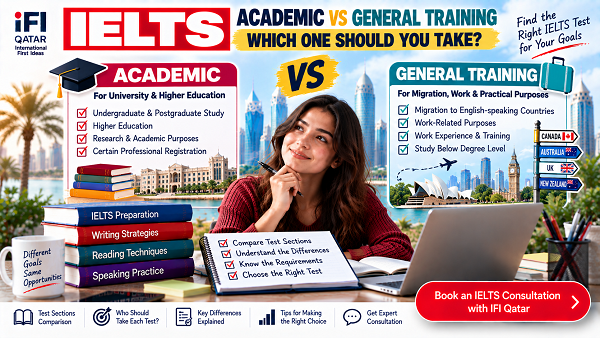
Choosing between IELTS Academic and IELTS General Training is one of the most important decisions you need to make before booking your IELTS test.
The two tests assess the same four English skills—Listening, Reading, Writing and Speaking—but they are designed for different purposes. Listening and Speaking are the same in both versions, while Reading and Writing are different.
So, which IELTS test should you take?
The answer depends primarily on why you need IELTS and which test your university, employer, professional body or immigration authority requires.
If you are planning to study at university, apply for professional registration, migrate, work or complete training, choosing the correct test before booking can save you time and money.
This guide explains the difference between IELTS Academic and General Training, compares each section, explains who should take each test and shows you how to decide which IELTS test is right for your situation.
IELTS Academic vs General Training: The Quick Answer
The simplest way to choose between the two versions is to start with your goal.
IELTS Academic is generally for:
- Undergraduate university study
- Postgraduate study
- Higher education
- Certain professional registration requirements
- Organisations that specifically require IELTS Academic
IELTS General Training is generally for:
- Migration to certain English-speaking countries
- Work-related purposes
- Work experience or training
- Study below degree level
- Organisations that specifically require IELTS General Training
However, there is one rule you should always follow:
Check the exact IELTS requirement of the organisation receiving your result before booking your test.
A university may require Academic, while a particular migration route may specify General Training. Professional registration requirements can also vary.
Do not choose a test simply because you have heard that one version is easier.
What Is IELTS Academic?
IELTS Academic is designed for people who need to demonstrate English ability in an academic environment.
It is generally the appropriate version if you are planning to study at undergraduate or postgraduate level or if a professional organisation requires Academic for registration.
You may need IELTS Academic if you are:
- Applying to a university
- Applying for a bachelor’s degree
- Applying for a master’s degree
- Applying for a PhD
- Applying to a higher-education institution
- Applying for certain professional registration requirements
IELTS describes Academic as a test designed to assess whether a candidate is ready to study in English.
IELTS Academic for University Applications
If you are applying to a university, always check the English-language requirements for your specific programme.
A university may specify:
- IELTS Academic
- A minimum overall band score
- Minimum scores in individual skills
- A specific test format
- Additional English-language conditions
For example, a university might require an overall 6.5 with no individual component below 6.0.
If the institution specifically requires IELTS Academic, taking General Training instead may not satisfy the requirement even if you achieve a high score.
This is why checking the official university requirement should come before booking your test.
What Is IELTS General Training?
IELTS General Training is designed around practical English used in everyday, workplace and social contexts.
It is generally intended for people who need IELTS for purposes such as:
- Migration
- Work-related training
- Work experience
- Study below degree level
- Certain immigration or employment pathways
IELTS identifies migration to English-speaking countries such as Australia, Canada, New Zealand and the UK as an important use of General Training.
However, immigration requirements depend on the specific country, programme and visa pathway.
You should therefore check the official requirement for your application rather than assuming that General Training is always accepted.
IELTS Academic vs General Training: Main Differences
Both tests contain four sections:
- Listening
- Reading
- Writing
- Speaking
The major differences are in Reading and Writing.
| Feature | IELTS Academic | IELTS General Training |
|---|---|---|
| Main purpose | Higher education and certain professional registration | Migration, work, training and below-degree study |
| Listening | Same | Same |
| Speaking | Same | Same |
| Reading | Different | Different |
| Writing | Different | Different |
| Writing Task 1 | Visual information | Letter |
| Writing Task 2 | Essay | Essay |
| Reading focus | Academic-style texts | Everyday, workplace and general-interest texts |
The official IELTS specifications confirm that Listening and Speaking are the same in both tests, while Reading and Writing are different.
IELTS Academic vs General Training: Listening
One of the easiest parts of the comparison is Listening.
The Listening test is the same for IELTS Academic and General Training.
Both versions assess your ability to understand spoken English in different situations and contexts.
This means you do not need to prepare for a completely different Listening test depending on whether you choose Academic or General Training.
Your preparation should focus on skills such as:
- Identifying key information
- Following conversations
- Understanding different accents
- Recognising paraphrases
- Predicting answers
- Following changes in information
- Identifying speakers’ opinions
- Managing concentration
If you are switching from one test type to the other, much of your Listening preparation can therefore remain relevant.
IELTS Academic vs General Training: Speaking
The Speaking test is also the same in both versions.
The official IELTS Speaking test is an interview with an examiner and consists of three parts.
Part 1: Introduction and Interview
You answer questions about familiar subjects such as:
- Home
- Work
- Studies
- Family
- Hobbies
- Daily life
- Interests
Part 2: Individual Long Turn
You receive a task card and have one minute to prepare before speaking for up to two minutes.
Part 3: Discussion
You discuss broader issues connected to the Part 2 topic.
Because Speaking is the same in Academic and General Training, you can use the same core Speaking preparation strategies for both tests.
You should practise:
- Fluency
- Vocabulary
- Grammar
- Pronunciation
- Answer development
- Expressing opinions
- Giving examples
- Comparing ideas
- Explaining reasons
IELTS Academic vs General Training: Reading
Reading is one of the biggest differences between the two IELTS tests.
IELTS Academic Reading
Academic Reading is designed around texts relevant to an academic environment.
You may encounter texts involving:
- Science
- Education
- Technology
- History
- Society
- Research
- The environment
- Academic or general-interest subjects
The language and organisation of the texts are intended to reflect the kinds of reading candidates may encounter in higher education.
Common question types include:
- Multiple choice
- True, False, Not Given
- Matching headings
- Matching information
- Sentence completion
- Summary completion
- Diagram labelling
IELTS General Training Reading
General Training Reading focuses more heavily on practical and everyday contexts.
You may encounter:
- Notices
- Advertisements
- Workplace information
- Job descriptions
- Instructions
- Training materials
- General-interest texts
The test is designed around practical uses of English rather than primarily academic reading.
Is General Training Reading Easier?
This is a common question, but it is not a good reason to choose your test.
Academic and General Training Reading are designed for different purposes.
You may personally find one type of text more familiar than the other, but your choice should be based on the requirement you need to meet.
If your university requires Academic, choosing General Training because you think it may be easier will not solve the problem.
Choose the required test first. Then prepare specifically for it.
IELTS Academic vs General Training: Writing
Writing is another major difference.
Both versions contain two Writing tasks, but Task 1 is different.
IELTS Academic Writing Task 1
Academic Task 1 requires you to describe, summarise or explain visual information.
Depending on the question, you may need to write about:
- Line graphs
- Bar charts
- Pie charts
- Tables
- Processes
- Diagrams
- Maps
You need to identify the most important information and present it in a clear, organised way.
IELTS General Training Writing Task 1
General Training Task 1 requires you to write a letter.
The situation may be:
- Personal
- Semi-formal
- Formal
For example, you might need to write to:
- A friend
- A landlord
- A company
- A manager
- A local organisation
You need to understand the purpose of the letter, use an appropriate tone and address all the points in the task.
IELTS Writing Task 2
Task 2 is an essay in both Academic and General Training.
You may need to:
- Present an opinion
- Discuss an issue
- Explain advantages and disadvantages
- Discuss problems and solutions
- Discuss different views
The specific question determines what you need to do.
This means your Task 2 preparation can overlap between the two versions, although you should still practise with the test type and question style you will actually take.
IELTS Academic vs General Training for University
If you are applying to a university, IELTS Academic is generally the version you should investigate first.
This applies particularly to:
- Bachelor’s degrees
- Master’s degrees
- PhD programmes
- Higher-education courses
- English-medium university programmes
However, requirements vary by institution.
Before booking:
- Find your university’s official admissions page.
- Locate the English-language requirements.
- Check whether it specifies IELTS Academic.
- Check the required overall band.
- Check minimum scores for individual skills.
- Confirm whether there are additional requirements.
Do not rely only on information from social media, forums or friends who applied to a different university.
Your own programme’s official requirements are what matter.
IELTS Academic vs General Training for Migration
For migration, General Training is commonly used for certain pathways, but you should always verify the exact requirement of your immigration programme.
Different countries and immigration routes can have different:
- Accepted tests
- Minimum scores
- Skill requirements
- Validity rules
- English-language thresholds
For example, the IELTS version required for one immigration pathway may not automatically be the same for another.
If migration is your goal, identify the exact visa or immigration pathway first.
Then check its official English-language requirement.
IELTS Academic vs General Training for Work
The correct test for work depends on the employer, profession and purpose for which you need IELTS.
For general employment or workplace-related purposes, General Training may be relevant.
However, professional registration can be different.
For example, a regulated profession may require IELTS Academic as part of its registration process.
If you are applying for:
- Healthcare registration
- Professional licensing
- Engineering registration
- Teaching registration
- Another regulated profession
check the official requirements of the relevant professional body.
Do not assume that General Training is automatically accepted simply because your purpose is employment.
IELTS Academic vs General Training for Professional Registration
Professional registration deserves particular attention because the wrong test can delay your application.
Some professional organisations specify IELTS Academic.
Before booking, check:
- The accepted IELTS test type
- Required overall band
- Minimum component scores
- Accepted test format
- Result validity requirements
- Any profession-specific conditions
The organisation responsible for your registration should be your primary source of information.
Which IELTS Test Is Easier?
There is no universal answer.
Academic and General Training are designed for different purposes, so it is misleading to treat them as simply “hard” and “easy” versions of IELTS.
You may personally find General Training Reading more familiar because it contains practical and workplace-oriented material.
Another candidate may be more comfortable with Academic Reading because they have extensive experience reading academic texts.
Your background matters.
More importantly, the test that matters is the test accepted for your application.
The Better Question to Ask
Instead of asking:
Which IELTS test is easier?
ask:
Which IELTS test does the organisation I am applying to require?
That question will lead you to the correct decision.
IELTS Academic vs General Training: Which One Should You Take?
Use the following guide as a starting point.
Choose IELTS Academic if you:
- Want to study at university
- Are applying for undergraduate study
- Are applying for postgraduate study
- Need IELTS for higher education
- Need IELTS for a professional registration process that specifies Academic
- Have been instructed by an institution to take Academic
Consider IELTS General Training if you:
- Need IELTS for a migration pathway that specifies General Training
- Need IELTS for work-related purposes where General Training is accepted
- Need IELTS for work experience or training
- Plan to study below degree level
- Have been specifically instructed to take General Training
If You Are Still Unsure
Do not book yet.
First contact the organisation receiving your IELTS result.
Ask:
“Which IELTS test do you require: Academic or General Training?”
This simple question can prevent you from booking the wrong test.
IELTS Academic vs General Training: A Simple Decision Tree
You can use this process:
Are you applying to university?
→ Check whether the university requires IELTS Academic.
Are you applying for professional registration?
→ Check the professional body’s specific IELTS requirement.
Are you applying for migration?
→ Check the exact immigration pathway and accepted IELTS test.
Are you applying for work or training?
→ Check the employer or programme requirements.
Still unclear?
→ Contact the organisation before booking.
The final decision should be based on the official requirement, not on which test someone else took.
IELTS Academic vs General Training in Qatar
If you are planning to take IELTS in Qatar, the same principle applies: determine the test type before you book.
IFI Qatar provides IELTS-related services in Doha, and candidates can check the currently available test options and dates when planning their exam.
Before booking, confirm:
- Academic or General Training
- Test date
- Test location
- Available test format
- Current test fee
- Identification requirements
- Registration deadline
- Your target score
Test availability and booking conditions can change, so always check the current information when you are ready to register.
Should You Take IELTS Academic or General Training Preparation?
Once you have identified your test type, your preparation should become specific.
If You Are Taking IELTS Academic
Prioritise:
- Academic Reading
- Academic vocabulary
- Writing Task 1 charts and diagrams
- Writing Task 2 essays
- Academic-style texts
- Complex reading passages
- Academic argument development
If You Are Taking IELTS General Training
Prioritise:
- General Training Reading
- Everyday and workplace vocabulary
- Letter writing
- Writing Task 2
- Practical reading situations
- Workplace-related texts
- General English communication
Skills You Can Prepare for Together
Because Listening and Speaking are the same in both tests, you can develop these skills regardless of your test version.
Focus on:
- Listening comprehension
- Vocabulary
- Pronunciation
- Fluency
- Grammar
- Speaking confidence
- Note-taking
- Paraphrasing
Common Mistakes When Choosing IELTS Academic vs General
Mistake 1: Choosing Based on Difficulty
A candidate hears that General Training is easier and books it without checking the requirement.
Better approach: Check the official requirement first.
Mistake 2: Assuming All Universities Accept General Training
Universities can specify the test type they require.
Better approach: Check the admissions page for your exact programme.
Mistake 3: Assuming All Migration Routes Use General Training
Immigration requirements vary.
Better approach: Check the exact visa or immigration pathway.
Mistake 4: Ignoring Professional Registration Requirements
Professional bodies may have their own English-language requirements.
Better approach: Check directly with the relevant professional organisation.
Mistake 5: Preparing for Both Versions
If you know which test you need, spending most of your preparation time on the wrong Reading and Writing format is inefficient.
Better approach: Prepare specifically for your chosen test.
Mistake 6: Checking Only the Required Overall Band
Some organisations also require minimum scores in individual skills.
Better approach: Check the complete score requirement.
IELTS Academic vs General Training: What Should You Do Before Booking?
Use this checklist.
Before Booking Your IELTS Test
- Identify your reason for taking IELTS
- Identify the organisation receiving your result
- Check the required IELTS test type
- Check the required overall band
- Check individual skill requirements
- Check whether your result must meet a specific validity period
- Check available test dates
- Choose the appropriate test format
- Start preparation for the correct version
This process takes only a few minutes but can prevent significant problems later.
When Should You Book an IELTS Consultation?
If you are still unsure whether you need IELTS Academic or General Training, a consultation can help you organise the decision before you commit to a test date.
A useful IELTS consultation should consider:
- Your study or career goal
- Your destination
- Your university or organisation
- Your immigration pathway, if applicable
- Your current English level
- Your target band
- Your test date
- The skills you need to improve
- The appropriate preparation plan
The consultation should help you identify the correct test and preparation path, rather than simply recommending a test without checking your requirements.
Frequently Asked Questions About IELTS Academic vs General Training
What is the main difference between IELTS Academic and General Training?
The main difference is their intended purpose and the content of the Reading and Writing sections. Listening and Speaking are the same in both versions.
Is IELTS Academic harder than General Training?
The tests are designed for different purposes, so it is not accurate to describe one as universally harder. Your familiarity with academic or practical English can also affect how difficult each feels.
Which IELTS should I take for university?
IELTS Academic is generally the relevant version for undergraduate and postgraduate study, but you should always check the exact requirement of your university and programme.
Which IELTS should I take for migration?
General Training is commonly used for migration to certain English-speaking countries, but the correct test depends on the specific immigration pathway. Always check the official requirement.
Is IELTS General Training accepted for university?
Do not assume that it is. Universities and programmes set their own English-language requirements, so check whether your institution specifically requires IELTS Academic.
Are IELTS Listening and Speaking the same for Academic and General Training?
Yes. The Listening and Speaking sections are the same in IELTS Academic and General Training.
Are IELTS Reading and Writing the same?
No. Reading and Writing differ between Academic and General Training because the tests are designed around different language needs.
Which IELTS has a letter in Writing Task 1?
IELTS General Training Writing Task 1 is a letter-writing task. Academic Writing Task 1 requires you to describe, summarise or explain visual information.
Is IELTS General Training easier?
It should not be selected simply because you have heard it is easier. The correct version is the one required by the organisation or authority receiving your result.
Can I use IELTS Academic for migration?
This depends on the specific immigration programme and its accepted English tests. Check the official requirements for your pathway before booking.
Can I use IELTS General Training for professional registration?
That depends on the professional body. Some professional registration processes specifically require IELTS Academic.
Do I need different preparation for Academic and General Training?
Yes, particularly for Reading and Writing. Listening and Speaking preparation can largely overlap because those sections are the same.
Get Personalised IELTS Guidance Before You Book
Choosing the right IELTS test is the first step, but it is not the only decision you need to make.
You also need to know:
- What band score you need
- Which skills require the most improvement
- How much preparation time you have
- Which test date is realistic
- Which preparation method suits your current level
If you are taking IELTS in Qatar and are unsure whether you should choose Academic or General Training, getting personalised guidance before booking can help you avoid preparing for the wrong test.
IFI Qatar can help you understand the available IELTS options, assess your preparation needs and identify the most appropriate next step based on your goal.
Need help choosing the right IELTS test?
Book an IELTS Consultation with IFI Qatar and get guidance on your test type, target score and preparation plan before you book your exam.
Final Thoughts: IELTS Academic vs General Training
The decision between IELTS Academic and General Training should not be based on which test you think will be easier.
It should be based on what you need IELTS for and, most importantly, what the organisation receiving your result requires.
Choose Academic when your goal involves higher education or a professional registration requirement that specifies Academic.
Choose General Training when your application requires it for migration, work-related training, work experience or below-degree study.
Remember the key difference:
Listening and Speaking are the same. Reading and Writing are different.
If you are still uncertain, check the official requirement of your university, employer, professional body or immigration authority before booking.
And if you are preparing for IELTS in Qatar but are not sure which test, band score or preparation route is right for you, an IELTS consultation can help you make that decision before you commit to your exam.