

Currently Empty: ر.ق 0,00


IELTS
IELTS Speaking Questions About Travel and Holidays
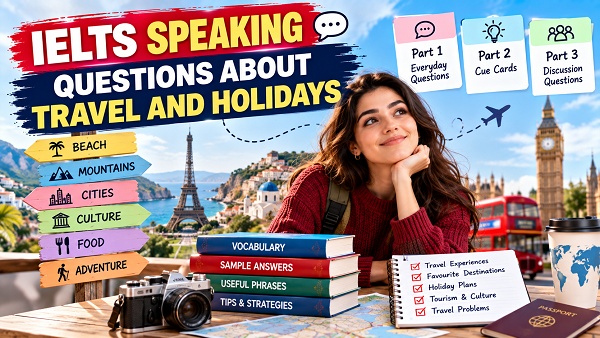
Travel and holidays are useful IELTS Speaking practice topics because they give you opportunities to talk about familiar experiences, preferences, places, activities and opinions.
You may be asked about travel in different ways during IELTS Speaking practice. For example, you might discuss a holiday you enjoyed, a memorable journey, a place you would like to visit, or the advantages and disadvantages of tourism.
However, you should not try to memorise complete answers.
The IELTS Speaking test is a face-to-face interview with an examiner and lasts 11–14 minutes. It has three parts: Part 1, Part 2 and Part 3. Your performance is assessed using four criteria: Fluency and Coherence, Lexical Resource, Grammatical Range and Accuracy, and Pronunciation.
This guide gives you a practical collection of IELTS travel speaking topics, sample questions, model answers, useful vocabulary, collocations and strategies for developing stronger responses.
What Are IELTS Travel Speaking Topics?
IELTS travel speaking topics include questions related to:
- Holidays
- Travel habits
- Tourist destinations
- Transportation
- Travel experiences
- Family holidays
- International travel
- Local tourism
- Hotels and accommodation
- Travel problems
- Cultural experiences
- Tourism and the environment
- The future of travel
Travel-related questions can appear in different forms, so you should prepare ideas and vocabulary rather than memorise fixed answers.
Are Travel and Holiday Questions Guaranteed in IELTS Speaking?
No.
IELTS Speaking questions are selected from topic areas appropriate to the test format, but there is no guarantee that a specific travel or holiday question will appear in your test.
The questions in this guide should therefore be used as practice material, not as predictions of the exact questions you will receive.
Why Is Travel Good IELTS Speaking Practice?
Travel gives you opportunities to practise several important Speaking skills.
You can describe:
- Personal experiences
- Places
- People
- Activities
- Preferences
- Advantages and disadvantages
- Causes and effects
- Changes over time
- Future plans
This makes travel a useful topic for practising all three parts of the Speaking test.
IELTS Speaking Part 1 Travel Questions
Part 1 lasts approximately 4–5 minutes and focuses on familiar topics and everyday experiences. The examiner asks questions designed to elicit information and opinions.
Travel questions in Part 1 should normally be answered naturally and directly. You do not need to give a long speech.
Do You Like Travelling?
Sample answer:
Yes, I really enjoy travelling, especially when I have enough time to explore a place properly. I like discovering local food, visiting interesting places and experiencing a different lifestyle. I also find travelling a good way to take a break from my normal routine.
How Often Do You Travel?
Sample answer:
I probably travel a few times a year. Most of my trips are relatively short because of work and other responsibilities, but I try to take at least one longer holiday whenever I can.
Do You Prefer Travelling Alone or With Other People?
Sample answer:
I generally prefer travelling with one or two close friends because I enjoy sharing experiences with other people. That said, I think travelling alone can also be rewarding because it gives you more freedom to decide where to go and what to do.
Where Do You Usually Go on Holiday?
Sample answer:
I usually prefer cities or coastal destinations. I enjoy places where I can combine sightseeing with relaxing activities, so a destination with interesting cultural attractions and good restaurants is ideal for me.
What Is Your Favourite Way to Travel?
Sample answer:
For long-distance journeys, I prefer travelling by plane because it saves a lot of time. For shorter trips, though, I usually prefer travelling by car because I can stop whenever I want and explore places along the way.
Do You Prefer Short Holidays or Long Holidays?
Sample answer:
I prefer longer holidays because I don’t feel rushed. When I have a week or more, I can explore a destination at a comfortable pace instead of trying to see everything in just a few days.
Do You Like Visiting New Places?
Sample answer:
Yes, definitely. I find it exciting to visit places that I have never seen before. Even if the destination isn’t particularly famous, I enjoy discovering local neighbourhoods and seeing how people live.
What Do You Usually Do When You Travel?
Sample answer:
I usually combine sightseeing with relaxing. I like visiting major attractions, but I also want some free time to walk around, try local food and simply enjoy the atmosphere of the place.
Do You Take Photos When You Travel?
Sample answer:
Yes, I take quite a lot of photos, although I try not to spend the entire trip looking through my phone. I mainly take pictures of interesting buildings, landscapes and memorable moments with friends.
What Was Your Last Holiday Like?
Sample answer:
My last holiday was quite relaxing. I visited a new city with a friend, explored several popular attractions and tried a lot of local food. We also had plenty of free time, so the trip didn’t feel too busy.
IELTS Speaking Part 1 Holiday Questions and Sample Answers
Holiday questions often ask about your preferences, past experiences and habits.
What Do You Usually Do During Your Holidays?
Sample answer:
It depends on the type of holiday. If I’m visiting a new city, I usually spend more time sightseeing and exploring. If I’ve had a stressful period at work or university, I prefer a quieter holiday where I can relax and recharge.
What Makes a Holiday Enjoyable for You?
Sample answer:
For me, the most important things are good company, comfortable accommodation and enough free time. I don’t need a very luxurious trip. As long as I can enjoy the destination without feeling rushed, I’m usually happy.
Do You Prefer Relaxing Holidays or Active Holidays?
Sample answer:
I prefer a combination of both. I enjoy relaxing by the beach or at a hotel, but I also like exploring the area and trying new activities. Having a balance makes the holiday more enjoyable for me.
What Was the Best Holiday You Have Ever Had?
Sample answer:
One of my best holidays was a trip I took with my family a few years ago. We visited several interesting places, spent a lot of time together and experienced a completely different culture. What made it special was the fact that we weren’t in a hurry.
Do You Usually Plan Your Holidays Carefully?
Sample answer:
I usually plan the important things, such as flights and accommodation, in advance. However, I prefer to leave some free time in my schedule because unexpected experiences can sometimes become the best part of a trip.
IELTS Speaking Part 2 Travel Cue Cards
Part 2 is the individual long turn. You receive a task card, have one minute to prepare, and then speak for up to two minutes. The examiner may ask one or two short questions afterwards.
The best way to practise travel cue cards is to learn how to organise ideas quickly rather than memorise a complete speech.
Describe a Memorable Holiday You Had
You should say:
- Where you went
- Who you went with
- What you did
- And explain why you remember this holiday
Sample answer:
One of the most memorable holidays I had was a trip I took with two close friends a few years ago. We decided to visit a city that none of us had been to before, so we were all quite excited about the experience.
During the trip, we visited several famous attractions, explored local markets and tried different kinds of food. One of the best parts was simply walking around the city because we discovered several interesting places that weren’t mentioned in our original plan.
What made the holiday particularly memorable was the amount of time we spent together. We had plenty of conversations, laughed about unexpected situations and took lots of photos. I think it was memorable because it combined a new experience with good company.
Describe a Place You Would Like to Visit
You should say:
- Where it is
- Why you want to visit it
- What you would like to do there
- And explain why you would like to go there
Sample answer:
A place I’d really like to visit is Japan. I’ve been interested in the country for several years because of its combination of traditional culture and modern technology.
If I visited Japan, I’d like to explore Tokyo first because I’ve heard that it has a fascinating mix of modern architecture, shopping areas and traditional neighbourhoods. I’d also like to visit some quieter areas outside the city and try authentic Japanese food.
The main reason I want to go is that the country seems very different from the places I’ve visited before. I think experiencing that cultural difference would make the trip particularly interesting.
Describe a Journey That You Remember Well
You should say:
- Where you travelled
- How you travelled
- Who you travelled with
- And explain why you remember the journey
Sample answer:
One journey I remember particularly well was a road trip I took with some friends. We were travelling to another city, and the journey itself was almost as enjoyable as the destination.
We drove for several hours and stopped at a few places along the way. We listened to music, talked about different things and stopped at a small restaurant for lunch.
I remember the journey because it was completely different from travelling by plane. We weren’t in a hurry, and we could stop whenever we saw something interesting. It made the journey feel like part of the holiday rather than simply a way of getting somewhere.
Describe a Holiday That Did Not Go as Planned
You should say:
- Where you went
- What happened
- How you dealt with the situation
- And explain how you felt about the experience
Sample answer:
A holiday that didn’t go exactly as planned was a short trip I took with a friend. We had organised several outdoor activities, but the weather changed suddenly and we had to cancel some of our plans.
At first, we were disappointed because we had been looking forward to those activities. However, instead of staying at the hotel, we decided to explore some indoor attractions and spend more time trying local restaurants.
In the end, the holiday was still enjoyable. The experience taught me that it’s useful to have a flexible attitude when travelling because unexpected problems are sometimes unavoidable.
Describe a Tourist Attraction You Have Visited
You should say:
- What it was
- Where it was
- Who you visited it with
- And explain what you thought about it
Sample answer:
One tourist attraction I really enjoyed visiting was a famous historical site in another country. I visited it with my family during a holiday.
The site was impressive because of its architecture and historical importance. We joined a guided tour, which helped us understand the background of the place rather than simply looking at the buildings.
I enjoyed the visit because it gave me a better understanding of the local culture. It was also interesting to see something that I had previously only seen in photographs.
How to Structure an IELTS Travel Cue Card Answer
A simple structure can help you speak for up to two minutes without losing your train of thought.
Start With the Basic Context
Begin by answering the basic question.
For example:
I’d like to talk about a holiday I had a few years ago when I visited…
This immediately tells the examiner what you are going to discuss.
Add Specific Details
Then develop the topic with details about:
- Where
- When
- Who
- What
- Why
Specific details make your answer easier to develop.
Add Personal Reactions
Do not only describe events.
Explain how you felt.
Useful expressions include:
- I was really excited because…
- I was surprised by…
- What I particularly enjoyed was…
- I found it fascinating because…
- The thing that impressed me most was…
Finish With Reflection
End by explaining why the experience was important or memorable.
For example:
Looking back, I think the experience was memorable because it allowed me to experience a completely different culture.
IELTS Speaking Part 3 Travel Questions
Part 3 is a more general and abstract discussion related to the Part 2 topic. It lasts approximately 4–5 minutes and gives you opportunities to explain opinions, analyse issues and discuss broader ideas.
Travel questions in Part 3 may therefore move away from your personal experiences and towards subjects such as tourism, culture, transportation and the environment.
Why Do People Like Travelling?
Sample answer:
I think people travel for several reasons. Some people want to relax and escape their normal routine, while others are interested in experiencing different cultures. Travel can also be educational because it allows people to see how other communities live and develop a broader understanding of the world.
How Has Travel Changed in Recent Years?
Sample answer:
Travel has become more accessible because of improvements in transportation and technology. People can compare flights and hotels online, use digital maps and organise most aspects of a trip through their phones. Social media has also influenced travel because people often discover destinations through online content.
What Are the Benefits of International Tourism?
Sample answer:
International tourism can bring significant economic benefits because visitors spend money on accommodation, restaurants, transport and attractions. It can also create employment opportunities. In addition, tourism can encourage cultural exchange because visitors and local communities have opportunities to interact.
What Problems Can Tourism Cause?
Sample answer:
Mass tourism can create several problems. Popular destinations may experience overcrowding, increased waste and pressure on local infrastructure. In some areas, tourism can also increase housing costs or put pressure on natural environments.
Should Governments Limit the Number of Tourists in Popular Destinations?
Sample answer:
In some cases, I think limits may be appropriate, particularly when tourism is damaging the environment or creating serious overcrowding. However, governments should consider the economic importance of tourism as well. Measures such as visitor quotas, seasonal restrictions or entrance fees could sometimes be more practical than completely restricting tourism.
Is International Travel Important for Young People?
Sample answer:
It can be very valuable because young people can gain independence and experience different cultures. Travelling can also improve communication skills and encourage people to become more open-minded. However, the benefits depend on how people travel and whether they actually engage with the local culture.
Will People Travel More in the Future?
Sample answer:
I think international travel will probably continue to be popular, although the way people travel may change. Technology could make planning easier, while environmental concerns may encourage travellers to choose more sustainable forms of transportation and accommodation.
IELTS Travel Vocabulary for Speaking
Using relevant vocabulary can help you explain your ideas more precisely, but you should prioritise natural and accurate language.
The official IELTS Speaking criteria include Lexical Resource, which considers the range and accuracy of vocabulary used to express meaning.
Useful Travel Vocabulary
| Vocabulary | Meaning | Example |
|---|---|---|
| destination | place you travel to | Paris is a popular tourist destination. |
| itinerary | plan of a journey | We created a detailed itinerary before the trip. |
| sightseeing | visiting interesting places | We spent the morning sightseeing. |
| accommodation | place where you stay | We booked our accommodation in advance. |
| tourist attraction | place visited by tourists | The museum is a popular tourist attraction. |
| landmark | recognisable important place or building | The tower is a famous city landmark. |
| local cuisine | traditional food of a place | I enjoy trying local cuisine when I travel. |
| cultural experience | experience involving another culture | The trip was a valuable cultural experience. |
| public transport | buses, trains and other shared transport | Public transport is convenient in large cities. |
| travel insurance | insurance covering certain travel problems | I always buy travel insurance for international trips. |
| budget-friendly | relatively inexpensive | We were looking for a budget-friendly hotel. |
| tourist season | period when many tourists visit | Prices are usually higher during the tourist season. |
| peak season | busiest travel period | Flights can be expensive during peak season. |
| off-season | period with fewer tourists | Travelling in the off-season can be cheaper. |
| breathtaking | extremely beautiful or impressive | The mountain views were breathtaking. |
Useful Vocabulary for Describing Places
Use adjectives that communicate specific ideas rather than repeatedly saying “beautiful.”
- picturesque
- vibrant
- peaceful
- historic
- crowded
- remote
- scenic
- lively
- charming
- cosmopolitan
- traditional
- modern
- fascinating
- spectacular
Example:
I visited a picturesque coastal town with narrow streets and traditional buildings.
Useful Vocabulary for Describing Travel Experiences
Useful expressions include:
- unforgettable experience
- memorable trip
- eye-opening experience
- cultural experience
- once-in-a-lifetime experience
- relaxing getaway
- adventurous trip
- family holiday
- weekend break
- long-distance journey
IELTS Travel Collocations for Band 7+ Speaking
Collocations can make your spoken English more natural and precise.
Try learning phrases rather than isolated words.
Travel Collocations
- travel abroad
- take a trip
- go on holiday
- visit a destination
- explore a city
- book accommodation
- catch a flight
- miss a flight
- travel by train
- experience a new culture
- try local cuisine
- visit tourist attractions
- take photographs
- make travel arrangements
- plan an itinerary
- travel on a budget
- avoid the tourist crowds
- travel during peak season
- explore off the beaten track
- broaden your horizons
Example Sentences
I really enjoy travelling abroad because it allows me to experience different cultures.
We decided to travel during the off-season to avoid the tourist crowds.
One of the best ways to broaden your horizons is to spend time in a culture that is different from your own.
How to Give Better IELTS Travel Speaking Answers
Strong answers are not necessarily the longest answers.
Your goal is to communicate ideas clearly and naturally.
Give a Direct Answer First
Avoid spending too much time introducing your answer.
Instead of:
Well, that’s actually quite an interesting question, and I’ve never really thought about it before…
Say:
Yes, I really enjoy travelling because it gives me an opportunity to experience different cultures.
Then explain your answer.
Explain Your Ideas
Do not stop after one sentence.
Use:
Answer → Reason → Example
For example:
Yes, I enjoy travelling. The main reason is that I like experiencing different cultures. For example, when I visit another country, I always try to learn about the local food and traditions.
Use Personal Examples
Personal examples are especially useful for Part 1 and Part 2.
You can talk about:
- A family holiday
- A school trip
- A weekend trip
- A journey with friends
- A place you visited
- A holiday problem
- A destination you want to visit
Develop General Ideas in Part 3
Part 3 requires more than personal stories.
Move from:
I like travelling because it’s fun.
to:
Travel can be beneficial because it exposes people to different cultures and perspectives. This may help them become more open-minded and improve their understanding of other societies.
Common IELTS Travel Speaking Mistakes
Memorising Complete Answers
Memorised answers can sound unnatural and may not fit the question.
The official IELTS preparation guidance emphasises the interactive nature of Speaking, and the test is designed so candidates cannot simply rehearse fixed responses.
Better approach: Prepare ideas, vocabulary and answer structures.
Giving Very Short Answers
Part 1 answers should be conversational, but one-word answers make it difficult to demonstrate your speaking ability.
Instead of:
Yes.
Try:
Yes, definitely. I enjoy travelling because I get to experience new places and take a break from my usual routine.
Speaking for Too Long in Part 1
Part 1 is not a two-minute speech.
Answer the question naturally, add a reason or example, and allow the examiner to continue the conversation.
Repeating the Same Vocabulary
Using “beautiful,” “interesting” and “good” repeatedly can limit your vocabulary range.
Try more precise words:
- scenic
- fascinating
- spectacular
- peaceful
- memorable
- enjoyable
- impressive
Giving Personal Answers in Part 3
Part 3 is more abstract.
Instead of focusing entirely on:
“I travelled to…”
discuss broader issues such as:
- Tourism
- Society
- The economy
- The environment
- Technology
- Cultural exchange
IELTS Travel Speaking Grammar You Can Practise
Travel topics are useful for practising several grammatical structures.
Past Tenses for Travel Experiences
Use the past simple and past continuous to describe previous trips.
I visited Spain last summer.
We were driving through the countryside when we saw a beautiful village.
Present Perfect for Travel Experience
Use the present perfect when talking about life experience.
I’ve travelled to several European countries.
I’ve never visited Japan.
Comparatives for Travel Preferences
Travelling by train is more comfortable than travelling by bus.
City holidays are usually more expensive than countryside trips.
Conditionals for Future Travel
If I had the opportunity, I would love to travel around South America.
If flights were cheaper, more people might travel internationally.
7-Day IELTS Travel Speaking Practice Plan
Day 1: Part 1 Travel Questions
Practise:
- Do you like travelling?
- How often do you travel?
- Where do you usually go?
- Do you prefer travelling alone or with others?
Record your answers and listen for hesitation and repetition.
Day 2: Holiday Vocabulary
Learn 15–20 useful travel words and collocations.
Create your own sentences rather than memorising dictionary definitions.
Day 3: Part 2 Cue Cards
Choose two travel cue cards.
Give yourself exactly one minute to prepare and then speak for up to two minutes.
Day 4: Travel Experiences
Practise describing:
- A memorable holiday
- A journey
- A tourist attraction
- A travel problem
Focus on using past tenses naturally.
Day 5: Part 3 Discussion
Discuss:
- Benefits of tourism
- Problems caused by mass tourism
- Future travel
- Environmental effects of tourism
Try to explain and justify every major opinion.
Day 6: Vocabulary and Pronunciation
Review your travel vocabulary and record yourself using the new words.
Listen for:
- Word stress
- Sentence stress
- Pronunciation
- Pausing
- Intonation
Day 7: Full Speaking Practice
Complete a simulated Speaking test:
Part 1: 4–5 minutes
Part 2: 3–4 minutes including preparation
Part 3: 4–5 minutes
The official Speaking format uses these three sections within an overall 11–14-minute test.
IELTS Travel Speaking Band 7 Checklist
Before your IELTS test, ask yourself:
- Can I answer travel questions without memorising scripts?
- Can I extend my Part 1 answers naturally?
- Can I speak for up to two minutes in Part 2?
- Can I organise a cue-card answer logically?
- Can I explain and justify opinions in Part 3?
- Can I use travel vocabulary accurately?
- Can I use a range of grammatical structures?
- Can I describe past experiences clearly?
- Can I discuss future possibilities?
- Can I paraphrase when I forget a word?
- Can I speak without excessive hesitation?
- Can the examiner understand me easily?
At Band 7, the official Speaking descriptors include the ability to maintain long turns, use spoken discourse markers and cohesive features flexibly, use vocabulary flexibly across topics, use a range of grammatical structures, and demonstrate the positive pronunciation features described at Band 6 plus some Band 8 features.
Frequently Asked Questions About IELTS Travel Speaking Topics
What are common IELTS travel speaking topics?
Common practice areas include holidays, travel preferences, destinations, transportation, memorable journeys, tourist attractions, accommodation, international travel, tourism and environmental issues.
However, these are practice topics rather than guaranteed IELTS questions.
How should I answer IELTS Speaking Part 1 travel questions?
Give a direct answer, add a reason and, when appropriate, give a short example. Keep your answer conversational rather than turning it into a long speech.
What travel topics can appear in IELTS Speaking Part 2?
Practice topics can include a memorable holiday, a place you want to visit, a journey, a tourist attraction, a holiday that went wrong or a travel experience that taught you something.
These should be treated as practice prompts, not predictions of the exact test.
How can I talk for two minutes in IELTS Speaking Part 2?
Use the cue-card points as a framework. Start with the basic context, describe specific details, explain your feelings or opinions, and finish with a reflection or reason why the experience was important.
What vocabulary should I learn for IELTS travel topics?
Focus on useful travel vocabulary such as destination, itinerary, accommodation, sightseeing, tourist attraction, local cuisine, cultural experience, peak season and travel arrangements. Learn these words in natural phrases and sentences.
Is travel vocabulary important for Band 7?
Vocabulary is one of the four IELTS Speaking assessment criteria. Band 7 requires flexible vocabulary use across a variety of topics, some ability to use less common and idiomatic items, awareness of style and collocation, and effective paraphrase.
Should I memorise IELTS travel answers?
No. It is better to prepare ideas, vocabulary, collocations and flexible answer structures. Memorised answers can sound unnatural and may not respond directly to the examiner’s question.
How can I improve my IELTS Speaking score using travel topics?
Practise all three Speaking parts, record your answers, review vocabulary and grammar, work on pronunciation, and get feedback on fluency, vocabulary, grammar and pronunciation.
Improve Your IELTS Speaking With Structured Practice
Practising IELTS travel speaking topics on your own is useful, but identifying exactly why an answer is not reaching your target band can be difficult.
A structured IELTS Speaking course can give you opportunities to practise:
- Part 1 questions
- Part 2 cue cards
- Part 3 discussions
- Vocabulary development
- Grammar accuracy
- Fluency
- Pronunciation
- Real-time speaking feedback
- Mock Speaking tests
At IFI Qatar, IELTS preparation can help you develop the practical speaking skills needed to communicate more confidently and effectively in the IELTS test.
If you are targeting a higher IELTS Speaking score, consistent practice with expert feedback can help you turn vocabulary and grammar knowledge into stronger spoken performance.
Ready to improve your IELTS Speaking? Explore IELTS Speaking preparation with IFI Qatar and start practising with a structured plan.
Final Tips for IELTS Travel Speaking Topics
When practising travel and holiday questions, remember these five principles:
- Do not memorise complete answers.
- Answer directly before developing your idea.
- Use specific examples from your experience.
- Learn travel vocabulary in collocations and sentences.
- Practise moving from personal answers to broader discussions.
Travel is a flexible topic, so use it to practise the wider skills that IELTS Speaking actually assesses: fluency, vocabulary, grammar and pronunciation.
The goal is not to predict the exact question you will receive.
The goal is to become confident enough to discuss an unfamiliar question naturally, clearly and with enough detail.