

Currently Empty: ر.ق 0,00


IELTS
IELTS Speaking Part 2 Cue Cards with Sample Answers
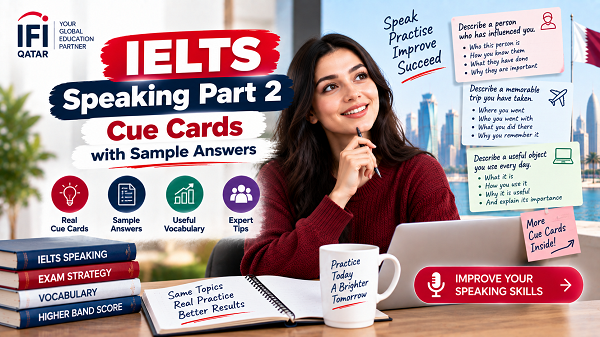
If you are preparing for the IELTS Speaking test, practising IELTS speaking cue cards is one of the most effective ways to improve your performance in Part 2.
In this part of the test, you receive a topic card and have one minute to prepare before speaking for up to two minutes. The challenge is not simply knowing English vocabulary. You also need to organise your ideas quickly, develop your answer naturally, and continue speaking without long pauses.
This guide includes common IELTS Speaking Part 2 cue cards with sample answers, practical strategies, useful vocabulary, and a structured practice plan to help you speak more confidently and naturally.
What Are IELTS Speaking Cue Cards?
An IELTS Speaking cue card is the task card used in IELTS Speaking Part 2.
The card gives you a main topic and several bullet points that suggest what you should discuss.
Typical cue card topics may ask you to describe:
- a person
- a place
- an experience
- a journey
- an object
- a skill
- a decision
- an important event
You receive one minute to prepare before speaking for approximately one to two minutes.
What Does an IELTS Speaking Cue Card Look Like?
A typical cue card may look like this:
Describe a memorable trip you have taken.
You should say:
- where you went
- who you went with
- what you did there
and explain why you remember this trip.
The bullet points are designed to guide your answer.
You do not need to answer each point like a separate question. A stronger approach is to connect the points into one natural story or description.
How IELTS Speaking Part 2 Is Scored
IELTS Speaking is assessed using four official criteria:
- Fluency and Coherence
- Lexical Resource
- Grammatical Range and Accuracy
- Pronunciation
Each criterion contributes equally to your Speaking score.
Fluency and Coherence
Examiners consider whether you can:
- continue speaking without excessive hesitation
- organise ideas logically
- connect ideas naturally
- develop your answers sufficiently
Lexical Resource
This criterion considers how effectively you use vocabulary.
You should aim to:
- use vocabulary appropriate to the topic
- avoid excessive repetition
- paraphrase when necessary
- use common collocations naturally
Grammatical Range and Accuracy
Strong candidates demonstrate a mixture of:
- simple sentences
- compound sentences
- complex sentences
- different verb tenses
- accurate grammatical structures
Pronunciation
You do not need a particular accent.
The main goal is to speak clearly enough that your ideas are easy to understand.
How to Use the One-Minute Preparation Time
Your preparation minute can significantly improve your Part 2 performance if you use it strategically.
Step 1: Choose an Easy Main Idea
Do not spend too long searching for an impressive example.
Choose something that you can explain comfortably in English.
For example, if the topic asks you to describe a person who influenced you, you could choose:
- a teacher
- a parent
- a friend
- a colleague
- a coach
The easiest example is usually better than the most unusual one.
Step 2: Write Keywords Instead of Sentences
Avoid writing complete sentences during your preparation time.
If your cue card is about a memorable trip, your notes might look like this:
Dubai — cousin — 2024 — beach — food — first trip abroad — relaxing
These short notes are enough to remind you what to say.
Step 3: Follow the Cue Card Bullet Points
Use the bullet points as a roadmap rather than a script.
A simple structure is:
Main idea → Background → Details → Feelings → Importance
Step 4: Add Personal Details
Think about:
- when it happened
- where it happened
- who was involved
- what happened
- how you felt
- what happened afterwards
- what you learned
Personal details help you extend your answer naturally.
Best Structure for IELTS Speaking Part 2 Answers
You do not need to memorise a fixed template, but having a flexible structure can make your response easier to organise.
1. Introduce the Topic
Start by clearly introducing what you are going to discuss.
Useful phrases include:
- “I’d like to talk about…”
- “The first thing that comes to mind is…”
- “One experience I remember particularly well is…”
- “I’d like to describe…”
- “A person who immediately comes to mind is…”
2. Give Background Information
Briefly establish:
- who
- what
- when
- where
This gives the examiner enough context to follow your story.
3. Develop the Main Details
This should usually be the longest part of your answer.
You can explain:
- what happened
- what you did
- what other people did
- what you saw
- how the situation developed
- what happened next
4. Explain Your Feelings or Opinion
Adding your reaction makes the answer more developed.
You might explain:
- why you enjoyed something
- why it was difficult
- why someone influenced you
- why an event was memorable
5. Finish with a Reflection
Conclude naturally by explaining why the topic matters to you.
For example:
- “That’s why I remember it so clearly.”
- “Looking back, I think it was an important experience.”
- “It changed the way I think about…”
- “Overall, it had a positive impact on me.”
IELTS Speaking Part 2 Cue Cards with Sample Answers
The following practice topics cover several common IELTS Speaking Part 2 themes.
Cue Card 1: Describe a Person Who Has Influenced You
You should say:
- who this person is
- how you know this person
- what this person has done
- and explain how they have influenced you
Sample Answer
I’d like to talk about one of my former teachers, who had a significant influence on the way I approach learning.
I met her when I was in high school, and she taught me English for two years. What I remember most about her was the way she encouraged students to express their own opinions rather than simply memorising information.
At that time, I wasn’t particularly confident when speaking English. I was worried about making mistakes, so I usually stayed quiet during class. She gradually encouraged me to participate in discussions and helped me understand that making mistakes was a normal part of learning a language.
What influenced me most was her attitude towards learning. She always told us that progress was more important than perfection.
I still remember that advice because I use the same approach whenever I learn something new.
That’s why I’d say she influenced me not only as a student but also as a person.
Useful Vocabulary
- have a significant influence
- build confidence
- participate in discussions
- make progress
- positive attitude
- encourage someone to
- learn from mistakes
Cue Card 2: Describe a Memorable Trip You Took
You should say:
- where you went
- who you went with
- what you did
- and explain why you remember this trip
Sample Answer
One trip that I remember particularly well was a short holiday I took with my cousin a couple of years ago.
We travelled to Dubai for several days, and it was one of the first times I had travelled abroad with a family member without my parents.
During the trip, we visited several popular attractions, tried different kinds of food and spent quite a lot of time walking around and taking photographs.
One evening, we went to the beach just before sunset, and the atmosphere was incredibly relaxing.
What made the trip memorable wasn’t simply the places we visited. It was the fact that we had very few responsibilities for several days.
Looking back, I think the trip was important because it gave me an opportunity to relax and spend quality time with someone close to me.
Useful Vocabulary
- memorable trip
- travel abroad
- popular attractions
- spend quality time
- relaxing atmosphere
- explore the city
- unforgettable experience
Cue Card 3: Describe a Useful Object You Use Every Day
You should say:
- what it is
- when you started using it
- how you use it
- and explain why it is useful
Sample Answer
I’d like to talk about my laptop, which is probably one of the most useful things I own.
I bought it a few years ago when I started taking my studies more seriously. Since then, I’ve used it almost every day for studying, working, watching educational videos and communicating with other people.
One thing I particularly like about it is its versatility.
For example, I can use it to take notes during an online class, research a topic, write documents or practise English. I also use it to organise my schedule.
The main reason I find it useful is that it saves me a lot of time.
Instead of using several different devices for different tasks, I can do almost everything in one place.
Useful Vocabulary
- extremely useful
- versatile device
- daily routine
- save time
- organise my schedule
- educational purposes
- convenient
Cue Card 4: Describe a Skill You Would Like to Learn
You should say:
- what the skill is
- why you want to learn it
- how you would learn it
- and explain how it would help you
Sample Answer
A skill I’d really like to develop is public speaking.
Although I can communicate comfortably with friends and colleagues, speaking in front of a large group is something I still find challenging.
I’d like to improve this skill because it could be extremely useful in my professional life.
Being able to present ideas clearly and confidently can make a significant difference in meetings, presentations and job interviews.
I would probably learn through a combination of online courses and regular practice.
I could also record myself giving short presentations and review the recordings to identify areas for improvement.
I think the biggest benefit would be greater confidence.
Useful Vocabulary
- develop a skill
- public speaking
- professional life
- communicate confidently
- areas for improvement
- regular practice
- build confidence
Cue Card 5: Describe a Place You Enjoy Visiting
You should say:
- where it is
- when you usually go there
- what you do there
- and explain why you enjoy visiting it
Sample Answer
A place I really enjoy visiting is a quiet park not far from where I live.
I usually go there in the late afternoon, especially when I’ve had a busy day.
When I go there, I normally walk for about half an hour and sometimes listen to music or a podcast.
There are also several benches under the trees, so I occasionally sit down and read.
The main reason I enjoy this place is that it gives me a break from screens and daily responsibilities.
It’s a simple place, but I associate it with relaxation, so I always feel better after spending some time there.
Useful Vocabulary
- peaceful place
- relaxing environment
- clear my mind
- take a break
- spend time outdoors
- quiet atmosphere
- daily responsibilities
Cue Card 6: Describe an Important Decision You Made
You should say:
- what the decision was
- when you made it
- why you made it
- and explain how you felt about it
Sample Answer
One important decision I made was to change the direction of my studies.
I made this decision a few years ago after realising that my original field didn’t really match my interests or long-term goals.
At first, I was hesitant because changing direction meant starting something unfamiliar.
I spent several weeks researching different options and speaking with people who had experience in the fields I was considering.
Eventually, I decided to choose a subject that I found much more interesting.
Looking back, I think it was one of the most valuable decisions I’ve made because it taught me that sometimes you have to accept short-term uncertainty to achieve a better long-term result.
Useful Vocabulary
- make an important decision
- long-term goals
- feel hesitant
- consider different options
- take responsibility
- make a change
- long-term result
Cue Card 7: Describe a Book You Have Read
You should say:
- what the book was
- when you read it
- what it was about
- and explain why you remember it
Sample Answer
I’d like to talk about a book I read a few years ago that had a surprisingly strong impact on me.
It was a book about developing better habits and managing time more effectively.
I read it during a period when I felt that I was constantly busy but wasn’t actually achieving enough.
The book explained how small changes in daily routines can gradually lead to significant improvements.
One idea that particularly stayed with me was the importance of focusing on consistency instead of expecting immediate results.
I remember the book because I actually applied some of its ideas rather than simply reading it and forgetting about it.
Useful Vocabulary
- have an impact
- develop better habits
- manage time effectively
- daily routine
- significant improvement
- apply an idea
- stay consistent
Cue Card 8: Describe a Time You Helped Someone
You should say:
- who you helped
- what the problem was
- what you did
- and explain how you felt about helping them
Sample Answer
I’d like to describe a time when I helped a friend prepare for an important presentation.
She had to give a presentation at university, but she wasn’t confident about speaking in front of an audience.
I offered to listen to her presentation and give her feedback.
We went through it several times, and I suggested that she simplify some of her slides and practise explaining the main ideas without reading directly from the screen.
We also recorded one of her practice sessions, which helped her notice that she was speaking too quickly.
On the day of the presentation, she was much more relaxed and confident.
I felt pleased because the help I gave her was simple, but it made a noticeable difference.
Useful Vocabulary
- offer to help
- give feedback
- practise regularly
- feel confident
- make a difference
- prepare for a presentation
- improve performance
Cue Card 9: Describe Something You Want to Buy
You should say:
- what you want to buy
- why you want it
- when you might buy it
- and explain why you haven’t bought it yet
Sample Answer
Something I’d like to buy in the future is a high-quality camera.
I’ve become increasingly interested in photography, particularly travel photography.
At the moment, I mostly use my phone, which is convenient but has several limitations.
A proper camera would give me more control over things like lighting, focus and composition.
I haven’t bought one yet because good cameras can be quite expensive, and I’m still researching which model would be suitable for a beginner.
I’d probably save money for a few months before making the final decision.
Useful Vocabulary
- save up for something
- high-quality equipment
- make a purchase
- suitable for beginners
- research different options
- expensive investment
- become interested in
Cue Card 10: Describe a Difficult Thing You Did Successfully
You should say:
- what you did
- why it was difficult
- how you managed to do it
- and explain how you felt afterwards
Sample Answer
One difficult thing I managed to do was complete an important project under a very tight deadline.
At first, I felt overwhelmed because there were so many tasks that needed to be completed.
Instead of trying to finish everything at once, I divided the project into smaller tasks and prioritised the most important ones.
We also communicated more frequently so that everyone understood exactly what they were responsible for.
There were several stressful moments, but eventually we managed to finish everything on time.
I felt extremely relieved afterwards.
More importantly, the experience taught me that difficult situations become more manageable when you break large problems into smaller steps.
Useful Vocabulary
- tight deadline
- feel overwhelmed
- prioritise tasks
- work under pressure
- complete a project
- feel relieved
- overcome a challenge
How to Extend Your IELTS Speaking Part 2 Answer
Running out of ideas is one of the most common problems in IELTS Speaking Part 2.
If you have already addressed the cue card bullet points, use the following techniques.
Add Your Feelings
Explain how you felt during the experience.
For example:
- “At first, I was quite nervous.”
- “I was genuinely surprised.”
- “I felt extremely relieved.”
- “I was really excited about it.”
Explain Why
Do not only describe what happened.
Explain the reason behind your opinion.
Instead of saying:
“I enjoyed the trip.”
You could say:
“I enjoyed the trip because it gave me an opportunity to spend quality time with my family without worrying about work or study.”
Give an Example
Specific examples make your answer more natural and detailed.
For example:
“We visited a small local restaurant where I tried a dish I’d never eaten before.”
Explain What Happened Afterwards
Talking about the result is an easy way to extend your response.
For example:
“As a result, I became much more interested in travelling and started planning another trip.”
Explain What You Learned
This works particularly well for questions about:
- experiences
- challenges
- decisions
- people
- mistakes
For example:
“The experience taught me that preparation can make difficult situations much easier to manage.”
Useful Vocabulary and Phrases for IELTS Speaking Cue Cards
You do not need to memorise complete scripts.
However, learning flexible phrases can help you organise your response more naturally.
Phrases for Starting Your Answer
- “I’d like to talk about…”
- “The first thing that comes to mind is…”
- “One experience I remember particularly well is…”
- “A person who immediately comes to mind is…”
- “I’d like to describe…”
Phrases for Adding Details
- “To give you a bit of background…”
- “This happened when…”
- “At the time…”
- “What happened was that…”
- “One thing I particularly remember is…”
Phrases for Giving Reasons
- “The main reason was…”
- “What made it special was…”
- “The reason I remember it so clearly is…”
- “One of the main reasons I enjoyed it was…”
Phrases for Moving to Another Point
- “Another thing worth mentioning is…”
- “Apart from that…”
- “On top of that…”
- “What was particularly interesting was…”
Phrases for Talking About Feelings
- “I was really excited because…”
- “I was quite nervous at first…”
- “I felt relieved when…”
- “I was genuinely surprised by…”
- “It made me feel…”
Phrases for Ending Your Answer
- “So, overall…”
- “Looking back…”
- “That’s why I remember it so well.”
- “For these reasons, it was a memorable experience.”
- “Overall, I’d say it had a positive impact on me.”
How to Avoid Memorised IELTS Speaking Answers
Memorising a complete answer for every cue card is not an effective long-term strategy.
Instead, prepare flexible ideas and language.
Prepare Topic Categories Instead of Scripts
Practise describing:
- people
- places
- experiences
- objects
- decisions
- skills
- challenges
Once you become comfortable with these categories, you can adapt your ideas to many different cue cards.
Reuse Experiences Without Reusing Scripts
A single personal experience may help you answer several related cue cards.
For example, one memorable trip could be adapted to topics about:
- a journey
- a memorable experience
- a beautiful place
- a person you travelled with
- something new you tried
- a photograph you took
The goal is not to memorise an answer.
The goal is to become better at developing ideas spontaneously.
Common IELTS Speaking Part 2 Mistakes
Avoiding common mistakes can significantly improve your Speaking practice.
Speaking Too Fast
Speaking quickly does not improve your fluency score.
A controlled, natural pace makes your pronunciation clearer and gives you more time to organise your grammar.
Giving Very Short Answers
Answering each bullet point with only one sentence can leave you with too little to say.
Develop your response with:
- reasons
- examples
- descriptions
- feelings
- consequences
Using Difficult Vocabulary Incorrectly
Do not force advanced vocabulary into your answer.
Accurate, natural vocabulary is more effective than complicated words used incorrectly.
Stopping After the Bullet Points
The bullet points are prompts rather than limits.
After addressing them, continue with:
- an example
- your opinion
- your feelings
- the result
- what you learned
Trying to Memorise Full Answers
Memorised answers may sound unnatural and can become difficult to adapt if the real question is different.
Develop flexible speaking skills instead.
How to Practise IELTS Speaking Cue Cards Effectively
Reading sample answers can give you ideas, but active practice is essential.
Use this three-stage method.
Stage 1: Plan for One Minute
Choose a random cue card.
Set a timer for 60 seconds and write keywords only.
Stage 2: Speak for Up to Two Minutes
Record yourself answering the cue card.
Try to continue speaking even if you make a mistake.
Stage 3: Review Your Recording
Analyse your answer carefully.
| Area | Questions to Ask |
|---|---|
| Fluency | Did I pause too often? |
| Coherence | Were my ideas easy to follow? |
| Vocabulary | Did I repeat the same words? |
| Grammar | Did I use different sentence structures? |
| Pronunciation | Was my speech easy to understand? |
| Development | Did I explain my ideas sufficiently? |
Then answer the same cue card again and try to improve your weakest areas.
7-Day IELTS Speaking Cue Card Practice Plan
A structured routine can help you cover a wider variety of topics.
| Day | Practice Focus |
|---|---|
| Day 1 | People and relationships |
| Day 2 | Places and travel |
| Day 3 | Experiences and memories |
| Day 4 | Objects and technology |
| Day 5 | Skills, decisions and challenges |
| Day 6 | Mixed cue cards under timed conditions |
| Day 7 | Review recordings and repeat difficult topics |
Daily Speaking Practice Routine
For each practice session:
- Choose 3–5 cue cards.
- Give yourself one minute to prepare.
- Speak for up to two minutes.
- Record your answers.
- Identify repeated mistakes.
- Repeat your weakest answer.
What Makes a Strong IELTS Speaking Part 2 Answer?
A strong answer does not require an extraordinary story.
A much better formula is:
Relevant + Developed + Organised + Natural
Focus on:
- answering the cue card directly
- developing ideas with examples
- explaining reasons and feelings
- connecting ideas logically
- using appropriate vocabulary
- varying grammatical structures
- speaking clearly
- maintaining a natural pace
IELTS Speaking Cue Card Strategy: Quick Checklist
When you receive your cue card:
- Choose an easy example.
- Write keywords instead of sentences.
- Follow the bullet points.
- Add reasons and examples.
- Include your feelings.
- Explain what happened afterwards.
- Keep speaking naturally.
- Avoid forcing difficult vocabulary.
- Use a mixture of grammatical structures.
- Finish with a short reflection.
Frequently Asked Questions About IELTS Speaking Cue Cards
How Long Should I Speak in IELTS Speaking Part 2?
You are expected to speak for approximately one to two minutes after receiving one minute to prepare.
How Many IELTS Speaking Cue Cards Should I Practise?
There is no fixed number.
Practising a wide range of topic categories is more valuable than memorising hundreds of model answers.
Focus on recurring topic groups such as:
- people
- places
- experiences
- objects
- skills
- decisions
- challenges
Should I Memorise IELTS Speaking Cue Card Answers?
No.
Use sample answers to understand:
- answer development
- vocabulary
- organisation
- grammar
- natural linking
Then create your own response.
How Can I Speak for Two Minutes?
After covering the bullet points, extend your answer by discussing:
- reasons
- examples
- feelings
- consequences
- comparisons
- what you learned
What Vocabulary Should I Use in IELTS Speaking Part 2?
Use vocabulary that is:
- accurate
- relevant
- natural
- appropriate to the topic
Focus on collocations and phrases you can use confidently.
Is IELTS Speaking Part 2 the Same for Academic and General Training?
Yes. The Speaking component follows the same format for IELTS Academic and IELTS General Training.
What Are the IELTS Speaking Scoring Criteria?
IELTS Speaking is assessed using:
- Fluency and Coherence
- Lexical Resource
- Grammatical Range and Accuracy
- Pronunciation
Improve Your IELTS Speaking with Structured Practice
Practising IELTS speaking cue cards regularly can help you improve far more than simply reading sample answers.
The most effective approach is to practise under realistic conditions:
- prepare for one minute
- speak for up to two minutes
- record your answer
- review your weaknesses
- repeat the task
Over time, this helps you become more comfortable with unfamiliar topics and develop ideas more naturally.
If you want structured IELTS Speaking practice, targeted feedback and realistic exam preparation, explore IELTS Speaking practice and preparation options with IFI Qatar.
Build your fluency, improve your confidence and prepare to communicate more effectively on test day.