

Currently Empty: ر.ق 0,00


IELTS
100 Most Useful IELTS Vocabulary Words for Band 7+
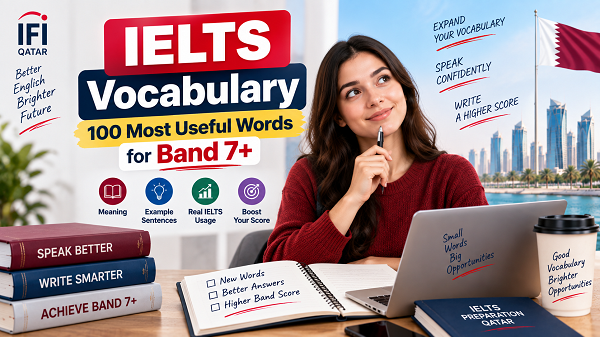
Building a strong vocabulary is an important part of IELTS preparation, especially if you are aiming for Band 7 or higher.
However, learning advanced words simply to make your English sound complicated is not an effective strategy. In IELTS Speaking and Writing, you need to use vocabulary accurately, naturally and appropriately for the topic.
The best IELTS vocabulary is therefore not necessarily the most difficult vocabulary. It is vocabulary that helps you express ideas clearly, explain your opinions, compare information and develop arguments.
In this guide, you will find 100 useful IELTS vocabulary words for Band 7+, organised into common IELTS topics such as education, technology, environment, health, work, society and globalisation.
Each word includes a simple meaning and an example sentence so you can learn how to use it in context.
What Vocabulary Do You Need for IELTS Band 7?
IELTS does not require you to memorise a specific list of Band 7 words.
Instead, your vocabulary performance is assessed as part of the Lexical Resource criterion in Speaking and Writing.
For a strong performance, you should be able to:
- Use a range of vocabulary
- Choose words appropriate to the context
- Express ideas precisely
- Use less common vocabulary when appropriate
- Form natural word combinations
- Paraphrase ideas effectively
- Avoid excessive repetition
- Use vocabulary accurately
For example, instead of repeatedly using the word important, you might use:
- Significant
- Essential
- Crucial
- Valuable
- Fundamental
But these words are not interchangeable in every sentence.
The goal is not to replace every basic word with an advanced synonym. The goal is to develop a flexible vocabulary that you can use accurately.
100 IELTS Vocabulary Words for Band 7+
The following vocabulary is organised by common IELTS themes. Learn the meaning, study the example and then practise creating your own sentences.
IELTS Vocabulary for Education
Education is one of the most common themes in IELTS Writing Task 2 and Speaking.
1. Academic
Meaning: Related to education, study or schools and universities.
Example:
Academic success often depends on both effective study habits and consistent effort.
2. Curriculum
Meaning: The subjects and content taught in an educational programme.
Example:
Schools should regularly update their curriculum to reflect changes in society.
3. Compulsory
Meaning: Required by law or by a particular rule.
Example:
In many countries, education is compulsory until a certain age.
4. Assessment
Meaning: The process of evaluating someone’s knowledge or ability.
Example:
Regular assessment can help teachers identify students who need additional support.
5. Literacy
Meaning: The ability to read and write.
Example:
Improving literacy rates remains an important educational goal in many developing countries.
6. Scholarship
Meaning: Financial support given to a student to help pay for education.
Example:
She received a scholarship that allowed her to study at university.
7. Vocational
Meaning: Related to practical skills and training for a particular occupation.
Example:
Vocational education can prepare young people for careers in skilled trades.
8. Tuition
Meaning: The money charged for instruction at a school, college or university.
Example:
High tuition fees can make higher education difficult to access for some students.
9. Discipline
Meaning: The ability to control behaviour and follow rules or a structured routine.
Example:
Self-discipline is essential for students who want to succeed through independent study.
10. Knowledge
Meaning: Information and understanding gained through learning or experience.
Example:
Universities provide students with knowledge that can support their future careers.
IELTS Vocabulary for Technology
Technology is another frequent IELTS topic.
11. Innovation
Meaning: A new idea, method or technology.
Example:
Technological innovation has changed the way people communicate.
12. Automation
Meaning: The use of technology to perform tasks with little human involvement.
Example:
Automation could reduce the number of workers required for some routine jobs.
13. Artificial Intelligence
Meaning: Technology that enables computers or machines to perform tasks associated with human intelligence.
Example:
Artificial intelligence is increasingly being used in education and healthcare.
14. Digitalisation
Meaning: The process of using digital technology to transform activities or systems.
Example:
Digitalisation has changed how businesses communicate with their customers.
15. Accessibility
Meaning: The degree to which something is easy to access or use.
Example:
Online education has improved accessibility for students living in remote areas.
16. Cybersecurity
Meaning: The protection of computers, networks and data from digital threats.
Example:
Businesses need to invest in cybersecurity to protect customer information.
17. Disrupt
Meaning: To significantly change or interrupt an established system or activity.
Example:
New technologies can disrupt traditional business models.
18. Efficient
Meaning: Working effectively without wasting time, energy or resources.
Example:
Online banking has made many financial services more efficient.
19. Transform
Meaning: To change something significantly.
Example:
Technology has transformed the way people access information.
20. Technological advancement
Meaning: Progress or development in technology.
Example:
Rapid technological advancement has created new opportunities in many industries.
IELTS Vocabulary for Environment
Environmental issues are common in IELTS essays and discussions.
21. Sustainable
Meaning: Able to continue without causing serious long-term damage.
Example:
Governments should promote sustainable methods of transportation.
22. Renewable
Meaning: Naturally replaced and therefore not permanently depleted.
Example:
Solar and wind power are important sources of renewable energy.
23. Biodiversity
Meaning: The variety of plants, animals and other living organisms in an environment.
Example:
Deforestation can have a serious impact on biodiversity.
24. Conservation
Meaning: The protection and careful management of natural resources or wildlife.
Example:
Wildlife conservation requires cooperation between governments and local communities.
25. Deforestation
Meaning: The removal of large areas of trees or forests.
Example:
Deforestation can contribute to habitat loss and climate change.
26. Ecosystem
Meaning: A community of living organisms and their physical environment.
Example:
Plastic pollution can damage marine ecosystems.
27. Emission
Meaning: The release of gas, heat or other substances into the environment.
Example:
Reducing carbon emissions is an important part of addressing climate change.
28. Pollution
Meaning: Harmful substances introduced into the environment.
Example:
Air pollution can have serious consequences for public health.
29. Depletion
Meaning: The reduction of something, especially a natural resource.
Example:
The depletion of freshwater resources is a growing concern in many regions.
30. Environmental impact
Meaning: The effect that an activity or development has on the natural environment.
Example:
Companies should consider the environmental impact of large construction projects.
IELTS Vocabulary for Health
Health-related vocabulary is useful for both Speaking and Writing Task 2.
31. Well-being
Meaning: A person’s general health, comfort and quality of life.
Example:
Regular physical activity can improve both physical and mental well-being.
32. Sedentary
Meaning: Involving little physical activity.
Example:
A sedentary lifestyle can increase the risk of several health problems.
33. Obesity
Meaning: A medical condition involving excessive body weight.
Example:
Governments are introducing policies designed to reduce childhood obesity.
34. Nutrition
Meaning: The process of obtaining the nutrients needed for health and growth.
Example:
Schools can teach children about the importance of good nutrition.
35. Preventive
Meaning: Intended to prevent a problem or illness before it occurs.
Example:
Preventive healthcare can reduce the risk of serious diseases.
36. Healthcare
Meaning: Services related to maintaining and improving people’s health.
Example:
Access to affordable healthcare is an important social issue.
37. Chronic
Meaning: Continuing for a long time or occurring repeatedly.
Example:
Poor lifestyle choices can contribute to chronic health conditions.
38. Epidemic
Meaning: A widespread occurrence of a disease within a particular population or area.
Example:
Governments need effective strategies to respond quickly to disease epidemics.
39. Treatment
Meaning: Medical care provided to deal with an illness or condition.
Example:
Early treatment can improve outcomes for many patients.
40. Awareness
Meaning: Knowledge or understanding of a particular issue.
Example:
Public awareness campaigns can encourage people to adopt healthier lifestyles.
IELTS Vocabulary for Work and Employment
Work-related topics frequently appear in IELTS.
41. Employment
Meaning: Paid work or the state of having a job.
Example:
Government investment can create new employment opportunities.
42. Unemployment
Meaning: The state of being without a job while actively seeking work.
Example:
High unemployment can have significant economic and social consequences.
43. Workforce
Meaning: The people who are available to work in a particular area or organisation.
Example:
A skilled workforce can contribute significantly to economic growth.
44. Productivity
Meaning: The amount of work or output produced in relation to the resources used.
Example:
Flexible working arrangements may improve employee productivity.
45. Job satisfaction
Meaning: The level of enjoyment or fulfilment a person gets from their job.
Example:
Salary is important, but job satisfaction can also influence employee retention.
46. Career progression
Meaning: The process of developing and advancing in a career.
Example:
Many employees value opportunities for career progression.
47. Qualification
Meaning: An official achievement or certification showing that someone has completed a course or reached a particular standard.
Example:
Professional qualifications can improve a person’s employment opportunities.
48. Profession
Meaning: A type of job that usually requires specialised education or training.
Example:
Medicine is a demanding profession that requires extensive training.
49. Flexible
Meaning: Able to change or adapt easily.
Example:
Flexible working hours can help employees maintain a better work-life balance.
50. Entrepreneur
Meaning: A person who starts and manages a business.
Example:
Many young entrepreneurs use digital platforms to launch new businesses.
IELTS Vocabulary for Society and Government
These words are particularly useful for IELTS Writing Task 2.
51. Inequality
Meaning: An unfair difference in wealth, opportunities or treatment between groups.
Example:
Education can play an important role in reducing social inequality.
52. Government
Meaning: The group of people responsible for governing a country or area.
Example:
The government should invest in public services that benefit the wider population.
53. Legislation
Meaning: Laws created by a government or legislative body.
Example:
Stricter legislation may be necessary to reduce environmental damage.
54. Regulation
Meaning: An official rule or system used to control an activity.
Example:
Effective regulation can protect consumers from unsafe products.
55. Public services
Meaning: Services provided for the benefit of the public.
Example:
Governments have a responsibility to provide essential public services.
56. Infrastructure
Meaning: The basic physical systems and facilities needed for a society to function.
Example:
Investment in transport infrastructure can support economic development.
57. Welfare
Meaning: Health, happiness and general well-being, or government support provided to people in need.
Example:
Social welfare programmes can provide assistance to vulnerable groups.
58. Equality
Meaning: The state of having the same rights, opportunities or treatment.
Example:
Equal access to education can create opportunities for people from different backgrounds.
59. Citizen
Meaning: A legally recognised member of a country.
Example:
Citizens should be encouraged to participate actively in their communities.
60. Public expenditure
Meaning: Money spent by the government on public services and programmes.
Example:
Public expenditure on education can generate long-term social benefits.
IELTS Vocabulary for Globalisation and International Issues
61. Globalisation
Meaning: The increasing connection and integration of countries and economies.
Example:
Globalisation has made international trade more accessible.
62. International
Meaning: Involving more than one country.
Example:
International cooperation is essential when dealing with global environmental problems.
63. Cross-cultural
Meaning: Involving or relating to different cultures.
Example:
Cross-cultural communication skills are increasingly important in international workplaces.
64. Multicultural
Meaning: Including people or influences from several different cultures.
Example:
Many major cities have become increasingly multicultural.
65. Migration
Meaning: The movement of people from one place or country to another.
Example:
Economic opportunities are one factor that can influence migration.
66. Immigration
Meaning: The process of moving to another country to live there.
Example:
Immigration can have both economic and social effects on receiving countries.
67. Integration
Meaning: The process of becoming part of a group or society.
Example:
Language education can support the integration of newcomers into society.
68. International trade
Meaning: The exchange of goods and services between countries.
Example:
International trade has become an important part of many national economies.
69. Cultural exchange
Meaning: The sharing of ideas, traditions and experiences between different cultures.
Example:
International education can encourage cultural exchange between students.
70. Global economy
Meaning: The interconnected economic system involving countries around the world.
Example:
Changes in the global economy can affect employment in individual countries.
IELTS Vocabulary for Media and Communication
71. Media
Meaning: Communication channels such as television, newspapers, websites and social media.
Example:
The media plays an important role in shaping public discussion.
72. Misinformation
Meaning: False or inaccurate information, whether shared intentionally or unintentionally.
Example:
Social media can allow misinformation to spread rapidly.
73. Influence
Meaning: The ability to affect someone’s behaviour, opinion or decision.
Example:
Advertising can have a significant influence on consumer behaviour.
74. Advertisement
Meaning: A public message designed to promote a product, service or idea.
Example:
Children are frequently exposed to advertisements for unhealthy food.
75. Journalism
Meaning: The activity of collecting, reporting and presenting news.
Example:
Professional journalism can help the public understand complex issues.
76. Communication
Meaning: The exchange of information, ideas or feelings.
Example:
Effective communication is essential in both education and the workplace.
77. Social media
Meaning: Digital platforms that allow users to create and share content and communicate with others.
Example:
Social media has transformed how people maintain relationships.
78. Digital content
Meaning: Information or media created and distributed in digital form.
Example:
Young people consume large amounts of digital content every day.
79. Credibility
Meaning: The quality of being trusted or believed.
Example:
Readers should consider the credibility of online sources before sharing information.
80. Persuade
Meaning: To convince someone to think or act in a particular way.
Example:
Advertising is often designed to persuade consumers to purchase a product.
IELTS Vocabulary for Cities and Transport
81. Urbanisation
Meaning: The growth of cities as more people move to urban areas.
Example:
Rapid urbanisation can put pressure on housing and transportation systems.
82. Congestion
Meaning: A situation in which roads or transport systems become overcrowded.
Example:
Improving public transportation could help reduce traffic congestion.
83. Pedestrian
Meaning: A person travelling on foot rather than in a vehicle.
Example:
Cities should create safer areas for pedestrians.
84. Public transport
Meaning: Transport services available for use by the general public.
Example:
Reliable public transport can reduce people’s dependence on private cars.
85. Infrastructure
Meaning: The physical systems and facilities supporting a society or city.
Example:
Rapid population growth can place significant pressure on urban infrastructure.
86. Sustainable transport
Meaning: Transportation that minimises environmental damage and resource consumption.
Example:
Governments should encourage sustainable transport such as cycling and public transit.
87. Metropolitan
Meaning: Relating to a large city and the surrounding urban area.
Example:
Metropolitan areas often provide more employment opportunities than rural regions.
88. Residential
Meaning: Related to areas where people live.
Example:
New residential developments should include access to schools and public transport.
89. Pedestrian-friendly
Meaning: Designed to make walking safe and convenient.
Example:
A pedestrian-friendly city can encourage residents to walk instead of driving.
90. Commuter
Meaning: A person who regularly travels between home and work or study.
Example:
Many commuters spend a significant amount of time travelling to work each day.
IELTS Vocabulary for Culture, Lifestyle and Society
91. Tradition
Meaning: A belief, custom or practice passed from one generation to another.
Example:
Traditional festivals can help communities preserve their cultural identity.
92. Heritage
Meaning: The cultural traditions, buildings, objects or history passed down through generations.
Example:
Historic buildings are an important part of a country’s cultural heritage.
93. Identity
Meaning: The characteristics and beliefs that define an individual or group.
Example:
Language can play an important role in cultural identity.
94. Diversity
Meaning: The presence of differences among people, cultures or ideas.
Example:
Cultural diversity can make cities more interesting places to live.
95. Lifestyle
Meaning: The way a person or group lives.
Example:
Modern lifestyles have become increasingly dependent on digital technology.
96. Consumerism
Meaning: A strong focus on buying and consuming goods and services.
Example:
Excessive consumerism can contribute to unnecessary waste.
97. Generational
Meaning: Relating to different generations of people.
Example:
There can be significant generational differences in attitudes towards technology.
98. Community
Meaning: A group of people living in the same area or sharing common interests.
Example:
Community projects can encourage people to work together and build stronger relationships.
99. Social cohesion
Meaning: The degree to which members of a society are connected and cooperate with one another.
Example:
Equal access to education can contribute to greater social cohesion.
100. Quality of life
Meaning: The general level of health, comfort, happiness and well-being experienced by a person or population.
Example:
Access to green spaces can improve the quality of life in urban areas.
How to Use IELTS Vocabulary for Band 7 Naturally
Learning 100 words is only the beginning.
To improve your IELTS performance, you need to move from recognising vocabulary to using it actively.
Learn Words in Context
Don’t memorise:
Sustainable = able to continue for a long time.
Instead, learn a complete expression:
sustainable development
sustainable transport
sustainable energy
This helps you understand how the word naturally appears in English.
Learn Collocations
A collocation is a combination of words that commonly occur together.
For example:
- Significant impact
- Major concern
- Economic growth
- Public awareness
- Government legislation
- Environmental damage
- Social inequality
- Career progression
- Academic performance
- Renewable energy
Using natural collocations can make your English more precise and fluent.
Learn Word Families
Learning related forms of a word can expand your vocabulary efficiently.
For example:
Develop
- Develop
- Development
- Developing
- Developed
- Developmental
Another example:
Environment
- Environment
- Environmental
- Environmentally
This approach gives you more flexibility when speaking and writing.
IELTS Vocabulary for Speaking vs Writing
Not all vocabulary should be used in exactly the same way.
IELTS Speaking Vocabulary
In Speaking, your vocabulary should sound natural and conversational.
For example:
I think technology has had a huge impact on the way we communicate.
This sounds more natural than forcing an unnecessarily formal expression into your answer.
IELTS Writing Vocabulary
Academic Writing generally requires a more formal style.
For example:
Technological development has had a significant impact on modern communication.
The vocabulary is more formal, but it is still clear and natural.
The important thing is to understand the register of the language you are using.
How Many IELTS Vocabulary Words Should You Learn?
There is no magic number of words that guarantees a particular IELTS Band Score.
Learning 500 words you can use accurately is more useful than memorising thousands of words that you cannot use naturally.
A practical strategy is to:
- Learn a small number of useful words each day.
- Study each word in context.
- Learn common collocations.
- Create your own example sentences.
- Use the vocabulary in Speaking practice.
- Use it in IELTS Writing practice.
- Review older vocabulary regularly.
Quality and active use matter more than simply increasing the size of your word list.
Common IELTS Vocabulary Mistakes
Using Advanced Words Incorrectly
Don’t use a word simply because it sounds sophisticated.
Incorrect vocabulary can reduce the clarity and accuracy of your communication.
Repeating the Same Words
Repeatedly using words such as “good”, “bad”, “important” and “big” can limit your lexical range.
Learn several natural alternatives and understand the differences between them.
Memorising Long Lists Without Context
A vocabulary list is useful as a reference, but memorisation alone does not teach you how to use words.
Always study examples and create your own sentences.
Using Informal Language in Academic Writing
Words and expressions that are appropriate in everyday conversation may not be suitable for IELTS Writing Task 2.
Learn the difference between conversational and academic vocabulary.
Overusing Synonyms
Replacing every simple word with an advanced synonym can make your writing unnatural.
Clear and accurate English should always be your priority.
How to Remember IELTS Vocabulary More Effectively
Try the following five-step method.
Step 1: Learn the Meaning
Understand what the word actually means.
Step 2: Study an Example
See how the word works in a real sentence.
Step 3: Learn a Collocation
For example:
significant impact
rather than simply memorising:
significant
Step 4: Create Your Own Sentence
Write a sentence connected to your own experience or an IELTS topic.
Step 5: Use the Word in Speaking
Say your sentence aloud and try to use the word naturally in a short answer.
This turns passive vocabulary into active vocabulary.
IELTS Band 7 Vocabulary Practice Exercise
Try completing these sentences using vocabulary from the list.
- Governments should invest more in ______ energy to reduce dependence on fossil fuels.
- Rapid ______ can create pressure on housing and public transport.
- Social media can have a significant ______ on young people’s behaviour.
- Regular exercise can improve physical and mental ______.
- Public investment in education can reduce social ______.
- Technological ______ has transformed many industries.
- Governments need effective ______ to protect the environment.
- Cultural ______ can make large cities more dynamic.
- Excessive ______ can contribute to unnecessary consumption.
- Reliable public transport can reduce traffic ______.
Answers
- renewable
- urbanisation
- influence
- well-being
- inequality
- advancement
- regulation
- diversity
- consumerism
- congestion
How to Use These 100 Words in Your IELTS Preparation
Don’t try to learn all 100 words in one day.
Instead, divide them into manageable groups.
For example:
Week 1: Education + Technology
Week 2: Environment + Health
Week 3: Work + Society
Week 4: Globalisation + Media + Cities + Culture
For each word:
- Learn the meaning.
- Study the example.
- Learn one or two collocations.
- Write your own sentence.
- Use it in a Speaking response.
- Try using it in an IELTS essay.
After four weeks, review the entire list and identify the words you can actually use confidently.
IELTS Vocabulary Band 7+ Quick Checklist
Before your exam, ask yourself:
- Can I paraphrase common ideas?
- Can I avoid repeating the same basic words?
- Do I know common IELTS collocations?
- Can I use less common vocabulary accurately?
- Can I distinguish formal and informal language?
- Can I use vocabulary naturally in Speaking?
- Can I use topic-specific vocabulary in Writing?
- Can I explain unfamiliar ideas using words I already know?
- Do I check my word choice for accuracy?
- Am I learning vocabulary in context rather than memorising isolated words?
If you can answer “yes” to most of these questions, you are developing a much more useful IELTS vocabulary base.
Frequently Asked Questions About IELTS Vocabulary Band 7
What vocabulary is needed for IELTS Band 7?
There is no official list of words required for Band 7. You need to demonstrate a good range of vocabulary and use words appropriately, accurately and flexibly.
How can I improve my IELTS vocabulary for Band 7?
Learn vocabulary by topic, study collocations, practise paraphrasing, create your own sentences and regularly use new words in Speaking and Writing practice.
How many words should I learn for IELTS Band 7?
There is no fixed number. It is more important to develop a vocabulary that you can use accurately and naturally than to memorise a specific number of words.
Is advanced vocabulary necessary for IELTS Band 7?
A strong vocabulary range is important, but using complicated words unnecessarily is not the goal. Accurate, appropriate and flexible vocabulary is more valuable than difficult vocabulary used incorrectly.
What are the best IELTS vocabulary topics to study?
Common topics include education, technology, environment, health, work, government, society, globalisation, media, transport, culture and lifestyle.
Should I use these words in IELTS Speaking?
Yes, but only when they fit naturally. IELTS Speaking requires natural communication, so avoid forcing formal or unusual vocabulary into conversational answers.
Should I memorise IELTS vocabulary lists?
Vocabulary lists can be useful for organising your study, but memorisation alone is not enough. Learn words in context and practise using them actively.
Can vocabulary improve my IELTS Writing score?
Yes. Vocabulary is one of the areas assessed in IELTS Writing. Developing a broader and more accurate lexical range can support your performance, although vocabulary is only one part of the overall assessment.
Improve Your IELTS Vocabulary With IFI Qatar
Learning vocabulary independently can give you a strong foundation, but knowing how and when to use vocabulary effectively is equally important.
At IFI Qatar, IELTS preparation can help you develop the language skills needed across all four sections of the IELTS test.
With structured IELTS preparation, you can work on:
- IELTS Speaking vocabulary
- IELTS Writing vocabulary
- Topic-specific vocabulary
- Grammar and sentence structure
- Fluency and pronunciation
- Writing organisation
- Exam strategies
- Practice and feedback
If your target is IELTS Band 7 or higher, focus on building vocabulary that you can actually use—not simply collecting difficult words.
Start Your IELTS Preparation With IFI Qatar
Ready to build stronger IELTS skills and prepare for your target Band Score?
Explore the IELTS Preparation Course at IFI Qatar and develop your English through structured practice, expert guidance and targeted IELTS preparation.